We are developing the social individualist meta-context for the future. From the very serious to the extremely frivolous... lets see what is on the mind of the Samizdata people.
Samizdata, derived from Samizdat /n. - a system of clandestine publication of banned literature in the USSR [Russ.,= self-publishing house]
|
Via Bishop Hill, I learn that Christopher Booker has an interesting little story up about a student who got a (nearly) fail for expressing insubordinate climatic opinions in an exam.
Her son is “an excellent scientist” who got “straight As” on his other science papers, but he is also “very knowledgeable about climate change and very sceptical about man-made global warming”. His questioning of the sources earned an “E”, the lowest possible score. His mother then paid £60 for his paper to be re-marked. It was judged to be “articulate, well-structured” and clearly well-informed, but again he was marked down with “E” for fail.
I realise that the ideal to which educationalists ought, in an ideal world, to aspire to is to measure how well a student understands and can explicate a particular body of alleged knowledge, rather than merely noting whether he agrees with that alleged knowledge. But this is a lot to expect. I have always regarded exams as measuring not so much actual rightness about things, as the ability to find out what the examiners want to be told, and to put that as fluently and ingratiatingly as possible. Exams have always been about identifying articulate yes-men. It’s just that what examinees have to say yes to changes from decade to decade.
But maybe this will change with the arrival of the internet, now that anyone who gets failed for saying “no”, fluently and persuasively, can now, as in this case, expose the inevitable biases of the education system to outside scrutiny and derision.
I look forward to learning who this young man is, what he actually wrote in his exam, and more about exactly who the examiners were who failed him. If he displayed a real knowledge of official opinion about climate change, before then explaining why he did not share this opinion, he might yet come out of this spat very well, better than if he had merely got straight As.
He might, for instance, get himself a job as a scientific journalist.
And none of them is Romney.
Now that Natalie, to whom deep thanks, has done the I-told-you-so posting that I feared I might have to do for myself, by linking to the piece I wrote last week in the privacy of my personal blog entitled Reasons to think Romney is going to win big, I thought I would follow up her posting and mine, by saying why I want Romney to win big.
First, I really want Obama to lose, big. A few years back, someone made up a quote about how America could survive another four years of Obama. It would be plenty tough enough, provided Obama himself was the only problem. But could America survive a longer term future in which it contains, decade after decade, all the people who re-elected Obama? That’s pretty much how I feel about Obama winning, this time around. An Obama victory would do quite a bit of harm. But worse, far worse, would be what it meant.
Second, if Obama loses, something bigger and more powerful and more important will lose with him, namely the USA’s Mainstream Media. The crowing of these people if Obama were to win would be unbearable. Their humiliation will be exquisite, when Romney, as I now believe he will, wins big.
But third, and by far my most important reason for wanting Romney to win big, is that an Obama win of any sort would be a horrible set-back for the Tea Party, given that the Tea Party has now thrown its considerable weight behind Romney. A big Romney win, on the other hand, will greatly strengthen the Tea Party, and I think that would be very, very good.
The more I learn about the Tea Party and their sayings and doing, the more I am proud of that posting I did here, well over a year ago now, which said that they are Good people with good ideas (a notion confirmed by the commenters responding to this later Tea Party posting I did). It seems that a great many Americans now agree with me. In my opinion this is, politically, just about the best thing that is now happening in the world.
 Early last week, in a favourite London haunt of mine, the second hand classical CD shop Gramex, its socialist owner (we are good pals despite our differences – and so we should be given how many classical CDs I’ve bought from him over the last three decades) announced that clearly nobody in their right mind would consider voting for Romney. I’d vote for Romney in a blink, I responded, instantly. And then I had one of those moments when you find out what you think by hearing what you say. I continued orating, still without skipping any beats. “I would vote for Romney because the Tea Party supports him. They say that the US government does too much, spends too much and borrows too much, and I entirely agree. I’d vote with them.” And I’m retro-editing that for fluency hardly at all. Those were pretty much my exact words. I continued, describing the Tea Party as a coalition between Goddists and Libertarians, with both sides setting divisive opinions aside (God and “social libertarianism”) and concentrating on their overlap, see above, and I’m totally for it. Yes, I actually said all this, out loud, in a London shop, with strangers present, some presumably (like most in the classical music tribe) of a deeply anti-Romney-ite persuasion. That’s how much I meant it!
I considered cutting the above paragraph, and finding a home for it at my personal blog. But I do not think it irrelevant to what I am saying here. There is more to what you think than merely being right about it. There is also the matter of how strongly you feel about it, and how comfortable you feel inflicting it upon strangers. Something tells me that many Americans have recently also turned this particular corner.
Anyway, back to what I think as opposed to how I think it.
Suppose that the Tea Party, in the course of its big confabulation amongst itself just after Romney had been nominated, had followed the Perry de Havilland line and decided that they were going to urge people not to vote for Romney, and instead to vote for, e.g., Gary Johnson, on the grounds that he would, unlike Romney, really cut US government spending. Or for some Goddist candidate of equal fiscal and financial clarity and rectitude, who likewise wasn’t going to win, but who likewise might cause Romney to lose or at least to give him a serious fright. Or suppose they had decided to urge everyone to vote for nobody at all. Suppose they had decided, in the words of de-Havillandist commenter “August” (on this) that …
It wouldn’t seem too much of a stretch to me to think Wall Street is running the whole show now. Obama got in because he’s a compliant tool, but now he’s up against one of the finance world’s own. They’ll lock down the private profit, public risk/losses model and keep making us pay for their mistakes until there isn’t anything left.
Suppose that, instead of electing Romney the Even More Compliant Tool, the Tea Party had decided to do everything they could to shaft him, and get Obama to win. And then, having demonstrated their power to break any candidate they did not like, they tried to arrange a candidate whom they did truly like, in 2016.
Well, I can’t vote for anyone in this, but I can blog my preferences, and maybe help to shift a few dozen American voters in my preferred direction. So, suppose the Tea Party had said: Don’t Vote Romney.
I would probably now be saying that also.
Not because I have a huge loathing of Romney, any more than I now have a huge liking for him. What I do have is a huge liking for the Tea Party. I want the Tea Party to win this election, big. I agree with what they decide. I want the Tea Party to emerge from this election as a Huge Fact about American politics, which any politician ignores at his peril.
For what it’s worth, I think the Tea Party made entirely the right decision to go all out for Romney, for reasons which I may or may not expand upon, some other time. But that’s not my point here.
Here are some interesting thoughts via Prof. Stephen Hicks about the death of one of the Mongols and what it meant for Europe back in the time of the invasions.
Thus spake the prophet Micklethwait on September 27, a week before the US presidential debate that has just taken place:
Romney is not nearly as big a jerk as a lot of disappointed Libbos and Conservatives seem to think, or as Dems hope. He keeps on winning. I think he will do much better in the debates than most others seem to, because he has a story to tell, to and about an opponent who does not. Romney is indeed not a genius debater, but he knows it, and knowing also that he is winning, he will prepare hard and go in with exactly the right amount of and kind of confidence, like a winning sportsman. He will surprise many by how well he does.
Meanwhile Obama, surrounded by yes men, and fatally arrogant, and tired, a fed-up and probably knowing he is going to lose, and having nothing to say, will not prepare well enough for the debates. He faces a near-impossible task, and will not be up to it.
Correct in every detail bar two. I do not think Mitt Romney knew he was going to win the debate and I do not think Barack Obama knew he was going to lose.
Romney was a Mormon missionary in France for two and a half years. Apparently he met with a slightly less overwhelming proportion of rejection than most, and was promoted. Whatever your opinion of Mormonism, no one can emerge after thirty months of knocking on doors and trying to proselytise the French, in French, and not have developed some debating skills and also seen the limit of what any such skills can do. No one can do this and not learn, ineradicably, that the world contains people who do not think like them at all. Romney lives among the heathen. Obama lives among those who defend him from the heathen.
Unlike some on this blog, Paul Marks, for instance, I do not see Obama as a hard core Marxist. Real Marxists live among the heathen, even on university campuses. I do not see Obama as having a hard core at all; he flows into the shape of whatever vessel he finds himself inside. His current vessel is fine and comfortable. I think he could not quite make himself believe that Romney would dare intrude.
Elections are mostly mere show, but what a splendid show a hard-fought one can be. I caught myself the other day being resentful because I could not turn to the back of the book or look up the episode guide on Wikipedia to see how it will all turn out. Aesop would have sold more fables if he had thought to have the moral (better yet, a hundred competing morals) in the middle but leave the tortoise and the hare still running right until the last page.
In 1992 I turned down a bet that would have obliged me to pay ten pounds for every parliamentary seat of Neil Kinnock’s majority, or gained me ten pounds for every seat short of it. I only turned down the bet because I’m a wimp who has never so much as been inside a bookmakers*; I knew that John Major was going to win because I eavesdropped on my fellow commuters on the Victoria Line. The UK media then were almost as domineering as the US media now; whenever obliged to interview someone willing to admit to the intention of voting Conservative the interviewer would visibly stand back to avoid contamination. I wanted Labour to win – I had stopped being a socialist but I was tired of the Tories – but I could tell, I could just tell that the media and the Cool People were talking each other up while the troglodytes on the Victoria Line were bullied into whispers but not into voting for the Cool Party just because the Cool People said that everyone who was anyone would.
Splendid as I am and nearly always right about everything, I have also been known to make wrong predictions. In the next UK election I thought the Shy Tory effect would still be present. If it was it was washed away in a flood of voters not shy in the least about finally having had enough of the Conservative party in power.
All this talk about bubbles has also reminded me of two occasions on which I specifically took note of obvious signs that the other sort of newsworthy bubble, a house price / stock market / tulip bubble, was expanding serenely away – noted these signs, cogitated upon their meaning, and ignominiously got it wrong. Or at best totally missed their major meaning because I was so keen to lecture the world about a minor sub-meaning. One such sign was seen in Ireland about six or seven years ago. My family is from Ireland and I always listen a little harder to news from there, so I was interested to learn from several different recent visitors to Ireland that everywhere you looked, on every little hillock and crammed into every little gap among the drystone walls, a new holiday cottage was going up, spoiling the austere beauty of the landscape somewhat but nice to see so many people doing well. I knew what that meant. It meant I could write a post for Samizdata about planning laws. Good thing I never got round to that one.
The other sign was from the United States. I, I will have you know, knew what “redlining” was, and knew of the laws and government pressure put upon banks to foribid this practice, and could speak knowledgeably of the Community Reinvestment Act long before the Crash of 2008. I knew what the CRA meant. It meant I could write a post for Samizdata about how the suppression of incentives for poor and marginalised people to act in ways that would help them get out of poverty (such as saving for a deposit on a house, or getting a steady job in order to qualify for a mortgage) would do them no good in the long run, not to mention encouraging them to take on debt they could not afford. There might still be a post in that, but the great floating balloon marked WORLDWIDE FINANCIAL CRISIS COMING TO YOUR TOWN SOON floated straight past me.
Blow me your bubbles, tell me about your predictions, especially the ones you got wrong.
*and also because the person offering it had endowed me with all his worldly goods anyway.
Incoming from Jamie Whyte:
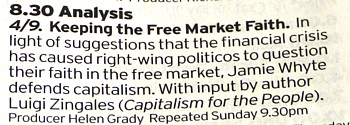
I have made a programme for Analysis on BBC Radio 4 which will be broadcast on Monday at 8.30pm. It concerns the Conservatives’ wrong headed abandonment of free markets following the financial crisis. You won’t learn anything you don’t already know — but then you are not the target audience! Nevertheless, you may be amazed to hear these things said on the BBC.
Relevant bit of the Radio Times (Monday October 8th):
Internet info from the BBC:
The financial crisis has made many on the political right question their faith in free market capitalism. Jamie Whyte is unaffected by such doubts. The financial crisis, he argues, was caused by too much state interference and an unhealthy collusion between government and corporate power.
Indeed.
” Half of the libertarians seem to have gone entirely off the rails… a very vocal half. Fiddle around reading “libertarian” websites and you’ll find all sorts of bizarre things: neo-Confederate denunciations of Lincoln, 9-11 Trutherism, anti-vaccine nonsense, climate change denialism, idiosyncratic “theories” of mental illness, apologia for Putin, arguments for the moral equivalence of Nazi Germany-United States-Israel, and (especially) rabid, blind rage against anyone who dares offer a counterargument. A sensible person, wondering what libertarianism is all about and trying to find whether it offers anything of value, would be so put off by this stuff that they’d forswear libertarianism as a kind of madness. (This isn’t hypothetical — decent people occasionally ask me how I can be associated with such craziness.) So right when the world most needs ’em, libertarians are going bonkers.”
Charles Steele, at his Unforseen Contingencies blog.
Hmmmm. I agree with much of this although it is worth repeating that being a skeptic about the claims made for catastrophic man-made global warming is not the same as being some sort of incorrigible “denier”.
I would also add something else. Libertarianism is no different from any other secular or for that matter, religious creed in having its fair share of nutters, heretics or those who say or do things that are just plain embarrassing. But even nutters can say or do things that open up debates that more “reasonable” people shy away from. Consider just how shockingly radical Mrs Thatcher’s brand of conservatism was made to appear 30 years ago, for example.
Long ago, I learned to stop worrying about this so long as the core message of respect for life, liberty and the pursuit of happiness came shining through and so long as the majority of people who held such views seemed to be, and were, decent people. The problems start when that does not happen.
If Hobsbawm had been an unrepentant Nazi, I doubt he’d be getting so many tributes. Strange how that works out.
– Samizdata commenter ‘Vinegar Joe’
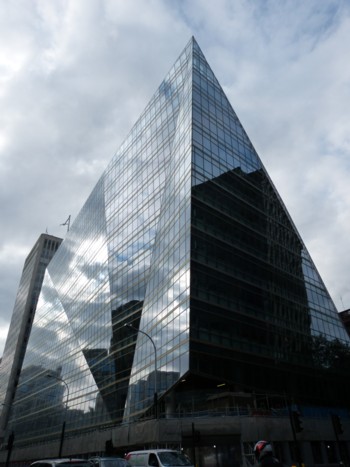
While delighting here in the new camera I bought early this year, I included a picture of a new building, then being constructed in Victoria Street, London SW1, near where I live. 62 Buckingham Gate is now nearly finished.
In February, as already show in that earlier posting, this was how it was looking:
There was a time when a building which looked like that when it was being built would end up looking pretty much like that when finished. This was the time of such architectural enthusiasms as “New Brutalism”, a time better know to civilians as the age of Concrete Monstrosities.
And that building above would have carried on as the misshapen oddity that it was when being constructed, looking like it had been put together by a bunch of builders who got drunk every breakfast time, while supervised by an architect who was suffering from a nervous breakdown.
But now look at it:
Yes it’s another contribution to the Buildings That Won’t Show Up On Radar style, already noted in an earlier posting I did here about One New Change. Here is another example of the style.
Partly, as I already mused in that One New Change posting, architects now do this kind of thing because they can. Whatever new thing they can do at any particular juncture in architectural history tends to get exaggerated and turned into a style. And they can do this kind of geometrical weirdness because now they have computers to enable them to keep track of it all, as they did not during the Concrete Monstrosity era.
They also have better technology, including such things as greatly improved glass of many different kinds, from which they can pick the exact one that is most suitable for their particular building.
But there is also a deeper change in play here, a change of aesthetic philosophy. → Continue reading: 62 Buckingham Gate nears completion
Remember sing-songs down the pub? OK, do you at least remember hearing that once upon a time there were such things as sing-songs down the pub? And Fred would stroll over to the old Joanna and have a tinkle on the ivories…
If this sounds as remote from modern life as the Wars of the Roses, that might be because for the last few years Fred would have been liable to arrest. The Licensing Act 2003 made live music at pubs illegal without a licence no matter how small the venue.
The good news is that it is no longer a crime to play a mouth organ in a pub without a licence.
The bad news is that for nine years it was a crime, and we submitted.
“Lots of hard problems have proven to be tractable. The planetary genome and proteome have been mapped so exhaustively that the biosciences are now focusing on the challenge of the phenome – plotting the phase-space defined by the intersection of genes and biochemical structures, understanding how extended phenotypic traits are generated and contribute to evolutionary fitness. The biosphere has become surreal: Small dragons have been sighted nesting in the Scottish highlands, and in the American Midwest, raccoons have been caught programming microwave ovens.”
Page 170 of Accelerando, by Charles Stross. (First published in 2005. )
Whatever you think of Stross’s non-fiction views, such as on libertarianism, his fiction often includes hilarious passages such as this.
I like this (the second paragraph (of two) of this):
For better or worse, there’s a world of difference between international and internal politics. Heads of state are like in-laws: obliged by their position to meet each other and smile about it no matter how they may feel about it. Their subjects are more like neighbours: they can pick and choose which ones to socialise with, and report the psychotic ones to the police.
That, which I only just noticed, was posted on June 23rd. But some things will keep.
Time was when lots of heads of states were, literally, in-laws.
“Hobsbawm’s implacable refusal to recant his views when faced with their grotesque consequences tells us something about the belligerent mindset of the wider British Left. But the eminence that he and his fellow travellers have enjoyed also speaks to the bovine complacency with which, since Mrs Thatcher, the Conservatives have allowed such dubious figures licence to dominate the soft culture of the BBC and our universities.”
– Michael Burleigh
|
Who Are We? The Samizdata people are a bunch of sinister and heavily armed globalist illuminati who seek to infect the entire world with the values of personal liberty and several property. Amongst our many crimes is a sense of humour and the intermittent use of British spelling.
We are also a varied group made up of social individualists, classical liberals, whigs, libertarians, extropians, futurists, ‘Porcupines’, Karl Popper fetishists, recovering neo-conservatives, crazed Ayn Rand worshipers, over-caffeinated Virginia Postrel devotees, witty Frédéric Bastiat wannabes, cypherpunks, minarchists, kritarchists and wild-eyed anarcho-capitalists from Britain, North America, Australia and Europe.
|






Recent Comments