We are developing the social individualist meta-context for the future. From the very serious to the extremely frivolous... lets see what is on the mind of the Samizdata people.
Samizdata, derived from Samizdat /n. - a system of clandestine publication of banned literature in the USSR [Russ.,= self-publishing house]
|
I can appreciate that it is important to attract visitors, for the economy and all that. But there is always a balance to be struck between encouragement and grovelling. If Johnny Foreigner wants friendly he should go to America. There the natives are capable of wishing you a nice day without even a hint of irony. Here if someone approaches you with a wide smile and an outstretched hand you feel not warmth but deep suspicion.
– Nigel Farndale
I remember reading Kate Fox’s “Watching the English” a few years ago and laughed out loud at some of her sharp insights about how we natives behave on this small, damp island.
Last October, I went shopping with my wife around San Francisco during a business/recreation trip to the Bay Area. With one exception – where I got treated rather rudely by a shop assistant – I was blown away by the friendliness and helpfulness of people and how it was done without being patronising or somehow false. Yes, California has its problems these days, but I wish I could import some of the attitude there to the UK.
It is always interesting that when newspapers cover Chinese news, mentions of history’s most prolific mass murderer just get reported baldly without much comment:
Players won points for acts of selfless Communist spirit and the winners were greeted, on screen, by Chairman Mao in Tiananmen Square. Points were deducted, however, each time a player had to be taken aside by his local Party secretary for a “corrective chat”.
– China embraces online gamers
Yet somehow if a German videogame maker (let alone a government sponsored one) were to feature that also-ran mass murderer Adolf Hitler ‘greeting’ players on screen in a video game, I suspect the reportage might be… a tad different.
Curious, no?
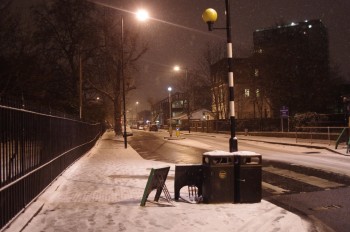
London, January 18, 2013
“Snowfalls are now just a thing of the past”
– The Independent, March 20, 2000
“Imagine a British politician saying: we’re so worried by the abuse of prescription drugs that we’re going to reduce the supply of powerful painkillers to our hospitals. And if people in genuine pain suffer as a result, too bad. The protests from the #WELoveTheNHS lobby would be deafening. The politician who said it would be out of office by the end of the week. But that’s exactly what Michael Bloomberg, Mayor of New York, has just announced.”
– Damian Thompson.
In some ways, Michael Bloomberg is merely being more honest than most puritans are prepared to admit. He openly says what they think. It is shocking, but in his own, depraved way, people like this man are doing us a favour in putting the horror of their views right up there, front and centre.
I have had a brief period of being in bad pain and thanked those brilliant scientists out there for inventing the drugs to remove it. And millions of people who have suffered excruciating pain have managed to get through thanks to painkillers. He would rather they suffered “a little bit” than that anyone should get addicted.
It is hard to be charitable and hope that he never suffers extended pain.
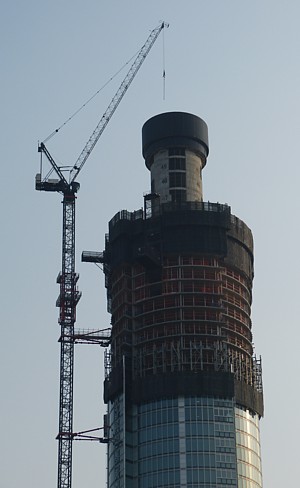
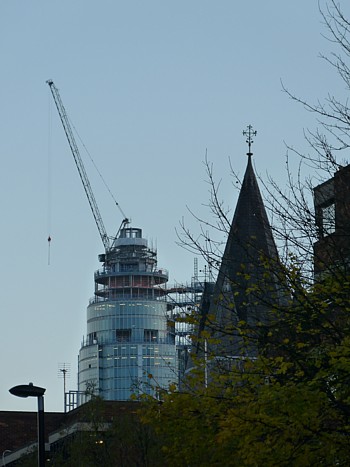
I like photographing new London buildings, the taller the better. And I am also very fond of photographing cranes, which can be quite dramatic but will soon be gone. So, when a new tower started getting built just across the Thames from me, all the while lovingly tended by just the one very tall crane, I photoed it, quite often.
Here is how the tower and its crane looked in May of last year.
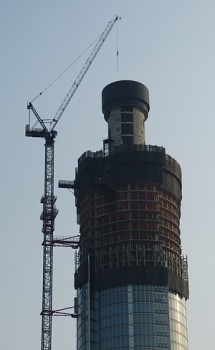
That’s a shot taken from Vauxhall Bridge.
Here is a somewhat more artistic shot of the top of the tower, and its crane, taken last November, from Vauxhall Bridge Road, which is to say from rather further away:
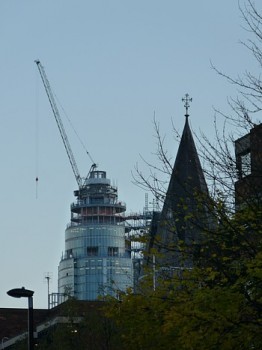
But now look at them, as photoed by me this afternoon:

The tower is okay, but the crane is in a sorry state.
During this morning’s rush hour, when it was very misty, a helicopter smashed into the crane. As you can see, the crane suffered badly, but what happened to the helicopter was far worse. It lost its blades, plummeted to the ground in flames, killing its lone occupant, the pilot, and another person on the ground. Blazing aircraft fuel was all over the place, and nearby cars were engulfed in the resulting flames and themselves also exploded. Had it happened rather later, when the road where all this happened would probably have been traffic-jammed, it might have been an order of magnitude more horrific.
Not surprisingly, this is one hell of a news story.
This afternoon I got nowhere near where all this drama had happened, and didn’t seriously try to. But a zoom lens was all I needed to photo what happened to the crane, and this will surely get photoed a lot, for as long as it stays up there for all the world within about half a mile to see. I’m guessing that there is going to be lots of tidying up and sorting out to be done at ground level, before it will become possible to replace the crane, and finish building the tower.
Terrible. Deadly. And, given how costly it is when a major building project is at all seriously delayed, as this one surely will now be: very expensive.
LATER: A better view of the ruined crane, in the form of an expanded detail of the crane itself, minus most of the tower, here.
If you are a national government wasting spending investing at least A$27.5bn (£18bn) of taxpayers’ money – over $1000 per capita – on building a government owned “National Broadband Network” because you think it is the job of the government do do this kind of stuff, and you then employ civil servants to ghost-write articles that can be published in the media under the bylines of lazy journalits, it is not a terribly good idea to include journals published by libertarian think tanks amongst your target publications.
Today a friend from way back who is a structural engineer by profession dropped by. He is semi-retired now, but was not so long ago a pretty big cheese in the bridge designing trade. He still has quite a bit of influence on bridge designing, albeit rather less now than he used to have.
He told me of an engineering bee, concerning train safety, now buzzing about inside his head.
Trains are, on the whole, he said, very safe. But apparently level crossings are the big train exception. A trickle of deaths? A rather big trickle, he replied. “Scores every year” was the phrase I recall him using. I don’t know if that’s quite right, but level crossing deaths are certainly a big deal in Britain.
Perhaps partly because he is a bridge designer, my friend believes that where possible and where not too disruptive and expensive, level crossings should be replaced by … bridges.
Trouble is, there is an acronymic organisation (I think he was talking about this one) concerned with British train safety, which demands very large clearances, both upwards and sideways, for all new road bridges over railways. And it takes only a small increase in a demanded clearance size to require a greatly more elaborate and expensive bridge. Which means that a lot of bridges, that might be built, aren’t.
Partly this demand for big clearances is because at some future date the railway line in question might be electrified, and in the meantime, space must be left under all bridges for that.
My friend says: Fine. In the meantime build smaller but temporary bridges. If electrification ever happens, replace these small bridges with bigger bridges. (Or, I suppose, go back to having level crossings, although that possibility wasn’t mentioned.) Meanwhile, save many lives now lost at level crossings.
But partly, the reason is a safety consideration of another kind. Says the acronymic organisation: all imaginable train wobblings, including the most unlikely, must be allowed to occur under all future bridges without any train afflicted by such wobbling hitting the bridge, even though many existing bridges allow for no such wobblings, with no detectable effect on train fatalities.
Result? The rather big trickle of deaths at level crossings goes on, and on, and on. In the pursuit of even more perfect safety where perfect safety has pretty much already been achieved, a closely related and very unsafe circumstance is caused to persist.
The pursuit of safety, badly done, is resulting in the persistence of unsafety.
When people now speak, as they so often now do, of “health and safety gone mad”, this is one of the things they surely mean. It isn’t just that safety is pursued and damn everything else. Safety is also pursued in accordance with mindless rules, that have the effect of reducing safety itself.
Something tells me that this is not the only example of such perverse safety thinking.
“The trouble with cults is that they aren’t actually about the parts that are true. They’re about using the true parts to hook you, to condition you into an becoming an eager little propagator of their memetic infection. For that to happen, your ability to think critically about the doctrine has to be pretty much entirely shut down. Fortunately the behavioral signs of this degeneration are quite easy to spot – I would have learned to recognize them back at the dawn of the New Age movement around 1970 even if I hadn’t gone to Catholic schools before that.”
– Eric Raymond. Read the whole way down to the punchline at the end. You will not regret it.
One day it will be recognised how the Met Office’s betrayal of proper science played a key part in creating the most expensive scare story the world has ever known, the colossal bill for which we will all be paying for decades to come.
Meanwhile, it is not just here that this latest fiasco, reported in many countries, has been raising eyebrows. Our ministers love to boast that British science commands respect throughout the world, They should note that the sorry record of our Met Office is beginning to do that reputation no good at all.
– Christopher Booker
I have filed this under “UK affairs” and “science and technology”. Perhaps, when it comes to the Met Office and such places, we need another topic code: “propaganda”.
Now some folk, such as libertarian Charles Steele, who is based in the US, get a bit exercised by those libertarians who, for example, pounce on the shenanigans of the CAGW alarmists. And he has a good point of course: whether the world is or is not heating up or not is not, specifically, anything to do with whether one favours free markets over state planning, collectivism or individualism, natural rights or serfdom, etc. (Science respects no ideologies). But – and it is a damn big but – it is a matter of inescapable, practical fact that the vast majority of those pushing the CAGW case are collectivists of one sort of another. Steele and others might try and reject that as they might reject that water flows downhill.
So while it is entirely possible for, say, a hardcore socialist to rejoice if the doom-mongers are proven wrong (the older type of socialist often liked to produce posters full of jolly workers in front of smoky factories), the fact is that showing the CAGW prediction to be the pack of bullshit that it is seems to be positive for a libertarian point of view. For what this will hopefully show is the dangers of when scientists become compromised by the rewards and incentives dangled in front of them by the State. I am sure some of the CAGW scientists are objective and high-minded. But if what Booker says about the Met Office’s behaviour is even half-true, a good many of them are nothing of the sort.
My son always wants to watch motorbikes on the telly. While watching an old episode of motorcycle adventurer Charley Boorman traveling through India by various means, I took note of Charley’s description of the ambulance service in Mumbai. He said that until recently there were no ambulances, so a group of entrepreneurs set up a service.
It is called Dial 1298 and it provides scheduled and emergency medical transportation. Even the poor are catered for:
The principle of cross subsidy is used wherein:
- Full charge to a patient going by choice to a private hospital.
- Subsidized charge to BPL (Below Poverty Line) patient going by choice to a government / municipal hospital.
- Free service to accident victims, unaccompanied, unconscious individuals and victims of mass casualty incidents.
One of their investors is Accumen Fund, who say: “We use philanthropic capital to make disciplined investments – loans or equity, not grants – that yield both financial and social returns.”
All good, voluntary stuff. Socialists hate it.
A large chunk of the Political Class is starting show all the signs of an entrenched deeply entitled group starting to smell the whiff of the great unwashed upwind of them.
No ‘responsible’ leader could ever leave EU, says Danny Alexander
David Cameron risks ‘sleepwalking’ UK out of EU, warns Ed Miliband
My gawd, what might happen if people in the UK actually got a choice about the EU?
But of course anyone who thinks that Dave Cameron actually wants the UK out of the EU, in spite of mild bleeting about ‘renegotiation’, is quite frankly a wilfully blind fool. My only hope is that Dave is stupid enough to think that he can ride that particular wild horse and keep it under control and taking sugar from his hand without biting his fingers off.
Fortunately I think he really is that stupid.
It sometimes makes me wonder why so few people seem to draw the connections between stories in the media that cry out to be connected. Here is one example, to do with food:
The price of basic food items could rise by as much as five per cent this year because of miserable weather last autumn, the managing director of Waitrose has warned.
Mark Price said food price inflation is already hovering at three to three and a half per cent, but this is just “the tip of the iceberg” and prices could increase even more dramatically over the coming months.
Produce such as bread and vegetables will become up to five per cent more expensive because of poor crop yields leading to a shortage of supply, he warned.
Many farmers are reporting that they still have not planted crops for 2013 because of the torrential rainfall which caused flooding across parts of Britain late last year.
From the Daily Telegraph.
Then there is this item about the waste of food in some countries:
Today, we produce about four billion metric tonnes of food per annum. Yet due to poor practices in harvesting, storage and transportation, as well as market and consumer wastage, it is estimated that 30–50% (or 1.2–2 billion tonnes) of all food produced never reaches a human stomach. Furthermore, this figure does not reflect the fact that large amounts of land, energy, fertilisers and water have also been lost in the production of foodstuffs which simply end up as waste. This level of wastage is a tragedy that cannot continue if we are to succeed in the challenge of sustainably meeting our future food demands.
Something is wrong with this picture. On the one hand, we are warned that food could be in much more scarce supply, hence the risk of skyrocketing prices; on the other, we produce oodles of the stuff and yet are wasting it, in various ways (poor storage, silly bureaucratic rules about sell-by dates, lack of basic knowledge about cooking, the ease of throwing out food rubbish.) It seems to me that inasmuch as there is a genuine problem, it is that we don’t have a full free market in food. If those who talk in horror about rich Westerners chucking out half-eaten meals really are disgusted by this, how much more disgusting are policies such as EU payments to farmers not to produce food under what is called “set aside”? (This is a policy pioneered by that champion of bad economic ideas, FDR, in the 1930s). And tax-subsidies for “biofuels” that distort agriculture markets are another glaring form of waste, surely. (It is also worth bearing in mind that state-subsidised farming is often also the most destructive from a sustainability point of view; the European Common Agricultural Policy saw the use of modern fertilisers and pesticides increase significantly).
If food prices rise due to a natural shift in the supply-demand imbalance, rather than due to the distortions of the State, then we wasteful Westerners will have to relearn some old habits, whether it be never leaving food on a plate and wise storage of our food. And just to finish on this thought: how much more severe would our shortages be, if, instead of being able to tap into a global supply of food, we had to rely on purely “local” produce, as the “locavores” would have us do?
On slightly tangential point, I read that a once-prominent opponent of GM foods has changed his mind and now admits that much of the opposition was not based on honest science and reasoning.
|
Who Are We? The Samizdata people are a bunch of sinister and heavily armed globalist illuminati who seek to infect the entire world with the values of personal liberty and several property. Amongst our many crimes is a sense of humour and the intermittent use of British spelling.
We are also a varied group made up of social individualists, classical liberals, whigs, libertarians, extropians, futurists, ‘Porcupines’, Karl Popper fetishists, recovering neo-conservatives, crazed Ayn Rand worshipers, over-caffeinated Virginia Postrel devotees, witty Frédéric Bastiat wannabes, cypherpunks, minarchists, kritarchists and wild-eyed anarcho-capitalists from Britain, North America, Australia and Europe.
|






Recent Comments