Maybe we should start emailing each other copies of the Constitution, so we can know that the government has read it.
– seen on Facebook by Instapundit
|
|||||
|
Maybe we should start emailing each other copies of the Constitution, so we can know that the government has read it. – seen on Facebook by Instapundit January 25th, 2014 | 15 comments - (Comments are closed)
 Yes, incoming from Simon Gibbs of Libertarian Home saying that the video of Aiden Gregg’s talk, that I earlier flagged up here as being on its way and worth a watch, is now there to be watched. In his accompanying commentary on the talk, Simon (after quoting me – thanks mate) lays out a lot of the data detail that I merely alluded to. Says Simon in his email to me:
Me? No. But maybe some readers are, and could oblige. And while they are about it, tell me more about reddit. I am starting to get the same feeling about the social media that I got about email, when I delayed bothering with that, way back whenever that was. Commenting on my posting yesterday about the Alex Singleton book launch, “RogerC” said:
Agreed. There is a lot that we can learn from the statist left, whose success in spreading their ideas has been all the more remarkable when you consider how bad their ideas are and how much havoc these ideas have long been known to cause. Aiden Gregg brings his expertise as an academic psychologist to this same terrain, of how to present ideas in such a way that they are more likely to win widespread acceptance. January 24th, 2014 | 17 comments - (Comments are closed)
“But please, let’s not now pile hypocrisy on top of our grotesque abdication of responsibility. No more hand-wringing. No further calls for “something to be done”. Nothing is going to be done. Because we don’t actually want it to be done. Yes, we want the horrors of Syria to disappear. We want Assad to disappear. But we want someone else to make them disappear for us, so we can go back to congratulating ourselves about how we stood tall for peace.” He raises the uncomfortable fact that, while non-interventionists can clearly state, with a lot of hard evidence to back them up, that intervening by military means can just make things worse, lead to a quagmire, etc, doing nothing also can have its costs. And he’s right to say that anyone who complains about Assad, and the other side, has no real credibility without at least stating what could or should have been done about it instead. Of course, if Western politicians say, “The situation is terrible, both if we get involved and if we don’t. Life is a bitch sometimes but there it is,” they are not going to be very popular. January 24th, 2014 | 17 comments - (Comments are closed)
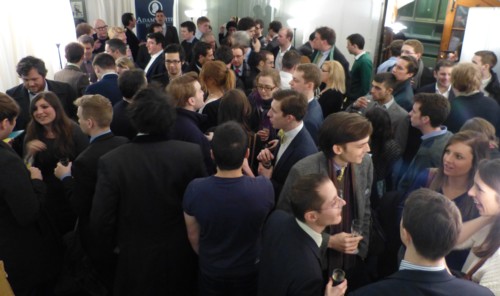
I am currently trying (although I promise nothing) to write a review of The PR Masterclass by my friend and occasional Samizdatista Alex Singleton. I had hoped to be able to combine this review with a report of the launch of the book that took place in the offices of the Adam Smith Institute on Tuesday evening of this week, but the former project is now delaying the latter, so here are some pictures of the launch. My more considered thoughts on the book will have to wait, not for too long, I hope. As so often, what really mattered at this event was not who spoke at it or what they said, but how many people were there to listen and to stand around trying to impress each other with their various opinions and alleged triumphs. The answer last Tuesday was: a lot. The place was packed out:
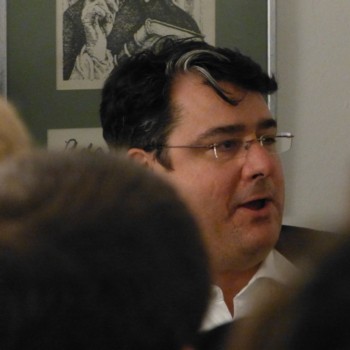
If you write a book called The PR Masterclass and you arrange a book launch for it, you had better assemble a decent throng of people. If word gets out via the few who did attend how few attended, you will come over as very foolish. That mission was definitely accomplished, that landmine definitely not stepped on. Alex told me later that the people present were a mixture of ASI-type “movement” people, PR professionals, and journalists. Just what he wanted, in other words. One reason why so many people showed up was that Alex had obtained an impressive star speaker:
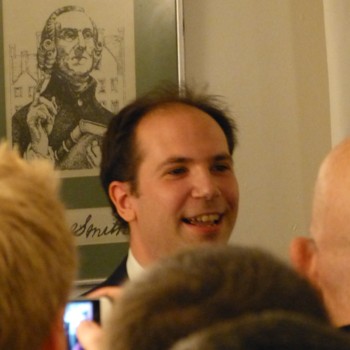
Guido started by remembering the old Globalisation Institute that Alex Singleton used to run, and how amazingly lavish was the press coverage that the Globalisation Institute used to get. Then he reminisced about a drunken night out the two of them had had, which had landed Guido in court. Or something. At this point in his speech Guido started speaking too quietly for me, at the back, to hear properly. But the people nearer the front of the throng seemed amused, and anyway, it doesn’t matter what gets said at these things. The point is for it to be made clear that a Big Cheese like Guido wants you to buy the book, is a friend of the author, blah blah. If you want to be in with the in-crowd, read this book. Alex himself also spoke, briefly:
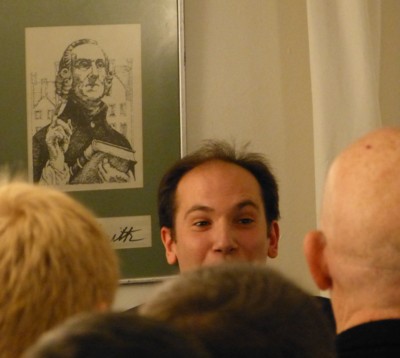
I like that one, but I like this one even more:
Both snaps capture, I think, the fact that Alex Singleton is an enthusiast about what he does, but that he doesn’t take himself too seriously. Some people might grumble about a picture like that second one of them. Alex won’t. Alex had emailed me earlier to say that it would be fine if I brought my camera with me, and used it. As is my habit, I looked to see if others were taking photos, but only spotted one, standing right next to me:
Had Alex not emailed me beforehand that me photoing would be fine, I might have refrained. That he found time to include this in the email he sent me about this event is typical of his attention to detail, and of his ability to see the world through the eyes of the people he is trying to influence, surely the core PR attitude. (And hey, I just got a phone call from him saying do I have any photos that he can use?) As for the book, in the event that I never get around to posting my properly serious review of it any time soon, let me now supply a short summary of what I already know I will be saying: the book is very good. One other thing, which also points up that this felt like a very successful event, and that Alex was coming across as a very successful and significant chap. While trying to impress those around me, I found myself talking about my Brian’s Last Fridays, and how brilliant they have so far been since I resumed doing them in January of last year. Someone asked me who will be my next speaker, on the last Friday of January, i.e. on the evening of January 31st. My reply? “Oh, yes. Come to think of it: Alex Singleton.” This actually did impress people, or so it seemed to me. I’m being rather frivolous about all this, but it really is quite a significant little fact about the world that one of the leading personalities in the bit of it that concerns itself with PR is now Alex Singleton, i.e. someone who probably agrees with me, and very possibly also with you, about really quite a lot of things. On the jacket of the book, Singleton’s publishers start their blurb about him by describing him as “one of the world’s leading public relations strategists”. That one could show up at this event and feel that this was not an obviously over-the-top or ridiculous or embarrassing claim is, I think, quite something. January 23rd, 2014 | 3 comments - (Comments are closed)
So will this be an apologia filled with ‘but’ and ‘trade off’ or a genuine inquiry into the growing global panopticon?
Sayeth the Guardian, listing all manner of statist worthies who will be a part of this. Worth watching methinks. January 22nd, 2014 | 6 comments - (Comments are closed)
What Patrick Crozier called the First World War War continues. Although the trenches have long been dug, the conflict can revert to being a war of manoeuvre with surprising speed, and sometimes evidence leaks out of mutiny among the troops of even the most committed belligerents. From the BBC of all people: Lions and donkeys: 10 big myths about World War One debunked Here are the ten myths debunked by the article: 1. It was the bloodiest war in history to that point I am surprised and heartened to see this article from this source, particularly because it is by Dan Snow, a popular programme maker. I am also glad to see these points made because they are true. ADDED LATER: The outcome of the First World War War matters to the cause of liberty now. Discuss. January 20th, 2014 | 60 comments - (Comments are closed)
Via Tim Worstall, this is far too good not to share:
I love the final sentence. January 20th, 2014 | 22 comments - (Comments are closed)
It was disappointing, however, to see that many of the recommendations offered by Obama’s own Surveillance Review Group were either neglected or specifically rejected. While the unconstitutional permanent gag orders attached to National Security Letters will be time-limited, they will continue to be issued by FBI agents, not judges, for sensitive financial and communications records. Nor did the president address NSA’s myopic efforts to degrade the security of the Internet by compromising the encryption systems relied on by millions of innocent users. And it is also important to realize that changing one controversial program doesn’t alter the broader section 215 authority, which can still be used to collect other types of records in bulk—and for all we know, may already be used for that purpose. January 19th, 2014 | 3 comments - (Comments are closed)
Crudely put, George Orwell is anyone’s bitch. Whatever the topic, whatever the political position, he can be wheeled out in support to enunciate universal truths in a voice as compelling as the ghost in Hamlet. January 18th, 2014 | 30 comments - (Comments are closed)
“I probably shouldn’t say this, since I have some good friends who are film critics, but I don’t think movie reviewing is a very high calling.” Roger Simon, screenwriter and novelist. He’s writing about the Oscars, and the whole jamboree around films that seems to take place around this time of year. The focus of his article is about the film Lone Survivor, which he believes is likely to be overlooked on account of its celebration of US military bravery, which is unlikely to connect with the sort of folk that run Hollywood. For what it’s worth, the films I have seen and enjoyed over the last 12 months or so in an actual cinema are Skyfall, Rush, Margin Call, Gravity and Les Miserables. Daniel Bruhl’s portrayal of Formula 1 racing driver in Rush is the best acting I have seen in years. I wonder what Roger Simon makes of restaurant reviewing? January 17th, 2014 | 53 comments - (Comments are closed)
On Thursday 9th of this month, exactly a week ago, I mentioned here a Libertarian Home meeting due to take place that evening in the Rose and Crown, Southwark. It happened, I went, and I wrote most of what follows the following evening. But then life got in the way, and I am only now posting what I then wrote. The first thing I want to say about Aiden Gregg’s talk about the psychological foundations of differing political beliefs, libertarian and otherwise, is that I greatly enjoyed it. And I got the strong impression that most others present did also. Much of what Gregg said was based on a book by Jonathan Haidt, entitled The Righteous Mind (now on its way to me via Amazon). Haidt looks as the contrasting ways of thinking and feeling of three big categories of American political people – in descending order by size: liberal, conservative and libertarian. (It’s an aside, but straight away, that itself strikes me as a big win for the libertarian movement. A generation ago, would “libertarian” have been in the mix, as a distinct big category? I wonder how greenies feel, if they read Haidt’s book, about not being included as a distinct big category. Also, as was asked during the Q&A, what of non-Americans?) My immediate reaction to Haidt’s various different ways of thinking and feeling was to wonder exactly what these are. Are they notions relating in any way to the biology of the brain? Are they, that is to say, “real”? Or are they merely things that Haidt has found that political people like to think about? Are they just questions which, if you put them to political people, seem to reveal and illuminate differences of deeper attitude? Are they, as Perry de Havilland might say, questions about contrasting meta-contexts? This is the perpetual problem of the social sciences. What exactly are you observing? What are you talking about? I will perhaps have more to say about such things, and about exactly which people score exactly what on which variable, once I have had a closer look at Haidt’s ideas in written form, although I promise nothing. Memory plays tricks – definitely mine now does – so others might describe this talk very differently to the way I am doing. But, what I heard as Gregg’s main conclusion was that nature, when it comes to political affiliation (religion was hardly mentioned) is not destiny. You are not doomed, because of the sort of person you were born as, to be any particular sort of political animal. The main thing to learn from such work as Haidt’s is not that most people are beyond hope when it comes to converting them to Righteousness (in my case, to libertarianism), but that you have a better chance of converting someone to Righteousness if you understand their psychological dispositions better. What “moral foundations” (to quote the words on my scribbled notes) do they consider to be most important? As to what these moral foundations are, we were offered six variables of concern, so to speak, to consider important, rather more or rather less than others: care/harm, fairness/cheating, loyalty/betrayal, authority/subversion, sanctity/degradation, freedom/oppression. If, like most libertarians, you are more exercised about freedom/oppression than, say, about sanctity/degradation, but are arguing with a conservative whose cconcerns are the opposite of yours, then you just banging on about how freedom/oppression is what matters most, and that libertarianism scores well on this variable, will not get you very far. It will be a dialogue of the deaf. It was a lively meeting, livelier than usual. Partly this was because of Aiden Gregg’s relaxed and low key demeanour. When the room erupted with interruption, as it did from time to time, his attitude seemed to be that this was amusing, rather than any kind of insult to him personally. I guess if you are an academic psychologist, a group of people is interesting to observe no matter how disruptively it behaves, and perhaps the worse the better. You look on with amused detachment, as if observing baboons. Especially if they are libertarian baboons and this the sort of behaviour you expect from such baboons. But there was, I think, another reason for the lively response to this talk, which is that all of us were, but not in a bad way, taking it personally. We were – certainly if my own response was anything to go by – thinking things like: how do I score on these various variables? What do I think is most important? And: I wonder how my scores differ from other people in the room, from other libertarians generally, and from other people generally. I have always felt myself to be, psychologically, a lot more like (compared to other libertarians) many of the ideological opponents of libertarianism, of the softer, kinder, better-meaning sort. I just think that the way to get a softer, kinder, better world is through a policy of radically diminished state activity and greatly increased freedom compared to what we live with now. I don’t favour the free market, despite it being rather red in tooth and claw but simply because it is free. It is free, and that’s very nice. But I do not think that it is actually very red in tooth and claw. And I think that the statist alternatives to it are much redder in tooth and claw than those proposing such alternatives typically suppose, or pretend. Socialism, for instance, and especially the sort of state-imposed socialism that is actually capable of being done in a big way, doesn’t strike me as at all egalitarian, at all fair (to allude to variable 2 in the Haidt list). It merely installs a different and far more toxic sort of unfairness. On another variable, authority, I also perhaps dissent a little from others in my libertarian tribe. For me one of the great glories of freedom is that it creates authority of the good sort. It only undermines authority of the undeserved sort. Ditto loyalty. In general, a free society makes people nicer. It makes people (Randians: look away now) more altruistic. One of the most significant shortages that afflicted the Soviet Union, throughout its baleful history and especially when it collapsed, was a shortage of public spirit, that is to say, of the willingness of people to put themselves out for each other, and especially for strangers. My point here is not just that I now have all these clever things to say about authority and niceness and the USSR and so on and so forth, on the back of having attended this Aiden Gregg talk. It is that I believe I was not the only one thinking personal thoughts in response to what he was saying, while he was saying it. We were all, I suspect, doing this. This was a talk that got us all, as the saying goes, going. It got us all thinking. It was, in short, very good, just the sort of thing that such talks should be. As is usual at Libertarian Home events, there was a video camera running, as I mentioned when commenting on this rather blurry set of photos that I took at the event. In a comment he has just attached to that posting, Simon Gibbs apologises about the lighting, following me moaning about it. But I think, if you take photos, that it’s your business to work around such things. That I did not do this very well on that particular night is partly because I was distracted by finding the talk so very interesting. I’ll end by saying that, if what Aiden Gregg was saying sounds like the kind of thing that interests you, keep an eye out for that video. Libertarian Home videos take quite a while to emerge, but emerge they always seem to do, eventually. (A previous Aiden Gregg performance for Libertarian Home, in the same venue, can be watched by going here.) January 16th, 2014 | 12 comments - (Comments are closed)
The United States, since the times of the “Great Society”, has spent approximately 24 trillion dollars on anti-poverty programs, while the percentage of those considered to be in poverty has remained the same. With a 50 year track record as evidence of the utter failure of the welfare state, it amazes me that the public continues to buy into this form of wealth re-distribution. – Samizdata commenter Michael Staab January 16th, 2014 | 17 comments - (Comments are closed)
|
   |
||||

All content on this website (including text, photographs, audio files, and any other original works), unless otherwise noted, is licensed under a Creative Commons License. |
|||||

Recent Comments