Ok, it is Friday, so how about this item on “How Technology Is Transforming the Wine Trade”.
Tech has not, yet, transformed the subsequent hangovers from excess, however.
|
|||||
|
Ok, it is Friday, so how about this item on “How Technology Is Transforming the Wine Trade”. Tech has not, yet, transformed the subsequent hangovers from excess, however. January 31st, 2014 | 5 comments - (Comments are closed)
 Whenever you hear of businesses or others carping about the lack of financing for this or that preferred cause, and demand that the State (ie, you, the taxpayer) steps in to fill the gap, it is worth bearing in mind that one of the glories of capitalism is in coming up with ever more inventive ways of putting those who want capital in touch with those who have it. This is the thrust of an article in the magazine Reason by Greg Beato (February 2014 edition):
As I sometimes note, while Hollywood, for instance, often produces films that slag off capitalism, (Michael Moore being the most egregious case) or smaller independent film producers do the same, the irony is that they make use of the innovation in fund-raising that modern capitalism constantly throws up. A related area of capital provision that bypasses banks – and their current, often stringent capital rules – is what is known as “peer-to-peer” lending. And needless to say, the UK financial regulator is getting concerned about this, fearful that people who lend money might make mistakes or, horrors, those who borrow might not fully understand the risks. Rob Fisher of this blog wrote on the topic last year. All this flowering of capital-raising is not really all that new, if you think about it. The idea of equities and other securities has been around for a long time; what is new is that the internet has put both sides to the transaction in touch much more easily, reducing barriers and the frictional costs associated with it. That’s surely an example of the “long tail” effect at work. January 31st, 2014 | 13 comments - (Comments are closed)
I keep saying that if you care about poor people, you should be a libertarian. The Institute for Fiscal Studies is pointing out that while poorer people are paying more for food and fuel, richer people are enjoying low interest rates. So government spending and borrowing and the artificially low interest rates that go along with that are harmful to poor people, as are taxes on fuel, and income tax on minimum wage earners, and countless other instances of state meddling. Real money and a small state lead to high growth which makes everyone richer. January 31st, 2014 | 11 comments - (Comments are closed)
If you want to know what the British – the educated British – thought of the Germans in 1914 here’s your answer:
Is it accurate? I think so, primarily because it explains the Zabern Incident so well. Was it the cause of the war? It was certainly a cause. It wouldn’t be the first time that an unpopular regime that found itself cornered attempted to prop itself by starting a war. Milosevic’s Yugoslavia springs to mind as another example. What it doesn’t explain is how such a divided nation was able to keep going for so long. 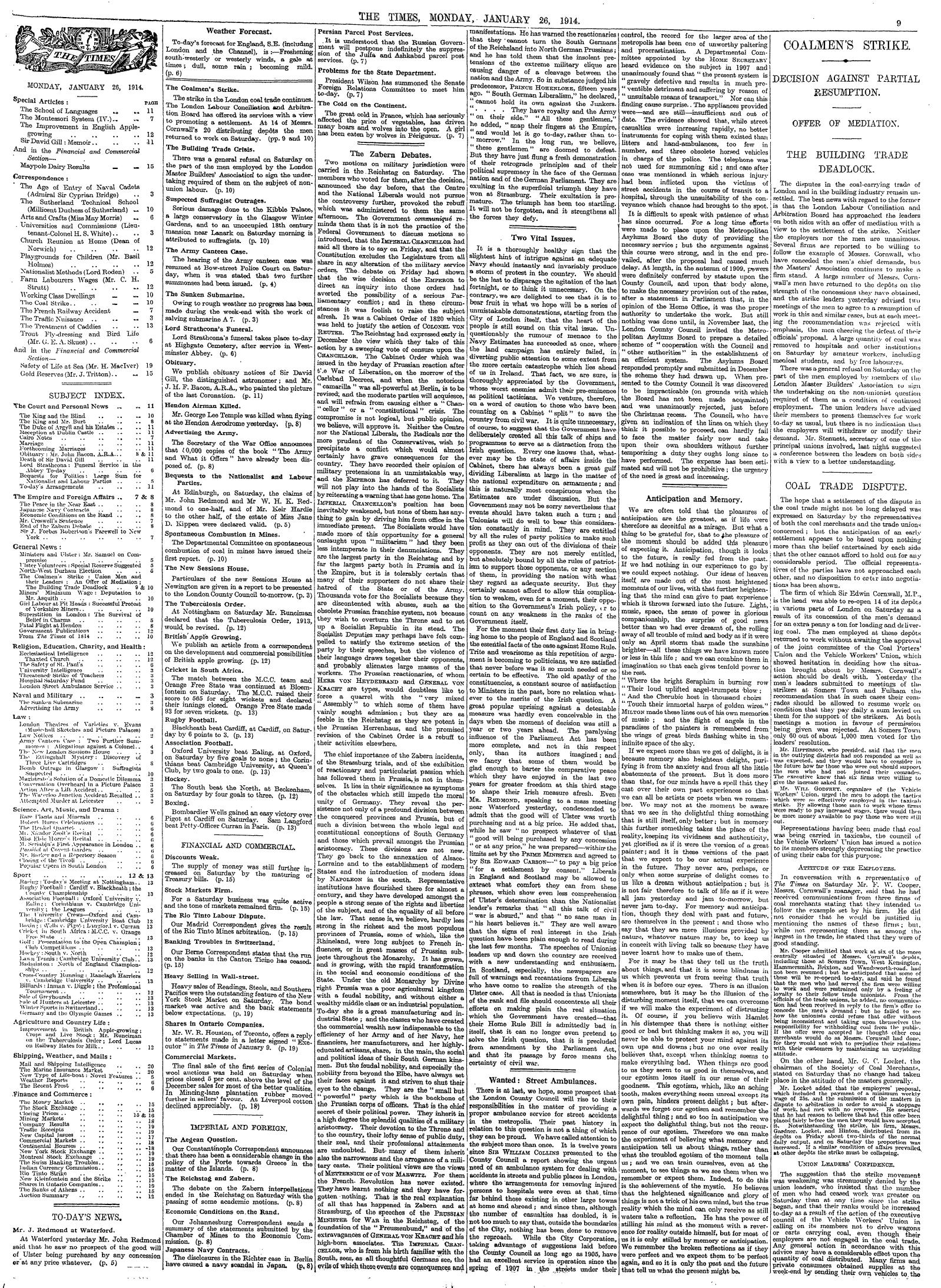 The Times 29 January 1914 p9 January 30th, 2014 | 14 comments - (Comments are closed)
A feature of British reporting on American affairs is that even newspapers that sell themselves as right wing or too grand to take a side in US politics take their tone straight from the Democratic party. For instance, this Times report of the State of the Union address appears in the news section, not the opinion pages, yet in this paragraph
the writer, David Taylor, takes it for granted that President Obama’s plans are “practical” and indubitably will “give people new ladders of opportunity”. Was there not room for a little “intended to” anywhere in that line, Mr Taylor? Again, this report from Peter Foster in the supposedly right wing Telegraph takes one look at Obama performing the standard politician’s trick of admitting to the fault of excessive reasonableness, and falls in love:
We all understand where the problem lies: with the rancorous ones who argue about the proper size of government. If only they would stop doing that our weary hero could rest. I am ready to be told in the comments that the Dems and the Repubs really are not that different. Allow me to agree in advance. It is just that the way that the Times and Telegraph maintain faithful station like Greyfriars Bobby long after their better paid friends in the Boston Globe and New York Times have noticed that the object of their devotion is politically dead is making a vein throb. Which reminds me, we were not always thus. As the great Malcom Tucker put put it during his visit to Washington (2 minutes 10 seconds into the clip):
(Warning: occasional words in the compilation of scenes from In the Loop linked to above are not viciously obscene.) I note with pride that two hundred years ago arguments about the proper size of the federal government were settled in a decisive yet still gentlemanly fashion. Wikipedia’s account of the burning of Washington says that “The British commander’s orders to burn only public buildings and strict discipline among the British troops are credited with preserving the city’s private buildings.” We even spared one of the more useful government buildings:
Despite this lapse, Major General Robert Ross did burn to the ground the White House, both houses of Congress, the War Office, the State Department and the Treasury, although I gather someone has rebuilt them since. January 29th, 2014 | 21 comments - (Comments are closed)
I don’t think Cameron has conceded anything very much. The Lib Dems are not much farther to the left than he is personally and he would have a much harder time with his own party if he was not in a coalition. I think Cameron has done quite well by his own miserable standard. Cable is just one of those people that think that the debate (was there one?) about the role of the state has been settled and that elections are just about replacing the management team. – Samizdata commenter Peter T January 28th, 2014 | 5 comments - (Comments are closed)
… because his, er, ideology makes him in favour of more spending and more taxation. Yes, really. Does he think his own views are not completely ideologically based as well? January 27th, 2014 | 11 comments - (Comments are closed)
A colleague of mine sent me this item, from the BBC:
How jolly decent of them.
Well, he now knows differently. A person with a bank account does not own the cash contained by the bank and has total control over it. (I am not aware of any line in my bank contract saying as such.) A deposit is a credit to the bank, and under modern banking laws, with the system as it operates, a bank is not obliged to instantly hand that over, no questions asked. (Under fractional reserve banking, the only kind of guarantee is by deposit protection, but that is usually only up to a certain limit.) In a full free market of course, people could make whatever kind of agreements with banks that they wanted, even consenting in some cases, perhaps, to having to give information to a banker to prevent fraud. However, government regulations in the UK (and certain other nations) being what they are (such as controls to stop money laundering and tax dodging), banks are increasingly operating as proxies for government agencies. According to HSBC, the issue is to combat financial crime. Maybe that is true but this is not the whole picture:
One of the ironies of the situation is that HSBC last year was hit by a massive fine for anti-money laundering offences (stuff to do with Iranian sanctions and drugs); hitting long-standing clients with this sort of intrusive crap will not do much for that bank’s brand reputation. It is right to stop fraudsters taking money out of accounts of clients, but perhaps the bank should be more frank with clients on why it makes these kind of demands and what is driving this situation. To a considerable extent, banks are no longer really part of any free market, capitalist system. January 26th, 2014 | 45 comments - (Comments are closed)
[The state of Oklahoma will] refuse material support, participation or assistance to any federal agency which claims the power, or with any federal law, rule, regulation or order which purports to authorize the collection of electronic data or metadata of any person pursuant to any action not based on a warrant… January 26th, 2014 | 28 comments - (Comments are closed)
[Nigel Farage] is a politician, so everything he says needs to be decoded. But licensing [of handguns] is vastly preferable to banning, not just a little bit preferable… more importantly he is doing the one thing you are not supposed to do in polite society, he is actually discussing the subject. Next thing you know people will be discussing the NHS and the phrase “envy of the world” will not be heard anywhere. – Perry de Havilland January 26th, 2014 | 24 comments - (Comments are closed)
Nigel Farage has just stuck up two fingers and waved them in the direction of the mainstream.
And of course he has unleashed a wave of outrage from ‘sensible’ statists of both left and right. Well done Farage! To annoy so many of them at the same time just drives home that the Tories, Labour and LibDems really are largely interchangeable. It also means you are indeed doing something right. January 25th, 2014 | 40 comments - (Comments are closed)
That rough diamond of the Labour party, ascended man of the people John Prescott, has fulfilled a lifetime’s dream, courtesy of a holiday to Cuba “provided by” Journey Latin America. Rum and cola in hand, he does the online equivalent of showing the neighbours his holiday slides, by regaling the Guardian audience with a matey account of his adventures: John Prescott leaves the 21st century behind in Cuba. He and his son, also along for the ride, had a fine old time. A moment of embarrassment over the right amount to tip provided an entertaining anecdote:
Down in the comments, this fisking by ‘brituser’ fails to enter into the holiday spirit. What a grinch! I have quoted only some of it; do not on any account read the rest. Prescott is in italics, ‘brituser’ in bold.
What an interesting way of describing everyone around as incredibly poor. Would you have wished that on your constituents?
In other words there’s no office jobs here. Look outside Havana and you’ll see 20% of the population working on the land in back breaking work in intense heat. Or rather you wouldn’t because you’re too exhausted from sitting on sunbed. You wouldn’t wish that on the UK population would you? ….
Something to do with the fact it’s a Communist dictatorship and you know if you say something you’d be rushed off to jail-no freedom of speech.
The trip was provided by Journey Latin America-Yes if was a freebie, despite the taxpayer paying a fortune in salary to you. You have registered the bribe-sorry holiday?
Or the UK before you banned smoking in public places. I thought it was supposed to be a health measure. Don’t you care about cuban workers and second-hand smoke?
In other words nothing works. With my western money I can act and feel like a millionaire. January 25th, 2014 | 12 comments - (Comments are closed)
|
   |
||||

All content on this website (including text, photographs, audio files, and any other original works), unless otherwise noted, is licensed under a Creative Commons License. |
|||||
Recent Comments