But the reality of Chakrabarti’s On Liberty, an awkward amalgam of the semi-personal and the mainstream political, never even comes close to realising the promise. Instead, it turns out to be a desperately dull encomium to the human-rights industry, a verveless trudge down Good Cause lane, with every battle against New Labour anti-terror legislation, each scuffle with the ASBO-happy authorities, eventually turning into a victory for the indispensable European Court of Human Rights. Hooray for Strasbourg! If John Stuart Mill wasn’t so liberal (and dead), he’d be within his rights to sue Chakrabarti for calumny.
|
|||||
|
My only objection to this…
… is that it was ‘unwitting’ 😛 November 19th, 2014 | 15 comments - (Comments are closed)
 This, I think, is my main objection to Band Aid 30: it is all predicated on a belief that the British public are mean-spirited and uncharitable, when in actual fact nothing could be further from the truth. It’s time the likes of Geldof stopped asking us to give money, and like Adele, started donating some themselves. Charity, after all, begins at home. The whole article is a magnificent demolition of celebrity “charity culture” and the cant that is associated with it. Given how some people, such as that now-dead monster, Jimmy Savile, used charity as a shield to ward off questions about his behaviour, and given that at a less odious level, people with interesting personal tax affairs like to go on with charity efforts to get good PR, this sort of analysis is overdue. “Sir” Bob Geldof should perhaps tend rather more to his personal family affairs, which appear to be in a bad way, than making sneering remarks about someone who wants to get on with developing her career as a singer. How selfish of her! November 19th, 2014 | 18 comments - (Comments are closed)
A hotel has a policy of charging guests an extra £100 if they leave a bad review of the hotel on any website. Should the state permit individuals to enter into such a contract? When a couple was so charged, they went and talked to the press. “What happened to freedom of speech?”, they asked.
The beautiful thing is that the state turns out to be completely redundant in this case. Things did not work out so well for the hotel, and it now serves as a terrible warning for anyone else with similar ideas. Now its reputation is trashed on Trip Advisor because of freedom of speech. And because The Internet. Though I do wonder about libel… November 18th, 2014 | 26 comments - (Comments are closed)
President Vladimir Putin sees his country in an “information war” with the West. The underlying assumption is that Western media organizations are linked in a vast conspiracy to defame and undermine Russia, so the Kremlin has no choice but to reply in kind. Since the beginning of the month, Russia’s state media holding Rossiya Segodnya has launched an international news agency, called Sputnik, as well as RT Deutsch, a German-language version of broadcaster Russia Today. The purpose of the media offensive isn’t so much to present an alternative point of view as to create a parallel reality where crackpots become experts and conspiracy theories offer explanations for the injustices of the world. The target audience is Western citizens skeptical of their own system of government. The goal is obfuscation. November 18th, 2014 | 22 comments - (Comments are closed)
In a Reuters article titled British EU exit debate scaring off investment – Hermes funds I hit a line that made me go: say what?
I was particularly struck by “and Zurich”. So Zurich, also in Europe but not in the EU, will benefit if London is not in the EU? Really? November 18th, 2014 | 15 comments - (Comments are closed)
As reported in most entertaining style by the Guardian, Ed Miliband had rather an ordeal at the hands of Myleene Klass. Looking at the picture Guido has up, the converse is also true. UPDATE: Second link seems to have collapsed. Here’s the Twitter post (including the [ADDED LATER: fake] relevant photo) from Mark Flanagan’s twitter feed that Guido linked to. UPDATE TO THE UPDATE: In fairness, a lot of people, including Mark Flanagan himself and many who are no friends to Ed Miliband, are saying the picture has been maliciously photoshopped. The transition between hand and wrist does look odd. The more I look at it the more sure I am it’s fake, made by manipulating this picture here. Guido’s link has changed, and the picture no longer appears on his post. November 18th, 2014 | 4 comments - (Comments are closed)
I love the idea that prosperity can be decreed by a G20 communiqué. World leaders in Brisbane have airily committed themselves to two per cent growth. (Why only two per cent? Why not 20 per cent? Or 200 per cent? Who knew it was so easy?) Meanwhile, in the real world, the divergence between Continental Europe and the rest of the planet accelerates. November 17th, 2014 | 8 comments - (Comments are closed)
On 27 October 1914 HMS Audacious, one of the Royal Navy’s newer battleships hit a mine and sank. The government censored the story and the loss wasn’t officially admitted until after the war had ended. This is about as close as readers of the Times got to hearing about it officially:  The Times 6 November 1914 p4 The point being that the Olympic (sister ship of the Titanic) helped in the rescue operation. Many of its passengers were Americans and some even took photographs. As there was no censorship in America news of the sinking slowly filtered across the Atlantic. There’s a good discussion about the sinking here: So, why the secrecy? Partly this was because of where the Audacious sank. The fleet was supposed to be in Scapa Flow in the Orkneys guarding the North Sea. However, due to the state of the submarine defences there it was thought prudent to move it to Lough Swilly off the northern coast of Ireland. The navy did not want the idea to get out that the North Sea was an open house. 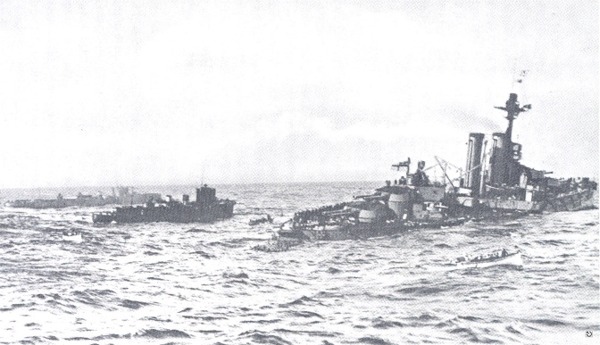 HMS Audacious sinking But there may have been another reason. The early months of the war had been a disaster for the Royal Navy. The German battlecruiser, Goeben, had evaded the British in the Mediterranean and went on to play a large part in bringing Turkey into the war. Three cruisers, the Hogue, Aboukir and Cressy had managed to get themselves sunk by the same submarine in the Channel in the space of an hour and a half. At the battle of Coronel a British cruiser squadron had attacked a superior German force with disastrous results. In the southern oceans the commerce raider Emden was making fools of its pursuers, seemingly able to pop up out of nowhere to shell ports and destroy wireless stations. There may have been a desire not to admit just how badly things were going. In situations like this questions are bound to be asked about the man at the top – or the First Lord of the Admiralty to give him his grand, official title – but it would take another year and more disasters before he would finally be sacked. The chap’s name? Oh yes, Winston Churchill. November 16th, 2014 | 33 comments - (Comments are closed)
Back in the bad old days, Kremlinologists used to try to figure out what was going on in the leadership of the USSR by observing signs and portents.
Brian Micklethwait has often written of the “sovietisation” of various parts of the British State such as state schools and the NHS. To illustrate this process, take a look at the way a “major incident” at Colchester Hospital has been reported. What major incident you ask? My point exactly: you ask, they don’t answer. Likewise “safeguarding” is repeatedly mentioned. Something needs to be safeguarded. Late last night or early this morning there were oracular bulletins from the Telegraph and Times, all chock-full of unspecified “incident”. From the Times:
All clear now? There was a similarly opaque article on the AOL homepage. It has been updated since, as has the Telegraph one, I think, but the Times, like a good horror movie, is delaying the big reveal. The BBC followed suit: “Colchester Hospital declares major incident.” The BBC did tell us what sort of general thing might constitute a “major incident” but not about this major incident. As a result everyone thinks it’s ebola and as I write this it’s the most looked-at article on the BBC website. Stand down. It’s not ebola. The Guardian was slow to get the story but does actually tell it:
Oh dear, what a let down. Just as it used to in the days of Pravda and Izvestia the secrecy concealed mundanity. It’s just the NHS in crisis again. Can’t they do anything right? The zombies they make aren’t even dead yet. November 15th, 2014 | 18 comments - (Comments are closed)
Hannah Thoburn has an interesting article on World Affairs called Putin the Unifier:
This pretty much squares with what I have heard from people I know or correspond with in the Ukraine. They tend to be deeply cynical about domestic corruption and local politicians generally, but all have told me hostility to the Kremlin and pro-western sentiments now largely transcends narrower political groupings, making for some eye widening collaboration amongst very unlikely allies. A guy I know also said much the same thing about many Russians becoming very vocally Ukrainian, with some going ‘deep nationalist’ as only Russians can these days, just not in the way the charming Mr. Putin might have expected. November 14th, 2014 | 9 comments - (Comments are closed)
The correct response to this is…
But Matt, listen to me buddy… never apologise. Seriously, your friends do not need it and your enemies will still hate you regardless, so either ignore your detractors, or better yet, tell them to shove it. hat tip: Darryl Watson November 14th, 2014 | 36 comments - (Comments are closed)
|
   |
||||

All content on this website (including text, photographs, audio files, and any other original works), unless otherwise noted, is licensed under a Creative Commons License. |
|||||
Recent Comments