We are developing the social individualist meta-context for the future. From the very serious to the extremely frivolous... lets see what is on the mind of the Samizdata people.
Samizdata, derived from Samizdat /n. - a system of clandestine publication of banned literature in the USSR [Russ.,= self-publishing house]
|
I understand why NickM, for instance, complains about all the people waving Je Suis Charlie signs at the recent Charlie Hebdo demos just over a week ago. But at least there were demos (Hebdemos?), and big ones. Whatever the finer points of the relationship between Islam and the rest of us, thousands upon thousands of people, in France millions, disapproved of cartoonists being killed, no matter how offensive anyone might think they had been, just because of various cartoons they had done. I agree that disapproval is not much. Ooh, they disapprove. But it’s a start. I mean, would you rather that all those millions of demonstrators had just shrugged their shoulders, stayed indoors and forgotten all about it?
And yes, there was plenty of hypocrisy involved, on the part of public personages who, only weeks or days before the attacks, had been saying more like: “Je Ne Suis Pas Charlie”, and who will be saying much the same as that in a few days or weeks time. But I prefer hypocrisy and inconsistency to brazen wickedness. If you demand consistency from public figures, you are liable to get consistent stupidity and consistent wickedness. The public attitudes that public people feel they need to strike, even if they strike them very insincerely or in a way that contradicts other things they have earlier said and done and will later say and do, still count for something.
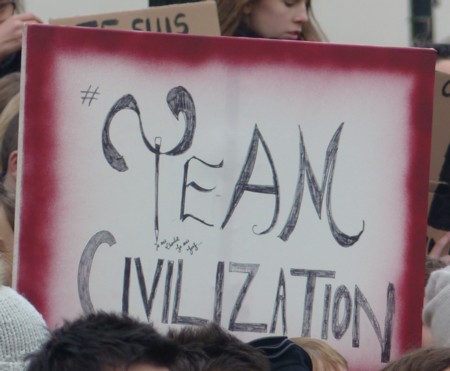
I attended the demo in London’s Trafalgar Square, and I made a point of photoing signs that said other things besides Je Suis Charlie, of which this was my favourite:
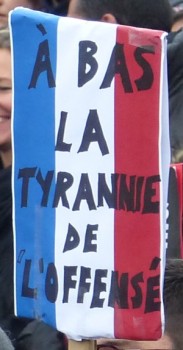
For the benefit of those with no French, that means (unless my French is letting me down badly) something along the lines of: “Down With The Tyranny of The Offended”. Good one. See also the earlier posting here, in which our Prime Minister is reported as standing up for the same idea. And, see my paragraph above (which I had already written before that earlier posting had appeared) about how the public attitudes of public people do matter, however occasionally and inconsistently they may be expressed.
This next sign might have been my favourite. But, that T for Team looks too twiddly, and not clear enough and assertive enough. It’s like the guy who wrote the sign was just taking dictation and didn’t really mean it.
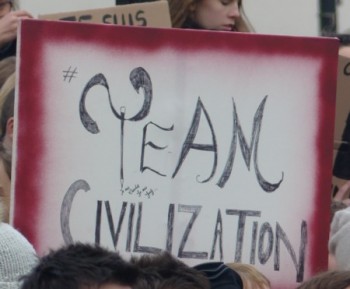
Or, it could just mean that here were some people demonstrating who had not done any such thing before. Because, this was not your usual demo, the sort of demo perpetrated by the demonstrating classes, so to speak. Which was another big plus, from where I was standing, photographing everything I could see.
You can view other photos that I took of signs that afternoon here.
From Ryan Paul, in this tweet:
Instead of inventing encryption that only government can break, we should just breed a special unicorn that magically blocks terrorist acts.
Did David Cameron just say something… um… well… sensible and manifestly correct? I can hardly believe my eyes!
British Prime Minister David Cameron said there was “a right to cause offence about someone’s religion” in a free society, drawing a distinction between himself and Pope Francis in their response to the deadly Islamist attacks in Paris.
Did Dismal Dave really say this? I need to lie down.
This post was written by my regular correspondent “ARC”, who has several family members working in the NHS. – NS
I’ve been discussing the NHS A&E issue that’s been in the news of late with the medically knowledgeable and NHS-aware members of my family and thought you might be interested in their background information, so have written it up while the conversations are still fairly fresh in my mind. I summarise, then give my own thoughts at the end.
The immediate cause of the NHS A&E issue being such a story in the media at this time (other than the upcoming election, of course) is simply that at Christmas a great many staff take holidays. The resulting shortfall exposes long-term trends in an area under pressure. There is no other immediate cause, as distinct from long-term trends: these problems have been growing for 15 years and more as follows.
1) Flow-though is crucial to A&E: you must get people out the back-end of the process to maintain your rate of input to the front-end. However ever-increasing regulations mean a patient without family cannot be released until a boat-load of checks have been done. This is clogging up the back end. It may be preventing the release of a few who had better not be sent home yet (not much and not often, is the general suspicion) but it is definitely delaying hugely processing the release of all others who could be. All this admin takes time and effort – delaying release and also using up time of staff in non-health work – and costs money.
This effect needs to be understood in the context of the 15-years-older story of the destruction of many non-NHS nursing homes by galloping regulation. These homes were mostly owned and operated by senior ex-NHS nurses and provided low-grade post-operative care. The NHS relied on them as half-way houses to get patients out of NHS hospitals when they no longer needed intensive care but were not yet recovered enough to go home. These nurses did not want to spend time form-filling instead of caring for patients, and for each home there was always one of the 1000+ rules that was particularly hard for that given home to meet without vast expense or complication. So they died one by one. The ‘waiting times have increased’ story of Tony Blair’s early-2000 years – “If the NHS were a patient, she’d be on the critical list” – was caused by this and the resultant bed-blocking more than any other one cause.
A more recent context is over-regulation of local councils’ social services leading to declining throughput, unrealistic expectations for their visit times, etc., and there have also been some social services cuts by said councils. These also have an impact on a hospital’s ability to get people out of the back-end to free up beds for A&E incomers.
2) The new 111 service is sending many more patients to A&E.
2.1) The service’s advice is very risk averse. The people who set up the process were afraid of the consequences of the statistical 1-in-a-million time when anything other than mega-risk-averse advice would see some consequence that would become a major news story blaming them.
2.2) Thanks to the post-1997 reforms, GPs work less hours on-call but the doctors are not just slacking off and doing nothing. The huge growth in regulation means they are in effect putting in as many hours as before, but on form-filling and admin to provide all the info the NHS and other government demand, to ensure they tick every box, etc. The out-of-hours on-call time they used to have is now swallowed by this work. So they are not in fact working less; it is the balance of what they are working on that has changed: less on healthcare, more on admin. Thus 111 must send people to A&E, not an on-call GP (and, of course, fewer on-call GPs mean more people phone 111).
3) Regulation prevents fixing the problem as well as causing it. A Birmingham hospital (Queen Elizabeth in Edgebaston IIRC), said to be very efficient as such things go, tried to create a low-level care unit precisely to solve the problem. Because of the regulations, the attempt had to be abandoned – they just could not tick all the boxes.
4) Back in the early-80s, when my sister (a doctor) did her elective in A&E, she loved it. Now, doctors are avoiding A&E as a speciality because they know how brutal is the pressure there. So the problem is beginning to compound itself.
There is a great deal more one could say, but the above are what my informed relations see as the key immediately-relevant causes. So far my summary. Now some thoughts of my own.
What I observe has most changed in the last two decades in these either left-leaning or were-left-leaning people is firstly their belief that “No party can fix it”. (This I heard from a previously definitely-left individual who would probably still cut her hand off before it voted Tory and whose heart wavered between Labour and [Scots] Nats although her head despises Nats ideas and despairs of Labour.) There is an expectation that no likely government will do anything other than talk of reform while actually causing yet more regulation. Some of this in some of them might be a reluctance to think that the side of politics they’ve loved to hate in the past might be the place to look for an answer (I am reminded of Gore Vidal in 1979, “I feel the despair of coming to think that the Soviet Union may be as despicable as the U.S.” – quoted from memory) but it also reflects their opinion that the Tory-led coalition has failed to reverse any of the above trends, and this opinion I fear is not mere prejudice but has a basis in their experience of the last three years, just as much of the above reflects their experience of the last 15 years.
Secondly, they report a widespread belief within the health service that this time “a bit of money can’t fix it”. There is no expectation of an ocean of money (and – I sense – awareness that the NHS already consumes an ocean of money, so can hardly demand another ocean of money even as a righteous goal, however impossible to arrange).
Lastly, I know that behind all this inefficiency of regulation, there lurks a compounding problem of looming social trends. The number of patients who have no family ready to help is rising. The promise that the state will look after all has led more people to lead lives that make no other arrangements. But these long-term trends are not the reason the NHS operates much worse now than two or three decades ago.
Detractors will try to argue that the poorest quintiles have a smaller percentage of the overall pie. And that might be true, but the pie is much, much bigger. Would you rather have 50 percent of a million or 20 percent of a billion? Another way of putting this is: Would you rather be better off, even if that meant certain people were super well off? Or would you rather everyone were worse off, as long as everyone were relatively equal?
That the poorest among us are still, on balance, doing better today than they were 50 years ago is a remarkable testimony to what relatively free people and markets can do, even as governments put up roadblocks. So if the poor aren’t getting poorer, why do people say they are?
– Max Borders
Politicians: The kind of people who think they can ban math
– the hilariously named “InfoSec Taylor Swift” referencing Dismal Dave Cameron.
Odious figures of the totalitarian regimes are not objects of the cultural heritage of either national or local significance
– Vyacheslav Kirilenko
But then I too am supporting Charlie Hebdo not because I like Charlie Hebdo or the idiot lefties who wrote for it, but because I oppose seeing said idiots murdered because they dared to express themselves. The attack on Charlie Hebdo was an attack on western civilisation itself, nothing less. The merits of the victims or their publication scarcely merits a mention to be honest. If ever there was a moment to go full blast Voltaire, this is it.
– Perry de Havilland
I just read a comment, written by someone calling himself “Jonny Overcat”, which (a) tells me that the art of invective is not dead, and which (b), I think, deserves wider circulation. At the time of me concocting this posting, it is comment number six on this take-down of the appalling Mehdi Hassan. Here it is in full:
I can hardly put into words how viscerally disgusted I’ve felt the past couple of days with a significant number of allegedly “progressive” writers in American media who just trip all over themselves to denounce Charlie Hebdo as racist, wrong, oppressors and likely people who fuck puppies for fun. The forceful ignorance, the utter lack of even the most basic research or familiarity with the publication and people they are crassly denouncing, and the apologism (is that even a word? Now it is I guess) for the murderers are just utterly subhuman. A big part of it is that I’ve lived in Paris, I have family in Paris and I’ve pounded the pavement in every arrondissement pretty extensively (I do a lot of street photography). I absolutely love that city and its people, and any sort of terrorist attack there is deeply upsetting to me. I’m quite familiar with the neighborhood where Charlie Hebdo’s offices are, I have friends I used to visit who lived just a couple of blocks away from there. I take a terrorist attack in Paris kind of personally, even though I realize that it’s not all about me. I’ve been there during terrorist events in Europe (the Madrid train bombing) and I’ve seen the squads of soldiers patrolling the streets due to that, and the fear on people’s faces in the Metro etc.
So over on Slate, there’s the walking abortion that is Jordan Weissmann, who, before the puddles of blood of the murdered were even dry, valiantly asserts that Charlie Hebdo is just some racist rag and does everything short of just coming right out and saying that they had it coming to them. Never mind, of course, that he quite clearly demonstrates with his mischaracterizations, outright falsehoods and quite obvious lack of actual knowledge about the publication or its staff, that he just hasn’t got a fucking clue. An opportunist piece of shit trying to burnish his PC cred by symbolically standing over the corpses of the murdered and screaming “RACISTS!”
Then over at Salon there’s a specimen called Falguni A. Sheth, who ideally should’ve been fed into a wood chipper as an infant, whose article asserts that the REAL issue is Muslim feelings and how utterly horrifically Muslims are treated by everyone and boo fucking hoo because the world doesn’t bow low enough to Islam. Of course she asserts that the murderers who invoked Islam as their motivation before and during the attacks weren’t motivated by Islam at all, because whitey is racist. Yep. She hilariously states that Charlie Hebdo, a paper that has been published weekly for about 35 years, which amounts to roughly 1800 or so editions, “disproportionately targets Muslims” because they’ve published about 10 or 12 images satirizing radical Islam in the past ten or so years. Thus they are just some Muslim bashing rag, and basically had it coming. Don’t say what we don’t want you to say or we’ll kill you, and it’s your own fault. Never mind, of course that ten or twelve editions satirizing radical Islam don’t even amount to one percent of Charlie Hebdo’s total published works. Yeah, “disproportionate”, but she can barely bring herself to denounce the killers in anything but a passing fashion, as though their murdering is some minor technicality to be glossed over, because the REAL issue is that some fucking Muslim somewhere has had their religious sensibilities sullied by these evil, evil cartoonists. Because cartoonists do such irreparable harm to society. Muslims, of course, are all saints.
Seriously, fuck these people, all of them, and anyone who agrees with them.
I’ve always been socially and politically liberal, never a lockstep liberal, but always generally liberal. I’ve always had a problem with the significant number of so called American liberals and progressives who are rigidly doctrinaire to the point of stupidity, but over this issue, my disgust is reaching critical mass. I need to seriously consider whether I really have common cause with the unfortunately significant number of so called liberals and progressives who are more enamored of finding common cause with the severely illiberal tenets of Islamic fundamentalist thinking. When Bill Maher called Islam “the motherlode of bad ideas”, he was seriously understating his point. These supposedly liberal pieces of shit who find common cause with Islamic fundamentalism, whose basic grasp of the nature/purpose/context of satire is just as tenuous, or even weaker, than that of their braindead counterparts on the right, are just a bit more than I can stomach anymore.
I just needed to get that off my chest …
For someone who can “hardly put into words” how disgusted he is, Jonny Overcat sure does have a way with words, doesn’t he?
I do love the internet.
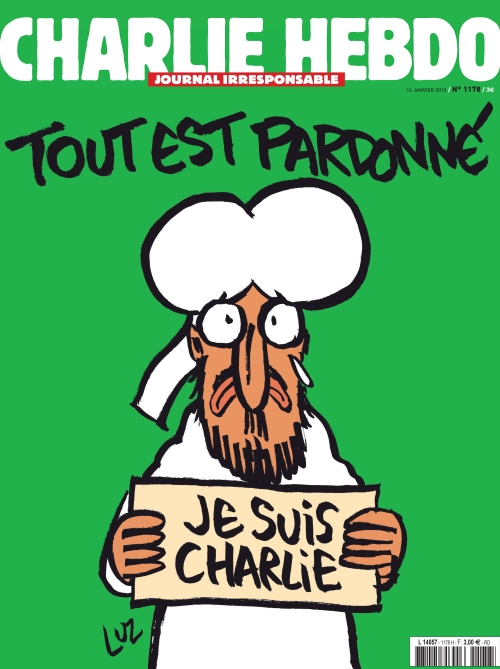
The latest edition of Charlie Hebdo has a cartoon of the Prophet Mohammed on the cover. This is when we see who are the men, and who are the boys, so… well done to all the various newspapers who have shown some defiance to those who urged submission, and republished the image.
Peretti is no stranger to bizarre theories. His recent offerings for the BBC have included The Men Who Made Us Fat and The Men Who Made Us Spend. Personal responsibility doesn’t seem to be on his ideological radar. This is fine, but we should expect more from a public broadcaster than to repeat theories nobody subscribes to, particularly when we are forced to pay for the privilege.
When they denounce “trickle-down economics”, Peretti and the figures above project their own world view. For many of them, it is spending that matters to an economy – and they disagree that the rich having more money to spend is as beneficial as others having it following redistribution.
Yet free marketeers don’t believe in low taxes because of their effect on spending. They believe in low taxes because they provide a strong incentive to earn more income in the first place. And the best way to earn more in a competitive, dynamic, market economy is to provide goods and services people want. Low taxes can therefore engender the sorts of entrepreneurial activity that enrich our lives through better and cheaper products – the productivity improvements we recognise as economic growth.
– Ryan Bourne
It is incomprehensible that you can turn against freedom… But if you don’t like freedom, for heaven’s sake pack your bags and leave. There may be a place in the world where you can be yourself, be honest with yourself and do not go and kill innocent journalists. And if you do not like it here because humorists you do not like make a newspaper, may I then say you can fuck off.
– Ahmed Aboutaleb, the Mayor of Rotterdam, speaking on live TV.
|
Who Are We? The Samizdata people are a bunch of sinister and heavily armed globalist illuminati who seek to infect the entire world with the values of personal liberty and several property. Amongst our many crimes is a sense of humour and the intermittent use of British spelling.
We are also a varied group made up of social individualists, classical liberals, whigs, libertarians, extropians, futurists, ‘Porcupines’, Karl Popper fetishists, recovering neo-conservatives, crazed Ayn Rand worshipers, over-caffeinated Virginia Postrel devotees, witty Frédéric Bastiat wannabes, cypherpunks, minarchists, kritarchists and wild-eyed anarcho-capitalists from Britain, North America, Australia and Europe.
|





Recent Comments