We are developing the social individualist meta-context for the future. From the very serious to the extremely frivolous... lets see what is on the mind of the Samizdata people.
Samizdata, derived from Samizdat /n. - a system of clandestine publication of banned literature in the USSR [Russ.,= self-publishing house]
|
About a week ago or so the Reform Party (est. 2022) claimed that it was about to overtake the Conservative Party (est. Mists of Time), in terms of membership. It even put up a ticker to demonstrate this. On Boxing Day, the ticker ticked over to the magic number of whatever it was and Nigel Farage, drank some beer in a field.
I was rather cynical about the numerical accuracy of this – political party membership is a weird and wonderful thing – but I had to admire the low cunning involved. The Conservative Party is in deep trouble. It governed very indifferently for a very long time. It made promises it not only did not keep but had no intention of keeping. And the result was that at the last general election the electorate gave it a thoroughly deserved kicking. But despite all this it has one thing going in its favour: size. It is very difficult for a new party to succeed in British politics. They get squeezed out by the big boys. This is a reason – perhaps the only reason – Steve Baker is still a member. So for Reform to be able to claim that in one respect – and it need only be one – that it is in fact bigger than the Conservative Party matters. It chips away at the edifice.
And there it might have ended. But Kemi Badenoch – the Conservative Party’s new leader – just had to stick her oar in.
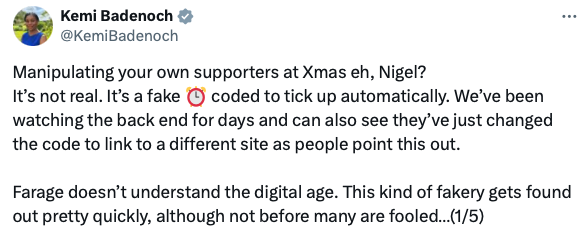
This just may win the award for the world’s worst tweet. In less than 140 characters she has:
-
- Kept the story alive.
- Demonstrated that she is worried about Reform.
- Suggested that she – or someone acting on her behalf – has been engaging in hacking. Or that she doesn’t understand what a “back end” is which is a little embarrassing for someone who not only was once a software engineer but keeps reminding people of the fact.
- Given Farage the opportunity to show that his number was independently verified.
- Given Farage the opportunity to demand an apology.
- Given Farage a win.
I have been generally pro-Kemi since she first gained attention on this blog. She quotes Thomas Sowell. She seems to be prepared to confront the blob. But her first few months as Conservative leader have been… underwhelming. She hasn’t outlined a bold new vision. She hasn’t sidelined the crypto-communists in her own party and my understanding is that there is very little to write home about when it comes to confronting the Prime Android in Parliament. This is not necessarily the end of the world. I once asked one of Margaret Thatcher’s staff what she had been like as leader of the opposition. “Dreadful” came the answer. But then the Labour government of the 1970s with its strikes, inflation and financial crises did most of her campaigning for her.
But this time is different – well, not in the dreadful Labour government sense. There is serious competition for the position of Alternative Government. And that competition has only got more intense.
Richard Sennett’s article in the Guardian, “McCarthyism stalked my family. Its paranoia contains a lesson for Trump’s second term” is well titled, but, as usual, the lesson is not the one the Left thinks it is.
Professor Sennett’s article treats the Second Red Scare as if it were simply an eruption of irrational hatred. This treatment of the McCarthy era was the standard one when I was young, but feels quaint now. The Venona Project established that when Senator Joe McCarthy claimed that many senior people in the American federal government were Soviet agents, he was right. The link takes you to a 2015 post by Patrick Crozier that I recommend you read. I also recommend you read Niall Kilmartin’s comment – McCarthy was right, but he was not a nice man. Professor Sennett is correct to say this about how McCarthy and Roy Cohn chose their targets:
They attacked public figures often arbitrarily, but if they met with resolute resistance, they tended to move on and find other targets. People such as the playwright Arthur Miller repelled McCarthyite charges through vociferous counterattacks, while more compromising ex-commies such as the choreographer Jerome Robbins suffered sustained persecution. My uncle, threatened by the FBI, turned the tables by conjuring up personal injury lawsuits naming the agents who menaced him; the FBI then lost interest in his case. Cohn thought of commie-hunting as a matter of profit and loss, pursued only so long as there could be a benefit to the persecutor. If not, ideology did not drive him to persist.
“They attacked public figures often arbitrarily, but if they met with resolute resistance, they tended to move on and find other targets.” Well observed mate, but you didn’t have to wait until the eve of Trump’s second term before making the parallel. Trump did nothing McCarthyite when he was president the first time, and I see no good reason to suppose he will be any different when he becomes president a second time. Professor Sennett, where were you in 2020 when your observations about how political witch-hunts work might have helped people who actually were being targeted in the same way as your parents were? What you are describing – the orgiastic yet opportunistic denunciations of individuals, with their degree of guilt a secondary consideration; the digging up of long-abandoned political flirtations; the way that apologies only excite the mob further – that is not Trumpism. That is Wokism.
We also paid a visit to the pages of Scientific American, where assistant professor Juan P Madrid indulged his urges to police other people’s speech, while wasting the time and energy of those more obviously productive. “The language of astronomy,” we were told, “is needlessly violent,” with the word collision being singled out as particularly brutal and masculine. An astronomer carelessly referring to a planet being stripped of its ozone layer by a gamma-ray burst, would, according to Dr Madrid, be using “misogynistic language” and should therefore be subject to the sternest of hands-on-hips chiding and an official reprimand.
– David Thompson
I’m not a huge fan of David Lammy, but when the Foreign Secretary and MP for Tottenham sends a tweet on Christmas Eve saying, “To all of my constituents and everyone beyond, I wish you a joyful and peaceful break and a very merry Christmas,” I mentally return his good wishes. OK, I don’t have any constituents, unless you count oxygen, carbon, hydrogen, nitrogen, calcium, phosphorus and assorted other elements, but you know what I mean.
His fellow Labour MP Zarah Sultana is having none of that. She replied,
“Does that include the Palestinian people suffering genocide and being killed with British-made weapons, David?”
To all our readers and everyone beyond, I wish you a joyful and peaceful break and a very merry Christmas.
“I’m BACK. I’m not as back as the Trump folks; they’re SO back. I’m just back.”
The senator from Kentucky is on fine form. Put the mince pies on to warm and read the whole thread.
“Build 1,000 new state of the art nuclear power plants in the US and Europe, right now. We won’t, but we should.”
– Marc Andreessen
A writer going by the name “Gurwinder” produces a popular Substack blog. In the following piece Gurwinder writes thoughtfully about the experience of discovering that one of his fans was a cold-blooded murderer:
“The Riddle of Luigi Mangione: My interactions with the alleged CEO assassin”
Quote:
We interacted on social media several times afterward, and each time he seemed as polite and thoughtful as he’d been in our chat. As the summer ended, I largely withdrew from social media to focus on my book, so I didn’t notice Luigi had vanished.
And then, a few months later, Brian Thompson was shot dead.
Many people celebrated the murder, mocking the victim and lionizing the killer. Some were frustrated that health insurance cost so much, and some were outraged that they or a loved one had been denied medical claims. For this they blamed Thompson, the CEO of the US’s largest health insurance company.
But while thousands reacted with laughter emojis to Thompson’s murder, and with love-heart emojis to his alleged murderer, I was sickened. Vigilantism is always wrong. If you celebrate someone gunning down a defenceless person in the street, then you advocate for a world in which this is an acceptable thing for anyone to do. You in fact advocate for a world in which a stranger can decide that you’re also a bad person, and gun you down in the street. In such a world, I promise you, your health insurance would cost much more.
The murder would’ve been shocking even if I didn’t know the murderer. But when Luigi was revealed as the suspect, everything became surreal. My mind raced back to our chat, searching for clues he could’ve done this. The only thing that stuck out was when Luigi briefly mentioned healthcare in the US was expensive, and said we Britons were lucky to have a socialized National Health Service. But even this statement, by itself, gave no indication Luigi was capable of what he was being accused of.
When someone is found to have committed murder, friends and relatives will usually say things like “I can’t believe it, he seemed like such a nice guy.” I instinctively said the same thing about Luigi. But as the shock faded and my wits returned, I ceased to be surprised. I’ve long known that people who are capable of great kindness also tend to be capable of great cruelty, because both extremes are often animated by the same crazed impulsivity. It’s why many of the people celebrating the murder are those who self-identify as “compassionate” leftists. And it’s why most of history’s greatest evils were committed by people who thought they were doing good.
(Emphasis added by me, although Gurwinder himself has chosen to highlight this passage.)
The Observer view on Labour’s plans to reform education is that the “government needs to go further on pay and workload if it is to retain high-quality teachers in schools”:
“. . . schools in England have been facing a worsening teacher for over a decade, and pupil to teacher ratios have risen, particularly in secondary schools. Last year, the teaching workforce grew by fewer than 300 teachers. Too few teachers makes it harder for those in the profession to do their jobs well – further adding to workload and behaviour management pressures, and undermining retention even more.”
I was once a teacher. I have been married to a now-retired teacher for decades. I have met a lot of teachers. The view of almost every teacher, and, equally relevantly, every former teacher that I have ever met was that pay and workload scarcely mattered in themselves. The pay is quite good. The uworkload for a conscientious teacher can be heavy during term time, but, as someone rightly points out every time teachers whinge about how long they spend marking homework and planning lessons, the workload is close to zero during school holidays. What really drives teachers out of the profession is the thing that the Observer editorial mentions as an afterthought, “behaviour management pressures”.
The House of Commons report to which the Observer article links says this:
Pupil behaviour
We recognise that teachers feel pupil behaviour has worsened in the years since the Covid-19 pandemic and we are concerned that this is driving teachers away from the profession as well as dissuading prospective teachers. Valuable work is now being done by Behaviour Hubs to help schools and teachers address pupil behaviour and we recommend that the Department expand this programme to increase capacity. The Department must also reinforce the importance of positive and effective partnerships between schools, pupils and parents in addressing and improving pupil behaviour and attendance
I expect the work of Behaviour Hubs is of some value, like the work of the Behaviour Units, Behaviour Centres, and other Behaviour Things that preceded them over the decades. I truly admire those teachers who choose to deal with the most badly-behaved children, and spreading the word about better techniques can make some difference. But none of these initiatives solved the teacher retention crises of the 1980s, 1990s, 2000s or 2010s, as these Hubs will not solve the crisis of the 2020s.
As for “The Department must also reinforce the importance of positive and effective partnerships between schools, pupils and parents in addressing and improving pupil behaviour and attendance”, I think it would be better if the Department reinforced the importance of dissolving ineffective partnerships. End them at the request of any party. If a so-called partnership between school, pupil and parent is not working, let it die. In no other area of life is an association maintained by force on one or more of the parties called a “partnership”.
In an ideal world, I would like that philosophy of voluntary association to apply across the education of all but the youngest children, but even in this world, it would do a hell of a lot of good for it to apply where the so-called partnership between school, parent and pupil is obviously a rotting corpse.
Pupils behave better if they know their schools can expel them for bad behaviour. We used to know this as a society, but the threat of expulsion has been neutered by making the process so difficult that schools instead strive to pass the bad kids around all the local schools like counterfeit money. Teachers behave better if they know their pupils can leave. Private schools still do know this, and self-employed teachers know it very well.
Most humans enjoy helping others to learn. Those who join the teaching profession do so because they want to do this good thing even more than most people do. But there can be no joy in teaching without a willing learner. It doesn’t have to be constant happy-smiley-type willingness for years on end, just a basic willingness to be there.
German political discourse is so insane, I always feel slightly ashamed translating this stuff for you. It feels like dishing out embarrassing family secrets.
– Eugyppius
TIME Magazine has made Donald J Trump, re-elected to the White House, as its Person of the Year. These POTY titles don’t necessarily mean the publication thinks that X or Y are good or praiseworthy; what counts is that they are significant in some overwhelming way. Trump fits the bill perfectly. Without a doubt, his election in November will shake things up, not always for the better. But shake them up they surely will.
If I were to choose an alternative POTY from the ranks of politics, my choice would be Javier Milei, president of Argentina. He’s been in the job for just over a year. On his watch, inflation in a high-inflation country has sunk to low single-digits. He’s deregulated the rental market and prompted a flood of new rental housing, cutting rents as a result. He brandished a chainsaw as his symbol of what he wanted to do to government. Thousands of public workers have been laid off; a number of regulations have been scrapped. The price of Argentinian debt, both public and private, has risen, and the yields have fallen. This represents a massive vote of confidence in the creditworthiness of a nation renowned for its fecklessness for decades. This will attract capital and investment, helping the country pull out of recession and hopefully, boost living standards in a sustainable way. It needs to happen: there is a lot of poverty in that country.
As a result of some of this free market medicine, the Argentinian peso has risen in value: The peso-dollar has surged 22 per cent a year before. So much so, in fact, that Keynesian columnist Ambrose Evans Pritchard, who often predicts the case for reflating this or that country with lots of cheap money, has denounced this situation. For those who have seen Latin American currencies reduced to dogfood (apart from maybe in Chile) in recent decades, no higher praise for Milei can be higher than catching the glare of a columnist who is so often wrong in his predictions.
So there you are: My choice for Man of the Year would be a chainsaw-wielding fan of Austrian economics in Buenos Aires, an actual classical liberal in a world gone increasingly collectivist.
Update: I fixed the way of expressing the foreign exchange rate; apologies. The point stands: the peso is worth a lot more today than a year ago.
Another update: Does a stronger Argentina make it more likely the government might try and re-take the Falklands? Maybe; one risk factor now in play is that under a socialist and self-hating PM, Sir Keir Starmer (who has an inferiority complex about Mrs Thatcher), the Argentinian public might, with some reason, think there is a chance the UK could be persuaded to transfer control. There is a lot of oil down in the South Atlantic; Milei does not, as far as I know, give a damn about Net Zero and might eye the area as a key resource. But he is also not a fool and might, with justice, think that a row with the UK is not worth the trouble, particularly if Argentina looks to rebuild trade relationships, particularly in a world of rising tariff barriers.
“Silence on cousin marriage is the unspeakable face of liberalism”, writes Matthew Syed in the Times (archived version here).
Mr Syed starts with a discussion of the self-censorship on this issue:
Let me start by telling you about Dr Patrick Nash, a somewhat shy legal academic who in 2017 came across an intriguing finding. He noticed that much of the “extremism” emanating from Pakistani communities seemed to have a “clan” component. The perpetrators were linked not just through ideology or religion but by family ties stretching through generations. He noticed something else too: these communities were cemented together by cousin marriage, a common practice in Pakistani culture. By marrying within small, tightknit groups, they ensure everything is kept within the baradari, or brotherhood — property, secrets, loyalty — binding them closer together while sequestering them from wider society.
At this point Dr Nash hadn’t come to understand the genetic risks, the patriarchal oppression and the bloc voting, nor the growing evidence that rates of cousin marriage strongly correlate with corruption and poverty, but — like any good scholar — he thought he’d do a bit more digging.
But then something odd happened: several academics invited him to the pub for a “drink and chat”. He thought nothing of it, but it turned out to be an informal tribunal. “It was put to me that I might consider another line of inquiry that would be more ‘culturally sensitive’, less likely to provide ‘ammo for the right’ and less likely to ‘make life more difficult for myself’ as a junior, untenured academic,” he told me. “It was sinister.”
You might dismiss this as a one-off or perhaps the testimony of an overly sensitive scholar, but bear with me. You see, I sought to study this area during a sabbatical last year. It’s a subject close to home: when I went to Pakistan as a youngster to meet the extended family, my dad half-joked that he could arrange a marriage with a cousin. He said it lightheartedly but the conversation stuck with me. As I grew up, I kept noticing stories that revealed the genetic risks of cousin marriage and how it could lead to cultural separation. It seemed an area ripe for deeper research.
But I quickly discovered that researchers wouldn’t return emails or calls. When I got through to one geneticist, he said: “I can’t go there.” It was like hitting a succession of ever-higher brick walls.
In the next paragraphs, Mr Syed gives other examples of scientific self-censorship. Both libertarians and many traditional conservatives will share his outrage at this, as will many left wingers. But Syed then goes on to draw a conclusion that in libertarian terms sorts the men from the boys:
Eventually I wrote a column calling for a ban on cousin marriage in April last year. I was assisted by Nash, who had continued his research despite being warned off (his trump card was that his salary was paid not by his university but by the Woolf Institute, an independent body committed to free speech). To my surprise, the piece became one of the most-read stories of the year and was picked up in Scandinavia. Not long afterwards Norway, Denmark and Sweden announced plans to prohibit cousin marriage and Tennessee passed legislation.
Last week the movement picked up momentum when the Tory MP Richard Holden gave a brave speech in parliament calling for a ban. He was strongly opposed by Iqbal Mohamed, one of the independent “Gaza bloc” of MPs, who argued that cousin marriage is a good thing since it “strengthens family bonds”, perhaps the most stunning piece of (unintentional) satire in modern political history. Mohamed’s intervention, however, seemed to do the trick. After first implying that it had an open mind on a ban, the government changed its position to “no plans to legislate”, doubtless fearful of losing more seats to the Gaza bloc. I suspect it will come to regret this cowardly retreat.
But the other striking aspect of the debate was the sinister influence of scientific malpractice. MPs on all sides kept referring to the genetic risks of cousin marriage as “double” those of relationships between unrelated couples. This “fact” is endemic throughout the media, from the BBC to The Telegraph, and for good reason: journalists trust what scientists tell them. But the stat isn’t true — indeed, it’s absurd. When inbreeding persists through generations (when cousins get married who are themselves the children of cousins), the risks are far higher, which is why British Pakistanis account for 3.4 per cent of births nationwide but 30 per cent of recessive gene disorders, consanguineous relationships are the cause of one in five child deaths in Redbridge and the NHS hires staff specifically to deal with these afflictions.
Tragic and terrible. But if you once give the State the power to forbid certain couples to have children the consequences might well be more terrible yet.
LFGSS and Microcosm shutting down 16th March 2025 (the day before the Online Safety Act is enforced)
I can’t afford what is likely tens of thousand to go through all the legal and technical hoops over a prolonged period of time
The author of this article is correct. There’s no way to safely run a web page with user interaction in the UK.
Addendum added by the editorial pantheon:
The official samizdata position to this is… they can go fuck themselves. It is unlikely we are important enough to attract official attention but if we do, samizdata has lawyers plus the actual site is hosted in USA.
So for the avoidance of doubt… the laughably misnamed Online Safety Act will be completely ignored.
We will continue to remove/reject comments we personally find offensive (or just inane/pointless) but under no circumstances will we remove a comment we do not find offensive just because someone else might.
|
Who Are We? The Samizdata people are a bunch of sinister and heavily armed globalist illuminati who seek to infect the entire world with the values of personal liberty and several property. Amongst our many crimes is a sense of humour and the intermittent use of British spelling.
We are also a varied group made up of social individualists, classical liberals, whigs, libertarians, extropians, futurists, ‘Porcupines’, Karl Popper fetishists, recovering neo-conservatives, crazed Ayn Rand worshipers, over-caffeinated Virginia Postrel devotees, witty Frédéric Bastiat wannabes, cypherpunks, minarchists, kritarchists and wild-eyed anarcho-capitalists from Britain, North America, Australia and Europe.
|





Recent Comments