We are developing the social individualist meta-context for the future. From the very serious to the extremely frivolous... lets see what is on the mind of the Samizdata people.
Samizdata, derived from Samizdat /n. - a system of clandestine publication of banned literature in the USSR [Russ.,= self-publishing house]
|
Uber might have won a court case, but Transport for London are still threatening to regulate all sorts of silly things. But you can have your say, by copying and pasting the link below and filling in the survey which is full of free-form text boxes. I am deliberately not linking directly to it as I do not want them to be tempted to analyse where their traffic is coming from.
consultations.tfl.gov.uk/tph/private-hire-proposals/consultation
Along the way you get to be entertained by the barmy, Soviet-style ideas they have for meddling in the intricacies of other people’s affairs, and the absurd justifications thereof. My answers made much of customer choice, the regulator’s inability to predict individuals’ needs and how some of the proposals would discriminate against minorities. I feel better now.
The idea that there is a fixed amount of wealth is a pessimistic fallacy held by cod economists. The idea that there is a fixed amount of stupidity is an optimistic fallacy held by cod psychologists. New forms of stupidity are being generated all the time; and this process is not the least hampered by old forms of stupidity continuing to flourish and even spring up anew in places from which naive observers had thought that particular species of stupidity had been eradicated.
The Guardian newspaper is a sort of Rare Breed Survival Trust for economic and political stupidity. It works to secure the continued existence and viability of endangered falsehoods. Heartwarmingly, its labours often meet with success and stupid ideas once considered moribund can thrive again. Not thrive in terms of achieving anything worthwhile, of course, because the ideas concerned are stupid, but in terms of being loved.
Let’s look at a case study of a fallacy brought back from the brink of extinction to flourish once again in the pages of the Guardian. I refer you to an article by Zoe Williams entitled “Poverty goals? No, it’s extreme wealth we should be targeting”.
Furthermore, as Martin Kirk from the activist network the Rules pointed out, all the language of sustainable goals frames poverty as a disease: eradicable, no match for the ingenuity of mankind, but fundamentally nobody’s fault. It is a landscape where everyone’s a hero and nobody’s a villain; one in which unfair trade agreements, land grabs, structural debt relations, privatisation of publicly owned utilities and tax evasion never happened.
Poverty is not a naturally occurring germ or virus; it is anthropogenically created though wealth extraction. Any goal that fails to recognise this is not only unlikely to succeed, but can only be understood as a deliberate act of diversion, drawing attention away from what might work; in its place, the anodyne, fairytale language of hope, in a post-ideological world where all politicians just want what’s best and a billionaire is just a benefactor you haven’t met yet.
To borrow a phrase from the techies, free speech is the ‘killer app’ of civilisation, the core value on which the success of the whole system depends. It is so all-fired important that every other right or claim should have to get in line behind it. Freedom of thought and of speech is a key part of what makes us unique as modern humans. Free speech is the link connecting the individual and society. It is the voice of the morally autonomous adult, nobody’s slave or puppet, who is free to make his or her own choices. That is why free speech as we know it could only truly develop in the Enlightenment, when the spirit of the age of modernity was on full volume. It was first captured 350 years ago by the likes of Spinoza, who challenged the political and religious intolerance that dominated the old Europe and set the standard for a new world by declaring that ‘In a free state, every man may think what he likes, and say what he thinks’.
– Mike Hume
I haven’t been blogging as much as I would have liked to from 1915. It’s not as if nothing has been happening so I thought I’d outline the main events of the year so far.
The big story of 1915 is that it has been a disaster for the Russians. They have been continually pushed back and have lost Warsaw and most of their forts. The Tsar has made the fateful decision to assume direct command of the Russian Army. It is a fateful decision – at least, people say it’s fateful – for two reasons. Firstly it means that any Russian military failures are his personal failures. Secondly, it means he is not in Petrograd to keep an eye on the domestic situation. At least, that’s the theory. There’s every chance he would have been every bit as useless in Petrograd as at the front.
In the west, the French have launched numerous offensives, none of which have been particularly successful. The Germans are inflicting two casualties on the French for every one the French inflict on them.
Their allies, the British have one problem: lack of everything. For instance there was recently a spate of correspondence in The Times on the subject of the manufacture of sandbags. If something as basic as sandbags are in short supply what isn’t? Not much. They don’t have enough men, shells, rifles, grenades, binoculars, periscopes, huts or gas masks. That’s just the things that are in short supply. Lots of other things they don’t have at all. For instance, they don’t have any tanks, gas shells, 106 fuzes, rifle grenades, Livens projectors or Sopwith Camels. And they lack knowledge and experience. Make that two problems.
In September, at Loos, the British used their 1914-recruited “New Army” formations in an offensive for the first time. They were able to employ a much larger barrage than before but it was still not big enough and they had to use gas to make up the difference. As it turned out they didn’t have enough gas either so they had to use smoke to make up that gap. Gas did, however, have an interesting side-effect: it corroded the enemy’s rifles and stopped them working. Still, the results were disappointing and the British lost twice as many men as the Germans. In other words they were no better – and to be fair, no worse – than the French. Most importantly, Loos was the moment the British Expeditionary Force (to give it its official, if rather odd title) lost confidence in the command of John French. Douglas Haig would succeed him in December. If you are looking for a detailed account of the battle have a look here.
On the home front gold is disappearing from circulation although there are still one or two banks that continue to issue it. I am not quite sure why this is but if there is anyone out there who can explain why – it’s disappearance is officially encouraged – I’d love to know. My guess is that it has something to do with fractional reserve banking but I am far from sure.
The round has been banned. In many parts of the country it is a criminal offence to go into a pub and buy someone a drink. There is a blackout in London due to Zeppelin raids. Well, more of a greyout in fact. Some street lighting remains. Ireland seems quiet. Too quiet perhaps.
Elsewhere, after getting crushed by the Russians – yes, the Russians – in the Caucasus, the Turks have started massacring the Armenians and are making little attempt to keep it a secret. Germany has put out some peace feelers. They involve the loss of French and Belgian colonies and – implausible as it may sound – freedom for the Jews. I presume this is a way of humiliating the Russians. The Germans, Austrians and their new ally Bulgaria have just invaded Serbia. Gallipoli continues to rumble on.
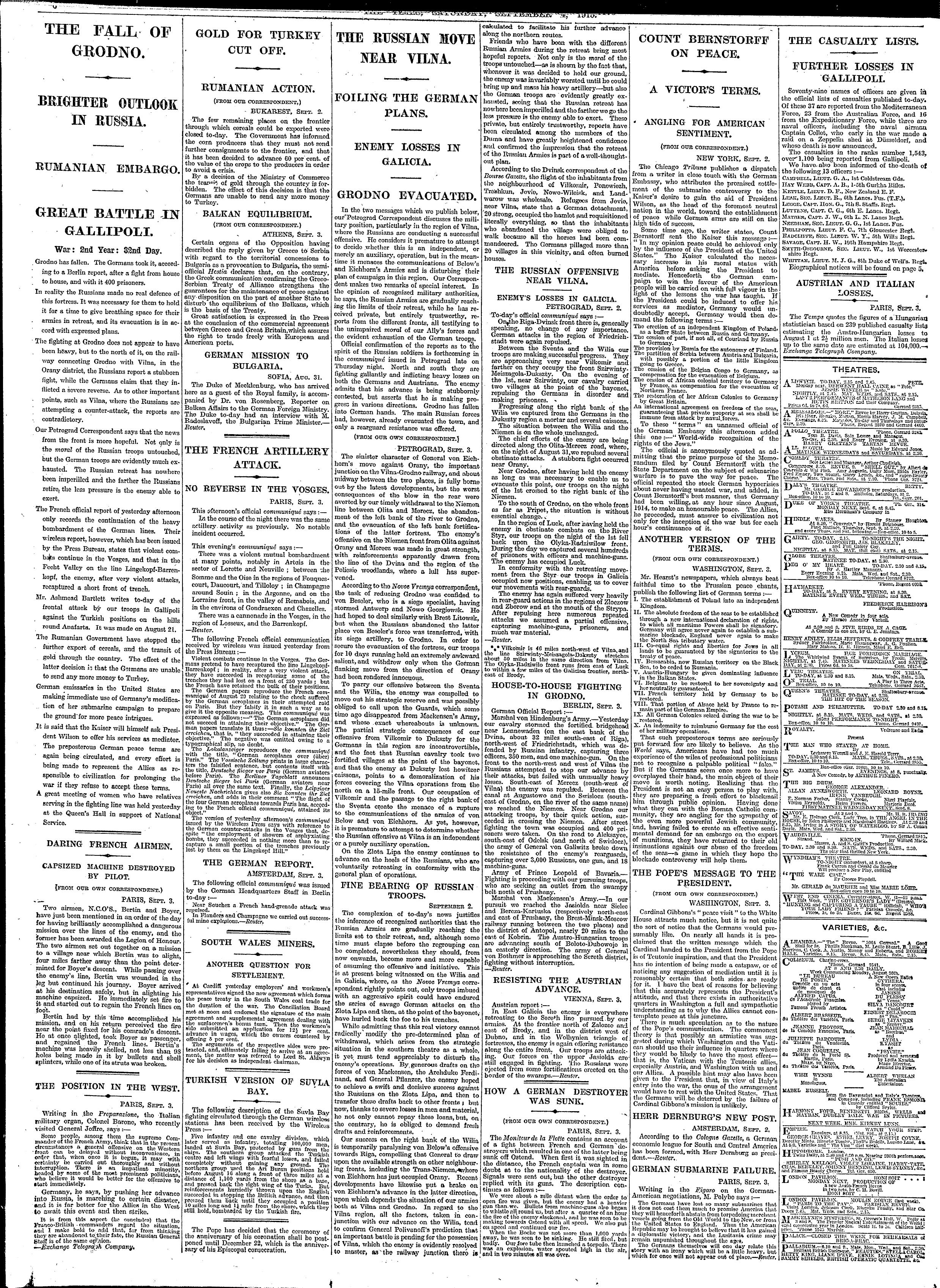
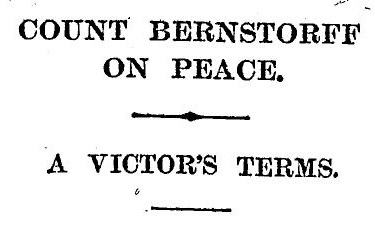 The Times 4 September 1915
A gentleman living on the Isle of Wight took his school-age daughter on holiday to Florida in term time. The child’s absence from school was noted…
The Local Education Authority issued him with a fixed-penalty notice for £60, for failing to ensure that his child attended school regularly. He refused to pay this ‘penalty’ (a bureaucratic alternative to prosecution). The ‘fine’ was doubled (by the bureaucrats) to £120, he refused to pay, so he was summonsed to the Magistrates’ Court by the authority to face a charge under Section 444 of the Education Act 1996 (from John Major’s time).
Sure enough, he argued, my daughter wasn’t in school, big deal. The offence was not made out. Here is the wording in question.
Offence: failure to secure regular attendance at school of registered pupil.
(1)If a child of compulsory school age who is a registered pupil at a school fails to attend regularly at the school, his parent is guilty of an offence.
So, for those (many) parents harassed, threatened and fined by bureaucrats, they have been acting as if the law required total attendance at school.
The rule of law has prevailed, the offence was not made out, on the prosecution’s case, the case failed. What troubles me is that I find that, in England in 2015, refreshing.
But as Mrs Thatcher once said ‘Just rejoice at that news!‘.
Licensing laws tend to have particularly harsh consequences on members of minority groups for a couple reasons. First, if a law requires a person to have, say, a college degree to practice the trade of interior design (which is the law in Florida), people who have less money and time to spend in college will find that avenue of opportunity closed to them. Since black and Hispanic Floridians are about 30 percent less likely to have a college degree, they will suffer more from this absurd licensing requirement than others will. Competitor’s Veto laws that forbid a person from practicing a trade unless they get permission from the businesses already operating in that industry are also very likely to create a sort of Old Boys Network, and to exclude entrepreneurs who lack political connections. Second, in a more general sense, any law that restricts economic opportunity for some to benefit others—as licensing laws tend to do—are likely to benefit those who have more political influence and can therefore get the government to regulate in ways favorable to them. Since members of minority groups have less political influence, they tend to be the ones excluded.
– Timothy Sandefur
Reason goes to sleep during election campaigns. Sometimes it is said elections are like the fiesta of democracy, which is true, but electoral campaigns are like bachelor parties which culminate in huge hangovers and sometimes culminate in disasters.
– Marek Belka
Party politics in Britain now is conferring retrospective significance upon a generation of – and this is putting it very mildly – bad mannered behaviour by lefties.
Here is an example:
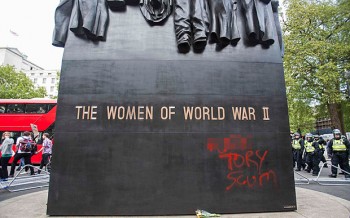
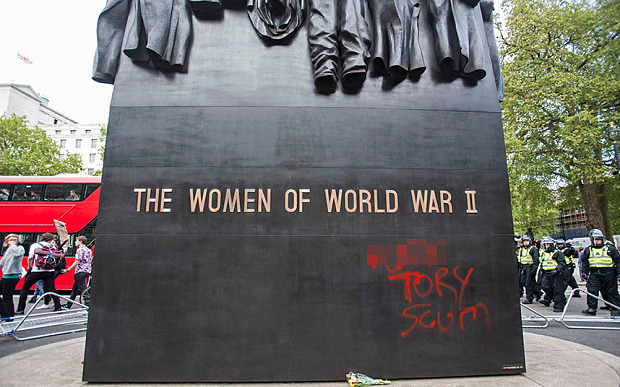
This picture was used by London Mayor Boris Johnson to illustrate an article about what is now happening to the Labour Party. It is a cleaned-up snap of what some lefty moral projectionist did to a war memorial in May of this year, during an anti-austerity demo.
The Boris Johnson article was posted last weekend at the Daily Telegraph website, to which links from here are not encouraged. Its title is: “Labour directs its impotent fury at all but those responsible – itself”. It is about how, because they dare not now discuss their own self-inflicted failures and perplexities accurately and clearly, Labourites instead now prefer to blame others for these things.
At the time it happened, the above-illustrated piece of moral decrepitude was not hugely significant. Some people now behave like this. Why? Insert preferred causal theory. Mine might have involved the expansion of the universities and of the welfare system, and perhaps also a reflection on what spraycans have done to our world. Religious people might have murmured something about the decline of religion as a moral force in our society. Those who think that history is now taught badly in Britain’s schools might have talked about that. Most feminists, torn between denouncing what is on several levels a horrible anti-woman insult or, on the other hand, denouncing a fellow lefty moral projectionist for perpetrating it, presumably remained mute.
But that picture now interests me more than it did in May, or would have had I seen it then, just as it recently interested Boris Johnson. Maybe I did see it back in May, but now, I am doing something else. I am noticing it. I even did some googling and found an uncensored version of what had been done. You pretty much knew already what the Boris version of this piece of rudeness was concealing, but I want now to spell it out:

I found this here. This did not take me long.
→ Continue reading: Expletive undeleted
If reports are true, the Finnish tax police want the public to report anyone selling a take-away pizza for less than €6.
“Unless a pizza is on temporary sale there is no way a legitimate establishment can offer pizza for less than six euros,” Det Insp Minna Immonen of the Uusimaa police department is quoted as saying.
So they have calculated that it is not possible to remain in business selling pizza for less than that price, and still pay the 12% VAT.
12% VAT? What a pleasantly low rate, here in the UK it is 20% for almost everything. I will not be diverted onto a discussion as to what is standard or zero-rated, except to note that on learning that horse semen is subject to normal VAT but bull semen is zero-rated (effectively exempt) as in most of Europe horses are not ‘food’, I decided that whoever made that ruling in Brussels bloody well deserved that to be their legacy.
However, the intrusion is greater, you should get a receipt for your pizza, so Finland has joined Italy as a place where every transaction (even a 1€ cup of coffee or Sachertorte in Venice) leads to a receipt being printed at the till, for fear of the Tax Police.
Police are trying to crack down on the “grey economy”, which costs the country millions of euros in lost tax revenue each year. They also want people to make sure they get a receipt for their pizzas, regardless of value.
We all surely know that the ‘country’ is in fact ‘the State’, and those millions of Euros of lost revenue go on to lead happy, productive lives in the private sector in the hands of their owners. It is a sorry state of affairs when price signals are used by tax authorities to go looking for suspects, rather than customers for bargains, perhaps the tipping point from a tolerably free society to an unpleasant one. I do recall the Sage of Kettering remarking years ago that someone had calculated that no business could carry on in New York City if it followed all the regulations that apply to it.
Still, this has generated some scorn, so that is a positive sign.
Dear NHS worshippers, sorry to be a killjoy, but look, the NHS is not ‘yours’, and never has been. You have no control over it. You feel like you are in control when you spin your little toy wheel, but try steering the car in any direction other than the one where it is already heading, and see what happens. The ones who really drive the car are the political class and the medical establishment. ‘Democratic accountability’ is a mirage. All it really means is that healthcare managers answer to bureaucrats, who answer to other bureaucrats, who also answer to other bureaucrats, who, after some more detours, answer to some politician. That’s democratic accountability. Feel powerful now? Accountability through the political system is about the weakest form of accountability one could imagine, and in healthcare it is even weaker than in other areas.
– Kristian Niemietz, who stonks the NHS in an article from 2014 called The Maggie Simpson delusion: the NHS is not ‘ours’
Finally, contemporary feminists do not believe that women are independent, free-thinking individuals. Feminists promote a cliquey, sisterhood mentality, but not through a collective and positive sharing of ideas. They’re the kind of group you’d encounter at school who would shun you if you weren’t wearing the right kind of hairband. Today’s feminism is opposed to criticism and nuance, refusing to allow women to form their own opinions or challenge preconceived ideas. And feminists call for the state to intervene when they want an opposing view silenced, and launch Twitter wars against dissenting views.
– Ella Whelan
For the benefit of my foreign readers, I should make clear that despite the protestations of the current dork masquerading as the Archbishop of Canterbury, the Church of England is not the national religion, it is the NHS! The people of Britain (dread words!) kneel and pray to it in adoration despite it being the biggest Ponzi scheme ever invented – well, it was but those ‘damn Yankees’ have out-done us again with their ludicrous ‘Obamacare’ nonsense. But perhaps the financial tectonic plates just shifted and finally reality will bring the temple crashing down.
– David Duff
|
Who Are We? The Samizdata people are a bunch of sinister and heavily armed globalist illuminati who seek to infect the entire world with the values of personal liberty and several property. Amongst our many crimes is a sense of humour and the intermittent use of British spelling.
We are also a varied group made up of social individualists, classical liberals, whigs, libertarians, extropians, futurists, ‘Porcupines’, Karl Popper fetishists, recovering neo-conservatives, crazed Ayn Rand worshipers, over-caffeinated Virginia Postrel devotees, witty Frédéric Bastiat wannabes, cypherpunks, minarchists, kritarchists and wild-eyed anarcho-capitalists from Britain, North America, Australia and Europe.
|






Recent Comments