We are developing the social individualist meta-context for the future. From the very serious to the extremely frivolous... lets see what is on the mind of the Samizdata people.
Samizdata, derived from Samizdat /n. - a system of clandestine publication of banned literature in the USSR [Russ.,= self-publishing house]
|
At the beginning of the Great War people wrote and the The Times published a lot of poetry. The main themes were glory and sacrifice. By 1915 The Times was publishing a lot less poetry and what it did publish was a lot less upbeat. Even so, I was a bit taken aback when they published this:
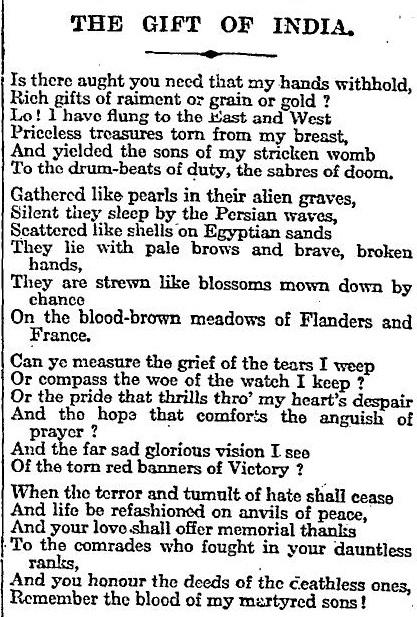 The Times 16 December 1915 p11. Click for full page.
There is nothing about glory. There is a lot about death. There is a bit of empire bashing. And there’s a bit of: “You owe us.” Frankly, I was a bit surprised that the pro-war, pro-empire Times had anything to do with it. And, oh yeah, there’s the author:

Not a lot of Indians wrote to The Times in 1915. Or, if they did, they didn’t get published.
I thought I’d google the name just in case. Interesting. The writer, it turns out was a woman, a graduate, an Indian nationalist thick with the Indian nationalist bigwigs and, after independence, a state governor. My guess is that that last bit means she did a lot of bad.
If there is one thing the BBC and Samizdata have in common, it is our coverage of all the important issues.
Simon Watson, 41, has been an unlicensed sperm donor for 16 years, donating once a week. “Usually one [baby] a week pops out. I reckon I’ve got about 800 so far, so within four years I’d like to crack 1,000.”
This is a whole new world of discovery for me.
The number of women using donated sperm to get pregnant is rising, but many find the cost of treatment at private clinics prohibitive. This has led some women to use unlicensed donors. […] Very few women are eligible for artificial insemination on the NHS as the criteria are very strict. Private licensed clinics cost between £500 and £1,000 for each cycle of treatment. Mr Watson charges £50 for his services […] “If you go to a fertility clinic people have to go through lots of hurdles – counselling sessions, huge amounts of tests and then charge absolute fortunes for the service – but realistically if you’ve got a private donor you can just go and see them, meet them somewhere, get what you want and just go,” he explains.
Regulatory hurdles push up prices for the end user, so the demand for cheap and cheerful is met elsewhere. But what about the supply side? Another BBC article, bemoaning the lack of donors, completes the picture.
Just nine men are registered as donors a year after the opening of Britain’s national sperm bank in Birmingham. […] Donors are paid £35 per clinic visit, but Ms Witjens said financial reward was not a good way to boost recruitment. “We might get more donors if we paid £50 or £100 per donation, but money corrupts. “If you feel you can make £200 a week for four months, you might hide things about your health.”
I would have thought women might want to be a bit pickier than have sperm from the kind of loser who gets out of bed for thirty-five quid.
So we have private services supplying a high cost, high quality product, but crowded and regulated out of providing better value or budget services. A state provider that manages to have nothing but shortages of supply and (I would guess) poor quality products. And a grey market filling in the gaps. This is not a new world at all: there is nothing new here. To make things better I would abolish the state providers and deregulate, creating an environment for reputable intermediaries to supply maximum value for money across the whole range of price points. If anything does change it will probably involve more rules and the criminalisation of the grey market, increasing costs and risks.
Zach Cope at Libertarian Home has a post that puts today’s UK NHS junior doctors’ strike into perspective.
…junior doctors have little choice of employer as there is an NHS monopoly on training; the market has shown the pay and conditions are too low, with dangerously understaffed rotas, rising emigration and increasing locum rates. The government’s proposals would reduce staff pay for an equivalent rota over time, thus hoping to delay the inevitable financial collapse of the NHS on their watch…the problem of regulation and central contracting leads necessarily to collective bargaining and industrial action.
Centralised provision of anything always leads to shortages. Mr Cope has various ideas for decentralising things in his post, too.
Personally, I envisage healthcare that is cheap and good because it is private. So cheap and good that nobody has to think twice about poor people who can not afford treatment. Much as our friend the Guardian commenter narnaglan described:
Did you know that the only medical proceedure where quality is going up and price is going down is elective Lasic eye surgery? Thats the proceedure where your cornea is made thinner to adjust the focus of your eyesight. It is not available out of stolen money, so the people who provide this service, and there are many of them, all compete with each other to give the best service at the lowest price. They compete to offer you the latest, safests techniques, using the most sophisiticated equipment.
Think about it. There are three Lasic clinics, two offering the same service at the same price and the third offering it at a lower price. Only one of the three has the latest equipment. You pick him out of the three, because he will give you the best outcome. The other two must adjust their offer to attract the clients. People with a little less money might pick the third, cheaper clinic, and the middle one might be chosen because it is closest.
What this shows is that in a dynamic market, everyone is served, and all clinics and service offerers are incentivised to do their best at the lowest price. This is completely different to the NHS, where it does not matter how dirty the hospital is, or what the outcome is; since there is no choice, no one needs to care about the price of anything or the quality of service being offered.
Of course, it will be cheap but doctors will still be well paid because they will be so effective.
It was one of the most emotional performances I’ve ever done. I was in tears. They’d backed up the stage to the wall itself so that the wall was acting as our backdrop. We kind of heard that a few of the East Berliners might actually get the chance to hear the thing, but we didn’t realize in what numbers they would. And there were thousands on the other side that had come close to the wall. So it was like a double concert where the wall was the division. And we would hear them cheering and singing along from the other side. God, even now I get choked up. It was breaking my heart. I’d never done anything like that in my life, and I guess I never will again. When we did “Heroes” it really felt anthemic, almost like a prayer. However well we do it these days, it’s almost like walking through it compared to that night, because it meant so much more.
– David Bowie, describing a concert he gave in Berlin, 1987.
Interesting take from Reason magazine.
RIP. He will be greatly missed and his influence on music has been undeniable.
Joris Luyendijk is actually Dutch but honorary knighthoods can be conferred on foreigners who “have made an important contribution to relations between their country and Britain”. I think he qualifies. He writes,
Yes, we would strangle or crush the English in the post-Brexit negotiations, the way any group of nations comprising 450 million people would to an opponent eight times smaller who has just tried to blackmail them
…
This is why the best way forward for Europe is to threaten to hit the English as hard as we can. We must stop treating membership of the EU as a favour granted by England, and instead make the English feel their vulnerability and dependence.
In 1915 regulations on drinking were introduced on a town by town basis up and down the country. These regulations included restricted opening hours and the banning – I kid you not – of buying a round. The ostensible reason was to get munitions workers to show up for work on time.
One of the very first – if not the first – hostelry to fall foul of the new regulations was The Swan in New Lane. Annie Hives, the landlady and three customers were all charged and found guilty of various breaches of the regulations. She had committed the heinous crime of serving alcohol after 9.30pm – without demanding payment, I might add – and they, the heinous crime of drinking it. Mrs Hives was fined 35 guineas in total which by my reckoning was about half a year’s pay for a working man on a good wage.
New Lane is now known as New Row and The Swan appears to have been renamed The White Swan. That’s good enough for me and it’s good enough for Michael Jennings. We’ll be revisiting the scene of the crime to toast the memory of the White Swan Four – as they weren’t known – at 9.31 (or thereabouts) on Monday. Please feel free to join us.
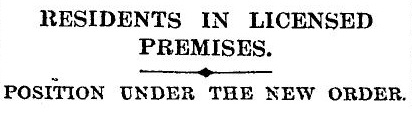 The Times 8 January 1916 p3
The BBC reports:
Arts body Creative Scotland has defended giving an artist £15,000 to spend a year without leaving Glasgow.
Ellie Harrison’s project is called the Glasgow Effect – a term relating to poor health in parts of the city.
The artist said she wanted to explore sustainability by travelling less and focusing more on local opportunities.
Critics on social media have described it as a waste of money but Creative Scotland said Harrison’s strong proposal had qualified for funding.
On a web page explaining the project, Harrison states: “The Glasgow Effect is year long action research project / durational performance, for which artist Ellie Harrison will not travel outside Greater Glasgow for a whole year (except in the event of the ill-heath / death of close relative or friend).
“By setting this one simple restriction to her current lifestyle, she intends to test the limits of a ‘sustainable practice’ and to challenge the demand-to-travel placed upon the ‘successful’ artist / academic.”
The Independent tells us that,
“The experiment will enable her to cut her carbon footprint and increase her sense of belonging, by encouraging her to seek out and create ‘local opportunities’ – testing what becomes possible when she invests all her ideas, time and energy within the city where she lives.”
Responses to the artwork have been mixed. Some Glaswegians have been offended at the idea that their city is evidently considered to be what the Diplomatic Service calls a “hardship posting”, a place that one must be paid extra to endure. Unkind residents of Edinburgh have said that for a year in Glesca, £15,000 isn’t nearly enough. I do think that the extra fifteen grand will make the restriction of Ms Harrison’s current lifestyle a little easier to bear. Unlike the majority of those citizens of Glasgow paid by the State simply for existing within its boundaries, Ms Harrison is free to augment her dole by continuing to work as “‘successful’ artist/academic”, and no need for the scare quotes round “successful”, either. She has done better than most artists in that she has been successful in getting someone to pay handsomely for her stuff (albeit not with their own money), namely the Scottish Government. Of course her finding a patron was probably made easier by the fact that, like herself, those who approved her grant application were part of the famously close-knit Scottish arts community. There is a rather different class of Glaswegian who has to work forty hours a week for a total level of remuneration often not that much different than the top-up Ms Harrison gets to fight off the people simply demanding that she come and bestow her art upon them. According to the Scotsman and the International Business Times, some of these benighted Weegies have been kicking up a fuss at having to pay for all this. You’d think they would be grateful that someone was taking an interest in them. Philistines.
By the way, you all knew that David Thompson would be making his own artistic response to this, didn’t you?
Finally, here are some of Ms Harrison’s own words from her grant application which she has kindly posted online:
Since then, I have developed an actively self-reflexive practice, which is as much concerned with analysing and exposing the motivations, processes and ethics of making art, as it is with the individual projects that I produce (see examples in attached Supporting Material). Whilst studying, I began to notice the environmental impact of my practice, becoming the first individual artist to launch an Environmental Policy. Published on my website in 2010, the policy summarises the action I currently take to reduce my carbon footprint and holds future decisions to account.
During the 15 years before Hitler came to power, there were more than 200 prosecutions based on anti-Semitic speech.
– Mark Steyn quoting from his book Lights Out.
Preston Byrne, who will be known to some Samizdata contributors, has this fascinating and lengthy comparison about the state of freedom in the US and UK. He comes to the conclusion that according to a range of metrics, the UK isn’t a free nation any longer.
The United States – while free – is never very far away from turning into something similar. The difference in attitude between my two homes (and two passports) is about a heckuva lot more than gun control: it is a misunderstanding about what rights are and how they should work. Modern Europeans don’t seem to notice or even particularly care about state overreach.
“Gun violence is a problem for the government,” says the man on the Clapham omnibus, “so guns should be banned, just as we banned them in England.” He goes on to point out that England wants to ban, or has banned, encryption, extreme viewpoints, democratically-elected foreign political parties, Donald Trump, knives, or whatever other Public Enemy Number One du jour happens to be in vogue, irrespective of whether the evidence supports or requires the proposed legislative action.
Rights, in the mind of the Englishman and in his laws (thanks to sub-section (2) of most Articles of the European Convention), are and shall always be conditional.
On the flip side, Europe can, and does, use policy to achieve social welfare gains far out of proportion to their cost. It is unquestionably better to be a small-time drug dealer (or a member of his family or circle of extended friends) when said dealer finds himself before an English court than if he found himself before one in New York County.
“Join thousands of Dryathletes dropping the drink this January and raising money to help beat cancer sooner”, says Cancer Research UK. What bilge. Abstaining from alcohol for a month does nothing and is nothing. Absent real problems, anyone can just drink exactly what they want whenever they want. That anyone takes seriously the pretence that deciding not to drink for a while is an act of effort comparable to training for an athletics event only indicates how low standards of achievement have sunk. People should be expected to grow a spine and take responsibility for their decisions as a matter of course, not pandered, patronised and praised for minor acts of agency like a toddler managing to eat his vegetables before his ice cream.
The supposed benefits of a month of abstention, apart from a “sense of achievement with your newfound hero status” — good grief — include losing weight, saving money and sleeping better. But one month out of twelve will not get you anywhere. If you are spending half of your life doing X and the other half worrying that you are doing too much of X, you are doing it all wrong. Either do less of X, or decide that the benefits of X are worth the costs. Do. Or do not. There is no try.
But maybe it will help to “beat cancer sooner”, and I should stop being a big meany. Well, it would be nice if Cancer Research UK would stop taking money away from its worthwhile research to squander on activism and lobbying.
The Dryathlon is, of course, just another bit of neo-puritan nagging. It probably makes a certain amount of sense for a cancer research charity to give out information that helps people balance fun versus risk. If I was told that my lifetime chance of getting cancer was 48% with total abstinence and 50% if I get completely drunk 3 times a week, and left it at that, I would say, “thank-you very much. Mine’s a pint of Pride.” But they will not do that. They’ll just tell me that alcohol causes 4% of cancer cases and really I should just stop thinking and drink less, and are happy to have taken a little bit of the joy out of the beer. Ok, it does not work on me but the BBC can find and interview people in a pub who have been made to feel bad about doing something they enjoy.
It does not stop there. Cancer research UK wants to prohibit product placement of alcohol. And in the latest pan–media offensive, we are told that there will be 700,000 cases of obese people getting cancer over the next 20 years, with no clue as to how significant this is. Then they are they are calling for a ban on advertising sugar before 9pm, a tax on sugary drinks, a general reorganisation of society to suit the NHS and, chillingly, the government to “take children’s health more seriously”. Supposedly children are bombarded with advertisments for sugary food and drink. I am a parent and I am not seeing it. I even have trouble buying sugary drinks without artificial sweeteners without resorting to Google and specialist suppliers.
I do not want to donate money to an organisation that is happy to goad the local mafia into “taking care” of me. Just cure cancer already so I can eat and drink what I want with impunity.
As The Big Short unfolds its racing narrative and the protagonists come to curse the authors of the disaster, and as the movie ends with the epilogue text running up the dark screen, we hear investment bankers, stockbrokers, and rating agencies condemned as pure frauds—criminals who should not have escaped jail. We never once—I know that this defies belief, given what has been published about the crisis—we never once hear government mentioned. Not the Federal Reserve, not the government-created, government-backed Federal National Mortgage Association or the Federal National Mortgage Association [Fannie Mae and Freddie Mac], not the legislation pressuring banks to make subprime loans. Not one word. A Martian somehow hearing and understanding this movie would not know that government existed—except for a few mentions of how government regulatory agencies were asleep at the switch. Capitalism, the private sector, through greed, stupidity, and sheer denial, brought on this epic collapse of the U.S. economy and endangered the world financial system, which had to be saved by governments.
It is impossible to see this as an innocent error. Perhaps in 2010, when Michael Lewis published his book—possibly, and I am stretching, here—a writer might have focused on the direct, immediate locus of the tragedy and missed its essential cause. But by 2015, when this film was completed and released, dozens of books and articles had laid out explicitly, irrefutably the role of government as enabler of the crisis. I might mention the account by a leading banker, John A. Allison, who went through the entire experience, managed his bank to save its depositors from the disaster, and then told the story in The Financial Crisis and the Free Market Cure [McGraw-Hill Education, 2012]. There are many other accounts, such as “Who Really Created the Global Financial Crisis”? The Big Short is told as though they do not exist.
Walter Donway, writing in the Savvy Street website (which I heartily recommend).
It is worth noting that portrayals of how financiers operate are not always bad or glaringly lacking in context. As mentioned on this blog before by Brian Micklethwait, one of the best movies made about the crisis has been Margin Call, starring the likes of Kevin Spacey and Jeremy Irons. That film does not seek to claim that bankers are all evil bastards masterminding, well, evil, like a lot of jumped up Bond villains who are evil because that is what they are. Rather, it shows a lot of flawed, not always admirable but very human, well, humans dealing with a fuck up as well as they can. Even Wall Street, the Oliver Stone movie of the 1980s, is pretty good to the extent that the “Greed is good speech” contains some pretty serious truths (alas, undermined by what Gordon Gekko says later about how business is about a zero-sum game, which it isn’t). It seems the fundamental failing of The Big Short (written by Michael Lewis), both in the book, and the film made about it, is what it leaves out, as Walter Donway correctly notes. There is no fundamental explanation of why the crisis happened. Ask someone why the crisis happened and they blather on about “bankers” or “greed” gives us as much information about developments as when a person tries to explain the origins of the First World War by saying “warmongering”, “Kaiser Bill” or “bayonets”.
I might see the Big Short, but given my own Scrooge-like approach, will buy the DVD when it comes out cheap, or via that capitalist marvel Amazon Prime, to which I now have access. (Woot!)
The daft old beardy has been at it a day and a half now and the only person he’s managed to actually eject is the shadow Culture Secretary. No, wait, I’m wrong – news just coming in – Pat McFadden is also out!
Who?
Never mind. Some poor schmuck dim enough to once think a career in politics would be a good idea, sacked by a man who looks as if he would be happier if their roles were reversed. OK, Jeremy Corbyn will eventually finish reshuffling. It may happen while I am writing this post. I do hope it is soon. Much longer and he will be in danger of shuffling off this mortal coil himself. The results of the reshuffle will not rejuvenate either Mr Corbyn or the Labour party.
In one of the science fiction author Larry Niven‘s short stories it is mentioned that when teleportation booths were still very new, some naive people put the booths inside their houses. It didn’t take that many house clearances by teleporting burglars before people realised that might not be wise. I thought of that story when I first heard that Jeremy Corbyn was likely to be elected leader of the Labour party. Some have attributed his success to an imprudent decision by Ed Miliband to lower the cost of becoming a supporter of the Labour party to a paltry £3, which encouraged far-left entryists and not a few malicious Tories to vote for Corbyn. However that was only part of it – Corbyn also won among longstanding party members. The main factor in his victory was, as in Niven’s story, a technology whose consequences were not yet properly understood. That technology was social media. Facebook and Twitter were where the idea of joining the party as a supporter and voting for Corbyn, the outsider, the joke candidate, the perennial loser given a chance out of pity, went from snowball to avalanche. When the existing members saw the avalanche building they, too, were caught up in the excitement. Suddenly the quasi-revolutionary hopes of their younger days seemed possible once more.
I don’t think this conjunction of factors will ever happen again. Political parties the world over are quietly upping their membership fees, instituting probationary periods before a new member gets to vote on the leader, and deciding against open primaries. The example of the UK Labour Party has shown them the need for a wall between your house and the teleportation booth.
|
Who Are We? The Samizdata people are a bunch of sinister and heavily armed globalist illuminati who seek to infect the entire world with the values of personal liberty and several property. Amongst our many crimes is a sense of humour and the intermittent use of British spelling.
We are also a varied group made up of social individualists, classical liberals, whigs, libertarians, extropians, futurists, ‘Porcupines’, Karl Popper fetishists, recovering neo-conservatives, crazed Ayn Rand worshipers, over-caffeinated Virginia Postrel devotees, witty Frédéric Bastiat wannabes, cypherpunks, minarchists, kritarchists and wild-eyed anarcho-capitalists from Britain, North America, Australia and Europe.
|





Recent Comments