We are developing the social individualist meta-context for the future. From the very serious to the extremely frivolous... lets see what is on the mind of the Samizdata people.
Samizdata, derived from Samizdat /n. - a system of clandestine publication of banned literature in the USSR [Russ.,= self-publishing house]
Having failed to win the support of the Eisenhower administration, who knew exactly what sort of man they were dealing with, Castro adopted communism purely for opportunistic and practical reasons. He was about as much a socialist revolutionary as he was a democrat. Naturally, the Soviets fell over themselves to shower any third-world thug who paid lip-service to communism with money, weapons, and other support and they did just that with Castro – even though his adoption of their ideology came to them as a complete surprise.
Many people think the USA is responsible for Castro’s rise and continuation in power, but most of the blame lies squarely on Moscow’s doorstep: without their cynical support in those early stages, Castro’s brutal dictatorship would likely have been over much more quickly.
Nothing however beats the BBC’s coverage. They are reporting Castro’s death more favourably than Thatcher’s. No ‘controversial’. No mention of the thousands summarily executed after the revolution. No mention that he demanded the USSR nuke the USA. No mention of the decades of impoverishment and human rights abuse. No mention of his secret police rounding up homosexuals and putting them in concentration camps. Castro gets a free pass on democratic norms – “his critics accused him of being a dictator”. Does the BBC think that is only an allegation? Particular congratulations to the BBC News Channel, who interviewed “Cuba expert” Richard Gott, without mentioning he was a KGB agent of influence. Slow clap.
Fidel Castro dies aged 90, but unfortunately his dynastic successor is still firmly in control. No doubt the shameless regressive left at the BBC and Guardian will sing the dead tyrant’s praises, but I suspect there will be some wild celebrations in Miami tonight.
You might not have noticed thanks to world events, but the UK parliament recently approved the government’s so-called Snooper’s Charter and it will soon become law. This nickname for the Investigatory Powers Bill is well earned. It represents a new level and nature of surveillance that goes beyond anything previously set out in law in a democratic society. It is not a modernisation of existing law, but something qualitatively different, something that intrudes upon every UK citizen’s life in a way that would even a decade ago have been inconceivable […] As David Davis said, before being distracted by Brexit, this kind of surveillance will only catch the innocent and the incompetent. The innocent should not be caught and the incompetent can be caught any number of ways.
– Paul Bernal. Good article, even if I was a bit bemused by the author’s surprise that a paleo-socialist like Jeremy Corbyn acquiesced.
If you are in the UK, please sign the petition to repeal the new surveillance laws (Investigatory Powers Act). We are half way to getting a Parliamentary debate (maybe 🙄 ).
Too many see Orwell’s “1984” not as a cautionary tale, but rather a compendium of interesting policy suggestions.
This is a statement by Geert Wilders about the attempts by the Dutch establishment to silence him for expressing a political opinion:
Now whatever you think of Wilders, this has been an astonishing attempt to simply shut down free expression in an western nation. And of course this will not silence him and will probably prove to be a spectacular establishment own-goal.
And in the UK, more and more infrastructure to censor internet porn is being put into place. Why is this related? Because once control infrastructure exists, it can and will be re-purposed, in much the same way the Department for Education’s “counter extremism unit“, set up ostensibly to prevent violent Islamic extremist views being taught in UK schools, gets re-purposed to shut down a gay secular journalist who has not called for any violence against anyone.
All across the Western World, political verities and assumption are starting to shift, and almost nothing can be accurately predicted any more. We live in times that are a danger and opportunity in equal measure, and people who care about liberty will have to get their hands dirty, making common cause with others who will not pass any purity sniff tests but with whom we share common enemies (however care does need to be taken in such matters for sometimes the enemy of my enemy is my enemy… but sometimes not), however now is the time for engagement and action.
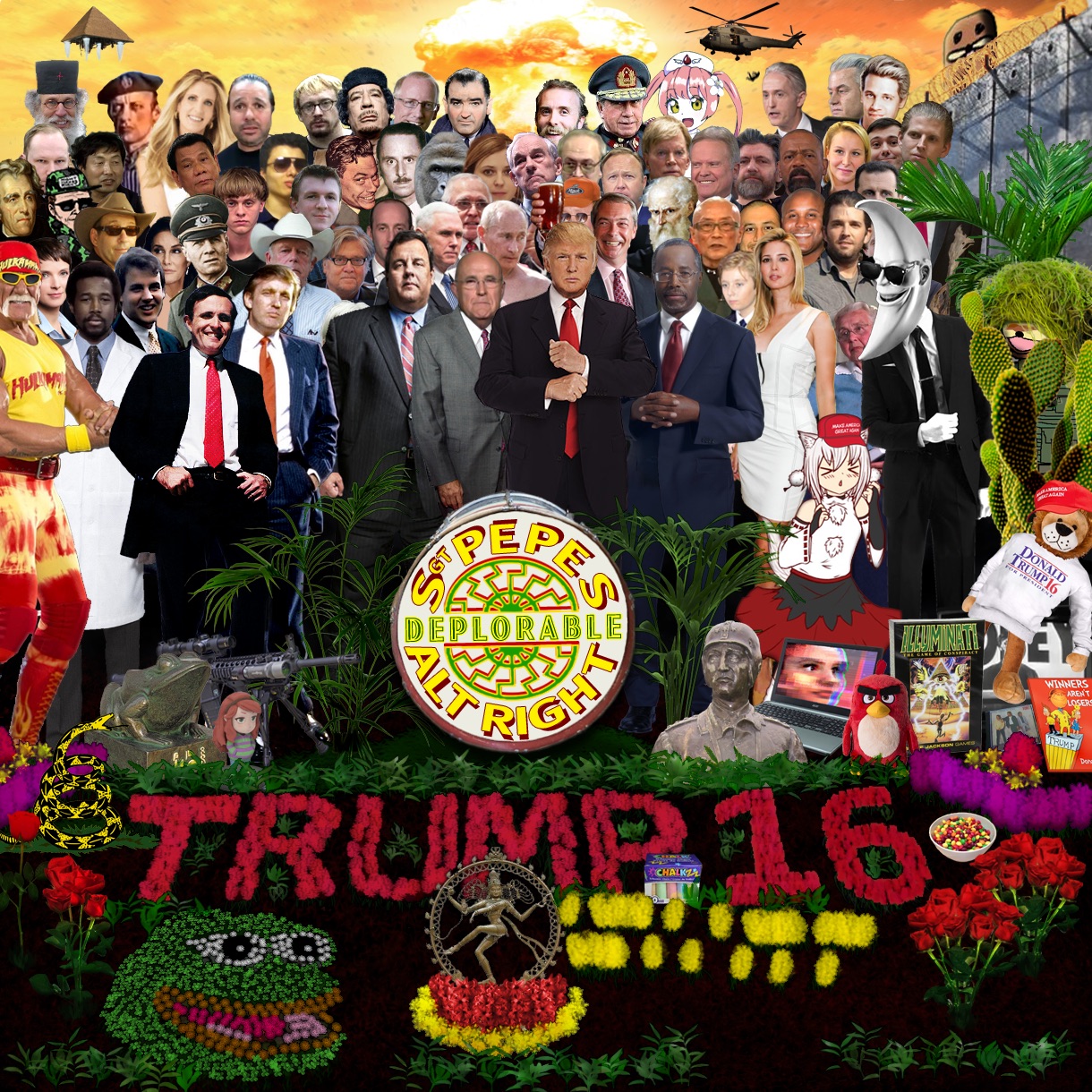
No Reagan or Thatcher. No Paul Joseph Watson or Stefan Molyneux either.
“Ah, it’s a homage to The Beatles’ Sergeant Pepper’s Lonely Hearts Club Band album cover. How clever.” I thought.
“Let’s see who’s here.”
“Well there’s Nige, Ron Paul, Pepe (of course), Ann Coulter, Milo, Harambe (heh!), Joseph McCarthy, Scott Adams. All good or good-ish stuff. Well maybe not Pepe. Or Harambe.”
“Who’s that skulking in the shadows?”
“Oh shit, it’s that Norwegian mass murderer!”
“And hang about that’s Gaddafi!”
“And that’s…”
By my count it’s 4 tyrants, 1 fascist leader, 2 mass murderers and 1 serial killer. And that’s the ones I recognise.
The disturbing thing is that this image may well be accurate. These people represent the intellectual (stop sniggering. Seriously, stop sniggering) underpinnings of the Trump presidency. Obviously, there are serious differences which will probably lead to serious subsidence.
But there are things that unite them. With the exception of Farage, I cannot think of any who would have been on the right side of history in 1939. Which is remarkable. Even Neville Chamberlain got that one right.
They are also united by a loathing of the establishment. Which I loathe too. The UN, the EU, the welfare state, crony capitalism, fiat money, political correctness, climate alarmism, regulation after regulation after regulation: they’ve all got to go. But in all of that happening all sorts of other things may happen. One can only hope those things are nearer the Farage than Mosley end of the spectrum.
How sad that the “huge, stifling bubble” being described is a university. I am not quite clear who wrote the following article for student magazine The Tab. The byline says Lucy Kehoe, a co-editor of Tab Liverpool, but the introduction suggests that she is quoting someone (a male) whose name is not given. Whoever wrote it, it is good to see someone fighting back:
The way the campus majority reacted to the new ‘Pro-Life Society’ is symptomatic of a lot of what’s wrong with student politics right now. It was oppressive and deeply intolerant — ironically, exactly what opponents of the society claim they want to defeat.
Speaking as an atheist and staunch pro-choicer, the attempt to shut down the Liverpool University Pro-Life Society before they’ve even had a chance to go for an ice-breaker pint strikes me as a pretty a sinister development. Without trying to sound like a badly-damaged record, simply disagreeing with someone’s opinion does not warrant this person being banned from voicing this opinion, no matter how stark or severe the disagreement may be.
Let’s confront this together, fellow pro-choicers. The members of this society probably find your pro-choice views outrageous, too. Morally reprehensible. In some cases, your views are an insult to their deeply-held religious views.
So, if the Guild was to approve a future application from a pro-choice society, should that be kicked off campus, too? Clearly, the answer is no. Because their outrage doesn’t trump free speech — and neither does yours. When people (like myself) reflect on how wonderful university was, a word we are pretty much guaranteed to use is “diversity”. Diversity of race, religion and nationality. Of accents and hometowns. Of opinion and perspective.
Campuses are places where opinions should be held freely, exchanged in good will and perhaps even debated where necessary. This is the essence of a mature democracy. It’s the basics, really. But this is under attack. No longer is the university an open, tolerant, marketplace of ideas, but a huge, stifling bubble where any group united by a conservative point of view risks being delegitimised by the opinion police.
So far as I know the society has not been banned, but everybody took quite seriously the idea that its suppression should be discussed. The petition to ban it started by a student called Katriana Ciccotto read in part:
“As a female student, I feel completely betrayed, insulted and neglected by the Guild’s recent approval of the pro-life society.
As a female whose student days are long gone, I feel completely wearied by reading political statements that start with “As a female I feel completely [insert line of sad face emoticons here]”. Honestly, kids, feminism once meant something quite different to this. At least with mansplaining you might learn something; a headache is all you get from being in range of womemoting.
“This is a society that is founded on the sole basis that women should oblige to their beliefs. One that denies a woman the right to her own body. These are not religious ideas, they are misogynistic and hateful.
I do not know what “oblige to their beliefs” means nor why it is meant to be a bad thing. The statement “These are not religious ideas, they are misogynistic and hateful” is odd, too. Is it some sort of politically correct charm spell, recited to protect the speaker against accusations of Islamophobia? I am religious but would not claim for a microsecond that an idea being religious is logically incompatible with it being misogynistic and hateful. And while there certainly are those who oppose abortion on non-religious grounds, it is common knowledge that there are vast numbers, including many women of the sort modern feminists do not see, whose opposition to abortion is religious and they are proud to have it that way.
“Whilst I understand and the Guild’s policy towards freedom of speech, misogyny does not come under this category. Surely the Guild would undoubtedly disapprove of a society that promoted racism, homophobia or any other form of hate speech? Why is this different?
“If the Guild want to maintain the idea that they represent their students, they should have the moral obligation to ban this pro-life group.”
I, not Ms Ciccotto, put the phrase “misogyny does not come under this category” in bold type. It was unendearingly typical of the class of “I believe in free speech but” arguments that define free speech down to meaninglessness. There is a word called “whataboutery”, describing a style of argument by deflection pioneered in Northern Ireland during the Troubles in which people avoided facing up to the evil done by their own side by endlessly bringing up evil deeds (especially evil deeds of many years past) done by the other side. Whataboutery often is used dishonestly, but not always. A demand that all should be judged by the same rules is fair. But I really cannot see much to defend in the tactic of buttery.
Bluntly when you’ve been called a bigot by the media and the left and you know you aren’t one, the chances are pretty high that you’ll discount the claims that others are the same. Especially when the same people also make the same false claims again and again. The activist who cried “racist” is meeting the same result as the boy who cried “wolf”.
In his comments over the past week, Obama has sounded some of the same themes we discussed back in 2013. He told Remnick: “Ideally, in a democracy, everybody would agree that climate change is the consequence of man-made behavior, because that’s what ninety-nine per cent of scientists tell us.” The 2009 revelations from the East Anglia emails that scientists had manipulated data and abused the peer-review process? Down the memory hole.
Remnick himself described the Obama presidency as “two terms long on dignity and short on scandal.” The IRS? The State Department scandal that arguably sank Mrs. Clinton’s campaign? Again, the memory hole.
In Lima on Sunday the president himself declared: “I am extremely proud of the fact that over eight years we have not had the kinds of scandals that have plagued other administrations.” That’s either delusional or very carefully worded: To our knowledge no other administration has used the IRS to punish ordinary citizens for dissent, nor faced FBI findings that the secretary of state treated classified information in an “extremely careless” fashion.
I have mixed feelings about Milo Yiannopoulos, but the notion that representatives of Her Majesties Government have pressured Simon Langton Grammar School in Canterbury into cancelling a speech by him on grounds of ‘extremism‘ is tantamount to a declaration of war on freedom of expression.
There needs to be push-back because this is scandalous.
Push back how? Names need to be named. Exactly who at the Department for Education was behind this? Who did Headmaster Matthew Baxter speak with? Names please. And who ordered those functionaries to contact the headmaster and press him into cancelling this event? Names please, because their reasoning needs to be subject to scrutiny.
Update: very interesting local article reporting on this. Once you get away from the London based media, you are more likely to find journalism that does not reflexively kowtow to the BBC/Guardian orthodoxy.
The Samizdata people are a bunch of sinister and heavily armed globalist illuminati who seek to infect the entire world with the values of personal liberty and several property. Amongst our many crimes is a sense of humour and the intermittent use of British spelling.
We are also a varied group made up of social individualists, classical liberals, whigs, libertarians, extropians, futurists, ‘Porcupines’, Karl Popper fetishists, recovering neo-conservatives, crazed Ayn Rand worshipers, over-caffeinated Virginia Postrel devotees, witty Frédéric Bastiat wannabes, cypherpunks, minarchists, kritarchists and wild-eyed anarcho-capitalists from Britain, North America, Australia and Europe.
All content on this website (including text, photographs, audio files, and any other original works), unless otherwise noted, is licensed under a Creative Commons License. Powered by WordPress & Atahualpa





Recent Comments