We are developing the social individualist meta-context for the future. From the very serious to the extremely frivolous... lets see what is on the mind of the Samizdata people.
Samizdata, derived from Samizdat /n. - a system of clandestine publication of banned literature in the USSR [Russ.,= self-publishing house]
|
A few days ago I reviewed John Keyes’ new play and mentioned it would soon be going on the road. I rang him t’other day for details so our London readers can drop in to see this excellent bit of theatre.
John will be performing his two act play at the Wimbledon Studio Theatre from Sunday February 24th to Tuesday February 26th.
Enjoy!
The Blue Button is a highly polemical independent libertarian blog. It is largely limited to American issues but within that purview tends to throw a fairly wide net. The blog has a blunt ‘in your face’ style and it would be fair to say ambiguity and nuance are eschewed for the Monster Truck car crushing approach.
I’ll tell you what really gets on my tits about Tom Tomorrow and the whole Village Voice “we’re not commies, honest” liberal set. They’ve all been doing a bang-up job documenting and bitching about privacy and civil liberty violations but when it’s cast-your-ballot time, where are they? In the booth with the statists.
Quite so. The Blue Button says it the way the author sees it. If you like opinions straight from the shoulder, then this is the blog for you.
Congress is now discussing ethics of business. This is the first time for many congressmen – not business, but ethics.
– Jay Leno
Scott Rubush is far from impressed with all this technology and I, for one, am greatly relieved that, at long last, somebody has had the guts to speak the truth.
“technology does little to change the quality of life…”
Says Scott and…
“Hell, I live in the 21st century in one of the wealthiest cities on earth, and I still had to roll my arse out of bed this morning and go to work—at a computer terminal, no less”
How right he is. I, too, am deeply nostalgic for the days when I could rise from my rat-infested bed of straw in the middle of the night to milk a goat, bury a couple of my children and vainly try to dig a turnip out of the frozen soil with rudimentary hand-tools. Those were the days when we had real quality of life.
After all, what has technology ever done for us, eh?
Well, I suppose there’s the steam engine, the lathe, penicillin, vaccines and manned flight.
But, apart from those things, what has technology ever done for us, eh?
Okay, well, there’s electricity, the internal combustion engine, steel, oil fractionating, synthetic fabrics, rubber galvanisation, intensive farming and antibiotics.
But, all that aside, what has technology ever actually done for us, eh?
And I suppose there’s radio, radar, cine film, pasteurisation, central heating, the lightbulb, plastics, telecommunications, the laser, microwaves, invitro fertilisation, the integrated circuit, computers and, of course, the Internet.
So apart from steam engine, the lathe, penicillin, vaccines, manned flight, electricity, the internal combustion engine, steel, oil fractionating, synthetic fabrics, rubber galvanisation, intensive farming, antibiotics, radio, radar, cine film, pasteurisation, central heating, the lightbulb, plastics, telecommunications, the laser, microwaves, invitro fertilisation, the integrated circuit, computers and, of course, the Internet…WHAT HAS TECHNOLOGY EVER ACTUALLY DONE FOR US, EH??
Despite my best efforts to filter out the Olympics, the bru-haha about the Skating Gold Medal has managed to show up as a blip on my radar screen. If I have got this straight, a Russian pair was awarded the Gold and a Canadian pair the silver only that seems to have outraged the whole world for some reason (there is a war on, you know) so a gaggle of IOC apparatchicks went into a furious round of secret investigations and deals were made in various smoke-free rooms and, voila, now the Canadians have the Gold medal instead. Apparently the judges got it all wrong
Which leads me to a question: how does anybody know?
First of all, skating is not a sport. It is a hobby; a genteel pastime, especially when it’s called ‘Ice Dance’ which is skating for homosexuals
Secondly, how does anybody know who ‘won’? In football, Team A scores more goals then Team B. Simple. Team A has won. In Boxing, Fighter A is parading around the ring holding a belt while Fighter B is being carried out feet first. Fighter A has won. In swimming, Swimmer A makes his way across the pool quicker then Swimmer B. No arguments; Swimmer A has won
Now skating: Couple A does some circles, triple salkos and pirhouettes. Couple B does some circles, triple salkos and pihouettes. And the winner is…??????
Seeing as Will Vehrs of Blog Watch II is moaning about the lack of Valentine party reports, here I go.
It all started off rather badly as I had a huge argument with my ‘significant other’. But that was probably just as well so this way I did not have him moping around later at the party like death’s head at the feast.
I was joint hostess of this party with two excellent lady friends of mine at a pleasingly nefarious and very out-of-the-way venue that for certain reasons will remain nameless. We expected 30-35 people but eventually got more than 80 I would guess, which proved interesting. I have no idea where they all came from and how they found our semi-private party. The guys running the bar (huge kiss to Marko, DJ Klaus and Dobroslav) had to go out twice and restock, the last time the underside of Marko’s old Trabi was scrapping the ground and making sparks because there was so much in the back and on the seats.
The title of the party was ‘Love and Massacres on Valentine’s Day’ and due to the preferences of one of my co-hostesses, the theme was ‘Goths in Love’: so I did radical things with my hair and had a rather fetching ‘tattoo’ painted on for the night.  
The party took place in a large concrete basement that was quite recently used as a bomb shelter, with two dance rooms, a chill room and a very unusual and, um, ‘sociable’ toilet room. Music in one room was things like Prodigy, Alice DJ, Jaxx, Chemical Brothers, Stromkern, Apollo 440 and Orbital and the other room stuck to the goth theme with things like local boys Gone, Laibach, Weeping Willow, Phantasmagoria and Drinking Skull, plus the inevitable Bauhaus, Sisters of Mercy, Siouxsie and the Banshees.
The place had a ventilation system which seemed to be running backwards and so it got hotter and hotter as more and more people arrived to engage in crazed dancing and innovative drinking games. After a while there was an interesting layer of cigarette and who-knows-what smoke sort of hanging just below the ceiling which did look rather cool. A bit later I had a very surreal conversation when four of us got trapped in the toilet room for about half an hour. I got talking with a very beautiful Hungarian boy wearing a bullet earring, who told me he “knew the people whose party this was and they were all smugglers from Russia”. I would have liked to hear more of this fascinating story but then Marko managed to take the big steel door off its hinges with a huge screwdriver and freed us all. All the waiting people who wanted to go pee pee rushed in and threw us out and I never saw the strange Hungarian boy again.
Many interesting things happened later but my memory gets hazy now…at least that is my story and I am sticking to it. It was a terrific party but I am really glad I didn’t have to clean up afterwards. Are you satisfied now Will? I demand *** for this revelation on Blog Watch II!
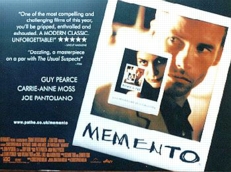
I must say that the most egregious omission from the Oscar line up for best flick is director Chris Nolan‘s highly unconventional Memento. Unlike the linked review I think it quite possibly does make it to “favorite-of-all-time status” rather than just pretty damn good.
Guy Pearce turns in his best performance yet, sympathetic without being sentimental and Carrie-Ann Moss proves there is more to her than just ‘Trinity’ from The Matrix with her alluring, pitiable and in the end utterly detestable character. Joe Pantoliano is of course as dependable as ever. The structure of this work is pretty much in a class of its own: we see a scene and we think we understand what is going on, but a few minutes later we see the exact same scene but the context has changed, and we realise what we thought had happened before was not the case at all. This happens several times throughout the film, which in effect starts at the end and works not so much backwards as backwards, forwards, backwards again, hop to the middle, jump back again…
This little non-linear gem is certainly in my top 5 movies of all time. Hey Oscar, we wuz robbed!
Scott Rubush write a reasonable piece on his self-named blog called Libertarianism and Marxism. I quite like the way Scott writes but I have to say he drives into several well worn potholes of misunderstanding when he mistakenly sees a confluence of views between Karl Marx and Dinesh D’Souza.
The notion that libertarians always disdain the ‘tried-and-true’ is his first misunderstanding. What libertarianism is based on is the rejection of the conservative and socialist predisposition to deference for deferences sake. Ours is the way that places civil society, and not state, at the centre of social interaction. We reject the nationalisation of private life. Yet civil society is not the product of our intellects but rather complex social evolutionary processes. Libertarians seek the solutions that emphasize free consent, binding contract and free association, all rooted in the ‘tried-and-true’ common law culture of the Anglosphere. It is only the state which can sweep away the ‘tried-and-true’ with the stroke of a pen, not libertarianism. What we reject is ‘traditions’ which have outlived their time, ‘tried-and-no-longer-true’, things like slavery, prohibiting women from owning property and legislated actions against consensual sexual practices like prostitution, homosexuality and other more unusual peccadillos.
The second misunderstanding is what D’Souza and Marx both said in the quoted passages. Whilst they both initially seem to confirm Rubush’s thesis, the last sentences in both of them illuminate why dialectical materialism is not the issue here at all because D’Souza and Marx have in fact drawn the opposite conclusions.
When Marx says in his well know remark “The weapons with which the bourgeoisie felled feudalism to the ground are now turned against the bourgeoisie itself”, he is arguing that the factory system of bourgeois collectivisation of the proletariat due to the advent of technologically derived mass production, makes the merging of society and state inevitable, thereby eliminating the raison d’etre of the bourgeoisie and resulting logically in a dictatorship of the proletariat which imposes social truth on all, leading to socialist ‘New Man’.
However when D’Souza says “So technology helped to free human beings from bondage, and that is a moral gain because it extends a cherished value: freedom”, he saying the exact opposite. His thesis is not that technology will collectivise us but rather that it will make the proletariat into the bourgeoisie… in other words, we are all de-collectivised middle class now. Technology frees us from an existence of collective tribal subsistence, allowing us to develop socially towards the more several existence of an extended de-collectivised civil order.
It is this extended order that allows morality, and not just collectivised force, to govern our actions. Man is still man but the idea that changing his circumstance makes no difference to his moral development is hard to support. Where is the Hottentot Aristotle? Where is the Nung Socrates? Where is the Inuit Aquinas? It is from a level of economic development driven by technology that permits us to spend less time shooting arrows at antelope and more time becoming more than just upright animals-that-survive.
That’s why his piece is fatally flawed. Rubush fails to see that whilst mankind’s nature may be essentially unchanging, his circumstances are not… and that is a non-trivial matter when it comes to allowing people to spend more time in non-utilitarian activities and less time just surviving.
Marx felt technology would turn society into a vast state-society based on ‘scientific socialist’ principles in which truth itself in collectively derived. D’Souza feels technology frees us to think and entertain such concepts as liberty itself.
Dale Amon, from Belfast, reports on the daft new regulation to limit decibels to 83db. Are the EU mad? Who is really going to enforce this? I can imagine the first time some little dweeb from the EU directorate goes into a death metal gig in Sweden. The venue is full of leathered, iron spiked and generally cranky death-metal fans. Is the EU bloke going to ask these nutters to turn down their music, and expect to live? Just look through the pages of Brave Words and Bloody Knuckles or Terrorizer to find examples of death metal types. Never mind the fact that most death metal fans I meet are huge, well built hard men who look like they could be vikings. Is it a co-incidence that extreme/death/doom/speed metal is very popular in Scandinavia and Germany? I don’t think so. Sorry to tell you Dale but punk rockers are wimps compared to these guys.
May I suggest we send Chris Patten to Wacken or maybe the Inferno festival? Someone needs to convince him to announce from the stage at about 10pm what his intentions are. “Excuse me fellow Europeans, I am here to inform you that this venue must turn down the music to an EU-approved 83db. The EU is only concerned for your hearing and well-being.”
Well good thing about this new db rule, it will turn anyone who likes loud and heavy music against the EU in an instant. What I would love to see is an army of leather clad insensed metal-heads decending on Brussels for a huge protest.
Oh yes and Dale, there have been several songs written about the EU. One, whose name I forget, mentions the great line: “another doomed utopian ideal…” You are also mistakened if you think all musicians are socialists. The loud-mouthed ones might be, but there are many a band whose lyrics speak to a libertarian mind-set (especially in the heavy metal/hard rock genres). Of course, I know of major bands who are Tory voting, all of whom think their being ‘outed’ would hurt/kill their careers.
Lagwolf
Rockers Outraged At Regulation (R.O.A.R.) arise against fascist EU state!
I think Tom Burroughes is far to genteel with his treatment of EU Commissioner Chris Patten‘s remarks in the Financial Times.
My answer is not that the unilateralist urge is wicked but that it is ultimately ineffective and self-defeating.
Here is the core of the crypto-socialist beliefs of purported conservatives like Chris Patten. Only the collective approach works.
The attacks of September 11, in which citizens of more than 80 countries lost their lives, brought home in a terrifying way the vulnerability of the US and the rest of us to the actions of extremists plotting from safe places in failed states such as Afghanistan.
Indeed. That is why the ‘failed state’ which harboured and succored Al Qaeda was overthrown by force of arms and replaced with one more to America’s liking.
In the immediate aftermath of the attacks, it seemed that the US had rediscovered its need for allies to confront this common menace. The stunning and un-expectedly rapid success of the military campaign in Afghanistan was a tribute to American capacity. But it has perhaps reinforced some dangerous instincts: that the projection of military power is the only basis of true security; that the US can rely only on itself; and that allies may be useful as an optional extra but that the US is big and strong enough to manage without them if it must.
I suspect in fact the US actions were based on the quaint notion that a dead enemy tends not to plan further attacks against you and that time was of the essence, given that attack by Al Qaeda was not just a possibility but had actually occurred. Expeditious action was unlikely to have been served by waited for the participation of Belgian, Portuguese and Greek para-commandos. How long did it take for the Europeans to acquiesce in the tepid military action against the Bosnian Serbs who had been randomly shelling civilians in Sarajevo? Is that how long Patten expected the Americans to wait after September 11th?
I hope those instincts will not prevail, because I believe them to be profoundly misguided. The lesson of September 11 is that we need both American leadership and international co-operation on an unprecedented scale. It is in the world’s interest, as it is in the interests of the world’s greatest power, that leadership should be exercised in partnership.
The US said ‘you are either with us or with the terrorists’, which sounds like leadership to me. They then proceeded to blow seven shades of crap out of Afghanistan… at which point nations such as Syria, Sudan and Yemen started ‘co-operation on an unprecedented scale’ with the US. Sounds like leadership and co-operation to me. The problem lies in the Islamic world and this it is the co-operation of the relavent bits of the Islamic world that matters. If the people who flew the aircraft into the WTC were mostly French and German, no doubt there would be more of an imperitive to secure French and German co-operation. Of course partnership is pretty much the antithesis of leadership so quite what Patten means by leadership should be exercised in partnership is unclear to me.
Why is that so? Let me offer five reasons. First, every day makes us more aware of the interconnectedness of the modern world: a world in which America is at the centre of an increasingly integrated web, in which modern technology is corrosive of national boundaries and national jurisdictions. That makes it all the more important to work with those who share your values in order to protect them.
Exactly. Which is why the US worked with the UK and not Brussels. The US and the UK share values. The US and the EU do not.
Second, while globalisation – the combination of open trade, capitalism and technology – creates unparalleled opportunities, it also has a dark side. The European Union symbolises the ability of countries to come together to tackle common problems.
The ‘dark side’ of globalisation is creating global capitalist wealth generating networks which stasis based institutions like the EU and repressive regimes everywhere have great difficulty controlling. The ‘common problems’ Patten refers to are common to trade unions, subsidised farmers and protected national industries. The ‘problem’ they have is that they are trying to sunbathe and finding themselves in the shadow of the Statue of Liberty. Patten said a few days after September 11th that the attack was ‘due to globalization’. So presumably if we restrict trade to within national borders and subject all economic activity to state regulation, Al-Qaeda would not have attacked the USA. Here is an alternate thesis: if for the last 50 years the EU and other trading nations had not protected their markets from Third World/Middle Eastern people trying to trade with them, the Islamic world would be far more prosperous and secular and integrated into the world economy and thus much less of a stagnant swamp of repressive governments and epistemologically crippled civil societies than they are now.In short, the September 11th attacks happened because people like Christopher Patten have limited globalization by trying to only let it happen on controlled statist terms.
Third, the international institutional architecture – from the United Nations to the International Monetary Fund, World Bank and World Trade Organisation – owes more to the genius of American statesmen than to any other source. But these institutions are under threat. Their rulings are challenged with increasing truculence and impunity. They lack democratic legitimacy, which fuels the muddled movement against globalisation. They need to be nurtured or they will lose their authority – and we shall all be the poorer for it.
The UN, IMF, World Bank and WTO are idiotic institutions. Not because they are not ‘democratic’, which is just another way of saying ‘politicized’ , but because they are statist, which is to say, they are based on the premise that trade occurs between states rather than people and free associations (companies). Legitimacy does not come from democracy, it comes from non-coercion and free choice. And so does prosperity. Left to their own devises and without layer upon layer of regulations and tariffs, would companies trade more or less? Obviously more, and as more trade means more wealth is created, the problem is not how can states facilitate companies trading but how can companies prevent states and the whole alphabet soup of state-based organisations they create, from getting in the way.
Fourth, Europe cannot hope to match US military spending – nor should it even aspire to do so. Like Lord Robertson, the secretary-general of Nato, I feel strongly that European governments should increase their national military budgets, shouldering more of the burden for their own defence. But “security” is a wider concept. The EU, with its member states, is a massive provider of development assistance. We provide about 55 per cent of total international assistance and as much as two-thirds of all grant aid. That too is a contribution to international security. No one disputes the need for tough military action to destroy the al-Qaeda network and its bases. But if we are to deny al-Qaeda, and other networks, the territory from which to plan future atrocities, we have to do all we can to bolster weak or failing states and prevent them falling into the clutches of the bin Ladens of this world.
By providing “55 per cent of total international assistance and as much as two-thirds of all grant aid”…TO STATES the EU underwrites 55% of the problem, not the solution. It takes money confiscated from EU taxpayers and gives it to kleptocratic regimes across the world, who allocate the money on socialist-statist principles. Far from adding to global security, the EU undermines it. Far better would be to take that ‘aid’ money, which only aids the very regimes which lock-in the self reinforcing doom loop of politicized economics, and leaving it with the individual EU taxpayers to whom it belongs. If the EU insists on stealing it however, they would do a hell of a lot more for global security by spending the money on aircraft carriers rather than supporting flawed third world governance.
There is a final point. I need hardly say that as well as affection and admiration for America around the world, there is also fear and resentment. As the world’s only superpower, the US carries a particular responsibility to maintain moral authority for her leadership. Do your own thing and everything seems clear and purposeful; but there is a cost in terms of legitimacy and long-term effectiveness. That cost accumulates over time.
Almost invariably when someone says “I need hardly say that as well as affection and admiration for America around the world” it means nothing could be further from the truth and they are about to say something that proves quite the contrary. Patten represents a fundamentally illegitimate organisation which even by his own standards of advocating legitimacy-by-democracy is illegitimate. Who elected EU Commissioner Chris Patten.
So where does this leave us? It leaves me, at least, uneasy. I look to America – as I have always looked to America – to engage with a complex and dangerous world. There is much that is evil in that world. But to brand a disparate group of countries as an “axis of evil” did not strike me as the finest phrase ever produced by the president’s speechwriters. Of course we must oppose what is evil. But we must also build on what is good – and on what offers hope of a better future.
And what exactly is the good that ‘we’ must build on in North Korea, Iraq and Iran?
In Iraq, for example, we must redouble our efforts to get the inspectors back in and to support the opposition to Saddam Hussein. But in Iran? When some in Washington say that European policy in Iran has failed, my immediate reaction is that we need to find new ways to support reform there, not that we should put up the shutters.
Militarily crushing the entire political and military apparatus of Iran and Iraq would be pretty much an unmatchable way of ‘supporting reform’. That is no more ‘putting up shutters’ than the manner in which the US and UK interacted with Nazi Germany. We did not remove the ‘problem’ of Auschwitz and Belsen by prevailing upon the Nazis to allow inspectors to visit. If Iran and Iraq do indeed pose a clear and present danger, then it must be made clear to them in no uncertain terms that such actions will lead the USA to pose a clear and present danger to them. Publicly calling them part of an ‘axis of evil’ seems to achieve that pretty well.
In the case of North Korea, the sunshine policy of Kim Dae-jung offers the best prospect in years of bringing real change. In the Middle East, we need dialogue, not isolation and further radicalisation of the Palestinians.
Patten ended up by quoting Henry Kissinger:
“America’s challenge is to transfer its power into moral consensus, promoting its values not by imposition but by their willing acceptance in a world that, for all its seeming resistance, desperately needs enlightening leadership.” That sentence is not mine but the final paragraph of a recent book by Henry Kissinger. Is it overly candid of this friend of America’s to say that I agree with every word?
Finally I agree with Patten… or more accurately, with Henry Kissinger. Although the US should not seek to impose them, the sooner the US realises its policy of benign neglect is a mistake the better: it does indeed needs to encourage the willing acceptance of its values… by Europe.
I’ve just had one of those “builders nightmare” conversations. You know the one. “We paid them X thousand pounds and the roof had a hole in it and the floor caved in, and then we waited Y months, and paid Z more thousand pounds …” This particular story ended up in the High Court of the Isle of Man, where my friend did at least get himself a semi-happy ending and isn’t too much out of pocket. But until then, it must have indeed been a nightmare. (I decided to do this blog even as I talked with him, and told him to expect this piece here, and that I would email him how to get to it, which I did. So watch out for a surge in our viewing figure from 90 million to 90 million and one, any day now.)
Why are there so many stories like this, and especially in Britain? First, is it only a British thing? Do Croatian builders do this to Croat householders? Is it like this in Belfast (which is still, just, part of the “UK and Northern Ireland” state)?
Possible answer: UK tax law bullies everyone into “buying” somewhere to live if they can possibly afford this (by going deep into debt), and into not renting as soon as they can afford to buy. If there was no tax advantage in buying rather than renting, much more building repair work would be supervised by large, specialist home-owners whose repeat business would not be something to piss on, the way it is with the wretched individual, building-ignorant UK home-owner.
In general, the relationship between owning-or-renting and freedom is surely the opposite of what it is so often said to be by British Conservatives. Renting equals freedom, not owning. Most home “owners” in Britain are about as free as a bird locked in a cage, which is why your British Conservative so loves his “property-owning democracy”. It puts him and his friends in command of British society. (Or it would, if only they could get the democracy bit right.)
Did you know that during his one lifetime Ludwig Van Beethoven moved house over fifty times? In Victorian England, it is said that people would decide to move, load all their possession onto a cart, and then go looking for a new place. In that order.
He still doesn’t get it, does he? ‘Sophisticated’ Chris Patten, the EU Commissioner about whom I waxed indignant the other day due to his attack on George W. Bush for labelling certain states as evil, has not only defended himself today he claims he is not anti-American, but also repeats the daft idea that U.S. and the EU must deal with terrorism by tackling poverty, human trafficking and autocratic regimes without actually saying exactly how, or indeed reflecting on how such ‘jaw-jaw’ approaches have failed in the past.
Surely the point is that countries such as Iran or North Korea are poor because they are closed societies, and so are not likely to be improved by disbursements of aid from the Western taxpayer (has the EU approach improved things by giving money to Yassir Arafat?). Patten is playing a dangerous game. He gives the impression that he is privy to Bush plans for some kind of crazed military rampage throughout the globe even though so far the US has not shown its hand and certainly not to the likes of him. It is hard to escape the suspicion Patten’s depreciation of US ‘unilateralism’ is as much due to annoyance of being left out of the loop in matters that are none of his business anyway.
The EU political class must stop talking about the US as if it were some kind of immature adolescent incapable of acting intelligently without the input of their wisdom. Apart from being downright rude and bad diplomacy, it reveals a profound ignorance. I don’t know what goes on inside Patten’s head but I can help feeling he has not grasped the degree to which Americans have been shocked and changed by September 11th. Get out of the Brussels bunker, Mr Patten, you are not doing yourself or anyone else a lot of favours right now.
|
Who Are We? The Samizdata people are a bunch of sinister and heavily armed globalist illuminati who seek to infect the entire world with the values of personal liberty and several property. Amongst our many crimes is a sense of humour and the intermittent use of British spelling.
We are also a varied group made up of social individualists, classical liberals, whigs, libertarians, extropians, futurists, ‘Porcupines’, Karl Popper fetishists, recovering neo-conservatives, crazed Ayn Rand worshipers, over-caffeinated Virginia Postrel devotees, witty Frédéric Bastiat wannabes, cypherpunks, minarchists, kritarchists and wild-eyed anarcho-capitalists from Britain, North America, Australia and Europe.
|







Recent Comments