What kind of world is it when, in sheer self-defence, you have to Fisk your own newspaper articles?
– Brian Micklethwait (in an article earlier today)
|
|||||
|
August 20th, 2002 | Comments are closed
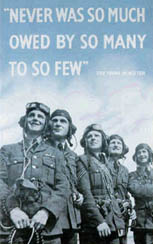
 August 20th 1940, and the fate of western civilisation hung in the balance. As the Battle of Britain was still being fought out between the Luftwaffe and RAF to determine if Nazi Germany would be the uncontested master of western Europe, Winston Churchill gave one of his most stirring of many memorable speeches in the House of Commons:
 August 20th, 2002 | Comments are closed
Yes, I’m ba-ack. Hard disk problems, and then as soon as this was semi-sorted to the point where I was able to start reading Samizdata again, and to think about writing for Samizdata again, I was commanded by the Sunday Times (to whom our editor-in-chief forbids links because they require subscriptions) to write an article about, and I love this, Ayn Rand. I told them I wasn’t really the person to be doing this, since, how can I put this, I don’t agree with her about, you know, her philosophy. But they were adamant, and my efforts – somewhat shortened and rewritten and re-arranged and with some tiny factual errors added and opinions that I don’t quite hold stirred in, and some anti-Rand insults kept in but with the small but perfectly crafted prior justifications of them cut out, but nothing drastic enough to matter what with it only being the newspapers – did appear in the day before yesterday’s Sunday Times (August 18 2002), and I may even be getting some money. All those who really, really want to read the full article as printed should email me, and I’ll send it in full. For the rest of you, be happy that some worthwhile points were made, and some ideas approximating to libertarianism were plugged.
In my original version there was then a bit about how Howard Roark, the architect hero of The Fountainhead, is an impossible character who had swallowed the nostrums of the Modern Movement in architecture whole. He is presented by Rand as omniscient, which is impossible. In other words, the following assertion was not merely asserted; it had been explained and justified.
I should have included Murray Rothbard there. Sorry Murray Rothbard. However I didn’t want to say that Rand is total rubbish, so thank god they also kept this next bit.
But …
The piece then continues that “for the Tories”:
Actually that was me stating my own opinion, not reporting on any Tory opinion.
No they bloody don’t! That last bit was, again, added to make the piece about Tories rather than about merely hardcore libertarians like me, who don’t count, and whose opinions won’t stir up any rows.
Quite so. Not “libertarian Tories”.
That last extremely dubious qualification was also added. Accept through gritted teeth more like. For as I was allowed to go on to say:
Nevertheless,
And so on. Not too ghastly. And particularly good was that they tailed it with me being the editorial director of the Libertarian Alliance and then printed the address of the LA website. This has caused what by LA website standards has been a definite hit-surge. In general, I don’t know whether to be pathetically grateful that my opinions were aired – with almost complete accuracy – in one of our great national organs, or irritated that they took it upon themselves to make tiny but annoying alterations. I don’t query their right to edit their own newspaper, and I realise I didn’t make it easy for them. I just wish they’d done it a bit better. These slight alterations are not completely insignificant. They turn me, from someone who is accurately describing his own opinions, into someone who is trying to stir up trouble in the Conservative Party by attributing opinions to members of it that they almost certainly don’t hold. What kind of world is it when, in sheer self-defence, you have to Fisk your own newspaper articles? I prefer Samizdata. My stuff here may sometimes be rubbish, but at least it’s all my own rubbish. It’s good to be back. August 20th, 2002 | Comments are closed
Given the previous post on the subject of state surveillance, it is good to hear that The Register is reporting that PGP encryption is back in the hands of an independent company. August 20th, 2002 | Comments are closed
Although I have never been a huge fan of Statewatch, a civil liberties advocacy group whose membership contains a high proportion of socialists (which I have always thought analogous to a temperance society whose membership contains a high proportion of brewers), the latest Statewatch press release is well worth reading. They clearly lay out how the European Union is about to take a giant leap towards the sort of total surveillance super-state that the Soviet Union could only dream of implementing. As Tony Bunyan, Statewatch editor, comments in the press release:
The Panopticon super-state ‘of the future’ is now very much upon us.  When the state watches you, dare to stare back
August 20th, 2002 | Comments are closed
One of the issues we Samizdatistas come up against a lot is how to sell the libertarian product in an often hostile climate. Chatting to some pleasant and mildly leftist characters recently, it struck me that one of the biggest hurdles we face is simply this – fear. How many times have you tried to make the sales pitch only to get a reply on lines like this – “Yes, but what about if poor people starve if there is no Welfare State?” or “What happens if every adult can have a gun?” or “What happens if we let anyone buy hard drugs?” Very soon it becomes apparent that a lot of decent, pretty smart people are put off the libertarian credo because it seems, well, downright scary. There are several reasons for this. Decades of socialism in the West have, I think, left people deeply ingrained with the idea that the only thing preventing the world from going to utter hell is those nice folk in the government. Our state-run education system plays a part in this, as does much of our popular culture: watch any soap opera or hospital drama and see what I mean. There are several ways we can get over the ‘fear hurdle’. Notwithstanding the recent stock market rout after the dotcom bubble went pop, I am certain that the rise of a shareholding culture and the growing wealth of the middle class is helping to foster a less fearful, more individualistic culture. I also reckon that things like home schooling can have the same effect in encouraging kids to grow up as independent-minded adults. And the sheer bloody awfulness of much of our state-run services, such as the British National Health Services, must surely reach a point where people no longer grip on to the state like a Nanny but appreciate things can be run differently away from the State. Maybe I am a naive optimist, but if there is any point to being a libertarian activist, then breaking the fear barrier is surely a worthwhile goal.  August 20th, 2002 | Comments are closed
After the recent abduction and murder of two young girls, Holly Wells and Jessica Chapman, parents everywhere fear for their children’s safety. This morning’s TV news was full of related items. There was an attempted child abduction just yesterday morning near where I live. And in another item, a Huddersfield University researcher reported that one in five children have been subjected to unwanted sexual advances outside the home. On GMTV yesterday morning, in an item about how to keep children safe, a National Society for the prevention of Cruelty to Children (NSPCC) representative said that parents should tell children that they don’t have to do everything an adult tells them. But what are children to think, when in the next breath their parents demand complete obedience? TCS (Taking Children Seriously) parents don’t give these mixed messages. Unlike many parents, they do not impose their will on their children, but instead resolve disagreements with their children rationally, by consent. In my Taking Children Seriously article, Questionable Motives?, soon to be re-published by the Libertarian Alliance, I argued that:
 [Editor: Samizdata.net welcomes Sarah Lawrence’s first post as a contributor] August 20th, 2002 | Comments are closed
As Paul Staines mentioned below, the Irish Young Progressive Democrats explicitly state they are not libertarians and just a glance at their agenda reveals that they are not friends of liberty by any stretch of the imagination. This party is just another bunch of statists pushing the conventional theft based ‘welfare’ politics of old, claiming responsibility for: · Introduction of a minimum wage
· Huge increase in overseas aid
· Taxi cab liberalisation
· Increased social benefits especially pensions
· Increased funding for education
I look forward to being invited to Paul Staine’s next garden party with food cooked over a barbecue lit with both his Tory Party and Progressive Democrat Party membership cards. August 20th, 2002 | Comments are closed
Whilst I’m very disappointed that Ireland’s Progressive Democrats (PD) are campaigning for a Yes vote on the Nice treaty again I noticed Milton Friedman in an interview in this month’s Central Banking (sorry, subscription required) excusing Irish membership of the €uro because they are a small country with an export orientated economy, he thinks the same can also be said for Central and Eastern European countries eventually joining the €uro. But the PD’s ‘Yes’ campaign coupled with the Young Progressive Democrats putting out a policy paper explicitly stating they are liberals, not libertarians, makes me wonder if I’ll be throwing my PD party membership card and my Tory party membership card into the fire. But I’ve just heard something that strikes me as an indictment of Gordon Brown and a tribute to PD leader Mary Harney’s tax cutting agenda. As the Tories tour Europe looking for policies, perhaps they should just dust off some of Thatcher’s old manifestos. Mary Harney did just that; she implemented major tax reforms, cutting Ireland’s basic tax rate to 22%, substantially raising tax thresholds, cutting the number of those liable to pay the top rate of tax, as well as cutting the top rate of tax, exempting the low paid from tax altogether, and finally slashing capital gains tax from 40% to 20%! State spending went from over 50% of GDP down to 26% today. Lo and behold, guess what happened? The Laffer curve smiled on Ireland and the Celtic tiger roared. So much so that Ireland, which was an economic basket case a little over a decade ago, now has lower tax rates than the UK, higher economic growth rates and, unbelievably, higher per capita income than the UK. Bejesus, would ya believe that? Come April, Gordon Brown will be putting up basic UK taxes 2% as we move into an economic downturn. Thick Scot, smart Paddies. Paul Staines August 20th, 2002 | Comments are closed
Just a reminder that our e-mail is still knackered, and has been so since last Friday. Please use our emergency e-mail rather than the one in ther side bar to contact us. August 20th, 2002 | Comments are closed
I am now officially sick and tired of hearing about how the pending players’ strike is going to kill Major League Baseball. The general manager of the Cincinnati franchise took some heat for a statement in which he basically argued that a players’ strike would be the 9/11 of baseball. Dave Campbell of ESPN also invoked 9/11 in describing the consequences of a player strike. For you incurably hysterical types out there, let me offer the following words of reason: Pro baseball will survive because it is played in a capitalist country. As long as there are athletes who want to play, and entrepreneurs who are willing to organize it, professional baseball will exist in some form. There has not been a lack of either of these elements in the United States since the 1870s. Every time I have made this claim, among family, coworkers, students, etc., it has been met with howls of derision. The counter-arguments boil down to: (1) what about the fans? the game is for the fans; what if the fans get fed up and leave? and: If you look at MLB’s attendance history (which of course I did), you will see that there is NO evidence that past strikes have had a long-term impact on baseball attendance. None. In 1972, a strike cut about ten games off the front of the season. Attendance per game dipped in 1972 — but attendance was higher in 1973 than it was in 1971, and has not since fallen below 1973 levels. A similar pattern emerged around the longer 1981 strike — attendance was higher in 1982 than in 1980, and grew from 1982 into the 1990s. In 1994, the players again struck, this time in August, and the season came to an abrupt end. This time, it looks like baseball paid a price — attendance in 1993 peaked at 30,979 fans per game, and has not risen to that level since the strike. But 1993 is a poor year to use as a baseline, because two new teams joined the National League that year, and first-year expansion teams draw exceptionally well. One of those teams, the Colorado Rockies, set an attendance record that still stands. If you use 1992 as the baseline, or just throw those expansion teams’ totals out of the league average for 1993, baseball had fully recovered its attendance base within about two seasons of the end of the strike. But let’s suppose the doomsayers are right, and baseball loses half its fan base. Let’s say MLB attendance falls from 30,000 per game to 15,000 per game as a result of the pending strike. Can we put that into some historical context? There used to be a time that insufferable sportswriters called the “golden era” in MLB history. Roughly defined as the years 1947-57, these are the seasons that sportswriters like Roger Kahn, in hushed and reverent tones, describe as the greatest ever. Ted Williams, Joe DiMaggio, Willie Mays and Mickey Mantle played during part or all of The Golden Era. Baseball was the only well-established pro sport. Baseball was The National Pastime, a huge part of our popular culture. Right? Well, guess what? The average major league paid attendance during The Golden Era was 14,010 per game. Yes, baseball is in danger, the doomsayers tell us, of having its attendance fall all the way back to … essentially what it was during The Golden Era, when baseball was allegedly pure as the driven snow and beloved by all Americans. What about those organized labor problems? Look, these issues are as old as baseball. The threat of the union striking is nothing compared to what players used to do when they didn’t like the way the owners treated them — they used to FORM RIVAL LEAGUES! The Federal League, to name just one, played in 1914-15; future Hall of Famers like Eddie Plank, Chief Bender, Joe Tinker and Mordecai “Three-Finger” Brown defected to the upstart league. The Federal League didn’t last, but it was a major wakeup call for the AL and NL. The AL itself started as a rebel league too, except that it survived. If the pampered players of today had the cojones to pull off something like THAT, the owners would have a lot more to fear than they do in Donald Fehr, the morose players’ union chairman. So rest easy, fans. Baseball is here to stay. How do I know this? Because capitalism is alive and well. August 19th, 2002 | Comments are closed
In a landmark decision, W.R. McDougall says:
August 19th, 2002 | Comments are closed
|
   |
||||

All content on this website (including text, photographs, audio files, and any other original works), unless otherwise noted, is licensed under a Creative Commons License. |
|||||

Recent Comments