We are developing the social individualist meta-context for the future. From the very serious to the extremely frivolous... lets see what is on the mind of the Samizdata people.
Samizdata, derived from Samizdat /n. - a system of clandestine publication of banned literature in the USSR [Russ.,= self-publishing house]
|
I don’t think anyone is naive enough to believe that the highly state-controlled business of arms sales isn’t a tool of foreign policy. With that is mind, news of this deal might be interesting:
“Lockheed Martin has won a contract to supply 48 new F-16 fighter jets to Poland, in Eastern Europe’s biggest military deal.
The US firm beat off competition from the French manufacturer Dassault and a joint British-Swedish venture by BAE Systems and Saab to secure the deal.”
I have not the first clue about the relative technical merits, or otherwise, of the various fighter jets concerned but I do know that high-grade weapons deals such as this are loaded (scuse pun) with political and diplomatic significance. The arms business is seldom just about business as one of the parties to the negotiations is only too quick to point out:
“Dassault chief executive Charles Edelstenne accused the Polish government of making a political decision by choosing an American plane rather than a European one.
“The political element was the dominating element, much more than the quality of the material and the price,” he told Radio France Info.
“I felt for a very long time that they very much favoured rapprochement with the Americans. So it’s not a surprise,” he said.”
Sour grapes? Well, possibly. But, then again, he might just be right:
“Lockheed was backed by a $3.8bn US government financing package and some heavy lobbying by President George W Bush’s administration.”
Alright, every government lobbies on behalf of its domestic arms industry. But Poland is one of the ten or so former Eastern Bloc countries pencilled in to join the European Union in 2004 and, arguably, the most important of them. How odd that the Poles should so publicly rebuff their prospective Euro-partners in favour of the Great Satan.
Could it be that the above-mentioned ‘lobbying’ was about more than jet-fighters and that the Bush administration has decided it would be good strategy to gently lure the Poles away from the twitching tentacles of Brussels? Watch that space.
I can’t imagine that HMG enacts legislation with a view to spawning a whole new line of British pulp fiction novels and crime thrillers but it certainly sounds like it:
“New powers allowing police and customs officers to seize criminals’ assets come into force on Monday.
The Proceeds of Crime Act will mean that money can be confiscated from all types of criminals and not just drug dealers, as previous laws allowed.”
‘All types of criminals’?. Only the financially successful ones surely?
The Proceeds of Crime Act referred to in the article has established the Civil Assets Recovery Agency (CARA) as a branch of the police force empowered to confiscate assets from those ‘suspected’ of criminal activity.
“The new act will enable police and customs officers to search for cash anywhere in the UK and not just at the country’s borders as was previously allowed.
From now on they’ll be able to crash into your home and root around the sofa looking for lost coins. Don’t laugh, you can pick up quite a lot of money like that.
“Even when there is no criminal prosecution a new assets recovery agency can now step in.”
Which is to say, they can target anyone they want whenever they like and for reasons they will never have to prove and whilst that all sounds (and is) scary enough, I have every reason to believe that it is HMG that will regret this in the long run.
Most nominally law-abiding, work-a-day citizens will not be targeted and, consequently, will bask in blissful ignorance. No so the drug-runners and gangsters, who will be only too aware of it (they are always far better versed in the law than most citizens and quite a few lawyers) and the smart ones will regard CARA as a corruption charter. For relatively low-paid public officials, the lure of easy cash, cars or luxury goods is something to which they can all too easily become addicted. Processing law-breakers through the justice system is difficult and time-consuming. Surely much more tempting to let the gangsters get on with doing whatever it is they do and live off the earnings.
This isn’t about the government stopping criminals; this is about the government getting into bed with criminals. It’s a scriptwriters dream.
Computer games are evolving at an astonishing rate, acting as the primary driver of desktop computer development (after all, how many people actually need a 2.5 GHz CPU, a 128 Mb graphics card and 512 Mb of RAM to do word processing and spreadsheet work?)
Back in the Paleolithic age of computers (the 1980’s), computer games looked like this…
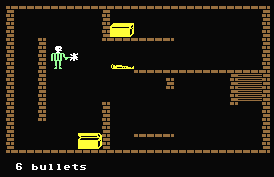
Wolfenstein: Shoot! Mild fun… but not for long
Mildly amusing but crude in the extreme. By the early 1990’s however, came the advent of the ‘FPS’: the First Person Shooter!
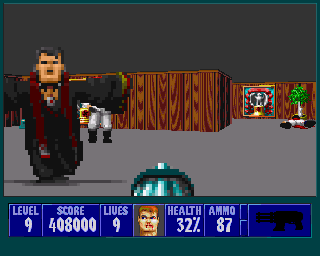
Wolfenstein 3D: Shoot! Great fun… but not for long
They seemed astonishing at the time, actually putting you inside the gun wielding hero. The graphics were rather basic, to put it mildly and after a while the lack of multifaceted interaction tended to make the games rather tedious after the initial ‘gee whiz’ factor wore off… other than opening doors, the only way to interact with things was to shoot at them.
My goodness how things have changed!
Wolfenstein 3D begat Doom, which begat Quake, Hexen, Marathon, Unreal, Duke Nukem, Tomb Raider etc, etc… all worthy ‘shooters’ of steadily increasing graphic quality.
Sudden surges came with games like Half Life, released at the end of the computer games neolithic era (1998) and yet still playable now…and featuring not just excellent graphics but Artificial Intelligence which actually shows a bit of intelligence, rather than just a desire to commit virtual suicide… Half Life & the spin-offs Blue Shift and Opposing Forces brought also the ability to ‘talk’ with the computer generated denizens of the game as opposed to just shoot at them.

Half Life: Don’t shoot, he is on your side.
Great fun… for hours on end!
Then games like No One Lives Forever (NOLF), a spy thriller set in the 1960’s with frequent plot specific cut scenes came along, and suddenly the story line of the computer game actually started to matter.
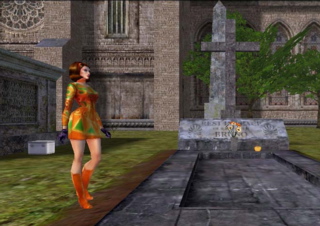
NOLF: Cate Archer, at the grave of her ‘dead’ mentor
The next generation of releases saw the success of story intensive NOLF and soon games of almost cinema grade plot and characterization started appearing, such as the conspiracy ladened Deus Ex and then the gritty darker than dark Max Payne.
And so yesterday the new Gamespy PC Game of the Year was announced, and it is the excellent No One Lives Forever 2.
As well as being superb graphically (caveat: you do need a high spec computer to get the best out of this game), it is just down right funny! Set in the 1960’s, this ‘spy shooter’ owes more to the wonderfully camp ‘Man from U.N.C.L.E.’ than James Bond or Smiley’s People. Although slightly more ‘serious’ than Austin Powers (but only slightly), it provides endless entertainment by allowing you to eavesdrop on the all-too-believable conversations of other people.
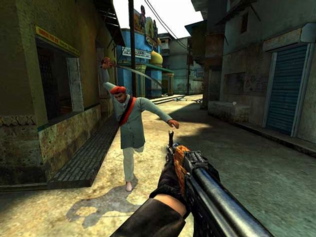
NOLF2: This Indian H.A.R.M. agent has a sword…
but Cate has a Kalashnikov
I look forward to continuous progress in computer games… pure distilled essence of capitalism married to explosive creativity. Within a few years, interactively with the virtual environment will be almost total, opening up steadily more ambitious story telling possibilities whilst at the same time the holy grail of photorealism comes closer to realization. The future is so bright, we are going to need shades to see it. I can hardly wait!
Patrick Crozier posted a piece on Transport Blog the other day about something called SkyTran, which I hereby throw to the Samizdata comment pack to see what they make of it. It seems like a wonderful idea.
Said Patrick:
Further to my investigations into alternatives to driving, I stumbled across a site promoting SkyTran. SkyTran will be a 100mph, computer-controlled, magnetically-levitated, almost door-to-door, non-polluting, personal transportation system. It will whisk us to our destinations in futuristic, light-weight pods, eliminate congestion at a stroke, cost next to nothing, turn a profit, allow spectacular views and be built along existing rights of way.
Can it be done? I have no idea. But I so, so hope it can. Imagine, an almost perfect transport system, making trains and cars look like the 19th century technologies that they are and consigning both to the rubbish bin of history.
I love it.
Maybe it was just that other blogs were taking the Christmas holiday off and there was nowhere else to go, but I’ve been struck not just by the quantity but also by the quality of the comments samizdata has been attracting recently. I can’t reasonably expect the number of comments that David Carr got for his piece about communism not collapsing the way it should, but a dozen or more good, informed responses to this proposal, maybe referring to what else has been said about this scheme by critics and commentators in America, is not an unreasonable hope. The more lucid of these comments, if there are any, can then be swung back to Transport Blog, together with a link to the rest if them. So let’s show these trainspotters what we can do, eh? A very cursory google search got me to several more commentaries about SkyTran, but they all seemed to be echoing the original sales pitch. Has anyone been minded to shoot the thing down in flames? → Continue reading: Might it work? – or is it just pie in the SkyTran?
I am back in the warm embrace of the West – the weather being considerably warmer in London than in Bratislava.  I shall write more about my ‘adventures’ abroad, suffice to say that towards the end of my trip I was genuinely looking forward to coming back home. I shall write more about my ‘adventures’ abroad, suffice to say that towards the end of my trip I was genuinely looking forward to coming back home.
The politics and the public life in Eastern European countries usually make me appreciate the subtlety(!) of British politics, but my first encounter with the news in Britain quickly dispelled any reluctant appreciation of developed western democracy. The most upsetting development is the tax rises awaiting the British taxpayers in 2003 or as Francis Elliott of the Sunday Telegraph calls it, a ‘triple whammy’, which could add up to as much as £1,200 per family:
- A one per cent rise in National Insurance
- An average seven per cent rise in council tax
- Congestion charges in major cities
According to the same article, taxes are rising more steeply in Britain than in any other European country, while in America, the tax burden has fallen in recent years by 0.7 percent to 29.8 percent.
As Maurice Fitzpatrick of Tenon, a national accountancy firm puts it:
“This is the year that Labour will break cover as tax-raisers. People will feel a direct impact for the first time. In the past, the Government has been chipping away at the margins. This time, it will be a straightforward assault.”
I suppose Labour has no need to fear the opposition anymore, as the Tories oscillate between moribund and ridiculous. Their feeble and seriously confused proposals to reduce public spending by ‘saving’ money confirm just how clueless the Conservatives in Britain are:
“It’s too early to say how much [public spending can be reduced], but it could be up to 20 per cent. There is waste going on all over the place. It’s completely ridiculous. Everywhere there is a massive spraying of money, without it actually delivering anything.”
Shock, horror, Mr Flight. And you are going to sort it out how exactly? By setting up commitees of advisors to find ways of simplifying the tax system, and by providing government support for company directors who set up employee share schemes as a way of promoting ‘democractic capitalism’!?
Oh, and first let your comrades know, because they were very surprised to hear about this.
“We had a memo about this in November but since then, nothing. When I heard about it on the radio you could say I was more than a little surprised.”
Watching the Labour government unmask itself and the Conservative Party to hasten its demise, I wonder how much longer it will take for a decent opposition to emerge. Not that I put much hope into any opposition arising within the existing political meta-context or know what would make an opposition ‘decent’ under the circumstances. Any ideas?
“America is fighting the War on Terrorism for one reason: to Secure the American Homeland, whatever it takes. If that takes Empire, fine.”
Trent Telenko
I hope that the US destroys the North Korean Communist regime by the time I’ve posted this text. If there is a legitimate nuclear target anywhere on Earth right now, the North Korean plutonium refinery has to be it.
I also would give a cheer if Saddam Hussein were to end up dead in a traffic accident, or choke on caviar, or find breathing under a pillow difficult, or take a cruise missile up his fundament.
And I am crtainly not one of those people who hopes that lots of American troops die in Iraq over the next few months.
I fear that the British military capability is over-stretched and less effective than its champions would like us to believe. For this reason I am wary of jingoistic talk in London. I would prefer to hear about orders for a decent rifle, a decent tank, a fighter that’s actually operational and reassurance that the anti-chemical warfare suits work.
I also question the double talk about nukes in Iraq when the good reasons for toppling/killing Saddam are…
- he’s a national socialist tyrant
- he’s allegedly one of Al-Qaeda’s main financial and logistical backers.
I’m told there is evidence to back up this claim, so why the red herrings?
BUT, the comment which opens this posting worries me. First it is obvious that if President Bush were seriously taking this line (I don’t think he is, but Mr Telenko may know better), then Europe had better do a deal with the fundamentalists, because America is clearly prepared to sacrifice allies as part of “whatever it takes”, it has the ring of the Yalta betrayal about it. The history of Japan from 1902 to 1945 and its deteriorating relations with the British and Americans is a nasty precedent.
Second “if that takes empire, fine” is precisely the scenario in which libertarians should not (and many will not) support the US. Waco was not a crime because Americans were killed, September 11th would have been a crime if the only victims had been Latino office cleaners. “Homeland” is a very nasty term to the four thousand seven hundred million people who don’t have a US passport or a Green Card. If the War on Terrorism is about protecting the US at the expense of the rest of the world, we’ve got a new Iron Curtain coming down, this time in front of the Statue of Liberty.
I really didn’t expect my warnings about the long-term temptation of absolute power to be vindicated so quickly.
The trick to beating student unions is to force them to follow their arguments to conclusion. Student politicians tend to be the sort of student who enjoys controlling other people’s lives. They hear fond stories of student protests in the 1960s, but are disillusioned by the lack of interest in student politics among today’s undergraduates. Boycotts particularly appeal to this mindset.
Let’s say a student politician proposes that the union ceases trading with any business with involvement in Burma. The result of such a ban would be minimal. But why should only Burma be included? The boycott is because the country has a poor human rights record. Surely, therefore, the union should cease dealings any country that abuses human rights? It is much better to student politicians the idea that lots of products ought to be banned. That way, there are two possible outcomes. The boycott will be stopped by the Tory wets (who would put up with a boycott of Guinness but couldn’t cope if Gordon’s disappeared too). Alternatively, half the drinks in the union bar disappear overnight, in which case people stop going to the union, and its power therefore decreases. It’s a win-win situation.
The problem is that this strategy is far too risky when it comes to national politics. If you tell the government to be more consistent, it might actually do what you say, and mess up the entire country. It’s much better for governments to mess up the economy inconsistently than do it properly.
Prompted, no doubt, by the hugely successful prohibition on the private ownership of handguns, UK police chiefs are planning a gun amnesty:
“A firearms amnesty is being planned for early in the New Year to try to reduce levels of gun crime.”
An inspired idea! I am quite sure that Britain’s urban desperados will be rushing, RUSHING down to their local police station to meekly surrender their Browning Autos and AK-47s.
“A ban on ownership of handguns was introduced in 1997 as a result of the Dunblane massacre, when Thomas Hamilton opened fire at a primary school leaving 16 children and their teacher dead.
But even since the ban, gun-related crimes have soared, with one study suggesting handgun usage had gone up by as much as 40 percent two years after the ban.”
The truly galling thing about this is conspicuous absence from the media of the various anti-gun campaigners who were infesting the airwaves barely five years ago assuring us that a complete ban on private gun ownership would reduce crime, make us all a lot safer and eradicate what they referred to as ‘gun-culture’ from Britain. Not a single one of these people have been brought back on air to be challenged or asked to explain themselves. I doubt that they ever will not least because many of them are still in government.
“The Home Office is considering a minimum five year sentence for anyone caught possessing a gun and setting up a national database and a new agency to trace illegally held weapons.”
In that paragraph, the future lies mapped out. The ‘amnesty’ will prove useless and the criminal use of guns will continue to spiral. Faced with mounting pressure to ‘do something’ the Home Office will impose minimum sentences for handgun possession of five years (or, possibly, ten years as some are arguing for). The result will be that heat-packing gangsters will be far more likely to shoot it out with the cops rather than surrender as well as more likely to ‘silence’ anyone they believe might snitch on them. I see dead people.
Because there is no foreseeable prospect of a policy re-think, I suppose that this whole horrid panoply of unintended consequences will simply have to play out. The British have a penchant for learning things the hard way.
…But nobody can be a great economist who is only an economist – and I am even tempted to add that the economist who is only an economist is likely to become a nuisance if not a positive danger
– Frederick Hayek
The dependably clueless Prince Charles wants the state to require tax funded institutions like Britain’s nationalised public health service and state schools to add insult to injury by not even attempting to get ‘best value for your stolen money’… which is to say he wants such arms of the state to be required to buy British farm products even if foreign products are cheaper/better… not only does he say they ‘should’ buy British, but that the government should force them to.
Like most people with socialist & fascist understandings of economics, producers are all and consumers are nothing to Charles. Why will people like him not be more honest and just admit directly that they want productive taxpayers to be compelled by force to prop-up less efficient areas of the economy and they should not be given any choice in the matter.
The Royal Family usefully occupy the same seriocomical niche as the Flag and ‘Hand-on-heart’ pledge of allegiance do in the USA… and like that inanimate object and rote chant, are largely empty of real meaning beyond their warm-fuzzy-glow value. If only we could devise some means of permanently depriving Charles of speech, leaving him only with earnest looks and poses, then the British monarchy could have another couple centuries of seriocomical semi-usefulness ahead of them.
The Raelians are a truly weird cult, that is for sure, and the fact they are claiming to have produced the world’s first cloned human is hardly going to calm feelings about the technology. However even if their contention to have done so is true (not surprisingly I am disinclined to just take the word of a group which claims humans are the descendents of bio-engineered clones created by space aliens), I must say that I find it hard to get all that excited about the whole matter.
Although I do have worries that the technology and underpinning science is sufficiently immature that there is cause for concern for the health of a cloned child, the principle itself does not bother me at all… a child is a child is a child, and the manner of its creation does not give it any less worth or intrinsic rights.
However the issue of how to assign paternal and maternal responsibility for the child is, of course, going to keep a small army of lawyers busy for quite a while! I would be quite interested to see what people’s views are as to “who is left holding the baby”, if you will forgive the expression 
I have just watched part of a left wing John Wayne film (I did not see it all – I got so irritated I turned it off)… In Harm’s Way (1965) blames American problems in the Pacific war against the Japanese, on stuffed shirt Conservative officers – people who call the war ‘Mr Roosevelt’s war’ as people from their evil wealthy families called WWI ‘Mr Wilson’s war’.
Of course there is no mention of the film that President Roosevelt deprived the Pacific front of resources so that he could prop up Soviet Russia. Nor was this policy confined to the United States. Why did Singapore have no Spitfire fighters for air defence? Because the Spitfires earmarked for Singapore were diverted to Soviet Russia. 100, 000 troops of the British Empire were captured at Singapore – and they were left to rot and die. About 80, 000 Americans were captured in the Philippines – and they were left rot for years as well (many thousands died).
This was not because American commanders (Navy or Army) were poor in the Pacific (although some of the British ones were poor indeed). It was because the New Dealers in Washington D.C. did not care – all they cared about was their sacred Soviet Union.
Before anyone says that the Soviet Union saved Britain from German invasion think about the following: Thousands of allied sailors died taking supplies to the Soviet Union (not Soviet sailors dying taking supplies to Britain). Whether operation ‘Sea Lion’ (the German invasion of Britain) was practical or not (and the Germans certainly lacked the resources vital to operation ‘Overlord’ the allied invasion of France in 1944), the choice by Hitler to switch German air attacks from British airfields to British cities made operation Sea Lion a dead letter.
This choice was made before the Germany invasion of the Soviet Union. The ‘Battle of Britain’ was won before the invasion of the Soviet Union (not after it).
Of course there would have been no WWII anyway if Hitler and Stalin had not allied in 1939 – but the New Dealers (and their friends in Britain) blanked that out.
|
Who Are We? The Samizdata people are a bunch of sinister and heavily armed globalist illuminati who seek to infect the entire world with the values of personal liberty and several property. Amongst our many crimes is a sense of humour and the intermittent use of British spelling.
We are also a varied group made up of social individualists, classical liberals, whigs, libertarians, extropians, futurists, ‘Porcupines’, Karl Popper fetishists, recovering neo-conservatives, crazed Ayn Rand worshipers, over-caffeinated Virginia Postrel devotees, witty Frédéric Bastiat wannabes, cypherpunks, minarchists, kritarchists and wild-eyed anarcho-capitalists from Britain, North America, Australia and Europe.
|





Recent Comments