We are developing the social individualist meta-context for the future. From the very serious to the extremely frivolous... lets see what is on the mind of the Samizdata people.
Samizdata, derived from Samizdat /n. - a system of clandestine publication of banned literature in the USSR [Russ.,= self-publishing house]
Miceal O’Ronainspotted a new item in the Times of London yesterday. He has also looked between the lines and seen where this will eventually go
The issue is, at least for now, congestion on the roads:
“…Satellite equipment to monitor every car journey will be ready only in a decade or more.”
[…]
“Satellite tracking and charging will be tried out on the lorries that use Britain’s roads under a scheme that will begin in 2006. If the experiment is successful, the system could be extended to cars as well.”
Here are the technical specifications for the system:
EU network is preferred system
A nationwide system would be likely to use the EU’s Galileo global-positioning network, an array of 30 satellites scheduled for launch in 2006 and 2007.
The alternative, the US military GPS network, used by the current generation of satellite navigation and tracking devices, does not guarantee access to civilian clients. Galileo is designed for civil use and guarantees an uninterrupted service.
Galileo will be accurate to 1 metre, GPS to only 30m. The lower accuracy of the US model could cause disputes on whether vehicles had actually entered charging zones.
But why stop with cars? Just surgically implant a transponder into each citizen of the UK. If you can do it for cars and wild life, you can do it to people.
There is quite a procession of folks headed for Mars at the moment, according to this BBC report. Coming relatively soon after the awful Shuttle disaster, it is heartening to see some actual stirrings of decent activity in the space field at the moment.
Right now, in the Middle East, Palestinian Arabs are being driven from their homes at gunpoint and forced into refugee camps. Only it is not the Israeli Army doing the driving, nor is this happening in Judea, Samaria or Gaza.
The gardens of Baghdad’s Haifa Club have been turned into Middle East’s newest refugee camp as hundreds of Palestinians are driven out of their homes at gunpoint by their Iraqi neighbours.
The Haifa Club, where Palestinians came to meet, drink coffee and play table tennis, is now packed with more than 250 tents, housing 2,000 people forced to flee.
In the climate of fear and reprisals that persists in the Iraqi capital, however, Palestinians’ association with Saddam Hussein has made them easy targets.
While the Palestinian cause may stir the passions of Arabs across the Middle East, Palestinians themselves are often regarded with suspicion.
What a curious and disturbing example of the duality of the Middle Eastern mind. We are constantly assured that the plight of the Palestinians is the ‘root cause’ of the rage and anger evident in the Arab (and wider Muslim) world. Yet, as in Kuwait and now Iraq, it is a plight which their fellow Arabs appear only to eager to exacerbate.
I cannot begin to tell you how frustrating it is that I cannot link directly to this article in the UK Sunday Times about the growing influence of Blogging and Bloggers.
The article is focussed on the fall on former New York Times editor, Howell Raines and unequivocally places the responsibility for his downfall on the Blogosphere:
A proliferating band of independent writers known as “bloggers” (short for web loggers) is pumping out personal takes on the news, and one of the most persistent themes of their websites has been that Howell Raines, executive editor of The New York Times, would have to resign or be sacked.
The bloggers got their man last week and have been exulting in their power. After a rollercoaster two years in the job, Raines resigned from The New York Times last Thursday along with Gerald Boyd, the managing editor.
The article goes on to specifically mention Glenn Reynolds , Andrew Sullivan and Mickey Kaus and the leading role that all played in the relentless (and thoroughly merited) hounding of Mr.Raines, emphasising that, ten years ago, he would have gotten clean away with putting idealism before the truth. Nor is this the end but merely the beginning:
Their latest target is Maureen Dowd, a star writer who jeered at Bush for claiming that Al-Qaeda was “not a problem any more” and has yet to acknowledge that she played fast and loose with his words.
The article also goes on to hint at the depth of the libertarian/conservative influence in the Blogosphere:
The attacks on The New York Times have added to the suspicion among Democrats that internet pundits are part of the “vast right-wing conspiracy” once alleged by Hillary Clinton. The right is certainly gloating over the newspaper’s discomfiture. According to Kaus, a Democrat, “the blogosphere does tend to skew to the right, though not as badly as radio”.
And a warning of things to come:
Raines’s departure is allowing bloggers to indulge in further self-congratulation. The internet’s new breed of media commentators is already savouring its potential impact on the 2004 presidential race.
Which means that traditional opinion-shapers like the UK Times are also ‘savouring’ (or, perhaps more accurately, ‘fearing’) that potential impact as well.
I must say that I have had my doubts about the capacity of the Blogosphere to impact upon the wider world but perhaps I have underestimated it. When a handful of bloggers can force the editor of a publication as august as the New York Times out of his job, you know that the game has changed. The once-untouchable are now touchable and they know it. That, of itself, is hugely significant.
I don’t believe that British or European bloggers are yet having the tangible impact on this side of the Atlantic that US bloggers are clearly starting to have on that side but, then, orthodox opinions are far more hegemonic here. Still, I do not believe that the Guardian would have been forced to issue a shame-faced apology for its woeful distortion of the Paul Wolfowitz statement even a year ago. Maybe they feel that they cannot get away with that kind of thing anymore. If so, good.
The watchers are being watched. They probably don’t like it. I expect that, in due course, they will respond by lobbying the government to bring bloggers under ‘democratic control’ which is the widely accepted procedure for laying low the competition. When that happens, we will all know that we have truly arrived.
[My thanks to my dear friend and reader Nigel Meek for alerting me to the article in the Times.]
The Times (which we do not link to) has reported that Home Secretary, David Blunkett believes the public will back the introduction of identity cards if reassured that their privacy would not be violated.
Mr Blunkett indicated that, in conjunction with Cabinet colleagues, he will assess the desirability of introducing an ID card system by the end of the summer. Apparently, the Home Office has been conducting a consultation exercise on such schemes.
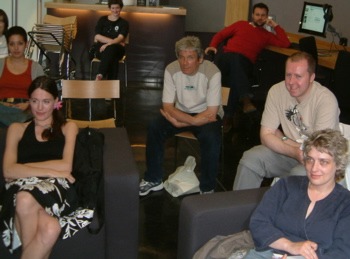
I have just got back to London after spending the night in more northern parts, where I gave a talk about blogs and blogging at Liverpool’s rather swanky new downtown FACT (Film, Art & Creative Technology) centre.
Many people are looking for the FACTs about blogging in Liverpool
It is good to proselytize the joys of blogging to a wider audience. Although though the audience was rather technology savvy, blogging was a completely concept to many of the people there. Also interesting was to see a couple people in the media lounge where I turned up to give my talk reading Salam Pax’s blog.
On a day in which an article in The Times notes the power of blogging to scare the living daylights out of some sections of the established media and quotes blogger Mickey Kaus, it is interesting to see our blogger-in-arms in Iraq helping to raise the profile of blogging generally in places like Liverpool.
I even managed to meet a new potential client for my latest business endeavor, a blogging consultancy that will show companies how blogs can greatly assist their businesses. Together with two fellow Samizdatistas David Carr and Adriana Cronin, who was the one who thought up and elaborated the idea, we have started a new venture called the Big Blog Company.
Blogs are increasingly starting to enter the public consciousness … we are spreading like a virus but are much more fun that SARS
Phil Zimmermann, the man who in the early 90s developed the Pretty Good Privacy (PGP) encryption product, believes that Moore’s Law and surveillance cameras make for a particularly dangerous cocktail, as reported by ZDNet.
Moore’s Law represents a “blind force” that is fuelling an undirected technology escalation, referring to what he sees as the threat to privacy from the increased use of surveillance cameras.
The human population does not double every 18 months but its ability to use computers to keep track of us does. You can’t encrypt your face.
Zimmerman sees surveillance as the biggest threat to civil liberties and nowhere, he believes, is this more egregious than in the UK.
You have millions of CCTV cameras here. Every citizen is monitored, and this creates pressure to adhere to conformist behaviour. The original purpose of cameras was to catch terrorists, but to my knowledge they haven’t caught many terrorists using cameras.
Another problem with using technology for surveillance according to Zimmermann is that while laws that are brought in during times of a perceived increase in threats to national security, they can be relatively easily repealed. I find it hard to believe that anything can be more inert and irrepealable than laws but his point about technology still holds:
The technology market doesn’t work that way. It has more inertia, and is more insidious. When you put computer technology behind surveillance apparatus, the problem gets worse.
People involved in political arguments often argue as if arguments are the entire point. Yet the current disputes within the USA, within Britain, and between the USA and “Europe” are as much about who we are, as they are about who is right.
Take France. Ruled by a bunch of sleazebags, right? Their “arguments” for not going to war against Iraq were, if that’s the way you are inclined to think, feeble in the extreme. X ergo Y and therefore it follows Z, blah blah blah.
But what if the real arguments now are not about who is right, but about who we are?
One of the oddities of British life is the extraordinary expensiveness and dramatic complexity of British TV car adverts. Something to do with a car cartel, I believe, which means there’s money to burn getting each buyer to step forward. And one TV car advert in particular goes straight to the heart of the France question, and the “who we are” question. I refer to the one that advertises the Renault Clio, by claiming that this car possesses “va-va-woom”. Various other things do also, like posh French-type birds posing in Mies van der Rohe style modern houses, while various other things don’t, like an over-coiffured small dog, and a strange looking character wearing nothing but a pair of stars-and-stripes bathing trunks and a cowboy hat, and waving guns.
This last one is so ghastly an apparition that Thierry Henry – the ultra-skilled black French footballer who plays for Arsenal (and France) with great distinction and who is in amongst all this, narrating with good humoured subtlety – just stares blankly into the camera. That’s all the comment we need. Those ghastly cowboys are just, you know, ghastly, while those (us) continentals are so suave and sophisticated and cultured.
It’s also a clever ploy to use a black man for all this, because smuggled in there (but totally deniable) is the suggestion that the cowboy is probably the type of hick who’d be bothered by Thierry Henry’s blackness, whereas you, oh viewer, are not, are you? Maybe I’m reading too much into things there, but I don’t think so.
What the advertisers are betting on is that there are a lot of Brits who think of themselves most definitely as on the French side of the France/Anglosphere confrontation, and who are willing to put large wads of money where their preferred identify is. And there surely are. This advert has been running for quite some time, and they’d have pulled it by now if it didn’t do the business. If Renault’s sold better by being smothered in Union Jacks and sat in by British bulldogs, then that’s what they’d have. Lots of Japanese companies sell stuff by waving the Union Jack and sponsoring ultra-British things like show-jumping.
Samuel Huntington (in Clash of Civilisations) saw all this kind of thing coming. He saw that whereas the communism/capitalism thing was about who and what was right (X ergo Y), now it’s all about who and what we are. This, for example, is what the Euro argument is really about. “Economic interests” have nothing to do with it. Who we are is what that is about.
And this is why, in this new world, “we” (whoever, exactly “we” are) need to go beyond the narrow logicality of political debate – beyond X ergo Y, into the territory of cultural affinities and coolnesses, the territory of who has va-va-voom and who does not.
This is why blogging is such a crucial addition to our persuasive arsenal. We can argue on our blogs. And, as part of and in among and in between the arguing, we can tease out the va-va-voom of things.
I never know with Samizdata postings whether there’ll be lots of comments, or some, or hardly any, or none. If there are comments on this, no doubt some will be easily summarisable: “I’m not French!!” But I’m hoping that others may be more nuanced.
There is a lot of remarkable news in Gabriel Syme’s posting about Sabine Herold, the young French woman who is spear-heading a brave fightback against the bolshevik hegemony that squats on her country like a poisonous toad.
That someone so young should be prepared to shoulder such a herculean (or perhaps even quixotic) task should be enough to earn her unqualified praise but what takes her stance onto a higher plane of bravery is the fact that she is prepared to do this openly. As this e-mail letter sent to Steve Den Beste reveals, France is a country where dissent against the prevailing orthodoxy is really dangerous:
As you may now, France is now undergoing a series of strikes protesting the government’s pension reform. Among the strikers, the Communist Union “Confederation Générale du Travail” is using unacceptable methods that violate the most basic human rights. Today it has vandalized and burnt the employers’ union offices in several cities. Worse, this organization has prevented, in the city where I leave, a meeting by a democratic political party and violently intervened in a demonstration by people who protested the strike, in order to make sure that demonstration would fail.
Furthermore, the government is taking no steps to maintain public order and guarantee people’s freedom of goverment and expression. The city of Toulouse was blocked during the morning of yesterday and not a single step was taken by public authorities to end this blocking. On the contrary, the police collaborated with the unions in order to make sure that people could not pass. In the demonstration I just mentioned, not a policeman was dispatched to protect us against the assaults of the communist union’s members.
I realize that this is small stuff compared to the atrocities taking place in several countries. Nevertheless it is taking place right in the middle of Europe and it would be of great help if this state of things were publicized by your organization. I can provide you with further testimonies about the events I am referring to, if needed. We badly need the help of the international community in fighting these constant violation of human rights by the communist union.
Yes, this is happening right smack dab in the heart of ‘civilised, sophisticated, nuanced’ Europe. What a stark contrast it provides to the baseless squealing of the spoilt brats of Hollywood as they wrap themselves in cloaks of martyrdom at the first sign of a drop in CD sales. France is a country where it is not just your dissent that can get crushed; you can get crushed along with it. → Continue reading: Le coeur de l’obscurite
The Samizdata people are a bunch of sinister and heavily armed globalist illuminati who seek to infect the entire world with the values of personal liberty and several property. Amongst our many crimes is a sense of humour and the intermittent use of British spelling.
We are also a varied group made up of social individualists, classical liberals, whigs, libertarians, extropians, futurists, ‘Porcupines’, Karl Popper fetishists, recovering neo-conservatives, crazed Ayn Rand worshipers, over-caffeinated Virginia Postrel devotees, witty Frédéric Bastiat wannabes, cypherpunks, minarchists, kritarchists and wild-eyed anarcho-capitalists from Britain, North America, Australia and Europe.
All content on this website (including text, photographs, audio files, and any other original works), unless otherwise noted, is licensed under a Creative Commons License. Powered by WordPress & Atahualpa







Recent Comments