We are developing the social individualist meta-context for the future. From the very serious to the extremely frivolous... lets see what is on the mind of the Samizdata people.
Samizdata, derived from Samizdat /n. - a system of clandestine publication of banned literature in the USSR [Russ.,= self-publishing house]
|
The Chancellor Gordon Brown has long been hailed as an economic wonder, a giant, a prince among men; a proto-tyrant possibly, but nevertheless an economic God. What a load of old spoons. Those feckless Tory MPs in the House of Commons may be scared of his bombastic rhetoric, his curling lip, and his comprehensive knowledge of the canon of John Kenneth Galbraith; well, at least the idiot’s guide to John Kenneth Galbraith. But let me tell you of a tale, to put a sword to the lie of this risible greatness.
It began yesterday morning, at 10am. The phone rang. A certain Englishman, of Scottish, Irish, and Jewish extraction, picked up the phone.
“Yes?”
“Hello, is that Mrs Duncan?”
“No, who’s this?”
“It’s the Inland Revenue, in Liverpool. Can I ask you some questions?” The man panicked. Did he ‘owe’ £10,000 more in Corporation Tax? Had his company secretary, or accountant, failed to send in Form IR-XYP/9100/97/a.30, his thirtieth of the year? He decided to go for the polite response, in case this was being taped.
“Yes…”
“But first, you will need to answer some security questions…” → Continue reading: Tales from the kingdom of the mad
As British citizens we have very little actual power to influence government. One weapon we do have is words, that’s why we write blogs. However if we’re honest the impact is small. Only a tiny proportion of the population will ever read any blog at all. Most will read ones they agree with – we’re largely preaching to the converted.
What we need to do is take our words out on to the street – to get other people using them for us. We can do that not with lengthy arguments or rants but with simple phrases that encapsulate our position. Soundbites, memes, call them what you will. Politicians, advertisers and the media all know the power of a simple slogan: “Things can only get better”, “Beanz Meanz Heinz”, “the innocent have nothing to fear”…
The term I want to popularise is Big Blunkett. David Blunkett is an authoritarian Home Secretary who believes in monitoring innocent citizens. He is responsible for some of the worst threats to civil liberties this country has seen for many years. In particular he seems determined to introduce compulsory National Identity Cards – yet the average person on the street seems unaware of the threat he poses.
I’m not trying to offend or hurt David Blunkett personally. He might be a really nice man socially – but as a politician he is dangerous. The thought that he might become Prime Minister is frightening.
The expression “Big Blunkett” sums up the dangers simply and effectively, especially in the Orwell centenary year. When people hear the name David Blunkett they should automatically think “Big Brother”. The fact that Blunkett is blind simply adds irony and provides a talking point.
I want to get “Big Blunkett” into common usage and I want to do it fast – time is running out. Please help me. Use the term “Big Blunkett” at every opportunity. Use it with your mates down the pub, use it in your blogs, use it in letters/emails to the media. If you’re a journalist use it in your reports, even if only to the extent of saying “some people are calling him ‘Big Blunkett'”. I search Google daily for the phrase “Big Blunkett”, hopefully soon I’ll find 5000 entries instead of just 5.
Words can make a difference. Let’s use them.
I don’t want Big Blunkett watching me.
Cross-posted from An It Harm None and the brand new Big Blunkett blog.
The Sunday Times reports that in a leaked letter Home Secretary David Blunkett describes the case for Compulsory National Identity Cards as “overwhelming”.
Citizens would pay £39 for the privilege of carrying a card containing biometric information. It would not be compulsory to carry your card at all times however you would have to show it to the police within a few days of demand. So don’t forget to take it with you if you’re on holiday.
Blunkett adds that “a highly organised minority” would “campaign vocally” against the cards.
Too right we will. This plan is a serious threat to civil liberties in Britain and must be stopped.
Cross-posted from The Chestnut Tree Cafe
The article on the ST site appears unavailable just now, you can read the BBC summary.
As usual, it starts with a scrum of bloggers descending on the beer and chili…
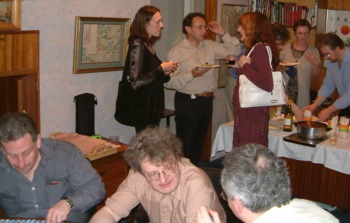
Glug, glug, munch, munch
Shockingly, many of the bloggers discussed… BLOGGING!

Patrick Crozier, Natalie Solent, Stephen Pollard
Eventually numbers and the need to smoke causes the proceedings to explode out into the garden. Many curses were uttered at the people responsible for the absence of Andrew Dodge and Sasha…
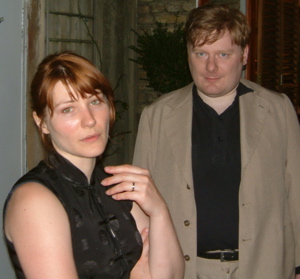
My… what big eyes you have!
Much beer was consumed…

I was only resting!
It is now 02:30 in the morning and strangely, people are starting to demand more chili!
Why aren’t you people tired yet? Will it never end???
Update: Over a dozen of the hard core are still here…

The Transportblog Team: would you buy a train ticket from this lot?
Nearly 04:00 in the morning and at least one intrepid blogger has passed out in The Comfie Chair…
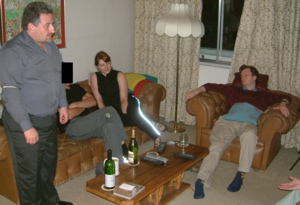
Don’t you people have blogs to write for?
DissidentFrogman’s face is censored to protect the guilty
Final update: The grizzled hardcore diehards finally staggered off into London’s cold morning air at the first warning glow of daylight, a few minutes past 05:00 this morning…

Another highly successful British Blogger Bash!
verb. To use one’s blog to beg for assistance (usually for information, occasionally for money). One who does so is a ‘blegger’. Usually intended as humorous.
This article is from nearly a week ago, but it is of interest still, I think:
Newspaper owners responsible for publishing racist or xenophobic articles in Britain are to be protected from being sent for trials abroad under government plans to soften the impact of the new Extradition Bill.
Ministers will introduce amendments today to tough European-wide laws that allow courts to extradite EU citizens accused of committing one of 32 generic criminal offences.
Concerns raised by the media that they could fall foul of the new law when it comes into force in January have prompted the Government to act to remove the threat of prosecution.
The Bill makes “xenophobia and racism” one of 32 crimes for which a British citizen can be sent for trial in another EU country – such as Germany or Austria, where it is illegal – although there is no such standalone offence in this country.
But because British newspapers are sold abroad and their articles are published on the internet, editors and their proprietors could face prosecution for racist offences committed in this country.
I can’t say I understand the full ramification of this, but my brain is abuzz with questions.
For instance. Will these amendments apply only to newspaper proprietors, or will, for example, the proprietors of group blogs be exempt also, in similar circumstances? If one of us junior contributors here did a White Rose posting that the government of Austria deemed to be xenophobic or racist, would Gabriel and Perry, the named organisers of White Rose, then still be in the firing line? Or do these amendments apply to them as well?
Looking at the larger picture here, the stink of this piece is that “Europe” is a place where what seems to matter is not what you have done but who you are.
What’s so special about these newspaper proprietors, other than that they have the power to affect the fortunes of major politicians? Are they like the drivers of fire engines needing to exceed the regular speed limits? I suppose they would argue that, metaphorically speaking, this is indeed what they are, sort of. They are our protectors, and therefore they themselves need special protection.
But one fears, on the contrary, that maybe these big media newspapers may ease off on their concern-raising about the other 31 of those 32 generic criminal offences – and about, you know, things in general – just so long as they themselves are not directly threatened by the new arrangements. One fears, in other words, that in exchange for their own protection, they’ll relax about protecting the rest of us.
Still, at least the Indy gave these other 31 criminal offences a passing mention. Can anyone say, or point to a place which does say, what they all are?
Silvio Berlusconi has crossed the line. It was bad enough that he is wealthy businessman and not a bureaucrat. His right-of-centre views are distasteful but containable. Even his support for America could be overlooked in the circumstances.
But, now, Berlusconi has gone too far. He has brought disharmony to Brussels and insulted a left-wing Eurocrat. That is beyond the pale. That is unforgiveable. Now he must be destroyed:
Even if he is voted out at the next election, the damage that has been done to Italian democracy will be difficult to repair. Should he remain in office, the prospects are grim indeed. It is time Europe woke up to the threat Berlusconi poses. He is not just another rightwing politician; he represents the greatest challenge to democracy anywhere in Europe.
As evidenced by this frothing-at-the-mouth, hysterical denouncement in the Guardian, the lefties have struck up the cogs, wheels and pistons of their considerable propoganda machine to churn away at full steam and not stop until Berlusconi has been drawn into the mincer and disposed of.
This is not going to be allowed to simply blow over. You cannot commit the ultimate crime of cocking a snoot at the Euro-left and expect to get away with it. Over the coming months the left will deploy the entire range of their customary demonology against Berlusconi in the same way they have deployed it against George Bush. In fact, Berlusconi is now the George Bush of Europe.
Signor Berlusconi has got a lot of money and a lot of moxy but what he needs most of all now is a set of brass balls. I hope he has got those too.
Sharon Stone is getting divorced. Not good news for Sharon but a significant chunk of the rest of the planet rejoices at the news she is ‘back on the market’.

45 years old and still hot
Update: As a commenter reminded me… “Consider that a divorce”
I’m afraid I don’t have a link for this – the FT’s web-site wouldn’t let me find the story. One of their columnists suggested a way to beat spam: this is roughly the gist:
Each ISP identifies mail addressed to more than, say, 100 receipients. An employee retained for the purpose glances at the mail, and accepts or rejects the mail. This should be relatively easy, as most spam is readily spotted, compared to mailing list entries, etc.
The employee reviews, say, 1 a minute, for 7 hours a day, stopping 60 * 7 * 100 = 42,000 pieces of spam a day. Over a 200 day working year, and at a salary of say £20,000, that works out at about a quarter of a penny per spam stopped.
The author went on to suggest given the global volume of spam, only a couple of people would be needed to stop it all. This seems fallacious, as EACH ISP would need to employee their own blockers.
I think most people reading this site would see the implications for privacy – ISPs would (perhaps be legally required to) read any mail sent to large numbers of individuals. This is not something I’d look forward to.
Hopefully, the idea will die the death of a thousand rapidly knocked up columns, but it’s worrying that privacy didn’t even strike the writer (or his editor) as an issue. Particularly as, once the proposal had been brought in, there would be a natural pressure to reduce the number of receipients that “triggered” checking. Spammers would drop the size of their mailings, and so the checkers would have to look at an ever higher proportion of mails to have any effect.
In a welcome turnabout for US citizens, MIT has launched the Government Information Awareness website.
The website developer Ryan McKinley explains
“Our goal is develop a technology which empowers citizens to form their own intelligence agency; to gather, sort and act on information they gather about the government,” said MIT graduate student Ryan McKinley, who developed GIA under the direction of Christopher Csikszentmihályi, an assistant professor at the MIT Media Lab’s Computing Culture group.
“Only by employing such technologies can we hope to have a government by the people and for the people,” McKinley said.
The method that McKinley uses is pilfered straight from the government itself.
GIA site users can submit information about public figures and government programs anonymously. In an attempt to ensure the accuracy of submitted data, the system automatically contacts the appropriate government officials and offers them an opportunity to confirm or deny submitted data.
But like an FBI file, information is not purged if the subject denies its veracity; the denial is simply added to the file. McKinley wryly added that those government officials who have nothing to hide have nothing to fear from GIA.
A nice touch!
The site itself is a bit limited; also, when I tried it out it was very slow. It might have underestimated the demand for it. This is a work in progress, but it’s a great start. This gives Big Brother a taste of his own medicine, and we need something like this in Australia.
Cross posted at The Eye of the Beholder
I must commend the BBC for not allowing the victims of the Bali massacre to be forgotten. Indeed, they have devoted a whole page on their website to the father of one of the young victims; a man who displays far more magnanimity than I could ever muster:
“Directly after the Bali bombing, it became apparent to us that ignorance and mistrust between people of different nations, faiths and backgrounds around the world fosters prejudice and hatred,” Mr Braden said.
Mr Braden said he did not feel hatred for his son’s killers, but sorry that they did not have the education and life Daniel had.
The BBC doubtless felt that Mr.Braden’s thoughts were worth sharing with the world. And they are. But, strangely, no mention whatsoever about the thoughts and feelings of some of the other victims:
Unrepentant Bali survivor Jake Ryan said he was overwhelmed by raw emotion when he loudly abused an alleged bomber in a Denpasar courtroom.
Accompanied by his brother Mitchell, Mr Ryan reacted to Samudra’s religious chants by screaming: “You’re a fucking dog, mate. You’re going to fucking die.”
Clearly Mr.Ryan wasn’t ‘repentant’ enough.
[My thanks to Tim Blair for the link to the article on Mr.Ryan.]
|
Who Are We? The Samizdata people are a bunch of sinister and heavily armed globalist illuminati who seek to infect the entire world with the values of personal liberty and several property. Amongst our many crimes is a sense of humour and the intermittent use of British spelling.
We are also a varied group made up of social individualists, classical liberals, whigs, libertarians, extropians, futurists, ‘Porcupines’, Karl Popper fetishists, recovering neo-conservatives, crazed Ayn Rand worshipers, over-caffeinated Virginia Postrel devotees, witty Frédéric Bastiat wannabes, cypherpunks, minarchists, kritarchists and wild-eyed anarcho-capitalists from Britain, North America, Australia and Europe.
|







Recent Comments