We are developing the social individualist meta-context for the future. From the very serious to the extremely frivolous... lets see what is on the mind of the Samizdata people.
Samizdata, derived from Samizdat /n. - a system of clandestine publication of banned literature in the USSR [Russ.,= self-publishing house]
|
I think they have been having a day of broody reflection over at the Daily Social Worker.
Peter Mandelson says:
Political projects that fail to renew themselves are soon swept away and deserve to be. That won’t be allowed to happen with New Labour. It is one reason why the progressive governance conference, which starts on Friday, comes at a crucial time for the international centre-left.
Meanwhile, Jeanette Winterson says:
How could we double spending on schools? We could start by abandoning the fetish of higher education, where armies of illiterate, innumerate kids are signed on to courses that are as useless as they are. Why are the kids useless? They haven’t been taught properly in school. Why haven’t they been taught properly in school? No money. So why do we insist on university targets when we aren’t able to educate all children at a basic level?
A far cry from all the smug triumphalism of the late 90’s, isn’t it. And is it just me or do I detect that these people are gripped by a mounting sense of panic? Perhaps even they have have realised that they have run out of ideas and that they need to clutch at something, anything before their entire project unravels.
Or maybe I am reading too much into it.
Although there was a debate a little while ago in the UK about the desirability (or otherwise) of state-funded political parties it did not generate a great deal of interest and quickly subsided.
However, and by default, the argument is now over because we find that we have a state-funded political party that evolved all by itself. This new party is called the BBC and it is currently engaged in a locked-horns, blood-spattered confrontation with the government over the Iraq war:
THE BBC last night defiantly reasserted its independence and impartiality last night as it insisted that it was right to broadcast claims that Downing Street had “sexed up” a dossier on Iraq’s weapons.
The corporation’s governors issued the strongly worded statement as No 10 urged the BBC not to prolong its extraordinary row with the Government by standing by “demonstrably untrue” allegations.
[From UK Times so no link.]
This is nothing but nothing but good. I am relishing every single second of this catfight; revelling in every bit of mutual recrimination and celebrating every reciprocal allegation of skulduggery and deceit. It is all so glorious.
The government will probably win out in the short term and force the BBC into a humiliating climbdown but that is just the start of the fun. If Blair and his chums knew anything about the true use of political power they would then proceed to shut down the BBC and sell off the broadcasting rights to someone like Rupert Murdoch (or, better still, Silvio Berlusconi). But, because they are the Labour Party, they won’t do that. Instead, they will leave it at that and the BBC, like wounded beast, will seek revenge by campaigning against the government from the left.
Meanwhile, we sit on the hill and watch the tigers fight in the valley.
Samizdata.net’s many spies have told us that these are being stockpiled in Iran for use during the coming ‘transitional times’.
After recovering from the revelries at the blogger bash, there was no better way to unwind than enjoy a trip down to Greenwich, east London, and wander around the superb clipper sailing ship in dry dock, the Cutty Sark.
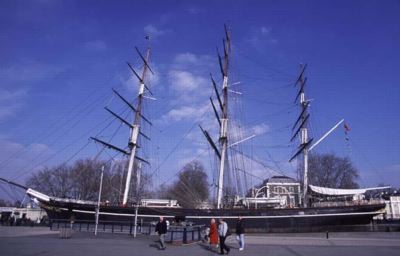
This three-masted, square-rigged jewel of 19th century sailing technology was built to carry goods like Chinese tea, Australian wool and other products at high speed to London. The vessel that could moor up at the great port of London ahead of the competition would get the best prices for its produce. These great beasts of the high seas were sailed with the kind of white-knuckle speed and skill that would put a modern America’s Cup yacht race to shame. They often frequently would beat steam-driven vessels over comparable distances.
When we think about today’s rows about globalisation it is easy to assume that so many aspects of economic life are new. They are not. Our Victorian forbears already conducted trade on a vast scale. Ships such as the Cutty Sark commonly had cosmopolitan crews from countries across the world. There were very few regulations governing who could join up as a merchant seaman.
Of course, many aspects of life have improved since then. I dread to think what it must have been like to climb aloft the Cutty Sark’s mainmast in a gale to reef in a sail with the ship rolling about – and you can forget anything like safety harnesses. But these men enjoyed an enterprising life which at times makes yours truly almost feel quite jealous.
Commenting on David Blunkett’s proposal for a £40 compulsory ID card, Liberty spokesman Barry Hugill said:
The real beneficiary of such a policy will be the fraudsters who will make a fortune selling forged cards. There is no evidence that ID cards lead to a reduction in crime yet the Government is contemplating spending at least £1.5bn on the scheme.
This is a Government that cannot manage to pay tax credits, deliver passports or enforce child maintenance payments without catastrophic system failure. Does anyone seriously believe it could manage something as technologically complex as a national ID card?’
Liberty
A leaked memo revealed that David Blunkett is pushing the Cabinet to back national identity cards for everyone aged 16 and over, carrying biometric information, such as fingerprints, to allow police to confirm the holder’s identity. Under Mr Blunkett’s scheme, the card will cost £39 for most people between the ages of 17 and 75.
An opinion piece about the identity cards news in Telegraph is yet again explaining what is wrong with Blunkett’s argument. Basically, each of the claims made by the Home Secretary in support of his pet scheme is wrong.
- First, Mr Blunkett says that there is strong public support for the idea. In fact, the Home Office’s recent consultation exercise focused on the concept of an entitlement card, a very different prospect. (Also, according to this Out-law article, the goverment has admited that the public opposes the ID card scheme.)
- The Home Secretary goes on to argue ID cards will help fight crime. This is one of those assertions that is forever being made, but hardly ever substantiated… The public mood is said to have changed since September 11, 2001, but no one has explained – or even seriously tried to explain – how ID cards would have thwarted those bombers, many of whom died in possession of forged papers.
- Nor, by the way, are ID cards a solution to illegal immigration. The root of the asylum problem is not that we cannot find clandestine entrants, but that we never enforce their deportation.
- More faulty still is Mr Blunkett’s central proposition, as set out in a letter to his Cabinet colleagues: “The argument that identity cards will inhibit our freedom is wrong. We are strengthened in our liberty if our identity is protected from theft; if we are able to access the services we are entitled to; and if our community is better protected from terrorists.” In an appendix to Nineteen Eighty-Four, Orwell describes how a concept can be traduced if the words used to express it lose their meaning. The example he gives, uncannily, is the word “free”. Now here is Mr Blunkett using “freedom” to mean more state control.
- Any doubts as to the wisdom of the scheme must surely be removed by the Home Secretary’s final argument in its favour: that we are “out of kilter with Europe”. Indeed we are, thank heaven. Policemen in Britain are seen as citizens in uniform, not agents of the government.
The most worrying is Blunkett’s spin on the concept of freedom. In his view we are strengthened in our liberty if our identity is protected from theft; if we are able to access the services we are entitled to; and if our community is better protected from terrorists. This is vaguely based on the distinction between negative and positive liberty, which are not merely two distinct kinds of liberty; they can be seen as rival, incompatible interpretations of a single political ideal.
Negative liberty is the absence of obstacles, barriers or constraints. One has negative liberty to the extent that actions are available to one in this negative sense. Positive liberty is the possibility of acting – or the fact of acting – in such a way as to take control of one’s life and realize one’s fundamental purposes. While negative liberty is usually attributed to individual agents, positive liberty is sometimes attributed to collectivities, or to individuals considered primarily as members of given collectivities.
Blunkett and his New Labour chums are classic and rather unexceptional anti-liberals. (I use the term liberal in its original meaning, based on negative definition of liberty and claiming that in order to protect individual liberty one should place strong limitations on the activities of the state.) In Blunkett’s mind, the pursuit of liberty (whether of the individual or of the collectivity) requires state intervention, which, by definition, is not contradictory with limitations on personal freedom. As a result, the protests of civil liberties groups do not make sense to him.
The concept of freedom as being unprevented from doing whatever one might desire to do is alien to him. According to Isaiah Berlin the defender of positive freedom will take an additional step that consists in conceiving of the self as wider than the individual and as represented by an organic social whole – “a tribe, a race, a church, a state, the great society of the living and the dead and the yet unborn”. The true interests of the individual are to be identified with the interests of this whole, and individuals can and should be coerced into fulfilling these interests, for they would not resist coercion if they were as rational and wise as their coercers.
I will not grant Blunkett’s social and political philosophy such level of ‘sophistication’. I will say that his are the simple and toxic insticts of a collectivist and a statist and that those protesting policies based on them will have their words muffled by the Big Blunkett.
Cross-posted from White Rose
An opinion piece about the identity cards news in Telegraph is yet again explaining what is wrong with Blunkett’s argument. Basically, each of the claims made by the Home Secretary in support of his pet scheme is wrong.
- First, Mr Blunkett says that there is strong public support for the idea. In fact, the Home Office’s recent consultation exercise focused on the concept of an entitlement card, a very different prospect. (Also, according to this Out-law article, the goverment has admited that the public opposes the ID card scheme.)
- The Home Secretary goes on to argue ID cards will help fight crime. This is one of those assertions that is forever being made, but hardly ever substantiated… The public mood is said to have changed since September 11, 2001, but no one has explained – or even seriously tried to explain – how ID cards would have thwarted those bombers, many of whom died in possession of forged papers.
- Nor, by the way, are ID cards a solution to illegal immigration. The root of the asylum problem is not that we cannot find clandestine entrants, but that we never enforce their deportation.
- More faulty still is Mr Blunkett’s central proposition, as set out in a letter to his Cabinet colleagues: “The argument that identity cards will inhibit our freedom is wrong. We are strengthened in our liberty if our identity is protected from theft; if we are able to access the services we are entitled to; and if our community is better protected from terrorists.” In an appendix to Nineteen Eighty-Four, Orwell describes how a concept can be traduced if the words used to express it lose their meaning. The example he gives, uncannily, is the word “free”. Now here is Mr Blunkett using “freedom” to mean more state control.
- Any doubts as to the wisdom of the scheme must surely be removed by the Home Secretary’s final argument in its favour: that we are “out of kilter with Europe”. Indeed we are, thank heaven. Policemen in Britain are seen as citizens in uniform, not agents of the government.
The most worrying is Blunkett’s spin on the concept of freedom. In his view we are strengthened in our liberty if our identity is protected from theft; if we are able to access the services we are entitled to; and if our community is better protected from terrorists. This is vaguely based on the distinction between negative and positive liberty, which are not merely two distinct kinds of liberty; they can be seen as rival, incompatible interpretations of a single political ideal.
Negative liberty is the absence of obstacles, barriers or constraints. One has negative liberty to the extent that actions are available to one in this negative sense. Positive liberty is the possibility of acting – or the fact of acting – in such a way as to take control of one’s life and realize one’s fundamental purposes. While negative liberty is usually attributed to individual agents, positive liberty is sometimes attributed to collectivities, or to individuals considered primarily as members of given collectivities.
Blunkett and his New Labour chums are classic and rather unexceptional anti-liberals. I use the term liberal in its original meaning, based on negative definition of liberty and claiming that in order to protect individual liberty one should place strong limitations on the activities of the state. In Blunkett’s mind, the pursuit of liberty (whether of the individual or of the collectivity) requires state intervention, which, by definition, is not contradictory with limitations on personal freedom. As a result, the protests of civil liberties groups do not make sense to him.
The concept of freedom as being unprevented from doing whatever one might desire to do is alien to him. According to Isaiah Berlin the defender of positive freedom will take an additional step that consists in conceiving of the self as wider than the individual and as represented by an organic social whole – “a tribe, a race, a church, a state, the great society of the living and the dead and the yet unborn”. The true interests of the individual are to be identified with the interests of this whole, and individuals can and should be coerced into fulfilling these interests, for they would not resist coercion if they were as rational and wise as their coercers.
I will not grant Blunkett’s social and political philosophy such level of ‘sophistication’. I will say that his are the simple and toxic insticts of a collectivist and a statist and that those protesting policies based on them will have their words muffled by the Big Blunkett.
My chum Julian, who is a prince amongst men, contrived to acquire me a copy of Lara Croft’s latest outing for the PC… Tomb Raider: Angel of Darkness. I have been very keen to see what could be done with this franchise now that all aspects of games technology have advanced so far.
Alas, although I am only about a third of the way through it so far, I am mightily unimpressed. The graphics are downright primitive: there is simply no excuse for representing tree branches and foliage with 2-D sprites these days. Character models are boringly drawn, lack detail and either do not lip-synch at all or do so very badly. Two female character in the part I have just finished use exactly the same face model, hands look like baseball gloves … if graphically speaking U2003 powered ‘Splinter Cell’ is the current state of the art, then Tomb Raider: Angel of Darkness is at least two years behind the curve. It is little more than a re-hash of the last Tomb Raider, which was looking tired even back then. The some of the graphics purporting to show the game on the Internet are misleading to put it mildly. If there is a way to get it to look that way I have yet to discover it. And yes, I am using a fairly high-end PC with a good graphics card and half a gig of RAM.
Additionally, the voice acting is flat, the controls are a f**king nightmare when attempting precise manoeuvres, camera control is dreadful and sometimes simply does not work at all, the story line is just a re-hash of all that went before it… in short, the whole bloody thing is un-engaging and frustrating.
To make matters worse, the program is buggy as hell, with entire documented features apparently unimplemented (I have yet to get ‘sprint’ to work no matter what key I map it to and unarmed combat does not seem to do much either). One character (a bartender) chats to Lara whilst appearing to be turned inside-out and all manner of graphic anomalies are scattered throughout the game, strongly suggesting extremely sloppy beta testing by the makers. I honestly cannot think of a single positive thing to say about this game.
I will probably complete the game regardless but if they had managed as much humour and snappy dialogue as someone did with the promotional stuff for the game, I might not be playing with gritted teeth.
Given that the ‘Lara Croft’ franchise is such a valuable property, if I was a shareholder with money invested in this I would be looking for boardroom-heads-on-spikes about now. I am very glad I got this game as a present but I would not recommend it to anyone. Save your pounds/bucks/euros etc. and wait for Half Life 2 and Deus Ex: Invisible War.
In response to another European Directive, the supine government of Her Majesty, will later today impose Workers Councils upon all companies employing 150 workers, or more. In 2008, the same regulations will apply to all companies with 50 workers, or more. No doubt, now this principle has been established, it will apply to my hiring of a single plumber, in the fullness of time.
Employers will be obliged to consult these councils on any change of company ownership, or on any change in the numbers of staff employed by the company; no doubt, this workers’ control will ultimately govern every minute decision taken by any employer, as the ratchet tightens itself further. This will, obviously, usher in a period of wealth, happiness, and economic harmony, as they currently possess in the rest of the mainstream EU. Like in Germany, and in France, for instance.
It seems now, that when I hire someone, by the hour, to carry out a task for me, not only do I have to compensate them, at an agreed rate, for the disutility of their labour, but I also become in thrall to them. I have to ask them whether I can suspend their employment, offer them less cash per hour, or sell my own property. Excellent. This won’t encourage me to invest offshore, invest onshore using more capital-intensive robotics, or sack more workers until I get down to a maximum of 49 people, or whatever the next minimum is. It won’t do any of that, no. It’s all been thought through.
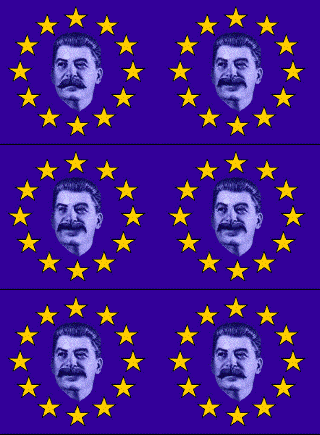
It also offers another splendid opportunity we cannot afford to miss. As the EU expands to the east, taking in countries such as Turkey, Cyprus, Siberia, and so on, the word European becomes increasingly redundant. We could replace the whole phrase with Union. But this single word looks a little lonely, by itself, a little doubtful. To give it some added strength, let’s uniquely identify what kind of union we have, by the addition of a description of its dominant economic philosophy. This gives us, the Workers Council Union. (You may be able to guess where this is going  ) )
Now, as we expand to the east, we need to make our Russian brethren (or comrades), feel a little more included. They’ve always felt a bit out on a limb, so I think we should take this opportunity to make them feel more at home. So let’s rename this new improved Union, in their honour. (This also takes us away from the evil English language of the American capitalists.)
So the Workers Council Union becomes the Rabochiy Sovyet Union. Which looks good so far. But brainstorming it even further, isn’t this now a little bit too long? And isn’t that pronunciation a little difficult, particularly for the Germanic tongue? In the words of Jeremy Clarkson, yes. I think so. So let’s shorten it, and simplify that pronunciation at the same time, killing two birds with one stone. Et voila, we have arrived at the perfect social democracy we have been trying to achieve for all these years. Ladies and Gentlemen, I give you, please, a round of applause, the new Soviet Union!
At the risk of emulating the Roman Republic’s Cato, who added Carthago delenda est! (Carthage must be destroyed) to the end of every speech he made, or letter he wrote, I think I’m developing my own personal version. The sooner we are out of the EU, the better. It really cannot come soon enough.
The Telegraph reports that a leaked memo revealed that David Blunkett is pushing the Cabinet to back national identity cards for everyone aged 16 and over. The Home Secretary insists in a memo to Cabinet colleagues that rather than limiting freedom, his plan for ID cards would reinforce people’s sense of liberty by making it easier for them to use services and protecting them from criminals and terrorists.
It is understood that he wants to introduce legislation in the autumn to allow cards to be brought in within the next few years. A full Cabinet discussion is expected within the next fortnight.
Privacy International, the civil rights watchdog, will mount a campaign against the plans this week. Simon Davies, its director, said:
This is without doubt the most threatening issue for civil rights and freedoms since the Second World War.
I just caught a snippet news item on the BBC about how magazines are complaining about people browsing through their mags in the shops, and photoing favourite pages with their camera-portable-phones and immediately phoning them to their friends. Information theft! Couldn’t find anything about this on the BBC website, but maybe someone else can.
I think this presages the moment when it won’t only be Big Brother who wields surveillance cameras in the street. Everybody will be able to! And they’ll be able to phone in the footage to – I don’t know – their personal websites or something. It’ll get even more fun, if that’s the word, when the cameras are in people’s buttons or glasses and you won’t even know that someone is doing it.
This kind of thing is probably happening already, on the quiet. The real excitement happens when doing it becomes a teen fad, and it starts being known about, and argued about by people saying they have a right to do it. Which maybe they do. After all, the government does it.
What happens then? What will White Rose make of that.
I’ve always been better at questions than at answers.
The usual practice here is to denounce France, and certainly (with only occasional and admirable exceptions) the French, as one of God’s more incomprehensible derelictions of His creative duty. But this device, the Trottoir Roulant Rapide – which means “fast rolling pavement”, is, I think, impressive.
Science fiction buffs have long been able to read about such gadgets. At Heathrow, as in many other places I’m sure, there’s a slow rolling pavement, which makes your journey a bit less wearisome from the tube station to one of the terminals. And I seem to recall something similar connecting a couple of bits of the London Underground somewhere in the City, although I could be imaging that. But this TRR is an altogether more serious creation, because it is fast. It is rapide.
“People have to learn how to use it and that takes time,” the trottoir’s inventor, Anselme Cote, told BBC News Online.
He added that escalators had presented travellers with a similar challenge when they were first introduced.
People stepping directly on to the TRR would be sure to lose their balance, so they first have to be accelerated – and then decelerated again at the other end.
“The problem lies in the transitions; one has to glide from one phase to the next; we ask people not to move, but they are not used to it,” says Mr Cote.
“One must keep one’s feet flat between the two phases, but people walk. There’s a technique to it. But people get used to it very quickly.”
Fair enough. → Continue reading: A nouveau kind of trottoir
|
Who Are We? The Samizdata people are a bunch of sinister and heavily armed globalist illuminati who seek to infect the entire world with the values of personal liberty and several property. Amongst our many crimes is a sense of humour and the intermittent use of British spelling.
We are also a varied group made up of social individualists, classical liberals, whigs, libertarians, extropians, futurists, ‘Porcupines’, Karl Popper fetishists, recovering neo-conservatives, crazed Ayn Rand worshipers, over-caffeinated Virginia Postrel devotees, witty Frédéric Bastiat wannabes, cypherpunks, minarchists, kritarchists and wild-eyed anarcho-capitalists from Britain, North America, Australia and Europe.
|





Recent Comments