We are developing the social individualist meta-context for the future. From the very serious to the extremely frivolous... lets see what is on the mind of the Samizdata people.
Samizdata, derived from Samizdat /n. - a system of clandestine publication of banned literature in the USSR [Russ.,= self-publishing house]
|
It is Labor Day here in the US, and the inimitable Mark Steyn, as usual, hits the nail on the head in a delightful column extolling the virtues of capitalism and the purblind idiocy of the hard left:
The transformation of Labour Day, from a celebration of workers’ solidarity to a cook-out, is the perfect precis of the history of Anglo-American capitalism.
The new received wisdom — forcefully articulated by, among others, Maude Barlow’s Council of Canadians at the laugh-a-minute 2002 Johannesburg “Earth Summit” — is that the masses themselves are the problem. To the irritation of their self-appointed spokespersons, the oppressed masses refuse to stay oppressed. If they were still down in the basement chained to the great turbines, all would be well. But, instead, they insist on moving out of their tenements, getting homes with non-communal bathrooms, giving up the trolley car, putting a deposit down on a Honda Civic and driving to the mall. When it was just medieval dukes swanking about with that kind of high-end consumerist lifestyle, things were fine: That was “sustainable” prosperity.
There’s no such thing as “sustainable” development. Human progress and individual liberty have advanced on the backs of one unsustainable development after another: When we needed trees for heating and transportation, we chopped ’em down. Then we discovered oil, and the trees grew back. When the oil runs out, we won’t notice because our SUVs will be powered by something else. Bet on human ingenuity every time. We’re not animals, and it’s a cult as deranged as the screwiest fringe religion to insist we are. Earth’s most valuable resource is us.
The whole article is a wonderfully wicked skewering of modern-day tribunes of the oppressed. I will confirm from personal experience Mark’s observation that speaking with a trade unionist is a disorienting experience. Bare, unvarnished Marxism/Leninism is still on display, with much talk about oppression of workers and the evils of capitalism. Mind you, the average union worker is more likely to be oppressed by the credit card debt he ran up buying a new boat and widescreen TV than by his boss, but nevermind…
I posted information about the first drop test of Scaled Composite’s X-ship a few weeks ago. Here’s a photo of the spaceship on approach to the Mojave airport during that test.
 Photo: courtesy Scaled Composites
Continuing my tales of Bratislava…
One of the things I very much enjoyed was the food. Although a short visit of only a few days does not give my views much authority, I have to say that both the home cooked meals and restaurant victuals were really rather good. One restaurant in particular was so good that I would have to say it would make my top ten must-eat-at places anywhere I have been… and all modesty aside I am extremely well travelled. This splendid place is called Café Zichy (formerly known by the name ‘Harmonia’). The venison in plum sauce with puréed chestnut was sublime. I was also introduced to the splendours of Demänovka, the excellent local firewater. The service at the Zichy was informative and agreeable without being intrusive: the place is a mandatory visit when in Bratislava!
Another thing that caught my eye…
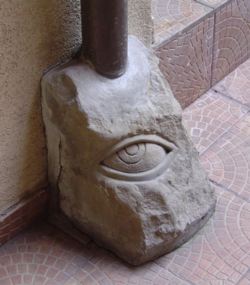
…is that if you pay attention, you can find interesting and idiosyncratic art all over the place. Some of it very modern and some of it very old indeed…
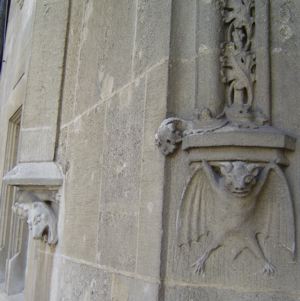
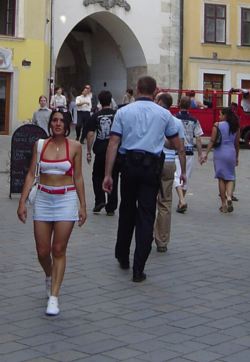
But as I have mentioned before, Bratislava is filled with the sort of distractions that can make a person miss such details…
During my meandering around the cobbled streets, I encountered the first dragon I saw in Bratislava: a rather fine golden dragon which happens to be the mark of a pharmacy…
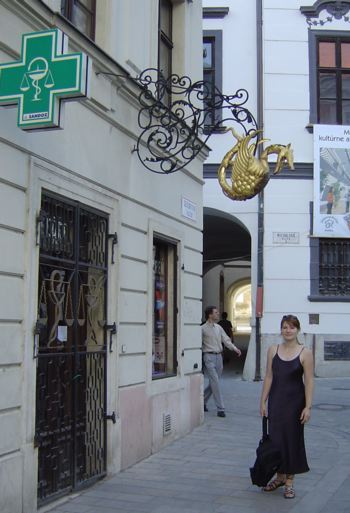
…and although I did not know it yet, it was the first indication I was about to fall madly in love, but more about that later 
Whenever I visit a new city, I always pay attention to the graffiti and political posters as I always believe it is worth seeing what ‘the others’ are saying. When I was passing though Vienna airport a few days earlier the only graffiti I saw was ‘EU NEIN’ engraved on the flusher in the men’s room…

Compared to Croatia, Slovenia and Bosnia-Herzegovina (the other part of the Slavic world in which I have considerable experience), Bratislava has much less of a problem with graffiti or flyposting. It was mildy interesting therefore that in Slovakia the only political posters I saw were for a rather incoherent group of ‘anarchists’ and a nameless call (in English) to ‘smash the reds’…


Warning sign number one… these ‘anarchists’ are waving their flags on May Day.
There may have been other political posters but the distractions on the streets of Bratislava are many and varied…
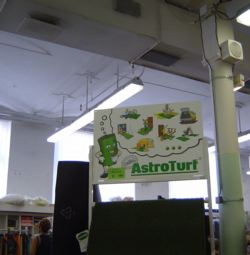
I saw an interesting sign of the transformations going on in Slovakia when I visited a carpet warehouse with my hostess, the mother of my travelling companion. The warehouse was until quite recently the Factory of MDZ (Medzinarodny Den Zien, or International Women’s Day)… an old style communist industrial collective. I was much amused to see that under its new capitalist management, it was advertising Astroturf, a quintessentially American product.
During our meanderings, we wandered past a rather typical gated Austro-Hungarian era courtyard and noticed a small sign directing us to something called ‘Gallery F7’. Being curious by nature, we went in and found at the far end, an exhibition of the work of an artist called Jozef Borovka… and that is where I well and truly fell in love.
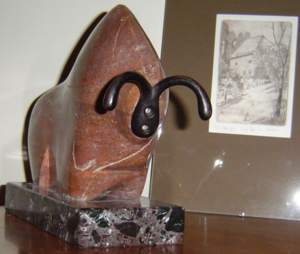
Borovka’s work was just fantastic. He is an extremely talented Slovak artist working in wood, stone, oil and pen and I would have happily walked off with almost every item that was on exhibit. As it happened, that day was the last day of the show and so we contacted the artist and arranged to purchase several of his works. The first we acquired was a superb and whimsical bison made of 5 kg (11 lbs) of stone with antlers made from a coat hook, the second was a pen and ink drawing of a rural house in the Slovak countryside, the third was a female torso in mahogany on a large brass base…
…and the last piece was a table… but, oh, what a table! This was the true object of my undying affections: the finest Dragon in Bratislava.
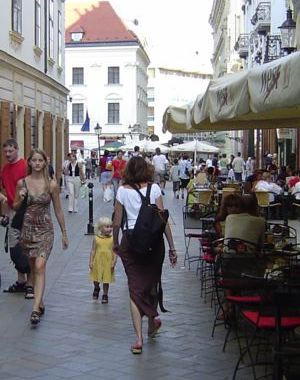
However seeing as we were flying on Air Berlin, which is El Cheapo No Frills Cattle Class Airlines personified, actually getting a honking great cherry wood, mahogany, glass and brass table that was very fragile back to London was rather a major problem. We explored shipping it back via DHL but that proved to be prohibitive on the grounds of price, so we retired to the many and wonderful cafés of Bratislava to ponder what to do and admire the passing parade…
More to follow…
Your intrepid correspondent (well, sort of) is filing this from Ramsgate on the Kent Coast where there appear to be some odd goings-on.
There is no way of telling whether or not any of this is connected in any way to yesterday’s security alert at Dover but, today, fully-armed, missile-laden RAF jets have been observed buzzing around the Kent Coast. I am advised that jet fighters are generally not armed if merely on exercise.
Also, this evening there have been widespread power blackouts in Dover and Deal although latest reports are that the power is now back on.
Coincidences? Connected? Sinister? Perfectly innocent? Who knows? Heading back to London shortly.
Following some rather personally difficult times, I was recently whisked off to foreign parts by a friend who decided I very badly needed to get out of London for a while to get my head together. And so, a day after a funeral and one of the worst days of my life here in London, I found myself on an Air Berlin BAe-146 aeroplane heading, indirectly, for Bratislava, the capital city of the Slovak Republic.
Due to the hasty nature of the flying arrangements, my friend and I travelled via Mönchengladbach (that’s near Düsseldorf, in Germany). As it happens, that 30 minute stop-over allowed me to see something to delight any aviation enthusiast… an airworthy Junkers 52!

From Germany we headed to Vienna, where we were picked up by my traveling companion’s mother and thence a short drive across the Austrian border to Bratislava.
Although I was very keen on getting a break from my surroundings, given that my friend had never really described Bratislava fondly (having grown up under communism does have that effect), I must say I did not have very high expectations, given the grey and bleak preamble I had received (I suspect my colleague is in no danger of being offered a job by the Slovak Tourist Agency).
Blimey… I was really in for a surprise!
Although surrounded by the expected outer layer of ghastly public housing (but then are any major cities on the west not similarly blighted?), Bratislava’s inner city is simply gorgeous.
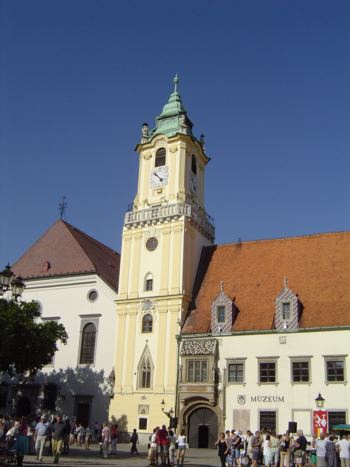
The inner city is almost entirely unspoiled by the pox of post war modern architecture, yet it far from being a moribund museum: it positively pulsates with life and exuberance. → Continue reading: A trip to Bratislava
Well, at least the language is sort of getting there:
John Reid, the health secretary, has embarked on the biggest ever programme of ministerial visits to NHS hospitals to persuade staff to accept fundamental changes in working practices to improve the service to patients.
He has told colleagues that the public will not accept there has been genuine improvement in the NHS until patients are treated with the same promptness and respect that they get as consumers of other goods and services.
As ‘consumers of other goods and services’ they are the paying the piper and therefore calling the tune. Contrast the NHS where the paying customer is the government and the patients are units of production.
Health ministers think their biggest political challenge is to engineer this change in the working culture of NHS organisations. They want them to tailor services to suit the preferences of the individual instead of expecting patients to adjust to the convenience of the professionals.
Fat chance! Public services are not run for the benefit of the public they are run for the benefit of the public sector. If you want ‘services to suit the preferences of the individual’ you need a free market in healthcare.
So another doomed ‘initiative’ will shortly bite the dust but not before, I hope, Mr.Reid and his advisers reach the logical conclusions of their own ideas.
Maybe White Rose should have an additional category entitled “Better Late Than Never”. I’ve certainly done several such WR postings.
Here’s another, from the Independent on August 25th:
The case of Stephen Kelly, who was found guilty in February 2001 of culpable and reckless behaviour, exemplifies the way the police and courts can access medical details collected as part of a research project.
That establishes that we’re dealing with a different Kelly. The guts of the story is that supposedly anonymous research data ended up being used to prosecute somebody, which is just the kind of thing we are constantly promised isn’t going to happen, can’t happen, must never happen, etc.
During the investigation of Kelly, police obtained the anonymised codes from patient medical records and used them to seize the scientific evidence that established the genetic similarity between the Aids viruses Kelly and his girlfriend had.
So much for “anonymised”.
Professor Leigh Brown was angry at the information being used. “These databases will have an important role to play in developing our understanding of genetic variation and disease, but what will protect them from seizure by legal authorities?”
Indeed.
The Armadillo Aerospace X-Ship is coming together nicely according to their latest report:
All engine plumbing and wiring is complete on the big vehicle. We loaded water into the big tank and tested all the valves, with pretty good results. Our distribution manifold has a leak in the weld which will need to be fixed, and the fill port 2″ threads were loosened during the filling process when the giant hose pressurized itself and whipped around a bit. We can’t just weld the inlet fittings, because the check valve is stainless steel, while the rest of the hardware is aluminum, so we may need to weld flanges onto each side and bolt them together.
They seem confident they are close to completion:
If there was catalyst in the engines, the big vehicle is now capable of flight, but we still need to get the drogue cannon worked out before it can land properly. We also need to make some honeycomb panels to protect the base of the tank from exhaust at launch, but we are running out of things to do on it. The base will need a fair amount of rework when we put the full size engines on it, but the basic layout will probably remain the same.
I look forward to news of their first static test of the big vehicle.
Who do you reckon wrote this?
But the truth is that a university degree is not the best educational attainment for the majority of people. Most jobs do not require such a level of education, although I firmly believe that education should not just be about what job you get. But for many, a university education provides little in terms of other personal development. Joining the job market earlier, or learning vocational skills, could be much more beneficial to the individual and society as a whole. Becoming a plumber or a butcher, rather than a teacher, is now a job with real security.
Some ghastly Conservative, talking sense of a sort, but doing it in that voice that we all hate and the memory of which still keeps the Conservatives in the bucket market unelectable, the one that goes: “Thanks to my hard-work and all-round merit I have reached the pinnacle of human achievement and am now a smarmy back-bench Conservative MP with ministerial ambitions.” Right? Certainly right as in not left.
Let us read on:
I know this is a case that many may find unpalatable, but we must recognise that the striving for equality should not blind us to the fact that we are different. We cannot all be a concert pianist, or a David Beckham. In the same way, a university education does not suit everyone.
→ Continue reading: Higher education debates
Once again, the British police risk life and limb to protect us from those who would do us harm:
A father and his son were confronted by armed police after a young boy was seen playing with a toy gun in a car.
Kevin and Jason Price were ordered out of the car and onto their knees after police were told a weapon was seen pointing from the window.
But in fact it was a £15 plastic ball bearing rifle bought for Mr Price’s seven-year-old son Connor, who was sitting in the back.
Police have defended their actions, and say they have to treat reports of firearms seriously.
No, more likely it was another opportunity to put on a public display of virility against a soft, safe and easy target.
Is there no end to this absurd hysteria? Are there no depths to which this official paranoia cannot sink?
Oh no I couldn’t possibly. No, no, no, no. No, never. I don’t need it. I don’t want it. What part of ‘no’ don’t you understand? I wouldn’t, I couldn’t, I shouldn’t. Not me. Not now. I said n………oh, well if you insist:
Hillary Clinton, the darling of the Democratic Party, is under growing pressure to make a late bid for the White House in 2004 from supporters who believe that only she can defeat George W Bush.
There will be no shortage of Americans willing and eager to step up and testify about the depths of loathing this woman incites in ‘fly-over country’. I am sure they would be right. But it would be foolhardy to ignore all those legions of baby-boomers with retirement on their minds. You don’t have to be liked to win elections (see either of Messrs.T.Blair or J.Chirac for details).
Another good excuse for infringing our privacy that governments are wont to provide is efficiency. In such cases, the best bet is to challenge the government agency in question to spell out exactly how these efficiencies are going to be achieved.
The latest gambit in Australia is to provide an electronic health records database. The government claims that this will improve the safety and quality of health care delivery. How, the newspapers do not say.
In another gambit to get this through, the government says there will be no electronic identification numbers, and that patient involvement was voluntary.
Both these gambits need to be challenged. If there are no numbers, one wonders how they propose to deal with the many people known as “Smith” in our country. Not everyone has a unique surname like Wickstein.
And one wonders how ‘voluntary’ this scheme will be in five years time. No doubt, after the scheme has been up and running for a few years, we will be told that to be more ‘efficient’ the scheme needs to be made universal (read, compulsory).
Privacy Commissioner Mal Crompton noted that people might be reluctant to reveal details about themselves if they had doubts about the privacy of their medical records.
There are of course sound medical reasons for the sharing of medical records with, for example, hospitals. But electronic records can stray far and wide.
I don’t think I’d have any real objections to this scheme as it stands now. However, we’ve seen in the past how one government agency likes to dig in the files of another, and frankly, I don’t trust the Australian health system to keep my details private.
How does this matter? Well, how would you like the Tax office auditing you and having access to your medical history? I wouldn’t like the creep auditing me and giving my financial records the third degree knowing my medical details.
|
Who Are We? The Samizdata people are a bunch of sinister and heavily armed globalist illuminati who seek to infect the entire world with the values of personal liberty and several property. Amongst our many crimes is a sense of humour and the intermittent use of British spelling.
We are also a varied group made up of social individualists, classical liberals, whigs, libertarians, extropians, futurists, ‘Porcupines’, Karl Popper fetishists, recovering neo-conservatives, crazed Ayn Rand worshipers, over-caffeinated Virginia Postrel devotees, witty Frédéric Bastiat wannabes, cypherpunks, minarchists, kritarchists and wild-eyed anarcho-capitalists from Britain, North America, Australia and Europe.
|





Recent Comments