We are developing the social individualist meta-context for the future. From the very serious to the extremely frivolous... lets see what is on the mind of the Samizdata people.
Samizdata, derived from Samizdat /n. - a system of clandestine publication of banned literature in the USSR [Russ.,= self-publishing house]
|
Iraqis are not just depending on government to protect their new liberty. According to this report from the Coalition Provisional Authority, they are armed and dangerous… to terrorists:
Elsewhere in Baghdad, individuals inside a white Opel fired small arms at ICDC personnel at the Al-Amil gas station. The Civil Defense Corps soldiers returned fire, and Iraqi customers waiting for fuel also fired at the Opel. The assailants broke contact, and a search of the area met with negative results.
Is it just me or does this paragraph sound like something out of an L Neil Smith novel?
An American scientist, William von Hippel has an explanation for racism. Well, a theory of why elderly people are more likely to be prejudiced than young people. And if his research is right, it’s not just because they grew up in a different era, because Blair’s Britain is a sink pit of immigrant crime, or because old people are brave enough to fly in the face of political correctness. Mary Wakefield explains in today’s Telegraph that a bit of their brain is missing:
According to von Hippel and other psychologists working in the same field, whatever age we are, our immediate thoughts are formed by cultural stereotypes. This means we instinctively think inappropriate and unfriendly things about each other.
…
For a highly social species, the ability to keep these thoughts to oneself is crucial, so we have developed a special part of our brains – a mesh of connections between the prefrontal lobes and the limbic system – to inhibit and temper them.
…
Where von Hippel’s research is new is in suggesting that older people’s brains often suffer the same sort of damage. They become prejudiced because they lack the power to inhibit the stereotypes that form our instinctive thoughts.
The gap in their brain releases stereotypes and they naturally infer that they are doing it on purpose.
I have no idea whether the theory will hold up to further scientific scrutiny. I also do not like the implication that older people’s opinions and behaviour are somehow not results of their rational discourse but determined by a neurological phenomenon. Nevetheless it is an interesting article that caught my attention and so it appears here without any firm conclusions from me as to its goodness or badness. If true, it has highlighted the importance of stereotyping and unexamined prejudices. Get your opinions in order before you are disconnected from them and begin to embarass your offspring. 
Of course, this means that there could be a psychological metacontext.
I’m going to be on the road again this month, so I don’t know how much posting I’ll be doing for a few weeks. It is the perk and the curse of being a freelance consultant. The upside is lots of travel and interesting people. The downside is lots of travel: sometimes three or even six months at a stretch away from home. The other downside is spending months at home between jobs with little to do but learn new and interesting ways of convincing the landlord not to put you out on the street.
This will be a short trip. I’ll be doing a job in San Francisco for a week and then back to Manhattan for a few days before coming home. On the San Fran end I simply won’t have time for anything – it will be 12 hour days netcasting a major business conference for which failure is not an option. As soon as we load out, we catch a Redeye flightback to the East Coast.
If any Manhattan bloggers are interested, I will have some free evening time there between January 16th and 22nd. (I have been known to frequent the Trad music haunts of the Lower East). If you miss me, don’t worry all that much: I’ve a regular customer there and pass through once or twice in almost every year.
Tony Martin was clearly a trailblazer:
A proposal to allow homeowners to use “any means” to defend their homes, has topped a BBC poll on the bill people would most like to see become law.
BBC Radio 4’s Today programme asked listeners to vote on suggested Private Members’ Bills, with the first choice taking 37% of the votes.
Norfolk farmer Tony Martin, whose fatal shooting of a burglar in 1999 sparked a national debate, welcomed the result.
As well he might. For him this is a vindication. For others, though, thi is an embarrassment, not least of all for the Conservative MP who was supposed to be Tony Martin’s champion:
Tony Martin’s MP, Conservative Henry Bellingham said the idea went too far by suggesting homeowners should use “any means” to protect their property.
→ Continue reading: And the point of that was?
After returning to the office for a few hours, I spent the usual wasted minutes deleting scores of spam emails from my inbox. I expect the same goes for most of this blog’s readers. Anyway, in a continuation of my festive spirit and seasonal good cheer, here is a link to a rather amusing collection of ideas for knocking off the spammers, courtesy of those ubergeeks at Wired Magazine.
In conversation with Perry de Havilland of this parish some while back, he likened spammers to horse thieves. Horse stealers were dealt with harshly for threatening the very economic viability of the regions in which they acted, since horses were vital to life prior to modern locomotion. The Internet is just as vital now, so the argument runs.
Hang the spammers? Well, I am sure quite a few of us have thought on these lines. The Wired article has less draconian solutions. Enjoy.
Tony Martin was clearly a trailblazer:
A proposal to allow homeowners to use “any means” to defend their homes, has topped a BBC poll on the bill people would most like to see become law.
BBC Radio 4’s Today programme asked listeners to vote on suggested Private Members’ Bills, with the first choice taking 37% of the votes.
Norfolk farmer Tony Martin, whose fatal shooting of a burglar in 1999 sparked a national debate, welcomed the result.
As well he might. For him this is a vindication. For others, though, this is an embarrassment, not least of all for the Conservative MP who was supposed to be Tony Martin’s champion:
Tony Martin’s MP, Conservative Henry Bellingham said the idea went too far by suggesting homeowners should use “any means” to protect their property.
For politicians this potato is just too hot to touch. The mere mention of rights to self-defence is enough to have them scampering away whelping like whipped curs. Nor do I expect that this synthetic exercise is going to make so much as a dent in the established view that defending oneself from barbarity is morally more reprehensible than the barbarity itself:
More than 26,000 votes were registered by listeners taking part in the poll and the winning bill will now be presented to the House of Commons by Stephen Pound MP.
He will need to persuade the 20 MPs who have been chosen to put forward Private Members Bills to take up the poll winner’s suggestion.
He will have more chance trying to persuade Osama Bin Laden to book his daughters in for pole-dancing lessons. Me being cynical? No, not at all. Just hear what the same Stephen Pound has to say about the whole thing in the Guardian:
Stephen Pound, Labour MP for Ealing North, who was one of the programme’s judges, expressed surprise at the high vote for such a controversial plan among listeners to such a programme.
“My enthusiasm for direct democracy is slightly dampened,” the MP told Today. “This is a difficult result. I can’t remember who it was who said ‘The people have spoken – the bastards’.”
Hmm, colour me skeptical but I have a hunch that his heart is not really going to be behind this campaign. These people are always agitating for ‘more democracy’ until it jumps up and slaps them in the face. Democracy is only supposed to be for the compliant: no ‘bastards’ allowed.
Mr Pound, however, is one of the more sanguine respondents. Elsewhere there is enough sqwauking and clucking to drown out a poultry market. The Guardian is already denouncing the result as a fix:
The BBC was warned yesterday that it may have fallen victim to a mass lobbying campaign after a controversial plan for a “Tony Martin” law topped a Today programme poll yesterday.
Suspicions were raised when thousands of listeners voted for the mock parliamentary bill which would allow homeowners to use “any means” to defend their homes from intruders. Such a law would have protected Mr Martin, who was jailed for the manslaughter of a teenage burglar, Fred Barras, in 1999.
And from the BBC article, linked above, a dire warning of what such mad and irresponsible ideas would lead to:
But leading criminal barrister John Cooper warned that the idea was dangerously flawed.
He said: “The law as it stands at the moment, despite its critics, is functioning. If you are in your house and you are attacked by someone or threatened by someone, you can use proportionate force.
“We do not live in the wild west. This legislation that is proposed effectively may well turn us into that.”
Thus proving that it is possible to be wrong on more than one level. For a start the ‘wild west’ was nowhere near as wild as legend would have it. But I’m quibbling here because I sort of know what he is driving at. He thinks RKBA and a right to self-defence would result in a desolate landscape riven with feuds, lynchings and random acts of carnage. He is still wrong though because that is exactly the type of scenario we are heading for now. The virtually unprotected citizen is easy meat for predatory.
Having assumed a monopoly of the crime-control business, the British state has found it cannot actually do that job and, increasingly, is disinclined to even try. The only thing they can maintain is the pretence by landing like a ton of bricks on any citizen who dares to be more than a docile farm-animal.
The result of the BBC poll gives lie to the whole facade. People are losing faith in the ability (and even willingness) of the state to come to their aid in time of crisis. As the police spend more of their time collecting taxes and scoring brownie points with their political masters, this disquiet will only grow.
[This article has been cross-posted to White Rose.]
By the time I finish concocting this post David Carr will probably have posted on the subject already, because it’s right up his alley, if he’ll pardon the expression. No, nothing from him yet and this posting is now done, so here goes. (UPDATE: something from David after all – see above – and HE got the Instapundit link. It’s a tough blogosphere.)
Basically, what it was was that the BBC, in the form of the Today Programme, decided to do a stunt stroke exercise in participatory democracy, and they arranged that listeners could vote for whatever law they wanted to vote for, and the winning law would then be presented to Parliament by a pre-appointed MP who, believing as he does in democracy and all that, was happy to commit himself to whatever law got the most vox from the populus.
The idea was that a law would duly be voted for about saving an Endangered Species or banning a Officially Disapproved-of food or pleasure or past-time. That would-be law would actually be presented to Parliament. It would not be enacted. But another little gob of nannyism would duly have been proclaimed as desirable.
However, the plan went wrong. The particular bit of the populus that got most organised and did the most voting was the bit that thinks that Tony Martin was right to shoot at those thieving bastards who attacked him in his rural farm, and that if one was killed and the other wounded, that should have been their problem for being thieving bastards, and not Tony Martin’s for defending himself and his property. So a new law was crafted along the lines of people being allowed to use any means they like to defend their property. It got the most votes. So now, the Independent reports, the MP who promised to present this to Parliament is going to have to do just that. He is not a happy MP:
Mr Pound’s reaction was provoked by the news that the winner of Today’s “Listeners’ Law” poll was a plan to allow homeowners “to use any means to defend their home from intruders” – a prospect that could see householders free to kill burglars, without question.
“The people have spoken,” the Labour MP replied to the programme, “… the bastards.”
Having recovered his composure, Mr Pound told The Independent: “We are going to have to re-evaluate the listenership of Radio 4. I would have expected this result if there had been a poll in The Sun. Do we really want a law that says you can slaughter anyone who climbs in your window?”
Well, it would seem that quite a lot of people do. And you know what? If there was such a law, there’d be a lot fewer burglars a-burgling.
Personally, I’m with Mr Pound in thinking that “reasonable force” ought to be sufficient. However, unlikeMr Pound, and many others, I think that the force which Tony Martin used against his attackers was itself quite reasonable, and that in general, lethal force is often a very reasonable way for householders to fight off burglars, and in the process to uphold the law (one of the laws being that you mustn’t burgle). After all, for many householders in many circumstances, the only choices available are: (a) householder shoots at intruders to kill, and therefore quite often does kill, or: (b) householder is helpless, and is duly robbed, or worse. What Official Opinion wants us all to accept is that there is a third alternative which is superior to both (a) and (b), which is: (c) the householder reports the crime, and the criminals are speedily apprehended by the Police and punished appropriately by the courts. But why is (c) so very much better than (a)? And what if (c) just about never happens, either because the burglars aren’t caught or because if they are caught they aren’t sufficiently punished?
Simon Jenkins isn’t my favourite columnist. (See here for evidence of just how fatuously wrong this man is capable of being.) But after starting off his latest column for Timesonline by denouncing the BBC for getting above itself by actually proposing legislation (and thereby setting itself up in competition with Parliament), and for failing to guide public opinion into a more proper direction, he ends up admitting that this little exercise has actually worked out rather well. It gave lots of people a chance to say that they don’t feel safe in their own homes and would like the right to defend their homes themselves, and they took it. By their insubordinate refusal to accept their duly allotted place in the grand scheme of things, the place allotted to them by people like Simon Jenkins, an important slice of public opinion got members of the pompous git classes to actually think about that proposition for a change. Jenkins’ column started out under the heading “How the BBC made democracy just a show”, but ended up saying this:
Which brings me full circle. There is virtue in the listeners’ law after all. I have debated it for an entire column. I am sure that the BBC would declare this as no more than their original intention. A listeners’ law is better than no law at all. Where indeed would we be without the BBC?
Under the circumstances, that’s quite an admission.
It is now 2004 and may I take this opportunity of wishing all Samizdata readers a happy, healthy and prosperous New Year.
As for me, I have resolved that I will be in the same bad mood this year that I was in last year. It makes perfect sense. My enemies don’t change their ways, so why should I change mine?
It is time to stand up for the “nanny state” – for Jowell and Hodge and, in other areas, Patricia Hewitt and Harriet Harman. And also, in general, for the state’s right and duty to involve itself in questions of diet, health, family budgets and good parenting.
So it turns out that all the leftie carping about ‘big food’ in 2003 wasn’t a joke after all. They really mean it. I predict, before the end of 2004, a ‘burger tax’.
The crucial point which critics of the nanny state fail to mention is that individuals and families don’t stand alone. None of us lives in a neutral social space, unharassed, and free to make wise long-term choices. Whatever the philosophical ideal, in the real world we are bombarded by corporate messages cajoling us and our children to consume and borrow. We are inhabitants of the more, now, spend-it, eat-it society, which – let us not forget – boosts the profits of the multinationals.
We are also inhabitants of ban it, tax it, regulate it society which – let us not forget – boosts the profits of the political classes.
Health-hectoring is now being added to enviromentalism and ‘anti-racism’ as a legitimating ideology of the ruling class. Another self-sustaining justification for their power, wealth and status. Nothing new about that of course, only now they are prepared to put the whole process on public display before nailing it into place.
Having returned to the land of hope and glory after almost two weeks of hectic holiday season and a limited access to internet, I have the need to blog of things I have seen.
I spent Christmas in Bratislava, the capital of Slovakia. After such splendid reviews of the town here on Samizdata.net, I was wondering whether it would live up to his impressions during the cold winter days. The Christmas markets in the centre of town, a tradition established in 1993, have a certain magic that increases with copious quantities of hot mead and wine.
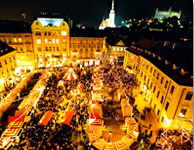
The crowds are impressive, with density matching that of any western shopping experience. There are many international brands present, many a multinational appearing in the ‘small town with big potential’. The most impressive sight, probably because most unexpected, was the vista alongside a new road by-pass relieving the centre of Bratislava of heavy traffic. The road is lined with enormous warehouses, hypermarkets, showrooms for car makers such as Mercedes-Benz, Porsche, Nissan, Audi, Jeep, Chrysler, there is Fuji Film and Coca-Cola. Driving along you could be in any western country. In the centre of town I have seen designer shops frequented mostly by the rich even in the West. I believe I caught a glimpse of Bang and Olufsen. Whatever you think of the brand, it is a huge leap for the design-conscious of Bratislava.
This all is very good and a superficial visitor might conclude that Bratislava represents a successful marriage of the charm of a small provincial city with a multinational presence and that Bratislava benefits from its proximity to Vienna without being reduced to a charmless suburb of its larger and more internationally renowned neighbour. Perhaps I should leave it at that and spread the good word without digging underneath the surface. Unfortunately, I stayed there long enough to encounter what lies beneath or, as we Samizdatistas would say, in the metacontext. → Continue reading: Potemkin village of capitalism
Oh how I wish I had the presence of mind to have taken a picture of her to illustrate the point of this post, not that I ever need much excuse to publish a picture of an attractive young woman… my camera was on my belt as usual but alas my brain was not in gear and moments later she was lost in the swirling post-Christmas sales crowds.
She was in her late teens or maybe early twenties, obviously from a fairly well off family, very stylish in a ‘Mayfair London’ manner (though I saw her in Kensington), beautiful in a ‘could be a model’ sort of way, dusky complexion, long legs made to look even longer by expensive looking high heeled shoes and a very short form fitting ‘little black dress’… and wearing an Iranian style hijab.
Although I can only speculate as I do not know the young woman who caught my eye, it is not hard to see the ‘domestic compromise’ at work here… her family insisting she wear the hijab whilst she insisted on dressing to kill in the manner of her adopted western culture and friends.
This little drama must get played out a million times a year across Europe and North America amongst the Muslim diaspora and in the long run, it is not hard to see which cultural force is going to win. I suspect that one of the reasons that small pockets of western Muslims have become radicalized is that it is they who are most starkly confronted with what happens in the majority of cases when the old ways are confronted by western secular individualism. No civilization based on submission to arbitrary edicts from the Dark Ages can survive contact with a civilization that essentially encourages you to find your own way and do what you will.
I suspect within one hundred years, maybe less, Islam will have about as much relevance to the life of most ‘Muslims’ as the Anglican Church does to most British ‘Christians’… something you might or might not encounter when getting married or buried and not much else.
We’ve commented very little here about the Iran earthquake of December 26th, which could obviously be an earthquake in more ways than one. For several days now, I’ve been wanting to do a piece called something like “Now wait for the political tremors”. But hello, what’s this?
Here’s how this Economist piece concludes:
… the catastrophe may have one benign effect: a lessening of the Islamic republic’s distrust of foreigners. That distrust was evident in 1990, when the Iranians turned down many offers of outside help in the aftermath of a previous catastrophic quake and officials denounced sniffer dogs as “unclean”. Mr Khatami, in recent days, has showed no such qualms, appealing for help from all bar Israel. Some people in Bam were rescued thanks to the once-reviled canines.
Mr Khatami’s conservative rivals have mixed feelings about foreign help. During his trip to the area, the supreme leader did not deign to mention the mainly western countries that had rushed to Iran’s aid, let alone thank the rescuers in person. That is not untypical of Iran’s stand-offish conservatives. Last Friday, while survivors of the disaster surveyed the wreckage of their lives, Mr Khamenei found time to extol at length the merits of making the pilgrimage to Mecca.
Yes, but setting aside how the conservative bit of the Iranian elite feels what is the Iranian elite as a whole doing that is any different?
This UPI piece is somewhat more informative on that score:
On the issue of a diplomatic thaw, Rashid Khalikov, a U.N. official, praised Iran’s quick call for help and opening of its borders. “They immediately opened up their airports for foreign flights, opened their consulates all over the world to issue visas for aid workers as fast as they could and have often waived them,” Khalikov said at a Monday news conference in Geneva.
U.S. Secretary of State Colin L. Powell said in interview with the Washington Post, “There are things happening, and therefore we should keep open the possibility of a dialogue at an appropriate point in the future.”
The story seems to be that there are two kinds of attitude that are contending for supremacy in Iran, the one that says that Allah will see to everything provided only that we grovel to him in the precisely correct manner while wailing the precisely correct noises, and the one that says that if Allah wants this mess (and all the other messes around here) sorted, the way he’ll do it is by us sorting it on his behalf, by making use of such things as dogs, foreigners, etc. The former tendency wants the West to drop dead. The latter tendency wants Iran to come alive.
And this earthquake, paradoxically, plays right into the hands of the Come Alive party, because it shines a big public torch on which attitude saves lives and which one does not. For never forget that the key to how many people die in disasters is not just how many die in that first horrible few minutes, but how many more die of boring things like malnutrition, the cold, infection caused by lack of sanitation, infection of untended wounds, etc., during the days that follow. And that latter figure is determined by the attitude of those in power who are able to do something, and who either do that something or do not.
Personally I don’t think it makes much sense to moan about whether buildings were or were not earthquake proofed. Hindsight is a wonderful thing, but is no help in clearing up a mess right now. That stuff comes later.
But a ruling elite that sits on its prayer mats in the immediate aftermath of disaster but otherwise does nothing is definitely moan-worthy. Mr Khamenei and his ilk will surely not be looking good in the eyes of their fellow countrymen right now.
|
Who Are We? The Samizdata people are a bunch of sinister and heavily armed globalist illuminati who seek to infect the entire world with the values of personal liberty and several property. Amongst our many crimes is a sense of humour and the intermittent use of British spelling.
We are also a varied group made up of social individualists, classical liberals, whigs, libertarians, extropians, futurists, ‘Porcupines’, Karl Popper fetishists, recovering neo-conservatives, crazed Ayn Rand worshipers, over-caffeinated Virginia Postrel devotees, witty Frédéric Bastiat wannabes, cypherpunks, minarchists, kritarchists and wild-eyed anarcho-capitalists from Britain, North America, Australia and Europe.
|





Recent Comments