We are developing the social individualist meta-context for the future. From the very serious to the extremely frivolous... lets see what is on the mind of the Samizdata people.
Samizdata, derived from Samizdat /n. - a system of clandestine publication of banned literature in the USSR [Russ.,= self-publishing house]
|
Today, May 1st, is a big day for the European Union because today is ‘Accession Day’ whereupon 10 new countries will be officially enjoined into the Union:
Leaders from the EU’s 25 member states are taking part in celebrations, after a night of festivities heralded its historic expansion.
The 15 old members welcomed in Cyprus, the Czech Republic, Estonia, Hungary, Latvia, Lithuania, Malta, Poland, Slovakia and Slovenia at midnight.
Yes, it is celebration time. The ‘family’ of 15 countries becomes the even bigger ‘family’ of 25 countries as hands are clasped in firm handshakes across once-inpenetrable borders in a new spirit of continent-wide brotherhood, sisterhood and transgenderhood. Ring out the bells, sound the trumpets and let the cliches flow like a swollen river.
Chief among the consequences that is causing excitement, even outside the usual Europhile circles, is the prospect of droves of fresh-faced and energetic young Slavs who will pour into the cities of Western Europe eager to programme computers, brew coffee and deliver hot pizza to Western Euopeans, most of whom will be quietly relieved that they are being served and waited upon by people who are unlikely to be donating any portion of their wage packets to Al-Qaeda.
I can sympathise with this enthusiasm for I, too, hope that this scenario will come about and, if it does, I expect that it will largely prove to be a very good thing for all concerned. → Continue reading: Misery loves company
Australians are known for having a fondness for drinking alcohol. This is all part of the general easygoing Australian lifestyle, beaches, beer, BBQ’s, and an all round good time.
As you can imagine, those killjoy statists in government here have always found this to be deplorable.
No government in Australia has ever had the courage/suicidal tendencies to actually try to impose prohibition, but in general, the trade in alcoholic beverages is one of the most highly regulated type of commerce in Australia.
And, as we have a Federal system of government, and the regulation of the sale of alcohol is a state matter, we have in effect seven different regulatory environments.
Although in nearly each case, the regulations started out as a Puritan attempt to regulate the drinking habits of Australia, over time the regulations have become a way for various rent-seekers to protect their interests at the expense of the consumer.
This can have unforseen consequences… → Continue reading: Here’s to a free market in wine!
Problem: beer cans that get too hot. Answer:
… scientists have come up with a solution: the self-cooling beer can.
Slightly longer than a normal drink can, it simply needs a twist to cool its content down. It can, its inventors claim, cool a beer to the perfect temperature of 3C within three minutes.
The I C (Instant Cool) Can works by using water evaporation. The top half is surrounded by a layer of watery gel. The base contains a water-absorbing material in a vacuum, and a special heat-absorbing chamber.
When the bottom is twisted, a seal between the two halves is broken. The vacuum draws the gel, and the heat, into the base. The gel is absorbed by the material, the heat is absorbed by the chamber – and the drink gets cold.
You see? Now why didn’t anyone think of that before? Because they were too busy thinking about big insoluble problems instead of small(er – hot beer is no small problem) soluble ones is why.
I spent last night pondering, among other things, Europe’s demographic decline. What the hell can I do to stop that? Have some kids? Maybe, but not nearly enough kids to solve the problem. And I never really have been one for actually solving problems, even small ones. What I can do is salute those who do solve problems. On the whole, they are called “capitalists”.
My thanks to Dave Barry. Quite what the impact of self-cooling beer cans will be on Europe’s demographic decline is beyond the scope of this posting.
Here is an excellent piece of political and cultural commentary, about the excellent TV show South Park and its excellent political and cultural commentary, from Michael Cust.
A brief survey of some of the more salient libertarian episodes bears this out:
Episode 713 takes aim at Hollywood director Rob Reiner and the anti-smoking movement. The movement – and especially Reiner – is portrayed as, and called, fascist, controlling, and deceitful, while big tobacco is portrayed as honest, hardworking, and well-rooted in American history.
In Episode 616 drug war propagandists are labelled “ultra-liberals” who operate on the principle that “the end justifies the means.”
In Episode 614, political correctness is condemned. When the boys (the main characters) refuse to tolerate their intolerable homosexual teacher, their parents take them to the Museum of Tolerance, where tolerance of everyone (except tobacco smokers) is taught. When this fails, the boys are sent to a gulag called “Death Camp of Tolerance,” where they are forced at gunpoint to produce arts and crafts that don’t discriminate along the lines of race and sexual orientation.
In Episode 301, the boys travel to the Costa Rican rainforest as members of an environmentalist choir. While there, they learn how dangerous and deadly the natural world can be – as a snake kills their tour guide and aboriginals kidnap them. Upon their return to civilization, the boys put on a musical performance that admonishes smug first-world environmental activists. (In this episode, Friends star Jennifer Aniston guest stars.)
But this is just scratching the surface of a fruitful and deep social commentary that comes out libertarian on pressing current events. Just about any issue that libertarians hold up as an instance of state excess or market success is portrayed in the show …
All of which is very noble and very true. But what I like about South Park is that it is so damn funny.
What I believe this shows is that “Hollywood” is not nearly as biased against our kinds of opinions as people with our kinds of opinions, who happen to be talentless bores, often claim. It is just that Hollywood is biased against them and against all other talentless bores, for being talentless bores. What Hollywood is biased in favour of, as is often pointed out here – especially by this Samizdatista in these two much admired postings – is making money. If people with our kinds of opinions can help Hollywood to do that, Hollywood will welcome them with open arms.
Hollywood, like Cartman’s mother, is a dirty slut.
Cust also has some interesting and provokingly positive things to say about Michael Moore, and about the fact that South Park‘s Matt Stone contributed (in a good rather than anti-gun way) to Bowling for Columbine.
I am in my kitchen, reporting on one of my last-Friday-of-the-month meetings. It is still in full swing. Most of the London events you read about on Samizdata are booze-ups at Perry’s, and at my meetings, there is also booze. From 9.30 pm until around midnight the drink flows and the conversation bubbles merrily, and I can hear it bubbling now. But there is also, always, an agenda. Starting at 8 pm, and proceeding until 9.30 pm, there is a speaker lead discussion.
I have been hosting these things since the late 1980s, and there a moment, a few years back, when I was finding them something of a drag to organise. Only the enormous inconvenience that would necessarily have continued, every last Friday of the month, even if I had stopped holding these meetings, in the form of regulars knocking on my door and demanding entry to a non-existent event and then having to be diverted (which might not be much fun) or told to go away (which might not be wise or kind), persuaded me to persist with these events. But then along came email, to the point where even I had it, and now they pretty much run themselves. I fix a speaker, email everyone on the list on about the Tuesday telling them of exactly who will say approximately what on the Friday, and of any other future meetings that have already been fixed. (Speakers for July and November are now settled, but nothing else is certain as yet, other than that someone will speak.)
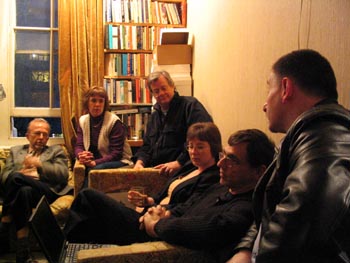 Tonight, Sean Gabb spoke about “Demography and History”. He is the second from the right in the picture, with our own David Carr lending an ear in the foreground. The guy in the corner is Bruce, a real photographer, who would have done a far better picture, but with him as with me, you get what you pay for, photographically speaking.
When Sean speaks about current affairs, he is always interesting, but so are most of us. We all have worthwhile opinions about what is happening now. But when it comes to speaking about the whys and wherefores of the fall of the Eastern Roman Empire in the Sixth Century or for that matter about the history of Eastern Europe in the years before the outbreak of the First World War, Sean is, in the London libertarian scene, in a class of his own. Not being burdened with false modesty, Sean was recording his talk, on his laptop computer, and I understand that it will be available on the Internet. He had to leave promptly at 9.30 pm to catch his train down to the South Coast where he now lives, so I can not be sure of the details of this, but I will supply a link to his talk as soon as I can, and maybe some more comment on it. → Continue reading: Of meetings and plagues
The new Wired has an article about a survey by MORI that found out that about 80 per cent of 1,000 British adults want a biometric identification card, citing concerns about illegal immigration and identity theft.
Though the survey shows that most Britons back national identity cards, there’s a wrinkle: Half said they won’t pay for it, and few were very familiar with the cards. Contrast that with the government’s plan to charge 35 pounds for an identity card good for 10 years, or 77 pounds for a card including passport, for every family member 16 to 80 years old.
Concerns about Big Brother? Try “bumbling brother,” with 58 percent of surveyed Britons predicting the government won’t be able to roll out new ID cards smoothly, and one-third saying their stored information won’t be safe. Still, most support such cards, principally to tackle illegal immigration and identity theft. The latter costs the United Kingdom 1.3 billion pounds per year.
In the United States, popular opinion and embarrassing biometric-test failures have blunted overt national ID card efforts, though U.S. passports and some states’ driver’s licenses will store biometric information soon, leading privacy activists to warn the IDs could become de facto national IDs.
Never trust a man who, when left alone in a room with a tea cozy, doesn’t try it on.
– Billy Connolly
I do not understand how this works, but it sounds like fun, or at any rate like a ripple of the future:
A band from Germany has adopted a novel approach to getting their music heard by millions.
Super Smart have turned their backs on vinyl and CDs and instead have decided to just release their album as ringtones.
The album, Panda Babies, is published by a German company that focuses on digital music for mobile phones.
So if there’s there is no CD, what does the word “album” mean in this connection? And, if Super Smart are a “band”, what is a Super Smart live gig like? A bunch of Germans waving their portable phones at the audience?
The identity of the four-piece from Munich is shrouded in mystery and in photos they appear with giant panda heads.
“Shrouded in mystery” presumably means that Super Smart is actually one person, and anybody can be a Panda for the photo shoots. The individual, by wearing a uniform, is subordinated to the Greater Whole, dominated by one “Super Smart” individual. Germans eh? – they never change. But I suppose much the same could be said of the Wombles.
I have yet to acquire a mobile phone, so none of this will make any difference to me. But I do have some questions. For example: Can mobile phone music play more than one note at a time, or is it like solo violin music without any double stopping? How long can it go on for? Is any of it any good?
And can I buy a compilation CD of mobile phone Greatest Hits?
As Mayday approaches and with it the traditional harbingers of summer, such as the sight of a freshly dug paving brick in flight, with its comet’s tail of dirt particles, tracing an arc towards a McDonalds plate glass window or the contents of a looted Baby Gap whirling in the breeze, blue bibs and striped sleepsuits hanging off street lights, my thoughts turn to that strange creature who has emerged from winter hibernation, the anti-globalisation “anarchist”. This creature represents a conundrum: While he professes to favour anarchy, he is more likely than not to owe his current indolent lifestyle to a most un-anarchical social welfare system. How to reconcile this contradiction?
The first thing I’d like to say is that I am not anarcho-libertarian. I do understand the arguments, I just remain unpersuaded. But my intention here is not to provide a rebuttal of anarcho-libertarianism, rather to compare it with the “anarchism” more prominent in the popular imagination, that of a Mayday protester. If you take such an anarchist at his word and grant that he will be happy to forego the benefits of a redistributive welfare state once his utopia arrives, where does his purported philosophy differ from an anarcho-libertarian or anarcho-capitalist?
It occurs to me that the principal difference lies in the respective attitudes towards private property. The anarcho-capitalist respects private property, his own and others. The “anarchist” considers all property to be theft and asserts a right to expropriate such property as he needs or wants from others. As a welfare state needs a state to sustain itself, the anarchist presumably imagines that the “needy”, in lieu of state handouts, simply steal what they “need” from others. Of course if you are one of those “others” you may not be so keen on this happening. As there would be no state police force, the task of defending property devolves to the individual who may contract it out to private security services. Thus the anarchy favoured by the “anarchist” turns out strikingly similar to that proposed by anarcho-capitalists. Is this really what he wants?
I suggest that what the “anarchist” really wants is short term anarchy. An afternoon or so of mayhem, “for kicks”, and then a return to an un-anarchical world where the welfare state remains to inadvertently subsidise his “alternative” lifestyle.
A letter to the editor of the Daily Telegraph, from Dr Chris Williams, European Centre for the Study of Policing, Open University, Milton Keynes:
One problem with the proposal for a national ID card (News, Apr 27) is the security of the information in its “clean” database.
Although police all sign the Official Secrets Act, and are well paid, well supervised and largely trustworthy, at least one policeman has been sent to prison for selling the information on the Police National Computer to the highest bidder – in this case, credit reference agencies. HM Inspectorate of Constabulary recorded their concern over this practice in 1999 and recommended measures to stop it, yet the Police Complaints Commission admitted in 2002 that “there will always be a few officers willing to risk their careers by obtaining data improperly”.
So we can’t trust the police to keep a sensitive database watertight. Can we trust other state institutions or outsourcing companies such as Capita? To be usable, an ID card database has to be accessible by hundreds of thousands of people. And the security has to be permanent.
In 1938, the Gestapo took over the files of Interpol’s predecessor when they entered Vienna. If we put all our data eggs in one basket, we need to be certain that a DVD with all our details on it never gets to al-Qa’eda, the IRA or the unknown evils that the future doubtless holds.
The thing I really like and admire about capitalism is its attention to detail, made possible by the division of labour. While we Samizdatistas get sucked into Political Class worries – like the EU and the Iraq War, overpopulation, underpopulation, etc. – capitalism continues to crank out solutions to problems so small that they can actually to be solved. Someone, somewhere (actually: Canada!), instead of worrying about the Iraq War (over which, he probably decided, he had no influence), has instead been worrying about bananas and how to guard them.
Consider this problem:
Are you fed up with bringing bananas to work or school only to find them bruised and squashed? …
I know I am. I have lost count of the number of times I have done damage to a bagful of Important Things, as a result of a neglected banana at the bottom of everything which I put there three days ago and then forgot about. But what to do? Bananas taste nice. You never know when a banana in your bag might come in handy.
So how do you stop it being crushed and becoming a sticky, destructive mess, dangerous to everything around it? Well, when a capitalist asks an arkward question like the one above, you just know that he will very soon start in on the answer, and this capitalist is no different:
… Our unique, patented device allows for the safe transport and storage of individual bananas letting you enjoy perfect bananas anytime, anywhere.
A perfect banana. Tell me more.
The Banana Guard was specially designed to fit the vast majority of bananas. Its other features include multiple small perforations to facilitate ventilation thereby preventing premature ripening and a sturdy locking mechanism to keep the Banana Guard closed. The Banana Guard is of course dishwasher safe for easy cleaning.
Of course. Small perforations. There goes that attention to detail.
You can get your Banana Guard in an impressive range of colours, namely: Ravishing Red, Outrageous Orange, Mellow Yellow, Sublime Green, Skyhigh Blue, Brilliant Blue, Passionate Purple, Pretty in Pink, and Glow in the Dark.
My thanks to this Monkey.
Useful Idiots
Mona Charen
Regnery, 2003
It must have struck many people besides myself that anti-Americanism, so much a world-wide sentiment and problem, is, to an extent it is hard to quantify, an American export. No nation, surely, has produced such a large volume of self-criticism, proceeding through self-denigration to self-hatred. Is it surprising that the rest of the world has listened to, copied, and amplified the message? Yet it was not always so; indeed Americans fought both World Wars and the Korean War with little dissent. Television may have been the ultimate morale-breaker in the Vietnam War, but why did those responsible use it for this purpose, even turning good news into bad, as with the crushing of the Vietcong “Tet offensive”? This book doesn’t give the motivations, just the facts.
“Lenin is credited with the prediction that liberals and other weak-minded souls in the West could be relied upon to be ‘useful idiots’ as far as the Soviet Union was concerned,” states the author and I have been unable (like her, I suppose) to find any source for Lenin’s insight in the handful of books of quotations I have consulted; it would be interesting to know to whom it was first contemptuously applied. If the function of a useful idiot is to support a cause detrimental to his best interests, then the definition is perhaps a little imprecise, for few, if any, of the useful idiots described in this book have received their come-uppance. But then, their cause didn’t triumph. Or didn’t where they lived; elsewhere, it was a different matter. → Continue reading: Idiots (complete with a big list of idiots)
|
Who Are We? The Samizdata people are a bunch of sinister and heavily armed globalist illuminati who seek to infect the entire world with the values of personal liberty and several property. Amongst our many crimes is a sense of humour and the intermittent use of British spelling.
We are also a varied group made up of social individualists, classical liberals, whigs, libertarians, extropians, futurists, ‘Porcupines’, Karl Popper fetishists, recovering neo-conservatives, crazed Ayn Rand worshipers, over-caffeinated Virginia Postrel devotees, witty Frédéric Bastiat wannabes, cypherpunks, minarchists, kritarchists and wild-eyed anarcho-capitalists from Britain, North America, Australia and Europe.
|





Recent Comments