We are developing the social individualist meta-context for the future. From the very serious to the extremely frivolous... lets see what is on the mind of the Samizdata people.
Samizdata, derived from Samizdat /n. - a system of clandestine publication of banned literature in the USSR [Russ.,= self-publishing house]
|
I am still out on the road, sitting in the Westin St Francis in San Francisco watching a bit of news after several long, long backstage work days at the JPMorgan Technology and Telecoms investors conference. I’ve a lovely view out over the bay from here on the 24th floor.
But that is not why I sat down to write this brief item. According to Fox News an airline flight from LA to DC (still in the air) is being watched closely by US security. There has been little detail on what is up.
Feel free to add any news you hear about the situation.
English weather is talked about, by the English, a lot. This is because if is caused by about nine different things, such as the Gulf Stream, the North Sea, the Arctic, and several other things of equal importance. It can change at any moment. How they forecaste it, I will never know, but they seem to be able to.
Take today. A fortnight ago, Summer had arrived. Then it got colder and wetter again. Then it brightened up, and yesterday, Michael Jennings was being congratulated for bringing the fine weather with him back from Australia. (Welcome back Michael.) That was Sunday. On Monday, Philip Chaston was back to bemoaning the bad again weather.
This morning was even worse. Windy, wet, horrid, and poor windswept me had business elsewhere in London in the morning. When my event began, men were forlornly standing about in their drenched summer clothes. At lunchtime, my business concluded, I waited in a second hand CD shop for the rain, which had suddenly got far worse, to calm down. When it did, and I ventured out, and it then started severely raining again, I scurried to the nearest tube station, and journeyed to my local station, Pimlico. What I found when I emerged from that was something else again.
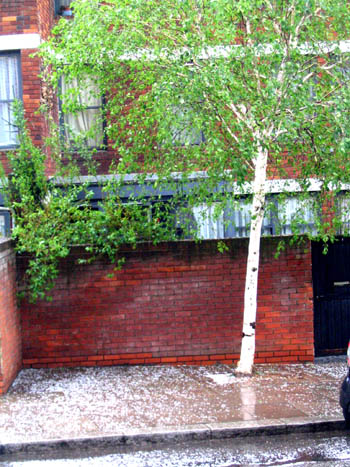
I found this:
I know what you are thinking. A tree, confused by the early summer sunshine, has blossomed, but then, shaken to its roots by the mad May breezes, it has shed its plumage and been given a good February-style soaking.
But look again at that “blossom”. When I first saw it, on the steps of the station, I of course could see that it was not blossom, and I thought: snow. But actually, it was hail. The hardest, most spherical, most peculiar hailstones I have ever seen in my life. They were perfectly spherical, and looked more like bits of polystyrene than anything natural.
I spent the next twenty minutes snapping artistic type photos of this hail with my Canon A70. In photography circles you are nobody until you have taken close-up, shiny droplet photos of all the various things that water does, when it lands on strange surfaces. So I snapped away at car roofs from close up, hoping that the results would resemble Abstract Expressionism.
The hail stones were not especially big, in fact they were quite small. But having been frozen with great ferocity, presumably at some extraordinary altitude, they appeared impervious to the ground temperature. They floated about in clumps, in puddles, melting not at all. Had my batteries not run out I could probably have carried on snapping away at them for the next hour.
The Dissident Frogman, with whom I discussed this English habit of weather talk only yesterday, said that, yes, in France, if it starts raining, it is liable to rain for the next three days, so there is nothing to be said. In England, you just never know from one hour to the next what the weather will do. Or when. I like it.
There is no political or philosophical message here, just English talk about the weather. But what I most like about stuff like this is that everything interesting to look at is now a photo-opportunity. That I really like. Well done my Canon A70.
As Perry de Havilland mentioned earlier, British and American armed forces may have committed a grotesque crime if reports about maltreatment of Iraqis are to be believed. Having not seen all of the reports myself, I tend to defer to writers such as former British soldier Andy McNab, who made his feelings abundantly clear in the Sunday Telegraph over the weekend. And he speaks with the moral force of one who has undergone torture during the 1990-91 war.
This issue cannot be finessed, or ‘put into a context’, to use one of the more common euphemisms of the age. What happened, if fully proven, is a total disgrace. To say that it puts back the necessary cause of winning hearts and minds is a massive understatement. It is also no good some folk arguing that this behaviour still does not put us on a moral par with Saddam. Of course it does not, although some anti-war folk, including frequent commenters on this blog, would claim that it does. Saddam’s disgusting rule (shamefully supported by the West in the 1980s, I might add) was not comparable to what has happened. But surely as armed forces of liberal, supposedly advanced civilisations, we should hold those in uniform to higher standards than those of the recent deposed Ba’athist regime? Much higher standards, in fact.
I have disagreed in a cordial fashion with noted libertarian blogger Jim Henley on the case for toppling Saddam by force, but never have I been in more agreement with him than on this issue.
[A]ny time you hear the term “consumer advocate”, think “government advocate”.
– Ted Schuerzinger
Journalist Nancy Rommelmann writes, after a surprisingly (to me, anyway) pleasant evening spent with feminist writer Susan Faludi, of sitting on the back steps of her home with her husband and a glass of wine:
It must be hard-wired into humans to want a little patch of earth and grass, a peaceful place to sit at the end of the day, or the beginning, and think, ours.
So true, so simple, and yet anathema to so many.
Read the rest of Nancy’s post for some unsurprising-but-fun gossip that she and Faludi exchanged about a certain tiresome feminist whinger extraordinaire.
Well, no prizes for having seen this one coming. From the Sunday Times headline: When you’re £30,000 down, ID cards look good. So says Sara Smith, a victim of identity theft.
Of course, nowhere in the article does the journalist, Rachel Cooke, make even a halfhearted attempt to explain the reality of ID card technology. Instead, she writes, “For [Sara Smith], a national ID card cannot arrive too soon.” Yes, a national ID card, any national ID card — don’t tell us if it can actually do what it says on the tin, just introduce one and make us feel a bit more falsely secure, please.
Cooke’s article does reveal, though not in so many words, exactly why it was so easy for Sara Smith’s identity to be used without her consent: Sara Smith let it happen.
Smith’s troubles began when she moved home. She arranged for her post to be redirected but, for reasons that are still uncertain, this was never done: her post continued to arrive at her old home, which was why she did not notice when her new Harrods store card failed to materialise. “If only I had,” she says. “That little piece of plastic was the start of it all.”
Some weeks later Smith received a telephone call. On the line was a man who purported to be from Harrods. “We are upgrading your card,” he told her. “Would you mind answering a few security questions?”
At first Smith protested, saying she had no need of more credit. However, she found herself telling him her date of birth and her mother’s maiden name.
Oh, it’s happened to us all. You know how it is — a stranger rings up, you get chatting about the weather, the snooker, or the state of your credit, and the next thing you know, you find yourself giving your most vital security information, for no reason you can really discern.
It’s not that I have no sympathy for Sara Smith; I certainly do. But when you consider her amazing new way of managing her most confidential business — not automatically trusting anyone who calls up asking for personal details, keeping a vigilant eye out for financial documents that fail to arrive in the post, actually looking at the statements for her “few accounts” — is really the way she should have been doing things all along, it does drive home the point that a bit of common sense is the best protection we all have against identity theft. An ounce of prevention is worth a pound of cure, and when it comes to ID cards, the “cure” is flawed both inherently and practically.
From this weekend, the adoption of RFID tags in the retailing industry has become a matter of time. At a recent conference, organised by the RFID non profit standards organisation, EPCglobal, both Walmart and Tesco warned their suppliers that they expected takeup of this technology. By forcing the adoption of RFID technology through their purchasing power, RFID will soon become ubiquitous in retail, over the next two years.
Colin Cobain, UK IT director for Tesco, advised suppliers to get involved and take a considered view of the new technology. “Some manufacturers are going down the route of slap-and-ship – I urge you not to do that… If you start of slapping-and-shipping, you’ll get a bad name in your organisation.” He added that the question about RFID was not “whether or not it will make a huge difference in the world: the question is, will you be ready?”
Simon Langford, manager of RFID strategy for Wal-Mart and Asda, said “start engaging in RFID today… don’t sit back and wait for it to happen.” Wal-Mart, remember, were so enthusiastic about the technology that they issued a mandate telling their top suppliers to get the tags in their supply chain by 1 January, 2005, or else.
WalMart began their testing of RFID tags in the supply chain on Friday in the Dallas/Fort Worth area. Their links with EPCglobal are also clear:
EPCglobal is a joint venture of EAN International and the Uniform Code Council. It is the organisation chosen by industry to develop standards for RFID technology in the global supply chain based on user needs and business requirements.
As a charter member of EPCglobal, Wal-Mart fully adheres to its core principles related to privacy issues, including consumer notice, consumer education and consumer choice. Wal-Mart’s Linda Dillman and HP’s Dick Lampman serve on the board of directors of EPCglobal.
To follow the work of EPCglobal, the website setting standards for electronic product codes can be found here, including details of their membership and policies.
It’s May Day Bank Holiday and the traditional British weather is gripping the South-East. Any hope of heading down the coast for a jolly boys’ ended with the incessant rain. Who would fancy pitch and putt in the wet.
Confined to the lounge with the Daily Mail, my eyes lit upon a quote from a politically correct employee of the BBC, in an article on how British citizens, formerly from East-Central Europe, viewed this country:
The British are intrinsically opposed to bureaucracy. A new car can be registered without visiting a government office – still unthinkable in Eastern Europe.
Having experienced communist rule first-hand, I was surprised to hear some educated people in Britain advocating socialism and never asking themselves why that ‘paradise’ needed barbed wire to keep people in.
Uttered by Andrius Uzkalnis, of Lithuania, who works for the BBC World Service.
Besides this, does anyone know what music is worth listening to whilst staring out of the window at the monotony of rain and wishing for sunnier days?
I spent a couple of hours at Tokyo Narita airport yesterday morning, changing planes on the way back from Sydney to London. Like many geeks people, I like to check frequently to check my e-mail / check the news / see if anyone has insulted me in the Samizdata comments section, so I wandered around the terminal looking for an internet terminal on which to do so. Narita is well served with such terminals, so I was quickly satisfied.
What is interesting here is that there are internet terminals provided by two separate companies here. The ones on the left are provided by a local ISP, and users are charged ¥100 (about £0.50) for ten minutes of use. The ones to the right are provided by Intel, and are free to use. The photograph illustrates that the usage patterns are indeed what would be predicted by the laws of economics.
It is actually quite common now to find free internet terminals for use in airport terminals, particularly in airside transit lounges where passengers may spend a few hours between flights. This is a relatively simple and cheap amenity for airports to provide to their customers, so they do. Often though, the airport does not even need to provide it: some technology company will set it up for free, in the belief that the sorts of people changing planes at major airports are the sorts of people they want to advertise their services to. As well as free internet terminals provided by Intel, I have also seen free internet terminals provided by Yahoo at Tokyo airport. (I have seen free internet terminals provided by Samsung at Sydney airport which never seem to be working – probably not a good way for the company to advertise itself). The good thing at Tokyo is that they seem to be willing to allow competition between various organisations that want to set up such terminals, and they apparently don’t have to be free.
Which when you think about it makes a certain amount of sense. If you provide a good for less than the market price, access to the good will normally end up being regulated by queues and quotas (ie willingness to wait, and restrictions on the amount of the good you consume, regardless of how much you want) rather than by ability or willingness to pay for it. (The public health systems of the world, which are full of people waiting endlessly for medical care, are prime illustrations of this). In busy periods, queues are likely to form for the free terminals, and at that point people who really need to access the internet quickly are still likely to be able to do so if they are willing to spend money. And such people can then use the terminals for as long as they like, whereas time restrictions are normally placed on free terminals. (From this we can also conclude that the health system of Australia, in which people who are willing to pay more can jump the queues of the public system and have their healthcare done privately, is better than the situation in Canada, where private provision of healthcare is essentially illegal).
In practice though, I doubt the providers of the for pay terminals at Narita are making much money, simply because the provision of free terminals there is so good. Putting them behind security restricts their use to passengers, and therefore demand cannot grow in the way it does for many free goods. They may get some use at busy times, but I suspect not much. However, in certain other airports (for instance Singapore) where there are free terminals but not many of them, for pay terminals could (and do) also get a lot of use.
And in the case of healthcare, where demand is capable of growing completely out of hand if you eliminate price sensitivity completely, private provision that people pay for directly is the only way that anyone will end up with reasonable access to healthcare. Given that (unlike with free internet terminals) people are paying for the public health system out of their own taxes in the first place, the argument for eliminating most public health care and having proper price sensitivity from the start is pretty strong.
Kofi Annan has perfected the Holy Man style of public performance. He speaks very quietly, in that exquisitely enunciated African accent, and people just take if for granted that he is a Good Man and a Good Thing. But Per Ahlmark (linked to by Instapundit) shows him to be a less than perfect human being. He describes the inaction and treachery of the UN, as lead by Annan, in first promising, and then failing, to protect the Bosnian Muslims from the Serbs. But, he continues:
No one should be surprised by the UN’s inaction, because only the year before it had demonstrated utter incompetence in facing the fastest genocide in history – the slaughter of 800,000 Tutsis and moderate Hutus in Rwanda in just 100 days. UN forces in Rwanda in 1994 were Annan’s responsibility before and during the crisis.
Annan was alerted four months before Hutu activists began their mass killings by a fax message from Romeo Dallaire, the Canadian general commanding UN forces in Rwanda. Dallaire described in detail how the Hutus were planning “anti-Tutsi extermination”. He identified his source “a Hutu” and reported that arms were ready for the impending ethnic cleansing.
Dallaire requested permission to evacuate his informant and to seize the arms cache. Annan rejected both demands, proposing that Dallaire make the informant’s identity known to Rwandan president Juvenal Habyarimana, a Hutu, even though the informant had expressly named the president’s closest entourage as the authors of the genocide blueprint.
This is the man who is being seriously proposed as the next ruler of Iraq, because he would be an improvement.
Annan, Ahlmark makes clear, is an object of religious worship, a human repository of millenarian hopes, rather than a man who has earned the adoration he basks in.
A similar error of false adoration was made by the more elderly admirers of Kofi Annan, when younger, with that other African Holy Man of severe actual unholiness, Julius Nyerere. As with Nyerere, it is hard to tell what proportion of Annan’s catastrophic blunders to attribute to sheer stupidity, and how much to actual wickedness. I suspect a combination of the two in the form of a murderously stubborn stupidity, which combines intellectual mediocrity with an immoral unwillingness to admit to error, possibly all floating in the same delusions as those that engulf the minds of his worshippers, but perhaps caused by mere vanity.
Robert Mugabe is another such. Although, having a slightly more severe and steely public persona, he is more readily identified as the mass murderer that he is. He should have gone to RADA. At the very least he should lose the Hitler moustache.
The vision Kofi Annan personifies with such theatrical precision is that of a single, infinitely benign World State, which will cure all ills, correct all injustices, right all wrongs, and put down the mighty from their seats. Allelujah. Especially those horrid Americans. That this same man might be an ill, a perpetrator of injustice, a wrongdoer and far too mighty one, and that the vision he personifies might be a road to ruin of our entire species, starting with its poorest and most unfortunate, and that those ghastly Americans may in fact be energetically rescuing the human race from a great and self-sacrificial folly with no good purpose to it whatever, is a thought that is simply not bearable to the World Statists. So they caste it aside. Mere evidence has nothing to do with it. To cease from the worship of Kofi would mean changing their entire way of thinking and believing and feeling, and that they will not do, no matter how much blood soaks their altar.
David Renwick is scornful of the 52 diplomats who signed a letter denouncing Tony Blair’s Iraq policies, and is equally scornful of those who described this letter as a revolt by The Establishment:
The fact that the letter was not signed by a couple of hundred other former ambassadors, including this one, was thought scarcely worthy of mention.
So who were these signatories?
Many of the signatories were former Arabists in the Foreign Office, affectionately known as the Camel Corps. Some members of the Corps have shown a tendency over the years to develop a quite passionate attachment to the Arab world that, unfortunately, has not always been reciprocated by the Arabs. They have tended to concentrate on the crimes of the Israelis, rather than those of the Palestinians. Most of us would prefer to be more even-handed.
Stephen Pollard is even more scornful. He links to a piece by Andrew Roberts in the Times which says that whenever the Foreign Offices protests like this it tends to be wrong:
TONY BLAIR should be delighted that no fewer than 52 former diplomats have written to him to say that his Middle Eastern policy is “doomed to failure”. Whenever a collective view has developed in the Foreign and Commonwealth Office it has been only a matter of time – and usually not long, either – before it has been proved spectacularly wrong.
So the 52 are either wrong because they aren’t the majority view at the Foreign Office, or because they are. But either way, they are definitely wrong.
Pollard also links to Melanie Phillips, who is even more scornful. To her the Camel Corps is also “The Establishment”.
The main personal consequence for the 52 diplomats of having put their heads above the parapet like this has been to draw attention to all the financial interests they have which predispose them towards saying what they have said.
Personally, I am not surprised that people have financial interests in alignment with their opinions. Most of us prefer to make money doing things we believe in. And if these guys believe in making friends with Arabs … For me, the question is, not: Who paid them to say this? It is: Are they right?
It is very disappointing that some officers in the British and US military seem to have lost control over their troops in the manner that the reports in the media are highlighting. No, I am not about to join the ludicrous cat’s chorus equating the Allied forces with Saddam’s institutional mass murderers, but no one who actually cares about the mess in Iraq eventually ending the right way up can be anything less than dismayed.
Certainly I understand how the stresses of urban combat can lead to itchy trigger fingers but for the custodians of prisoners to have allowed this to happen is completely impossible to justify. That the perpetrators felt the need to take pictures of their criminal actions suggests that we are dealing with your common-or-garden variety of psychopath rather than people ‘merely’ brutalised into callous indifference or shooting first/asking questions later due to being in a combat zone.
The only way this can be salvaged is for the clear difference between the torturers of Iraq’s ancien regime and the US/UK’s militaries to me made starkly clear: the people responsible must be subjected to swift and decisive military justice.
And while we are on the subject of ‘what the military should be doing’, can anyone please explain why the Italians who were kidnapped in Iraq the other day had been disarmed by US troops at a checkpoint? Whilst the fighting against the Islamo-fascists seems to be progressing, in other ways the last few days have hardly been days to bask in the glow of a job being well done by some of ‘our boys’, which is a great pity indeed.
I cannot help thinking that whilst the leadership in-theatre did well during the conventional conflict, perhaps a far reaching change in local military commanders might not go amiss as it is not enough to just manage the battles in a situation like this.
|
Who Are We? The Samizdata people are a bunch of sinister and heavily armed globalist illuminati who seek to infect the entire world with the values of personal liberty and several property. Amongst our many crimes is a sense of humour and the intermittent use of British spelling.
We are also a varied group made up of social individualists, classical liberals, whigs, libertarians, extropians, futurists, ‘Porcupines’, Karl Popper fetishists, recovering neo-conservatives, crazed Ayn Rand worshipers, over-caffeinated Virginia Postrel devotees, witty Frédéric Bastiat wannabes, cypherpunks, minarchists, kritarchists and wild-eyed anarcho-capitalists from Britain, North America, Australia and Europe.
|







Recent Comments