We are developing the social individualist meta-context for the future. From the very serious to the extremely frivolous... lets see what is on the mind of the Samizdata people.
Samizdata, derived from Samizdat /n. - a system of clandestine publication of banned literature in the USSR [Russ.,= self-publishing house]
|
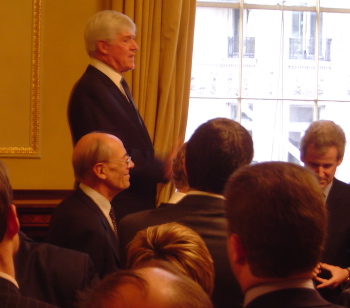
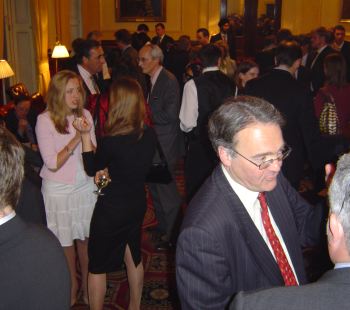
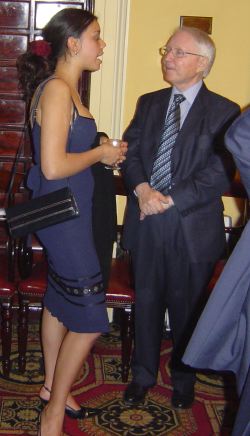
One reason for the limited output of bloggage from some of us tonight was that several of us went to an extremely well attended party. This was hosted by the Adam Smith Institute in order to celebrate the 25th anniversary of the start of the Thatcher Revolution. The event at the Oxford and Cambridge Club in London.
It is easy today to look back and scoff at what went wrong in those days, but those of us who lived through the steady economic and social collapse wrought by the likes of Jim Callaghan, Harold Wilson and Ted Heath, I have no hesitation describing what Thatcher presided over, which was nothing less than turning the tide of socialism, as a glorious revolution.
We are older and wiser now and all too aware of the missed opportunities and wrong turns of that era, but credit where credit is due. The future could have been very much darker indeed without Margaret Thatcher.
Update: More pictures on the Adam Smith Institute blog
Over at the excellent libertarian group weblog, Cattalarchy, there is a fine and thoughtful collection of articles, which was published a few days ago, to mark the May Day parades of old socialists with a wide-ranging broadside against what communism has wrought. I urge folk to fire up some coffee and take time out to read them all.
With all that fine material in mind, I was stunned to read a screed in the latest edition of The Spectator by ultra-rightwinger Peter Hitchens. As well as saying some decidedly uncomplimentary things about former South African President and anti-apartheid campaigner Nelson Mandela, a topic to which I may return later, Hitchens also bemoans what he claims has been the lack of any real improvement of life in countries which have been released from communism.
Really? Have there been no improvements at all? I mean, for a start, surely a declared Christian like Hitchens should be glad that fellow believers are no longer persecuted as they were in the old days of Communism. The Gulag is no longer in operation. Members of the KGB no longer drag you off in the middle of the night. And yes, key parts of the economies of those nations are not just recovering, but offering some of the tastiest investment opportunities in the world today, as this article illustrates.
There is a priceless passage in which Hitchens even refers to the elderly generation in the former Eastern bloc who miss the good old days of guaranteed jobs, even if that era came with bread queues, bureaucracy and compulsory military service. That’s the spirit! None of this messy and vulgar capitalist nonsense, with all that bothersome choice, and ugly advertising, noisy department stores and red light districts.
I honestly do not know what to make of folk like Hitchens and whether he has any coherent political philosophy at all apart from a desire to shock what he thinks is the received wisdom (not always a bad or dishonourable urge, mind). A few weeks back he wrote a superb article shredding the case for state identity cards, of the kind that any libertarian would be proud to write. Yet a few issues later we get a gloomy piece almost pining the days when half of Europe was run by the communist empire of the Soviets.
Weird.
There are many myths about Sweden and they go back a long time.
For example, in the 1930’s various supporters of the ‘Middle Way’ (such as the future Conservative party leader Harold Macmillian) suggested that if Britain followed a policy of greater statism, Britain would be more prosperous – and they pointed at Sweden as an example of greater statism. Such folk did not tend to stress such things as Swedish levels of taxation being about half British levels at the time.
Sweden’s great success was avoiding both world wars (and the capital consumption these wars involved), but this is not often talked about (the record of Sweden, in relation to Germany, in the 1930’s and during WWII is especially not something people like to talk about).
Of course these days Sweden does indeed have very high taxes (although I doubt they really are the “highest in the world”, as is often claimed – after all the stats for levels of taxation in many nations in the world are fantasy as they do not include the endless bribes one must pay and extortion one is subject to in these countries).
However, at least in recent years the Swedish government has at least managed to control its (very high) levels of government welfare-state spending (unlike the United States – see the Cato Institute for the Bush Administration’s latest lies about the cost of the Medicare extension), and whilst not as well off as Americans (“Sweden most prosperous nation in the world” is an absurd myth one still finds being talked of from time to time) the Swedish people are not doing too badly.
Apart from the control of government spending (yes it is still very high – but at least it’s growth has been controlled in recent years so government spending as a percentage of GDP has fallen – although, I repeat, it is still very high) which has led to a balanced budget, Sweden has also followed a policy of one of the lowest money supply growth rates in the world.
Now why is this? Fiscal and monetary conservatism is hardly what Sweden is supposed to be about – this is supposed to be a nation that has long worshipped the doctrines of Lord Keynes.
However, a theory does occur to me. The Swedish government has long wished to get the nation to join the European Union’s system of money (the “Euro”). How would the people of Sweden be convinced to vote to join the EU currency?
According to the doctrines of Lord Keynes (at least as they are popularly understood) if a government follows a policy of balanced budget and tight control of the money supply then (at least at some points of the “economic cycle”) such lines of policy will produce recession.
Could the intention of the government of Sweden have been to produce recession and get people to vote for the Euro as a possible “way out”? In short could the rising levels of GDP and industrial output in Sweden be not just unintentional, but the opposite of what the government wanted?
The notorious right-wing, Reaganite, propoganda machine of Hollywood is crushing the dissent of Michael Moore:
Walt Disney on Wednesday found itself the focus of a controversy over its refusal to allow the group’s Miramax studio to release the latest film by Michael Moore, the gadfly Oscar-winning director.
Mr Moore, director of the anti-gun Bowling for Columbine, proclaimed himself a victim of censorship in an open letter on his website on Wednesday that said Disney had this week “officially decided to prohibit our producer, Miramax, from distributing my new film, Fahrenheit 9/11.”
According to Disney, the subsidiary’s independent-minded managers Harvey and Bob Weinstein were told a year ago that the production, exploring alleged links between the family and government of president George W. Bush and Saudi Arabians, including relatives of Osama bin Laden – would not be allowed into cinemas under a group brand.
A sobering day indeed when even the ‘limousine-liberals’ of Hollywood decide that Mr. Moore’s recipes of fabrication and manipulative agit-prop are too much even for them to stomach.
In his website posting Mr Moore indicated that he intended to keep the controversy simmering. “The whole story behind this (and other attempts) to kill our movie will be told in more detail as the days and weeks go on”.
And right there is Mr. Moore’s next best-selling book (“Stupid Movie Moguls”).
It is almost enough to make me feel sorry for them:
European leaders will meet with intellectuals and business leaders to discuss Europe’s core values in a high-level conference later this year.
EU heads of state and government will be invited to attend a special conference on European values at the beginning of December- an event organised at the personal initiative of the Dutch prime minister, Jan Peter Balkenende.
It is hoped the conference – to be held in the Netherlands – will be the culmination of a half-year long EU-wide debate on the meaning and political relevance of the European idea, initiated by the upcoming Dutch presidency which takes office in July.
Writers, artists, policy-makers and business leaders from all over the world are set to be present at the public event, where up to 1000 people will be able to attend.
If they are harvesting “intallekchools” from all over the world to come to Europe to tell Europeans (a) who they are, (b) what they are supposed to be doing and (c) why they are supposed to be doing it, then said Europeans have, shall we say, some issues with self-esteem.
Mr Balkenende hopes the event will provide an ideological underpinning for Europe.
The only thing the event will produce is several hundred pages of repetative cant and nauseating PC pieties, liberally sprinkled with terms like ‘respect’ and ‘solidarity’.
He recently remarked that embarking on a European discussion on values such as respect, freedom, integration and solidarity would give a “new dynamism” to the reunified Europe.
See, it’s started already and if ever anyone tells you that that are seeking a “new dynamism” you can be cast-iron sure that their get-up-and-go has got-up-and-gone. Probably never to return.
What does it say about the great ‘European Project’ if its political leaders are prepared to prostrate themselves before a gathering of the global great-and-good and admit that they do not have single moral imperative on which to hang their hats?
I am watching the BBC current affairs Newsnight. What a truly rich feast of stuff to look at. The main item was about the U.S. government’s response to the stories of atrocities by U.S. forces. Now I won’t go into the specifics but one point bugged me. It was the way in which the BBC presenter endlessly went on about the ‘Arab Street’.
Now, I no doubt imagine that the sort of persons who go on about the ‘Arab Street’ are sincere in imagining that all those who live in what is the Middle East are part of some common community, or ‘street’. But what is all too rarely pointed out is that this term in fact bands together tens of millions of very different individuals under one banner. It is a form of unthinking collectivism. The truth, of course, is that there is no such thing as an ‘Arab Street’, any more than there is a ‘Western Street’, ‘Asian Street’, or ‘North American Street’.
I hate to point out the blindingly obvious to collectivists on the Guardianista left and the isolationist right, but there are no ‘streets’ of this sort. The world is a tad more complex than that.
‘Underground, overground,
Wombling free,
The Wombles of Wimbledon Common are we.
Making good use of the things that we find,
The things that the everyday folks leave behind.’
I was half watching one of those interminable nostalgia programmes on TV last night when my intention was caught by the voice of Bernard Cribbins, whose vocal intepretation of the flawed yet quietly heroic role of Orinoco (not to mention Tomsk, Wellington, Tobermory, Madam Cholet and Great Uncle Bulgaria) in The Wombles will forever have its place in the hearts of all who heard it.
Among the many interesting things he said (did you know that all those endearing dithery mutters were ad-libbed?) was that Womble-fixated kiddies used to go to Wimbledon Common and drop litter there in the hope that a Womble would come and take it away.
This proves something. I am not sure what, but something.
One of the brighter spots for the global economy in recent years has been China. A heady rate of economic growth – 9.7 percent growth in GDP last year – has encouraged some to wonder whether this nation’s decision to hitch its wagon to the star of capitalism can be translated into a more lasting adoption of liberal civil society. So far, the jury is out, but some signs are encouraging. I honestly cannot see how China can long resist reforms to its political arrangements in the long run.
More recently, though, a number of fund managers, banks and economists have voiced a few worries about whether China could be vulnerable to the sort of jarring market moves that hit Southeast Asia, starting in Thailand, back in the late 90s. China has a fixed exchange rate to the dollar, which means that at present Chinese goods are very cheap in overseas markets, but also swells the Chinese money supply. Credit expansion, guided by the state-owned banks, has been rapid, and a lot of the investment has been spent on questionable enterprises. About 40 percent or more of China’s GDP growth is dependent on bank lending. There are many signs that China could be headed for a serious hangover.
One of the biggest worries could be the state-run banks. About 40 percent of all the loans held by these banks are so-called non-performing loans — in other words, they will never be repaid. These banks are in the throes of a major overhaul, as the Chinese authorities in Beijing try to restructure the system along more commercial lines. But in the meantime, the authorities are trying to cut the pace of monetary growth, which may come at a time when the financial infrastructure is in a weak state.
Attending a conference in the City today, an economist, speaking off the record, said this: “Alan Greenspan (Fed Chairman) is a smart man, has access to all kinds of research backup, but he has made mistakes on the economy. Now the Chinese authorities, who are isolated in their Beijing centre, inexperienced in such matters, could make very big mistakes indeed.”
China offers a great deal of promise in the medium term. In the short term, anyone with a few pounds to spare on an investment should tread very carefully. China could be in for a bumpy ride.
A few weeks ago, I opined that the current troubles in Iraq could well be a decisive turning point. In favor of the good guys.
As to Fallujah, well, I am beginning to think we blew an opportunity, although Wretchard continues to keep a candle lit. We have managed to give the universal impression that we retreated from a hard fight in Fallujah. I doubt that is entirely true, but in this war, even the appearance of a retreat is a real defeat for us.
As to al Sadr, though, he is toast, because the other Shiite leaders have turned on him, as predicted.
Representatives of Iraq’s most influential Shiite leaders met here on Tuesday and demanded that Moktada al-Sadr, a rebel Shiite cleric, withdraw militia units from the holy cities of Najaf and Karbala, stop turning the mosques there into weapons arsenals and return power to Iraqi police and civil defense units that operate under American control.
I’ve been flagging up England versus Zimbabwe cricket here because I anticipated that the row about whether England ought to be playing cricket against Zimbabwe, given the state of Zimbabwe, was not going to go away. What I had not anticipated was that Zimbabwean cricket would itself be wrecked by the same processes which are destroying Zimbabwe in general. I should have, but I failed to.
The Zimbabwean cricket team (like Zimbabwe itself) is now a racially and politically polarised shambles:
Zimbabwean cricket will reach meltdown this morning when 15 rebel players and their lawyer draft a letter rejecting the board’s offer of mediation and renewing their boycott. This time they will walk out for good.
“This will hopefully be our final letter,” one of the rebels said. “We’ll probably be set free in about 14 days when they fire us.” The Zimbabwe Cricket Union will be forced to pick Test sides from the willing but hopelessly inexperienced young players who crashed and burned to a 5-0 one-day series defeat against Sri Lanka.
So what have these “rebels” been rebelling about. Well, their problem is that the Zimbabwe cricket team is now being selected, not by people who know their cricket, but by people who know their Robert Mugabe.
As Michael Jennings (who did see this coming a year ago) said on Ubersportingpundit about three weeks ago:
As far as I can see, any argument for continuing to play Zimbabwe is based on the idea that cricket and politics have been largely separated, and that the strongest team is being fielded. This is now manifestly not so, as players are being selected (or not) on racial and political grounds. …
And things have not got any better since then, as Scott Wickstein explained on Ubersportingpundit today.
Tony Blair has said that England “shouldn’t” tour Zimbabwe in the autumn. But he isn’t willing to decide the matter, and I can see his point.
The problem is that the ICC (International Cricket Council) has dug itself into a position of insisting that England must tour Zimbabwe, on the grounds that (now that South Africa has been sorted) politics and cricket must be kept separate, and the dominant ICC voices (i.e. India, and also Pakistan and Sri Lanka) are from countries whose citizens are extremely reluctant to admit to white people that they might have made a mistake. Although actually, they could change their policy now, on the grounds that Zimbabwean cricket has also changed. The Zimbabwean team used to be selected on cricketing merit. Now it is not.
I have just started a weekly environment column for the Brussels-based Centre for the New Europe.
My first article called Reports of My Extinction are Greatly Exaggerated is about the ‘reappearance’ of previously ‘extinct’ species, in this case the New Zealand storm petrel, believed extinct for 150 years. No animal conservation programme can claim credit for this, although with a ban on trafficking, expect a market to develop in contraband. So governmental action may actually provoke the extinction of the bird.
[I am aware that at the moment individual articles do not link, I shall be speaking to the CNE webmaster about this.]
Regulation is the new taxation. Eamonn Butler has an example of this at “Europe’s Favourite Think Tank blog”, as the ASI blog has taken to describing itself:
… Germany is introducing a new workplace regulation, which insists that businesses must take on at least one trainee/apprentice for every fifteen workers they employ.
An excellent initiative to get young people learning a trade, you might think. …
But I wonder whether this concession is one that we free marketeers should perhaps stop inserting into pieces like this. Something more along the lines of “well now let us think of just what sort of harm this state compulsion is going to do” might be more in order, instead of ritual obeisance towards the supposed good intentions of the people who imposed this rule. So, let me see. This one will result in masses of businesses having apprentices who just hang around going through the motions. Wasted young lives, in other words. A classic welfare trap, imposed upon the ‘private’ sector.
But as with all government interventions over the marketplace, there are unintended consequences.
Quite so.
For Germany recently legalized brothels. And, like other businesses, they too are covered by the new law. So for every 15 girls employed, another must be enticed into the trade as an apprentice.
A rather odd result – which just shows what a tangle politicians get into when they start telling businesses how to run themselves.
But what if this “tangle” is actually the whole idea? The people who did this, I surmise, hate business, all business. But recent intellectual trends make it harder for them to say this out loud. So, they just go ahead wrecking businesses anyway, without any public justification, and then they blame the very principle of doing business for the wreckage that they have themselves unleashed. Bastards.
The trouble with the theory of “unintended consequences is that you deny yourself the chance to call people doing harm evil. And calling such people evil might be just the thing to get them to stop.
On the legalising prostitution thing, a couple of years ago the Libertarian Alliance published a piece by a prostitute, who argued that the last damn thing her line of business needed was to be made ‘legal’. ‘Legal’ equals smothered in idiotic laws and regulations (and taxes of course), whereas illegal means she could run her business the way she wanted, uninterfered with, apart from the occasional bribe or two, by meddling government officials.
|
Who Are We? The Samizdata people are a bunch of sinister and heavily armed globalist illuminati who seek to infect the entire world with the values of personal liberty and several property. Amongst our many crimes is a sense of humour and the intermittent use of British spelling.
We are also a varied group made up of social individualists, classical liberals, whigs, libertarians, extropians, futurists, ‘Porcupines’, Karl Popper fetishists, recovering neo-conservatives, crazed Ayn Rand worshipers, over-caffeinated Virginia Postrel devotees, witty Frédéric Bastiat wannabes, cypherpunks, minarchists, kritarchists and wild-eyed anarcho-capitalists from Britain, North America, Australia and Europe.
|






Recent Comments