We are developing the social individualist meta-context for the future. From the very serious to the extremely frivolous... lets see what is on the mind of the Samizdata people.
Samizdata, derived from Samizdat /n. - a system of clandestine publication of banned literature in the USSR [Russ.,= self-publishing house]
|
What distinguishes libertarians from other political obsessives is that our goals are rather more long-range than merely the next round of Senate elections or the fiscal policies some mediocre politician.
The presentation of the X-prize today to Burt Rutan is the portender of greater things to follow than the inauguration of either a President Bush or a President Kerry. The launch of an annual contest (the X Prize Cup) is a sign that the rate of private space technology growth could be about to grow exponentially.
Those who might reasonably argue that without the right policies in Washington, commercial space flight would never happen are missing the broader picture.
It is no longer a question of if, but when and where the launch sites will be. The USA could almost close down tomorrow, the technology is out there and people will get out of this planetary orbit. One could almost say that the US has achieved its historic purpose. Once spread out among the stars, it will take centuries to bring all the colonies to a statist heel, if ever.
In which a Samizdatista wanders approximately along the northern road to Santiago and beyond, views some industry and some magnificent rugged coastal country, tries some regional cuisine, watches some football, and encounters an interesting individual while drinking port in Vila Nova de Gaia
In August I took a summer holiday starting out at San Sebastian and Pamplona more or less on the Spanish/French border, working my way west across pretty much the entire Atlantic coast of Spain, and then spending several days in Porto in northern Portugal. For some reason an urge to visit that part of the country had been developing in my head for quite a few months, and I wanted to get it out of my system by going there. Sometimes I will visit a place because there is one thing there that I feel I must see, but more often the reasons resemble the reasons why I choose to read a particular book. If I find that I find two or more unrelated recommendations of a book in places and unconnected as possible, even slight or in passing recommendations, then this will encourage me to read it more than a single, stronger, recommendation, or two recommendations from the same place. And going to northern Spain and Portugal was like this.
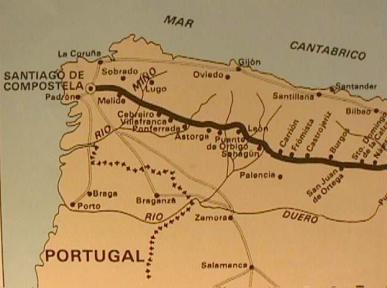
One thing was that I went to Cornwall in England last year and had a wonderful time. And Cantabrica and the Asturias and Galicia are in a way the Cornwalls of Spain – the last parts of Spain to become Spanish, places that are less well integrated than many other parts, places that are still at least a little bit Celtic, and places that retain a distinct regional character. Or so I was told. (And Spanish food is said to retain more regional culture than most places). And like Cornwall, there is lots of rugged and beautiful coast to see.
But while Cornwall has always been a remote and economically relatively poor part of England, the Atlantic coast of Spain is something else, because when Spain conquered and ruled America, this is where the ships sailed from. And the industrial heartland of Spain came into being in this area as well. And of course this is the base of the massive and much maligned Spanish fishing industry, at least by the people of Cornwall and parts of Canada. (And of course this is the fishing industry that may have reached North America well before Columbus sailed to the Carribean).
I was curious about another thing, possibly more trivial. One of Spain’s greatest and most famous football teams is Deportivo La Coruña, which comes from the city of La Coruña in Galicia, a city with a population of only 230 000. This makes La Coruña into almost the Green Bay, Wisconsin of Europe – a major sporting team in a seemingly minor city. I was curious about this, too, so I thought I would go and have a look. Football, culture, and nationalism are incredibly mixed up wherever you go in Europe, but in Spain this is as extreme as anywhere. For decades the great club Real Madrid were basically an arm of General Franco’s fascist government (and some would perhaps crudely argue that they are basically an arm of the Madrid government today) and cheering an opposing football team was often one of the few public ways of protesting the government that was available, and passions for football clubs in ethnic minority regions can often be extreme.
And there was the city of Santiago de Compostela, the destination of the great pilgrimage to the supposed burial place of the apostle St James, that was once a point through which Christians amongst other things demonstrated resistance to muslim rule of Spain.
And there was another question that vexed me. Spain officially has three minority languages: Catalan, Basque, and Galician. The nationalist issues that go with Catalan and Basque are well known (and I had been to both places before), but the Galicians have a lower profile. Alas, I am not a linguist, but at least some people had told me that Galician is mutually intelligible with Portuguese, so that Galicia is essentially the Portuguese speaking part of Spain. And I was curious about this, and whether Galicia felt Spanish or Portuguese. So I thought I would visit Galicia and northern Portugal and compare the two places.
And I had heard that Porto is a stunningly beautiful city, and I thought I would go and look for myself. And I am a big fan of the great fortified wine that both comes from and is named after the city of Porto.
So all these things came together, and had been making me want to visit. Finding myself with a couple of weeks before starting a new job, I bought a ticket to Bilbao and flew off. → Continue reading: An encounter on the lower Douro
Privacy advocates are appalled by the ongoing plan to equip all U.S. passports with RFID chips that can be read surreptitiously from a distance Business Week reports. Computer security expert Bruce Schneier says:
We do need passports with more data. But they chose a chip that can be queried remotely and surreptitiously. I can’t think of any reason why the government would do that, other than that they want surreptitious access. And if airport and border security guards can read everyone’s passports on the sly, so could anyone with a radio-chip reader, from terrorists to identity thieves.
Stop! Have you not raped the planet enough? Is it not time that you lifted your greedy foot from the head of the oppressed?
Put down that cup of steaming, hot coffee right now. Toss that doughnut away. Rip off your cotton T-shirt and consign it to the rubbish tip.
There. Doesn’t that feel so much better? And would you not like to feel this good all the time? Wouldn’t you just love to luxuriate in the warm, satisfying glow of self-righteousness? Tell me that would not like to tuck yourself up in your cosy bed at night and sleep the sleep of the just?
Well, now you can do all of those things. Yes, those guilty days and sleepless nights are at an end for you too can reach out for the ‘Rough Guide to Ethical Shopping’:
Along with the usual demons such as Nike and Gap, which are routinely accused of using sweatshops to keep production costs low, are other alleged villains. The fashion label French Connection is accused of having a “feeble” code on ensuring its clothes are not produced in sweatshops, while the Arcadia boss Philip Green, who owns Top Shop and BhS, has refused to join the UK’s Ethical Trading Initiative.
Ah yes, the UK’s Ethical Trading Initiative. Otherwise known as a ‘shakedown’ → Continue reading: Shopping for the Insufferably Sanctimonious
… Gunpowder treason and plot!
I shall be going out tonight to give that Catholic boy Guy Fawkes a rousing send off on this most politically incorrect of nights.
The liberal-leaning USA Today describes The Guardian today as a “left-leaning British newspaper”, showing a rather more sophisticated understanding of British political culture than the self-styled most intelligent newspaper in the UK can demonstrate of the world.
We now know that Clark County, the target for a Guardian operation to get out the vote for the Democrats, was the only county in Ohio to switch from a Democrat majority to a Republican one. The idea that Holland Park socialists living in £5 million homes could communicate with the concerns of a district of Ohio where $100,000 is considered a lot of money to spend on housing is bizarre.
In fact it is the exact reverse of the old Tory caricature: grandees looking down their noses at the ‘Great Unwashed’ and telling them what to do, for their own good of course. The true sign of just how ridiculous the Guardianistas are, they have no idea how arrogant and stupid they sound in the real world.
Every conservative and libertarian criticism of President Bush is at least partly justified. He has not vetoed any spending proposal from Congress. He has presided over a terrible budgetary situation (to the point where I almost oppose the tax cuts on the grounds that the budget deficit has to be contained first). He did introduce steel tariffs (which did not win him Pennsylvania or Michigan). The policy in Iraq worries me (since the spectacular successes of liberating Bagdad and later capturing Saddam Hussein) by looking all too similar to the political fudges of Vietnam in the late 1960s. I like the idea of the US spending money on Iraqi state education and a national health service no more than I would like it in Camden. I still think North Korea was and remains a bigger threat to the West than Iraq. The Patriot Act is at the very best a temporary necessary evil. And I am not so sure about “at the very best” or it being “temporary” and “necessary”.
But the tribal test of elections is simple. All the bad guys, the Guardian readers, the little-Hitler bureaucrats, anti-smokers, the Socialists, idiot British Conservatives like Alan Duncan, the Palestinian 9/11 cheerleaders, the terrorists, the UN crooks, virtually the entire Left worldwide. They are the ones reaching for Kleenex, anti-depressant pills and shaking their fists at God.
All the people I know that are cheering are the good guys. I have even made this Guardian article my home page on IE, so that every morning for the next few weeks, I am reminded that We win and They lose sometimes.
Just to cast a slightly different view in to the frenzy of commentaries here about the election in the USA…
Sorry but I cannot see how the election of George Bush, a big government right-statist, shows that the the so-called ‘right’ differs that much from the McGovern/Mondale/Kerry view in reality. Fetishizing the differences between the two, which is particularly strange when viewed from overseas, does not change the fact the underpinning meta-contexts are pretty similar when you add it all up. Sure, the Republicans will probably not do something idiotic like try to emulate Britain’s nightmarish socialist healthcare system whereas that is exactly what many in the Democratic party want… but how many government departments is Bush going to simply wind up in order to roll back the state? The argument between the two parties is how much to turn the ratchet of the state’s encroachment into civil society, not whether or not to actually turn the ratchet around to face the other way.
Economic and technological reality will eventually break the regulatory statism of both left and right: party politicos will follow, not lead that process, but please, just keep in mind the only real good thing about Dubya winning is that we get to give all manner of sanctamonius lefties an aneurism, and whilst taunting the collectivist left because the collectivist right won is indeed great fun, it is little more that a minor blood sport that will soon loose its appeal as Leviathan gets more corpulent by the day as both left and right shovel more severed bits of civil society into its maw… the defeat of the ghastly Kerry by the ever so slightly less ghastly Bush was hardly the victory of the forces of light over darkness.
What makes dictators dictators is not that they don’t believe in the power of the majority but that they don’t believe in the rights of the individual.
– Adriana Cronin
This observation by Big Trunk at Powerline certainly took the shine off of my morning:
When the electorate rejected George McGovern in 1972 and Walter Mondale in 1984, it did so on each occasion by a margin of roughly 20 percent. The McGovern/Mondale/Kerry view of the United States has made enormous inroads in the past twenty years. It is less than three percent short of a majority and the trendline seems to be moving in its favor. Shouldn’t we be asking what we need to do to roll it back before it crosses over to majority status?
Simson Garfinkel of MIT Enterprise Technology explains:
RFID technology is already broadly deployed within the United States. Between the “proximity cards” that are used to unlock many office doors and the automobile “immobilizer chips” that are built into many modern car keys, roughly 40 million Americans carry some form of RFID device in their pocket every day. I have two: last year MIT started putting RFID proximity chips into the school’s identity cards, and there is a Phillips immobilizer chip inside the black case of my Honda Pilot car keys.
He comes to an interesting conclusion:
The problem of voluntary, industry-approved privacy standards is that they’re voluntary—companies don’t need to comply with them. And the very real danger facing the RFID industry is that a suspicious public will push for regulation of this technology. Although the industry has successfully killed legislation proposed earlier this year in California and Massachusetts, high-handed actions on the part of RFID-advocates will likely empower consumer activists and their legislative allies to pass some truly stifling legislation.
Indeed.
Iraq The Model has translated comments of Iraqi’s about the US election that were posted to the BBCArabic site. You can read them all
here
The election victory of George Bush is a hugely significant event in its own right but at least part of the reason why it gets so much coverage here is due to the near-absence of anything good happening in the UK. It has been this way for years.
Hence, I am doubly-delighted to note that a small proportion of the British electorate has done something right for a change:
People in the North East have voted “no” in a referendum on whether to set up a new regional assembly.
The total number of people voting against the plans was 696,519 (78%), while 197,310 (22%) voted in favour.
That is not just a ‘no’, it is a big, fat, resounding ‘no’.
The ‘new regional assembly’ that HMG was attempting to foist on the public was supposed to be the first of many similar boondoggles designed (allegedly) to facilitate ‘local decision making’.
Dressed up in the fuzzy, fashionable, eminantly spinnable language of ‘decentralisation’, these assemblies actually represent nothing more than yet another grossly expensive tier of government, complete with an army of paper-shufflers, ticket-punchers, regulators, office-holders, rubber stampers and form-fillers. Not to mention the heavy battalions of outreach co-ordinators, inclusivity counsellors, gender advisers, diversity directors, real nappy officers and sundry other busybodies and parasites.
In short, the whole thing is simply an ‘Enemy Class’ job-creation scheme and I like to think that (at long last) some sections of the British electorate were able to see the truth of this. Perhaps, just maybe, some of the long-suffering British cash cows have decided that they have donated more than enough blood to these Vampires-Who-Walk-By-Day.
HMG has promised that, in the event the referendum was lost, they would drop the whole idea. I am not at all confident they will abide by that pledge. The career ambitions of their supporters will not be so easily thwarted.
But, for now at least, I am prepared to bask in the moment and declare myself temporarily content.
|
Who Are We? The Samizdata people are a bunch of sinister and heavily armed globalist illuminati who seek to infect the entire world with the values of personal liberty and several property. Amongst our many crimes is a sense of humour and the intermittent use of British spelling.
We are also a varied group made up of social individualists, classical liberals, whigs, libertarians, extropians, futurists, ‘Porcupines’, Karl Popper fetishists, recovering neo-conservatives, crazed Ayn Rand worshipers, over-caffeinated Virginia Postrel devotees, witty Frédéric Bastiat wannabes, cypherpunks, minarchists, kritarchists and wild-eyed anarcho-capitalists from Britain, North America, Australia and Europe.
|







Recent Comments