We are developing the social individualist meta-context for the future. From the very serious to the extremely frivolous... lets see what is on the mind of the Samizdata people.
Samizdata, derived from Samizdat /n. - a system of clandestine publication of banned literature in the USSR [Russ.,= self-publishing house]
|
Alex Singleton says that this is good news:
The Royal Mail will lose its monopoly on delivering Britain’s letters on Jan. 1, an industry regulator announced Friday – 15 months earlier than originally planned.
Regulator Postcomm said that from the beginning of 2006 private companies will be able to bid for licenses to deliver letters, previously the sole preserve of the state-backed Royal Mail Group PLC.
Postcomm chairman Nigel Stapleton said more competition would create “a more innovative and efficient postal industry.”
“This is only the first step in a process which the commission hopes will eventually see market forces replace regulation as the main driver of an efficient and effective mail industry,” he said.
Bulk mail delivery is already open to competition, but domestic letter services are the exclusive domain of the Royal Mail.
I agree. I have no problem with the principle that postal services ought to be competitive rather than monopolistic, and most of the arguments I hear which allegedly defend that monopoly strike me as misguided. For instance, I have never understood why sending a letter to people living at the far end of beyond in the deep, deep countryside, should cost no more than sending a letter from a dweller in a city to another dweller in the same city. If a competitive postal delivery service wants to have a one-price-fits-all policy, as many do, for simplicity’s sake, fine. If it wants to deliver non-urgent packages sent by me to someone half a mile from me by sending them to Birmingham and back, again: their problem (and their solution) rather than mine. But if other postal services want to ‘skim’, that is, do only easy deliveries (and maybe do them really, really quickly), and thereby force a little product differentiation into this market, well, again, why not? Making a bicycle is easier and cheaper than making a luxury car, and bikes accordingly change hands for far less. Where is the problem with that? Why should both cost the same?
Add all the obvious advantages associated with competitors competing with each other to establish reputations for reliable, efficient and really clever service, and you get a compelling case for a free market.
There is also the point, which I was only reminded of when deciding whether to label this as being about “globalization”, that postal services these days cry out to be global, rather than merely national with global stuff treated as a bolted-on afterthought.
However, I believe that I do see one problem with this particular exercise in demonopolisation. → Continue reading: Demonopolising postal services: the front door problem
It’s one thing to have people looking at your sex tapes, but having people reading your personal e-mails is a real invasion of privacy.
-The anonymous source who took the story of Paris Hilton’s hacked BlackBerry to the press
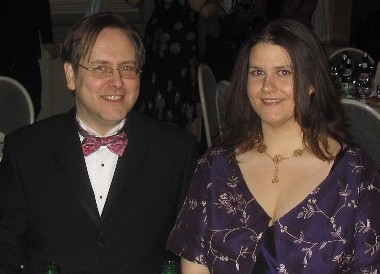
If Samizdata has been a bit quiet of late, you can blame it on the fact that so many of the contributors have been in Brussels for the Centre for the New Europe‘s 2005 Capitalist Ball. (Some of you may remember David Carr’s eye-pleasing entry about last year’s soiree.) Many of last year’s attendees were present this year – including the tall, glamourous Texan from David’s 2004 entry – and the whole event was nothing short of splendid. To be in a room with hundreds of people who broke into enthusiastic applause when one of the speakers quoted Father Juan de Mariana‘s assertion that any individual citizen can justly assassinate a king who imposes taxes without the consent of the people, seizes the property of individuals and squanders it, or prevents a meeting of a democratic parliament was, to put it mildly, very refreshing.
Without any collectivists in the room at whom they could snarl, Perry and Jackie were forced to smile
Brian was not pleased with his date’s smugness over forcing him into a dinner jacket and out of his beloved Birkenstocks
There was no prize for best posture or most regal attendee, but we had a winner for both of those categories on our table anyway
Brussels itself is a somewhat drab – if not totally miserable – town. Upon arrival, I was surprised to see a workman on a ladder in the train station, doing a bit of welding – without a properly fitted protective mask, and with sparks raining down mere inches from passersby. This total disregard for the cult of ‘health and safety’ was an oddly pleasing sight.
We took it as a good sign when the two flags flying right outside our hotel room window were the Union Jack and the American stars and stripes. Even more cheering was this sticker on a lampost near – I kid you not – Rue du Gouvernement Provisoire (Provisional Government Street):
It is the “as much as possible” that made us smile. Keep trying, scumbags.
And speaking of scumbags, it seems the local communists know they have a bit of a PR problem, to say the least:
Roughly translated, they are trying to sell the line that being against capitalism does not necessarily mean being in favour of the gulag. I suppose that may be true, in much the same way that being against breathing does not necessarily mean that one is in favour of a horrific death, but…Again, keep trying, scumbags. The pro-liberty contingent that gathered in Brussels this weekend are not the only people around who know you are full of crap. From the looks of the city’s Grand Place, a European stronghold of capitalism since the 17th century, it would appear that the denizens of Brussels have had that one figured out for quite a while. With any luck, and exposure to the free market principles celebrated at the CNE’s Capitalist Ball, the young communists of Belgium will get on the winning side of things any day now.
The Guardian is serious about blogging, and it is also serious about presenting the occasional non-left piece of writing. (They used regularly to publish pieces by Enoch Powell.) So the surprising thing about this piece about blogging is not that the Guardian published it, but that the name of Iain Duncan Smith appears where the author’s name goes. (I share Patrick Crozier‘s doubts about the piece’s true authorship. And when we are talking about blogging, being who you say you are is a big thing, I think.)
IDS (I will assume this to be real from now on) hopes that blogging will revitalise the right in Britain, and notes that blogging has already revitalised the right in the USA, and has utterly deranged the left by causing the left to drag their party away from electability.
I wonder. I suspect that the problems of the Conservative Party are more serious than that, and that blogging will as likely serve to dramatise all the many differences that are now contained, if that is the right word, within the Conservative Party.
The Conservatives now have a hideous problem. Having lost confidence in its own economic nostrums, with the collapse both of the old USSR and of its own attempts to galvanise the British economy by seizing control of it, the British dirigiste left is content to allow Blair – or, I suspect, any likely successor of Blair – to triangulate away into the sunset. Labour knows that for them, it is either New Labour or no Labour at all. Which means that the Conservatives are no longer united by Labour. Instead they are divided by New Labour.
I do not go out of my way to converse with Conservative Party activists or critics or cheerers-on, but every one of such persons I have met with during the last decade or so has had his own distinct plan for the future of the Conservative Party, consisting of his own preferred mixture of policies. Each activist knows that his particular plan is The Answer, and that all that is needed is for all those other Conservative morons to stop with the negativity and embrace his plan without reservation. Easy really.
The Conservative Party should take a firm stand about this (or its opposite), without compromise. But, it should fearlessly compromise on that, by either lying or not talking about it. Go hard with England, Britain, Europe, the Anglosphere, the World (mix and dilute to taste). Be anti-immigrant, pro-immigrant. Anti-ID-cards, pro-ID-cards. Smash the welfare state, buy voters with an even better welfare state. Cut pensions, raise pensions. Support state education, destroy state education. Defend fox hunting, ignore fox hunting. Applaud the Americans, denounce the Americans. (I once thought that the Conservatives could maybe agree about applauding the Americans and leave the rowing about the Americans to the Labour Party. Fat chance.) Etcetera, etcetera, etcetera. Every policy front is a distinct way to destroy Conservative Party unity.
It used to be that the Leader would decide all these things. Now they all want to be the Leader. And if they are not the Leader, and a different mixture of policies and attitudes is propose to their preferred mixture by the bloke who is the Leader, they are about as loyal to the Leader as a basket of low-IQ, but poisonous, snakes. As a result, the Conservative Party is now nigh on unleadable. It is not that they have chosen bad Leaders, or for that matter that they have chosen their Leaders by the wrong methods. It is that they cannot be lead.
I cannot see blogging being much help with all this. On the contrary, I think it will only allow the stupid snakes to hiss louder and louder. Blogging will be a whole new source of indiscretions and vituperations, a whole new way to destroy the Conservative Party. The anti-Conservative journalists could have a field day, and I think the Guardian knows it.
IDS says that blogging will put the fear of God into the “metropolitan elite”, and assumes that this will help the Conservative Party. It is just as likely to start a new civil war within it. IDS says that lazy journalists think only of the impact of this or that policy on the opinion polls. Which the leadership of the Conservative Party never does, does it? The title of IDS’s piece is “Bloggers will resue the right”. But what it blogging rescues “the right” from the Conservative Party?
But, we shall see. Politics is weird. Often something that seems utterly impossible one month, becomes unavoidable a few short months later. Maybe blogging will provoke a big Conservative revival.
Personally I do not much care one way or the other. I agree with Perry that a speedy return of a Conservative government would improve very little, and very possibly make things even worse. My loyalty is to blogging itself. This is where I have placed my bets. If blogging very publicly sweeps the Conservatives back into office, hurrah! If it rips the Conservatives into unmendable fragments, hurrah also!
Or then again, maybe the unanimous ignorance of the modern world and its possibilities will mean that the stupid snakes continue to neglect this new way for them to hiss, and we bloggers will have to spread our enthusiasm for this new and amazing medium by quite other means.
The land of the free is imposing privacy-busting requirementson its visitors.
At America’s insistence, passports are about to get their biggest overhaul since they were introduced. They are to be fitted with computer chips that have been loaded with digital photographs of the bearer (so that the process of comparing the face on the passport with the face on the person can be automated), digitised fingerprints and even scans of the bearer’s irises, which are as unique to people as their fingerprints.
There are so many concerns that one does not know where to start:
For one thing, the data on these chips will be readable remotely, without the bearer knowing. And—again at America’s insistence—those data will not be encrypted, so anybody with a suitable reader, be they official, commercial, criminal or terrorist, will be able to check a passport holder’s details.
So we have unencrypted details about an individual, recorded in by an unreliable manner (biometrics). That’s what I call the worst of both worlds…
A second difficulty is the reliability of biometric technology. Facial-recognition systems work only if the photograph is taken with proper lighting and an especially bland expression on the face. Even then, the error rate for facial-recognition software has proved to be as high as 10% in tests. If that were translated into reality, one person in ten would need to be pulled aside for extra screening. Fingerprint and iris-recognition technology have significant error rates, too. So, despite the belief that biometrics will make crossing a border more efficient and secure, it could well have the opposite effect, as false alarms become the norm.
And far more unpleasant as you already be ‘guilty’ of not having your non-papers in order.
The scariest problem of all is the remote-readability of the chip, which combined with unencrypted data on it, make is designed for clandestine remote reading. Deliberately.
The ICAO specification refers quite openly to the idea of a “walk-through” inspection with the person concerned “possibly being unaware of the operation”.
Privacy and liberty implications of this are enourmous… and it gets worse. Identity theft will become a matter of setting up such clandestine remote readings. Terrorists will be able to know the nationality of those they attack.
Even the authorities realised that this would be double-plus-ungood and are looking for ways to ‘protect’ the chip either by blocking radio waves with a Faraday cage or an electronic lock. As a result, some countries may need special equipment or software to read an EU passport, which undermines the ideal of a global, interoperable standard. And so we come the full joyous circle of government ‘compentence’…
Cross-posted from Samizdata.net
The land of the free is imposing privacy-busting requirements on its visitors.
At America’s insistence, passports are about to get their biggest overhaul since they were introduced. They are to be fitted with computer chips that have been loaded with digital photographs of the bearer (so that the process of comparing the face on the passport with the face on the person can be automated), digitised fingerprints and even scans of the bearer’s irises, which are as unique to people as their fingerprints.
There are so many concerns that one does not know where to start:
For one thing, the data on these chips will be readable remotely, without the bearer knowing. And—again at America’s insistence—those data will not be encrypted, so anybody with a suitable reader, be they official, commercial, criminal or terrorist, will be able to check a passport holder’s details.
So we have unencrypted details about an individual, recorded in by an unreliable manner (biometrics). That’s what I call the worst of both worlds…
A second difficulty is the reliability of biometric technology. Facial-recognition systems work only if the photograph is taken with proper lighting and an especially bland expression on the face. Even then, the error rate for facial-recognition software has proved to be as high as 10% in tests. If that were translated into reality, one person in ten would need to be pulled aside for extra screening. Fingerprint and iris-recognition technology have significant error rates, too. So, despite the belief that biometrics will make crossing a border more efficient and secure, it could well have the opposite effect, as false alarms become the norm.
And far more unpleasant as you already will be ‘guilty’ of not having your non-papers in order.
The scariest problem of all is the remote-readability of the chip, which combined with unencrypted data on it, make it designed for clandestine remote reading. Deliberately.
The ICAO specification refers quite openly to the idea of a “walk-through” inspection with the person concerned “possibly being unaware of the operation”.
Privacy and liberty implications of this are enourmous… and it gets worse. Identity theft will become a matter of setting up such clandestine remote readings. Terrorists will be able to know the nationality of those they attack.
Even the authorities realised that this would be double-plus-ungood and are looking for ways to ‘protect’ the chip either by blocking radio waves with a Faraday cage or an electronic lock. As a result, some countries may need special equipment or software to read an EU passport, which undermines the ideal of a global, interoperable standard. And so we come the full joyous circle of government ‘compentence’…
We interrupt your browsing for this bulletin:
Mark Steyn is back on-line.
That is all.
The Great International Petroleum Exchange Uprising was noted here earlier, and plans for a T-shirt commemorating the event are in the works.
We all knew that, of course. But when the Manolo puts the evil eye on you, well, time to update your will, launder your cash, gas up the Lear, and oil the hinges on the back door.
Beautiful shoes for everyone! Death to the tyrant who would deny the peoples the beautiful shoes! This it is the political philosophy of the Manolo.
The Cuban embargo should be lifted, not for ideological libertarian reasons, but for pragmatic ones. Doing so will unleash a tide of cash and goods into Cuba, not to mention Americans, and nothing could be more corrosive of the tyrannical regime there.
Much as I love cigars, I won’t buy Cuban cigars, because that is a state-controlled industry and I choose not to do business with the Cuban state. (Plus, I think they are overrated). I would go to Cuba, though, after the embargo is lifted because doing so would allow me to circumvent the state, meet real Cubans, and undermine a Stalinist bastard in my own small way.
I am watching the BBC’s Culture Show, and they are telling a sad little story. Apparently, the regional theatre companies of Britain have, during the last five years or so, enjoyed a bonanza of government money. There has apparently been a mini theatrical renaissance in the provinces. Hurrah!
But now, the horrid government is imposing a pay freeze, and this “great achievement” is in jeopardy. For the sake of a few more million quid, this great achievement could all collapse. Woe!
I could have told them. Never, I would have said to them (had they thought of asking me), depend upon government money and the promises of politicians. Never get addicted to the contents of the public purse, for they can be snatched away from you without warning. Renaissances funded only by politicians have a way of dying very prematurely. Getting money from mere customers may be harder in the short run, but once you learn the trick, you have a foundation you can build on more confidently.
Probably all this is just the political machine doing what it does. It spends. It cuts back on its spending. Occam’s Razor says that this is what is happening here. But, although it was not discussed on the show, I wonder if the end of the romance (that is to a Times on Line piece, which may be a problem for some, but it tells this story better than any other I could find) between New Labour and the Luvvies – caused by such things as New Labour going to war in Iraq, and the Luvvies going to war against the war in Iraq – might have something to do with this story of theatrical feast and threatened theatrical famine.
Last night I started to get into the mood for the Capitalist Ball (that being a link to David’s piece about it last year), which will take place in Brussels this evening, by playing waltzes by Johann Strauss II, on my medium- to lo-fi hi-fi machine.
And what lovely music it is! I remember reading that when Herbert von Karajan got hired to conduct the New Year’s Day concert in Vienna, in 1987, he experienced a sense of both musical and personal renewal. This makes perfect sense to me.
With these waltzes, marches and dances, the symphony orchestra had its one great age of pop superstardom. Before then, pop music was played in taverns and in the open air, and classical music was for the aristocracy. As the audience for orchestral music widened, and as the symphony orchestra widened with it, composers like Brahms and Dvorak, in among grander works like piano and cello concertos, and symphonies of course, also wrote dances for the orchestra. But there was about these pieces an air of down-market music being ever-so-slightly elevated by these grandees of the concert hall. The music of the Strauss family was the genuine, popular article, the purest example of orchestral popular dance music ever created.
In Italy, opera was enjoying a similar period of genuine popularity, where high art and popular art were similarly united.
With arrival of the twentieth century, and the age of electronic recording, and then of electronically enhanced instruments, pop music and classical music again went their separate ways. While the classical musicians concentrated on recording what would now be called their back catalogue, the popsters switched back to more raucous sounds, more suited to the limitations of early recording, and then more attuned to their new audiences, no longer beholden to the musical conventions of an earlier epoch. And opera also divided, the torch of popularity being handed on, via operetta, to the stage ‘musical’.
Meanwhile, the once imperial city of Vienna has been dining out on the music of the Strauss family just about ever since, first for real as it were, and then – and now, still – in reaction to the very different and disappointing reality by which it was increasingly engulfed, and to which it made its own baleful contribution, in the form of the influence and perverse inspiration it supplied to the young Adolf Hitler. No wonder the Viennese still prefer the Beautiful Blue Danube version of their past to more recent horrors. (The moment of transition, when what had been a joyous reality was sliding into history, was memorably captured by that other Strauss, Richard, no relation, in the waltzes he wrote for his opera, Der Rosenkavalier.)
But the music of the original Strausses still plays on. As the centuries pass, it seems all too possible that, horrifying though they were, the wars and massacres of the twentieth century may eventually be topped by later and greater horrors as yet unimaginable. The slaughters that now seem to us so uniquely evil may in due course seem only banal, like the murders and feuds of the Italian Renaissance, which we now think of as the mere backdrop to all those wondrous paintings. But those waltzes, dances and marches of the century before the one just concluded – the waltzes especially – will never be bettered.
At the Capitalist Ball, one of the organisers has just told me, there will be a French swing band in action. A different and later style of dance music, but one I am greatly looking forward to hearing.
by Rick Tumlinson
Rick Tumlinson of the Space Frontier Foundation is an old friend of mine who has been directly involved in much behind the scenes in commercial space, including the private attempt to save MIR. Here, with his permission, is an article like the one I have been intending to write. I am still traveling and just have had no time do so. Rick probably did a better job of it anyway
There are three initiatives from 2004 that if built upon the right way will rapidly accelerate the human breakout into space.
The first was U.S. President George W. Bush???s vision of permanent human presence beyond Earth orbit, which was endorsed by congressional funding and clarified by the Aldridge Commission.
The second was the flight of SpaceShipOne, the first major triumph of the new space movement and its goal of opening space to the people. This was solidified by a multi-million-dollar contract from Virgin Galactic to build a fleet of commercial spaceships.
Finally, the passage of legislation in Congress that begins to create regulatory certainty in the New Space transportation field clears the way for the long-term development of this nascent industry.
→ Continue reading: Private Industry Can Help NASA Open the Space Frontier
|
Who Are We? The Samizdata people are a bunch of sinister and heavily armed globalist illuminati who seek to infect the entire world with the values of personal liberty and several property. Amongst our many crimes is a sense of humour and the intermittent use of British spelling.
We are also a varied group made up of social individualists, classical liberals, whigs, libertarians, extropians, futurists, ‘Porcupines’, Karl Popper fetishists, recovering neo-conservatives, crazed Ayn Rand worshipers, over-caffeinated Virginia Postrel devotees, witty Frédéric Bastiat wannabes, cypherpunks, minarchists, kritarchists and wild-eyed anarcho-capitalists from Britain, North America, Australia and Europe.
|









Recent Comments