We are developing the social individualist meta-context for the future. From the very serious to the extremely frivolous... lets see what is on the mind of the Samizdata people.
Samizdata, derived from Samizdat /n. - a system of clandestine publication of banned literature in the USSR [Russ.,= self-publishing house]
|
My February last Friday has just ended, and it was definitely one of the better ones. Patrick Crozier spoke about libertarianism and private road ownership. Excellent talk, excellent discussion. The result of Patrick’s time writing for and bossing the now only archived Transport Blog, which he has now ended. (He now writes this.)
Among those present was Alex Singleton, and he naturally talked about his newly launched Globalization Institute, which, of course, has a new blog.
It occurs to me that you might expect the word itself, ‘globalisation’ (I prefer an ‘s’ in the middle there), to be the equivalent, at the global level, of ‘nationalisation’ at the national level. Yet, while nationalisation means the national government stealing things, globalisation means something quite different and much nicer. If globalisation was the same at the global level as nationalisation is at the national level, globalisation would mean a World Government stealing things.
Does this matter? Well, maybe it does, because we surely do need a word to describe the equivalent of nationalisation, but at the global level. I have been drinking and may have forgotten the obvious, but my impression is: we do not have such a word.
Surely the existence of the word ‘nationalisation’ made it far easier to oppose the thing itself. Not having a word for this other form of ‘globalisation’, predation by the government of the globe, makes it harder to oppose, I think.
For a while now, I have reading about how the mighty U.S. economy, heavily in debt, with big budget deficits and a large current account black hole, is headed for the rocks. The dollar is on the skids, inflationary pressures are rising, the Fed has been putting up interest rates, the coming Social Security crunch… you know the drill. And some of these worries are to my mind justified, which explains why, with all the plan’s faults, I broadly applaud the efforts of President Bush to overhaul the state pensions system.
Is the situation really as grim as some of the jeremiads claim, however? This suitably wonkish article in the prestigious Foreign Affairs journal argues that things are not nearly as worrying as some might make out and that if anyone has cause for worry, it is Europe with its shrinking birth rates.
The article concudes with this paragraph, and it seems to hit the mark, in my view:
Only one development could upset this optimistic prognosis: an end to the technological dynamism, openness to trade, and flexibility that have powered the U.S. economy. The biggest threat to U.S. hegemony, accordingly, stems not from the sentiments of foreign investors, but from protectionism and isolationism at home
Indeed.
To strengthen defence, cut taxes and balance the budget is very difficult.
Ronald Reagan managed the first two tasks, but failed in the third. President Bush made no effort to control nondefence spending in his first term and is only now trying to do so – we shall see how how well he does (he does not have President Reagan’s defence of the Democrats being in control of the House of Representatives)
However, it is not impossible to achieve all three tasks. Perhaps the most important example in history is that of the Emperor Anastasius.
When Anastasius became Emperor of the Eastern Roman Empire in 491 AD (the Senate allowed the choice of Emperor to rest with the Empress Ariadne) the Western Roman Empire had already collapsed. Here and there (such as in the Province of Britian) there were local leaders who continued to fight against the Germanic peoples, but the vast majority of the old empire in the west was under various Germanic kings.
The Eastern Roman Empire (which evolved into what we call the Byzantine Empire) was not in a good state. As with the Western Empire taxes were crushing, and yet the treasury was empty and the defences of the Empire were falling apart.
Anastasius fought many wars, both against invaders and against domestic rebels (mostly Chalcedonian Christians who objected to his austere Monophysite variety of Christianity – although I am not claiming that all Monophysites were austere, and it should also be remembered that Anastasius did not tend to persecute other sorts of Christians – not even Arians, the religion of the most of the barbarian rulers in the West and a religion whose doctrines were further from the “one divine nature of Christ-God” of the Monophysites, than were the “two natures of Jesus” view of the Chalcedonians from which the vast majority of modern Christians get their doctrines), and yet he greatly reduced taxes. Anastasius abolished the “chrysargyon” (a major tax on the urban population) and reduced the “capitatio” – one of the great taxes on the peasantry. → Continue reading: The Emperor Anastasius and the city of Philadelphia
I am very disappointed by the options given in this online slashdot poll. Where is the “Built from vast numbers of Nescafe jars” option?
The line here, which I pretty much toe, is that the Olympic Games are an orgy of drug-sodden, politicised insanity, which Britain, London in particular, will spend the next century or more paying for, in the unfortunate event that Britain, London in particular, get the damn things, in 2012. That the politicians all seem to love the Olympics is enough to make me hostile, even though I do have a serious weakness for modernistical structures of the sort that they build nowadays to accommodate sporting events.
Luckily, Paris is now said to be the front runner. But, the news from Paris is deteriorating. On March 10th, that gang of bribe guzzlers known as the IOC (International Olympic Committee) will be visiting Paris, and the local unions, purely by coincidence I feel sure, happen to be agitating at that time against … the future basically:
French unions have rejected calls to shelve strikes planned for the day the International Olympic Committee (IOC) is due in Paris to assess its bid.
Seven unions are to take part in marches and stoppages on 10 March, to protest against government moves to relax France’s 35-hour working week.
Meanwhile, Mayor of London Ken Livingstone is up to his neck in a row about some insulting and borderline anti-semitic remarks he made to a Jewish journalist, in the course of his ongoing feud with a newspaper group.
The pressure on London Mayor Ken Livingstone intensified today as Tony Blair joined calls for him apologise for his Nazi jibe to a Jewish journalist.
In the capital, there were fears that the continuing row over Mr Livingstone’s outburst – in which he likened the journalist to a concentration camp guard – could damage the city’s chances of hosting the 2012 Olympics.
Well, it certainly could, and the French press is presumably spinning this story like a nuclear powered top. But, a possibility that does not seem to have been much discussed is that Ken Livingstone’s attitude during this ruckus might be what it is not despite the attempt to get the Olympics for London, but because of it. The initial insults sound less than calculated, but politicians like Ken Livingstone are nothing if not good actors. What if Ken picked this particular fight deliberately? Okay, that may be somewhat farfetched. But the aftermath? After Ken had had time to think things through?
Israel has called on Ken to apologise. “International” people, like the people in the International Olympic Committee, are just going to fall over themselves to obey Israel. Not.
Tony Blair wants Ken to apologise. And he is another focus of adoration throughout International land. Again, not.
I do not know the political attitudes of the IOC people, but I bet Ken Livingstone does. And what if he calculates that hanging tough, in the face of all this pressure, adding further insults to the original insults, will actually get him more points with these people than backing down?
The threat to civil liberties in Britain posted by the Labour government, with laws that make the Patriot Act in the USA seem like a mere trifle, is finally regularly getting the sort of attention it deserves, at least in the Daily Telegraph.
The notion that a politician would dare to try and take powers to deprive people of their liberty without recourse to courts and without even presenting evidence because they ‘know’ that they pose a threat is astonishing. It should also should answer all those people who shrug their shoulders and say “why get worked up about ID cards? We can trust the state.” House arrest without trial and without the ability to confront your accusers… and of British subjects on British soil. And the people who want to do this expect to just be trusted without at any point being required to present proof of a crime or threat to national security. If this is allowed to stand then truly, Britain stands on the brink of something truly dark.
I reckon we ought to be a part of (better somewhat belated than never) this:
An online protest Tuesday of Iran’s crackdown against bloggers made an impact – even on Iranian officials.
So says a leader of the Committee to Protect Bloggers, the group that organized the effort to decry the jailings of Iranian bloggers Arash Sigarchi and Mojtaba Saminejad.
Reuters on Tuesday reported that Sigarchi was jailed for 14 years on charges ranging from espionage to insulting the country’s leaders, a move probably linked in part to the timing of the protest, said Curt Hopkins, the committee’s director. “I think there’s got to be some connection,” Hopkins said.
A message left with the Iranian mission to the United Nations was not immediately returned.
Hopkins’ group – whose deputy director is Ellen Simonetti, the former Delta Air Lines flight attendant fired over photos of herself in uniform that she posted on her blog – asked those who maintain Web logs to call attention Tuesday to the plight of Iranian bloggers through posting banner ads and contacting government officials.
Some notable members of the blogging community took up the cause. They included Jeff Jarvis, who runs the BuzzMachine site, and Glenn Reynolds, who’s behind Instapundit.
Hopkins said the response was just as impressive around the world. Hits on the committee site jumped from a daily average of about 500 to about 3,000 just during the Asian daytime hours. “It’s been going like gangbusters,” he said. “We’ve had people from Brunei and Saudi Arabia, and Japan and Russia.”
Notice how, what with this being from News.com (www address: news.com.com, which I rather like), it is full of links. Old Media stuff which has merely been shoved online but without links, even to things mentioned in the text with .com in them, or to bloggers that they deign to name, are starting to look, even to a www latecomer like me, very dated.
As for Iran, my understanding of Iran now is that it is rapidly moving towards being a very sensible country, and that a little pressure from outside, of the sort described in this posting, will be all that is required. It only needs for the priests to stop getting above themselves and go back to being priests, and to let politics be done by politicians, with plenty of overlap between these two trades, but nevertheless a distinct separation of realms also.
Any attempt at military conquest from outside is, or at least should be, out of the question. Mind you, it does help that the country next to Iran has been conquered. When that happens, and you then say things like “… out of the question …”, it still causes flutters, even if, like me, you absolutely mean it. They do not know that, is the point. Without the Iraq invasion, the Iranian government would not be nearly so bothered about all this blog chatter. Anyway, it all looks like a situation well worth watching.
I would love to be able to say that I saw this kind of thing coming before Iraq was even invaded, and, looking back to then, I reckon I did. Many of the comments on that posting also look even cleverer now.
Well it seems that today, short little link-pieces are okay, so here is a short little link piece, with links to these mealy-mouthed trimmers, arguing for a flat tax, and to me, arguing that mere flatness is not the point. Just having a flat roof to the graph is a hideous compromise. It must be flattened until it is zero-height roadkill. (Metaphor muddle there, but I hope you get the picture.) Seriously, this is one of my best diatribes (“THE TOP RATE OF INCOME TAX SHOULD BE CUT TO ZERO”) from my time as a Libertarian Alliance pulpit banger, and I recommend that you read the whole thing, even if it is only a .pdf.
When the world in due course sees the wisdom of this proposal and enacts in universally, the result will be that there will remain a top rate of income tax, but that whatever money you earn above the level at which the top rate of income tax kicks in, you keep. All of it. These flat-raters say that it should be fifteen percent or whatever for everything you earn. I say, once you have paid your share of the rent, you should keep the lot.
Sorry, I went on a bit there.
For the last several weeks I have been watching with growing pleasure, every Monday night from 8 pm to 9 pm, two episodes at a time, one of those Channel 5 TV series that tend to pass without much comment or many claims of significance, called Massive Engines.
Last night saw the airing of the final two episodes, number 9 about massive pumps, and number 10 and finally, about the massive jet engines that enable modern airliners to ply their trade. The presenter was Chris Barrie, who is probably best know for comedy-of-embarrassment characterisations like Rimmer in Red Dwarf, or Brittas in The Brittas Empire, and in Massive Engines there are occasional Rimmer/Brittas style, self-send-up moments of leaden humour. The impression you get is that Barrie is not as sure as he would like to be that he is keeping his audience’s attention.
For myself, I absolutely do not think Barrie need have worried. Whenever, which was most of the time, he forgot about being comical and concentrated on explaining the whys and wherefores of his various massive engines, often while himself operating them and with every sign of knowing pretty much what he was doing, I was held, and fascinated.
I learned all kinds of things I never knew. For instance, in the last show, about aircraft engines, I learned that on an early aircraft engine, not only did the propeller rotate, but the cylinders also, firmly attached to the same bit of the engine as the propeller, and rotating along with the propeller. To keep them cool. Amazing. Well, you probably knew that, but I had no idea. You probably also know that whereas petrol engines work with regular explosions, diesel engines (names after a German bloke called Diesel) do not feature externally induced explosions. The pressure caused by the cylinder coming back up again is enough to set fire to the next lot of fuel. Well, I sort of vaguely did know that. But now I know it a little better.
In general, throughout the run of the show, Barrie’s quick and clear explanations of the principles behind all the mechanisms he was describing were, well, amazingly quick, and amazingly clear.
The only episode which I found a bit weak was the one about motorbikes, which featured rather too much footage of Barrie trundling about rather pointlessly on a motorbike, in between the serious explanatory stuff. The trouble with motorbikes is that frankly, they are not massive. They got as big as they will ever be many decades ago, and anyway, the point of them is speed, plain and simple, rather than speed (or anything else for that matter) achieved through massiveness.
That episode aside, all the engines on show got steadily bigger and more effective throughout their history. They are not necessarily massive any more. The pumps, for instances, that shift water hither and thither used to be a lot bigger, when they were steam engines, than they are now, now that they are diesel or electrical engines or whatever. But a good few of the engines Barrie talked about with such enthusiasm are huge right now, and getting ever huger.
The earth moving kit they now use is unbelievably huge, as was proved with a trip to a massive open cast coal mine in Germany, where there were also earth-shifting lorries with wheels the size of terrace houses. The machines used to dig tunnels are now as massive as they have ever been. As are those aircraft engines of course.
I expected the airplane episode with which the show ended to be a commercial for the Airbus A380, but actually it was a commercial for the Rolls Royce Trent Alphabetsoup engine. No Airbuses were mentioned, but a Boeing was, the two engine 777, which is apparently almost as huge as the four engine 747.
I recall no mention whatsoever of the wickedness of massive engines from the environmental point of view, which was most refreshing. On the contrary, massive engines got massive because they were used, again and again, to solve massive environmental problems, such as the environmental mess that the London sewage system had become towards the end of the nineteenth century, or the massive problem of travelling vast distances across the damn environment, most especially the sea. (There was an episode devoted to massive ships.) The entire show was a continuous hymn of praise to the God of the Technical Fix. You have a problem? Building a massive engine to solve it.
I cannot claim to remember all the technical details that were laid out before me on Massive Engines, but when they were being laid out I recall very, very clearly that they did make perfect sense, at the time. Had I written the stuff down, I am confident that only my own handwriting would have then stopped it making perfect sense now.
What I am really saying is, if I come across DVDs of this show at a suitably miserly price, I would definitely consider buying them, and watching the whole show again, repeating the quick and clear explanations and fast forwarding through the motorbike trundling.
As a potential interester of intelligent and intellectual curious children, boys especially of course, these shows would, I feel sure, prove excellent.
And Chris Barrie’s Rimmerisms might even help from that point of view. By the end, even I was enjoying the rest of it so much that I found myself smiling instead of wincing when Barrie started up yet another massive engine not with a “right let’s start this thing up”, but instead by shouting rather self-consciously: “let’s rock”. Very embarrassing dad. But when you really like the serious work that someone is doing, you can put up with mannerisms and foolishnesses that would drive you insane if it was just another pointless idiot doing them. And when they are gone, you even find you miss them.
So, an outstanding show, and particular proof of the value of having lots of different TV channels, allowing lots of different points of view besides the official one, which as far as massive engines is concerned is now that massive engines are, at best, a necessary evil, and at worst, just plain evil.
This is the question asked by Anthony Daniels over on the Social Affairs Units blog. His article conveys the sense of mounting unease that I certainly share. Read the whole thing.
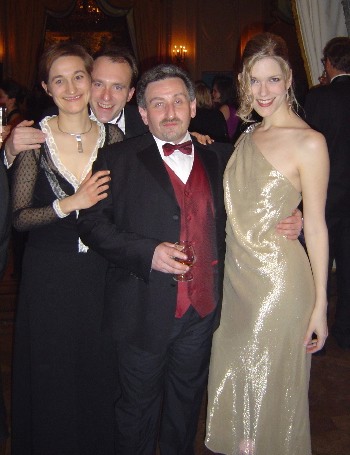
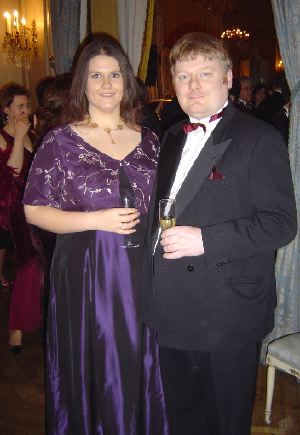
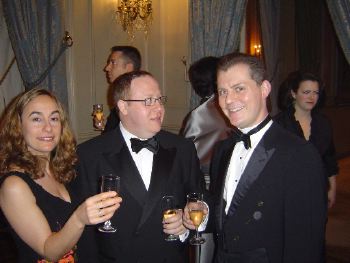
I thought a few more images from the splendid Capitalist Ball last week in Brussels would not go amiss…
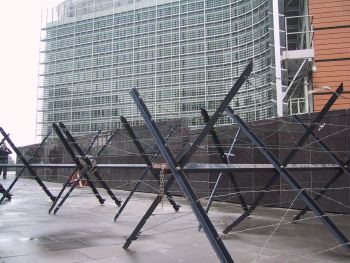
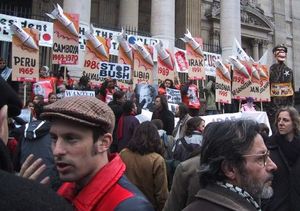
And whilst in the Heart of Darkness, there were some anti-Bush protesters in town (well, I know most of the people who work for the EU fall into that category but that is not what I mean… and as a result security was somewhat tighter than usual. Someone I always imagined Berlaymont, the HQ of the European Commission, as being a place that has a great deal of barbed wire in its future.
The interesting things about the protesters for me were…
… firstly their very small number and secondly, their fascinating choice of protest placards which decried US military action against a mass murdering fascist regime in Iraq, a mass murdering fascist regime in Yugoslavia, in support of a democratic regime in Bosnia, against a right wing dictator in Panama …
Very revealing, would you not agree?
I bought a DVD of Nabucco the other day. It’s the usual story: boy meets girl; girl’s father attacks Jerusalem; Hebrews carted off to Babylon. “Sack, burn the temple,” says the King of the Babylonians. “This cursed race shall be wiped from the earth.” But first, let’s all have a sing-song.
I saw it in Hong Kong a couple of years ago. It was the Latvian National Opera, so I was watching Latvians, in China, pretending to be Jews in Babylon, and singing in Italian. Well that’s all right. I can take a joke.
– Harry Hutton last Friday. More about Nabucco here.
|
Who Are We? The Samizdata people are a bunch of sinister and heavily armed globalist illuminati who seek to infect the entire world with the values of personal liberty and several property. Amongst our many crimes is a sense of humour and the intermittent use of British spelling.
We are also a varied group made up of social individualists, classical liberals, whigs, libertarians, extropians, futurists, ‘Porcupines’, Karl Popper fetishists, recovering neo-conservatives, crazed Ayn Rand worshipers, over-caffeinated Virginia Postrel devotees, witty Frédéric Bastiat wannabes, cypherpunks, minarchists, kritarchists and wild-eyed anarcho-capitalists from Britain, North America, Australia and Europe.
|







Recent Comments