We are developing the social individualist meta-context for the future. From the very serious to the extremely frivolous... lets see what is on the mind of the Samizdata people.
Samizdata, derived from Samizdat /n. - a system of clandestine publication of banned literature in the USSR [Russ.,= self-publishing house]
|
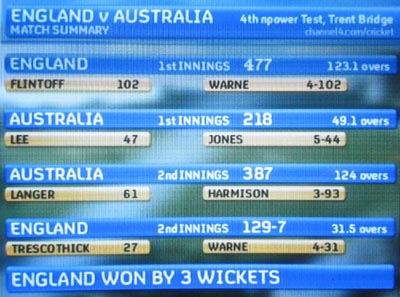
Yesterday I expressed the hope that England would beat Australia at Trent Bridge, and today they did.
But England fans like me were once more put through the ringer. England should have had no difficulty knocking off the 129 runs they needed in their final innings. But the Australians fought like hell to claw their way back into the contest at exactly the moment when they should have been accepting the inevitable, and once again they nearly succeeded, England scrambling home by a mere three wickets. Warne and Lee are such ignorant fellows. They never seem to know when they are beaten.
The general opinion is that this is one of the greatest Ashes series ever. And this England win is good for that series in the sense that if England had lost this game, Australia would have retained the Ashes, no matter what happened at the Oval. As it is, the Oval game is winner take all.
The closeness of this Trent Bridge game makes it all the more regrettable that this otherwise fabulous contest was disfigured by yet another important and hideously mistaken umpiring decision. Australian batsmen Simon Katich was given out leg before wicket, at a time when he was batting very well and might have gone on to help set England a lot more than 129 to win. We all make mistakes. Umpires cannot be infallible. But on this occasion, technologically generated evidence made it clear to everyone before the unfortunate Katich had even walked off the pitch that the ball (a) pitched outside the leg stump, and (b) would have gone over the top of the stumps, and that the umpire was accordingly wrong on both counts to give him out.
Some erroneous decisions by cricket umpires take many minutes to deconstruct fully, but this Katich decision was immediately revealed to be wrong. So, if the umpires had had the same technology in their hands as the commentators now have, not only would a correct decision have been given at a crucial juncture in this very close match; it would have been given with almost no delay.
The current circumstances, in which umpires are made public fools of within seconds of giving their verdicts, cannot be allowed to continue indefinitely.
The LBW decision that did for Gilchrist also looked dodgy, but, assuming that I understand the finer points of the LBW law, the technology was able to show that this decision was almost certainly right. But that just means that the umpire guessed right, this time. He should not have had to guess. He should have known.
Cameras are already used to settle run outs, to the general satisfaction of all involved. Today, cameras were used to show that a possible run out was not, because England’s wicketkeeper had knocked the bails off before the ball arrived, and again to establish that the catch which later on dismissed Andrew Strauss was properly held and had not hit the ground first. There was a bit of a delay, but not an excessive one given the importance of such decisions.
I understand how this situation has arisen. This clever LBW technology could not immediately be given to the umpires. It had to be refined and proved to be satisfactory. But now it has proved itself. We all – fans and players alike – now trust its verdicts more than we trust the umpires. Had the umpires had it in their hands today, who knows how the result might have gone? Who knows how many runs England might have had to chase in their final innings?
All of which made the characteristically sporting manner in which the Aussies took their defeat today all the more impressive. Considering how little practice they have had at it during the last fifteen years, they are good losers.
Perfect 10, an adult website, sued Google last November for infringing upon its copyrighted material, its trademarks and, to get bang for their bucks, unfair competition. The original complaint was covered by Wendy Seltzer.
Now, Perfect 10 has requested that Google is prevented from showing any of their copyrighted images. Their argument is that, through advertisements accompanying these images, Google profits from their display even though it is perceived to be a free search engine:
Perfect 10 sued Google in November of 2004. It says that Google is displaying hundreds of thousands of adult images, “from the most tame to the most exceedingly explicit, to draw massive traffic to its website, which it is converting into hundreds of millions of dollars of advertising revenue.”
Perfect 10 claims that under the guise of being a search engine, Google is displaying, free of charge, thousands of copies of the best images from Perfect 10, Playboy, nude scenes from major movies, nude images of supermodels, as well as extremely explicit images of all kinds.
Dr. Norm Zada, the founder of Perfect 10, argues that the business model of Google, whereby images can be displayed and downloaded for free without accessing the original website, reduces the profitability of pay-per-view pornographic websites. Furthermore, as the majority of searches are for pornographic images, this represents a misappropriation of intellectual property, since Google depends upon lust for its profits, at the expense of companies like Perfect 10.
Overture’s Key Selector Tool indicates that most searches on the internet are sex-related,” says Zada. “Google’s extraordinary gain in market cap from nothing a few years ago to close to eighty billion dollars, is more due to their massive misappropriation of intellectual property than anything else,” says Zada.
This court case represents an attack upon the business model of Google. It also demonstrates the unresolved tensions between the perceptions of intellectual property that pervade new and old media. Zada explains why his injunction is beneficial to other traditional media outlets:
Any website publisher can sign up for Google AdSense. It’s an easy way for publishers to display Google ads – those being paid for by its AdWords customers – on their content pages. AdWords customers pay Google and Google pays a commission to AdSense publishers. So Google can maximise its revenues by maximising the traffic that it sends to AdSense affiliates. Perfect 10 does not suggest that Google is weighting its search results in favour of AdSense-supported sites; but it does argue that Google profits directly from the popularity of porn, and its particular concern is that it profits from Perfect 10’s porn that has been stolen by others.
Zada believes that the outcome of Perfect 10’s motion for preliminary injunction should have a major impact not only on Perfect 10, but also on traditional media outlets which are losing the ad revenue war to search engines, in part because of all the nude and semi-nude images search engines offer for free.
Right now, he says, consumers who want to view a nude scene involving Halle Berry, Nicole Kidman, or other Hollywood beauties, can view that scene for free by visiting a search engine without purchasing the DVD. “If all an infringer needs to avoid liability is to provide some sort of a ‘search function,’ that will be the end of intellectual property in this country,” says Zada.
Is this a principled defence of intellectual property or an opportunistic front in the war against the new media?
“Organic farming has been put forward as one of the major pillars of a new, more-sustainable human society that would be “kinder to the earth”. Unfortunately, organic farming cannot deliver on that promise. In fact, organic farming is an imminent danger to the world’s wildlife and hazard to the health of its own consumers.”
Dennis Avery, quoted in Fearing Food, (page 3) by Roger Bate and Julian Morris.
Something for George Moonbat to ponder, I reckon.
I do not really believe this, but it makes a good story:
The man who sparked the flat tax revolution is former Estonian Prime Minister Mart Laar. He governed his country from 1992 to 1995 and from 1999 to 2002. When the historian became Prime Minister in 1992 at the age of 32 he knew nothing about economy. Laar’s area of expertise were Europe’s 19th-century national movements. “It is very fortunate that I was not an economist,” he says. “I had read only one book on economics – Milton Friedman’s “Free to Choose.” I was so ignorant at the time that I thought that what Friedman wrote about the benefits of privatisation, the flat tax and the abolition of all customs rights, was the result of economic reforms that had been put into practice in the West. It seemed common sense to me and, as I thought it had already been done everywhere, I simply introduced it in Estonia, despite warnings from Estonian economists that it could not be done. They said it was as impossible as walking on water. We did it: we just walked on the water because we did not know that it was impossible.”
Shrewd politicians often pretend to be dumber than they are, if only so that they can look well-meaningly sheepish instead of thoroughly ridiculous when things go wrong. So, I take Laar’s claim to ignorance of economics and of economic policy outside Estonia with a pinch of salt. But what does not seem to be in doubt is the importance that a good book can have, and good ideas in general. If only the same did not apply to bad books and bad ideas.
I visited Estonia briefly in 1991, for a Libertarian International gathering in Tallin. I am not surprised that the Estonians are now doing well. They struck me as very level-headed and efficient people. They of course have a long mercantile tradition as a result of their proximity to and seaborne trade with Scandinavia. Those places are not called the “Baltic” states for nothing.
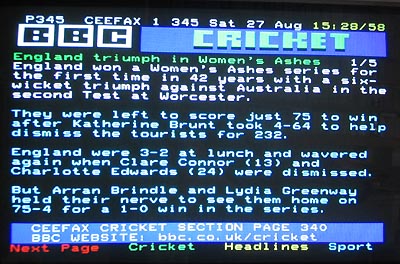
I like to interrupt TV coverage of test cricket with CEEFAX news of about other cricket matches, and this afternoon the news trickled through that England were (probably) winning – and then that they had finally won – the Ashes!
The ladies of Australia have had the same armlock on the Female Ashes as their menfolk have had on the Male Ashes in recent years, only more so. But today the English ladies beat the Australian ladies by 6 wickets to clinch a series win. With luck, England will get the Male Ashes back this summer as well. The men of Australia followed on today at Trent Bridge, and the men of England are well placed to get a win tomorrow and go one up with one to play in their series. Here’s to us limeys making it a double.
I wonder if a lady will ever play international cricket for her men’s team, so to speak. Cricket is not a game that is wholly conditional on brawn, although you do have to be fit, of course. Some of the greatest ever batsmen, like Bradman, Gavaskar and Tendulkar to name but three, have been quite small men. And bowlers, even quick ones, do not have to be giants either. And great slow bowlers can be quite small, and even physically handicapped. So, even if a female physique may be a handicap, it may one day be overcome.
Meanwhile the usual low-level politico-sporting storm rumbles and bumbles along about whether Civilisation ought, still, to be playing cricket games against Zimbabwe. At one time I was in the habit of making a bit of a fuss about such games here, because it was a way to make a fuss about Zimbabwe. But all the world that cares now knows that Robert Mugabe is ruining that unhappy country and the only question is whether someone can end his life and/or despotic reign before natural causes finally oblige. Other African rulers do not want anything done, because this might set a dangerous precedent. I mean, what kind of place would Africa become if merely being a thieving and destructive monster meant that you lost your job as tyrant? Very different, that is for damn sure. And since the rest of the world is disinclined to revive White Imperialism and barge in and rearrange matters without lots of local consent – the only new imperialists in Africa these days are the Chinese, and they are there for the minerals, not to take up the Yellow Man’s Burden – it really does not matter what the cricketers do about Zimbabwe. Playing against the current politically deranged Zimbabwe team and thrashing it probably does just as much good (and just as little) as refusing to play against it.
The fact that the leaders of the Sunni minority oppose a federal structure for Iraq, and have the ability to torpedo the new constitution, does not change the reality on the ground that Iraq is already in effect three nations.
The Kurds in particular have both an effective local administration and by far the best militias to call on if needed. The Kurdish situation is also helped by the fact that it was really the Peshmerga who moved into the vacuum and liberated the Kurdish region whilst US and British forces smashed Saddam’s armies in the south.
Eventually if the Kurds do not get the autonomy they desire, it is just a matter of time before they simply secede and I rather doubt the US had either the stomach or the inclination to use force to prevent what is a purely internal matter for the Iraqis and Kurds. Any in any case, so what if Iraq breaks up? The obsession with ‘stability’ and countering Iran is what lead the West to unwisely back Saddam Hussain for so many years and look where that got everyone in the end.
An independent Kurdish Northern Iraq may give the Turks cause to fret (unfortunate but them’s the breaks) and give Iran acute dyspepsia (which has to be a good thing) because Kurdish success in Iraq will no doubt give the Kurdish minorities elsewhere ideas above their station. However I fail to see how thwarting long standing Kurdish aspirations is in the interests of the US and UK, particularly as the Kurds have been quite amenable to US interests as of late and have shown themselves to be the sharpest operators.
Of course the prospect of a Shi’ite Islamic Republic of Southern Iraq is not very agreeable but it at least has the virtue of allowing more tailored pressures to be put on the three constituent parts of ‘Iraq’ rather than a probably futile one-size-fits-all constitution which in any case may fall apart as soon as western forces pull out.
An Iraq of highly autonomous cantons is probably the best that Iraq’s Sunni politicos have any right to expect because the alternative is never going to be a return to the ‘good old days’ of Sunni dominance and centralised rule from Baghdad, it is going to be splitting the county in three independent parts. And there is something to be said for that anyway. To hell with ‘nation building’… sometimes the cause of liberty (and probably long term stability too) may be served by a bit of ‘nation wrecking’.
There is an article in The Spectator which perfectly sums up the expression “The state is not your friend” that described the nightmarish encounter someone had with the officious little shits that are employed to police our borders and protect us from middle class Australian women.
It should be only under the most extraordinary circumstances in which an agent of the state should be able to legally refuse to give you their name and thereby avoid personal responsibility for their actions. Read the article and then ponder the thesis that the reason many people take jobs in places like the Immigration service is to satisfy a psychological need to exert arbitrary power over others. This is your tax money at work.
Is there anything, anything, now going on in what used to be called, either with delicate euphemism or with a sneer, the “developing world”, but which now really is the developing world, that is more encouraging than the rapid spread throughout said world of portable telephones?
I have just done a piece for the ASI blog about this process in Africa, linking to this New York Times article. And the Private Sector Development blog (whom I have just added to my personal blogroll here), in addition to supplying the same link today, have also linked to of a recent Economist piece on the same subject. Pablo Halkyard also links to this Wall Street Journal piece.
It is not all good news. It never is. Governments all over the place are now demanding extortionate connection taxes, to the point where the tax bill is starting seriously to outweigh what would have been the regular cost. Sounds like those cheap European air tickets that I sometimes buy on the internet for peanuts, where the government then charges me peanuts times four. Nevertheless, even there the news is partly good, because at least some governments are learning that if they cut connection taxes down to something more in line with the extreme cheapness of the service itself, people are more ready to pay such taxes. That is because illegal phones are more likely to go wrong and harder to get mended if they do go wrong. Is the unwillingness of people to pay big taxes good news or is their willingness to pay small taxes bad news? You decide.
The portable phone quote that made me smile the most this morning was this, from the Economist piece:
(Oh, and the “digital divide” vanishes, too.)
I especially like the brackets.
Until a day or two ago, I tended to regard the word “nanotechnology” as nerd-speak for it will never happen. But there really does seem to be a buzz surrounding this latest nanotchnological announcement:
A joint effort between the University of Texas and Australia’s Commonwealth Scientific and Industrial Research Organization has created industrial-ready material made of nanotubes. The scientists reported this in the Friday edition of the journal Science.
The nanotubes are made of carbon and possess incredible strength. The sheets of nanotubes measure just a few times wider than the actual carbon atom, or 2 millionths-of-an-inch (2000 times thinner than paper). A square mile of this will could weigh as little as 170 pounds. The sheets are transparent, flexible and stronger than steel or high strength plastics.
Apparently that has applications to batteries, fast cars, flat screen TVs, and at least half a dozen other things I forget. Oh yes, it will make it easier to build those giant lifts that will take stuff into space for thirty pence per item, instead of for twenty zillion dollars per item which is what the Space Shuttle now costs.
This is the stuff that I find most impressive:
“Rarely is a processing advance so elegantly simple that rapid commercialization seems possible,” says Ray Baughman, a chemist from the University of Texas at Dallas. The process starts “with a ‘forest’ of half-millimeter-long nanotubes sticking upright on an iron-based platform. Pulling gently from the edge of the forest with an adhesive strip, such as a Post-It note, uproots a row containing millions of nanotubes. As these nanotubes pull out, they tangle with the next row, and so on.”
It sounds almost like something you could do at home, like spinning.
The point is: (a) this guy presumably knows what he is talking about, and (b) if he is wrong, he is going to be proved extremely wrong, extremely soon. He will not want that, so presumably he is on the level.
Most of the readers of this blog who care about this kind of stuff will already know all about this particular excitement. After all, Instapundit has already linked to it, and generally been all over the story. So has Tim Worstall. My point is not so much that hey, here is this techo-announcement. My point is that this particular techno-announcement does actually have a seriously historic feel to it. This sounds so very easy to do, and so very useful, for so many different kinds of stuff. This, in short, feels big.
Am I right?
Laissez Faire Books, the bookshop that stocks all manner of fine tomes from the complete works of Murray Rothbard to obscure 19th century liberal historians, now has a blog. Definitely worth checking it out on a regular basis and some of their stuff is frequently cheaper than the other big online book retailers. I once spent a very pleasant two hours browsing through their store in downtown San Francisco last year.
Thanks to the ever-readable Marginal Revolution for the pointer.
If the UN says something should or should not be done, it is a safe bet that doing the opposite is most likely the correct course of action. Thus when the UN says Britain must not expel Muslim clerics who incite terrorism, clearly this is indeed the best policy.
It does not matter if a compass always points south, as long as you know that you can use it to find your way just as effectively as with one which always points north.
I had never heard the word blogger until May 25 . But now I know them well because of all the amazing coverage they had of the protests. My friends overseas all followed what happened through the blogs, because they have more credibility than the mainstream media.
– Rabab al-Mahdi, a political science professor at the American University in Cairo, and an opposition activist.
|
Who Are We? The Samizdata people are a bunch of sinister and heavily armed globalist illuminati who seek to infect the entire world with the values of personal liberty and several property. Amongst our many crimes is a sense of humour and the intermittent use of British spelling.
We are also a varied group made up of social individualists, classical liberals, whigs, libertarians, extropians, futurists, ‘Porcupines’, Karl Popper fetishists, recovering neo-conservatives, crazed Ayn Rand worshipers, over-caffeinated Virginia Postrel devotees, witty Frédéric Bastiat wannabes, cypherpunks, minarchists, kritarchists and wild-eyed anarcho-capitalists from Britain, North America, Australia and Europe.
|





Recent Comments