For centuries, philosophers and poets have tried to understand what happiness is, and what might contribute to it. In recent decades, scientists have started to come up with the answers. Happiness is electrical activity in the left front part of the brain, and it comes from getting married, getting friends, getting rich, and avoiding communism.
|
|||||
|
Though I am without a car, and without a prospect of a car, I love Jeremy Clarkson. The motoring information is not useful, but the snide asides are glorious. And usually spot-on (if exaggerated for effect). But here the striving for effect goes horribly wrong:
Jeremy, Jeremy, Jeremy. For once, you have missed the point entirely. The Olympics are only the grand jamboree they are because they provide an opportunity to make stupid political points for collectivist monsters with funny macho facial hair. (Moustaches mostly — you should recall cuddly Ken is a recovering moustache-wearer — though the beards do get a look in.) Any human physical achievement is the incidental means not the end. For anyone who doubts me on this, imagine an alternative Olympic movement. There are no anthems; no national teams; no equipment the competitors cannot personally carry; sponsorship, fine, but of individual achievers not collectives. The venue is chosen by lot, 18 months in advance only, among those places that already have facilities adequate for staging the narrower set of events, so there’s no auction using other people’s money. Would such an event still constitute a celebration of human physical achievement? Would there still be sporting heroes and heroines? You bet. Would it be beamed 20 hours a day to the state television channels of all the world’s nationalist socialist régimes (i.e. almost all the world’s ré:gimes)? No. It would be relegated to the status (too high for my taste, but that’s the market) of ordinary sports programming, with each sport taking its usual audience share. The main news would turn back to “Prime Minister greets Chinese Foreign Minister and signs Human Rights Treaty” news, where a quota of flags, anthems, parades, and national self-importance could be assured. September 19th, 2005 | 8 comments - (Comments are closed)
 In an interview for the New York Daily News in 1997, the actor and entertainer Clint Eastwood explained how the world would change if politicians adopted a flat tax:
Go ahead, Gordon. Make our day. September 18th, 2005 | 14 comments - (Comments are closed)
I fly a lot and have spent more hours in aircraft and the associated departure lounges than I care to think (don’t get me wrong, I am a regular propellerhead). One thing that really cheeses me off is that creature: The Flight Attendant/Pilot Who Thinks He Is The Next Great Wit. On a recent flight our pilot insisted on mixing up his usual spiel (read the safety instructions, we arrive at X GMT, please fasten your seatbelts) with a sort of annoying, endless attempt at making the whole process funny. You could tell that the passengers were getting restless. One chap sitting behind me shouted out “Don’t give up your dayjob” but it was no good. The jerk went on and on for about 10 minutes before, mercifully, takeoff commenced. A small plea to any wannabee Bob Newharts out there in the airline business: just fly the goddam plane and shut up. Okay, I feel better now. September 18th, 2005 | 17 comments - (Comments are closed)
Just in case you have not been already doing so, essential blog commentary on Germany’s cliff-hanger can be found over on David’s Medienkritik. It will be interested to see if just under 12% unemployment has actually got the attention of the German electorate or is it going to be more of the same old stuff? Angela Merkel is something of an unknown quantity and the mere fact she is described as a ‘loose cannon’ by the political chattering classes makes her someone worth watching with at least a soupcon of hope. Germany badly needs an ‘Iron Lady’ so it will be interesting to see if Angela Merkel has what it takes or will the entrenched system just make her one of them. The election hangs on a knife edge… September 18th, 2005 | 29 comments - (Comments are closed)
Charles Moore on the lamentable Mayor of London, Ken Livingstone:
We are. The time has long gone when Livingstone and all that he represents could be dismissed as fringe Moonbattery. But he remains in power because he is such a cheeky chappy. Well, I am not laughing. Thanks to regular commenter Julian Taylor for pointing out the Moore article. Read it all. September 18th, 2005 | 16 comments - (Comments are closed)
Friday’s Guardian carried a scary piece, headed: Extremist groups active inside UK universities, report claims So? What do you expect? I was getting ready to say. Of course students like to try on new ideas and they suck up stuff from all sorts of weirdos from the Hare Krishna, to the Federation of Conservative Students (RIP), to the Department of Gender Studies. Some of my best friends are “extremists”. A university that’s a tepid-bed of moderation is scarcely worthy of the name. Then my eye hit the scary bit. The second paragraph reads:
I may have had very little administrative contact with my own universities, but I am fairly sure it wasn’t part of the vice-chancellors’ job description to tell students what they can say and what they can think. And I knew the current administration had taken the first steps to control by seizing admissions procedures, but I definitely missed the bit where universities ceased to be independent institutions, and Mrs Secretary of State Kelly could order vice-chancellors what to tell the student body what it may say and think. The excitable self-promoting report by erstwhile history professor Anthony Glees (who seems interestingly close to the security establishment) was picked up in a number of places, but I haven’t heard suggestions elsewhere that Kelly is doing any such thing. Let us hope that this is just a mistaken presumption on the part of the journalists involved that all-powerful ministers can order anything… not a PR prelude to the Government “discovering” it does not have such a power and that it is vital it gets it quick “for national security”. September 18th, 2005 | 14 comments - (Comments are closed)
In fact, the only fun and spontaneous bit was booing Livingstone, but I assume that was edited out. If those feet in ancient times really did walk upon England’s mountains green, they’d have found themselves with Sue Barker sticking a microphone in their countenance divine… For our Trans-Atlantic brethren who do not get the reference, the words of the hymn Jerusalem can he found here or hear it here (Real Audio required). September 17th, 2005 | 11 comments - (Comments are closed)
I think it is a mistake to assume that the motivations of all people in government, or most of the people who vote for governments, is knowingly malevolent. Most people want to believe the policies they support are ‘helping people’ because voting or passing a law makes them feel good about themselves as they are ‘doing something’. Consequently such people really dislike having it pointed out that their ‘something’ actually makes things worse more often than not, regardless of what their motives are. That said, I think there are indeed quite a few people who understand full well the real harmful consequences of what they do, and they do it anyway because all they care about is maintaining the political apparatus from which they benefit at the expense of others. Those people will also react angrily to this being pointed out, because what they do requires their motives to be thought of as benevolent by the wider public whereas in reality it is just a force backed appropriation that benefits a favoured constituency at the expense of those less favoured. My view is that ‘doing something’ via the state is sometimes the correct thing in an emergency (most obviously during a war, plague or natural disaster). Alas people often then apply the same logic to normal civil society outside the context of the emergency, acting as if the social logic of the lifeboat and normal civil society were one and the same (libertarians of some ilk often make the same mistake but from the opposite direction). A leitmotif of the post war British election in 1945 was “Look what we achieved together in wartime, think what we can do in peacetime!”… as if life in a total war and life in the social context of peacetime were much the same thing. The same logic used when being threatened by a totalitarian state is then applied to the ebb and flow of normal social life generally with monstrous results. But cynical politicians who know full well the real consequences of their actions have powerful reasons to misrepresent the truth bacause all they care about is maintaining their personal power and influence and they do this by playing to people’s need to feel good by ‘doing something’… and they are the people who will do it. For this reason I think it is very important to keep pointing out the true effects of actions that governments take, and the consequences of participating in a process designed to lead to those sorts of interventions in civil society. Sometimes it is important to make people feel bad about themselves for ‘doing something’. September 17th, 2005 | 14 comments - (Comments are closed)
Last Monday, England won the Ashes. (If I tell myself this often enough, I will eventually believe it.) And when I mentioned this fact (for fact it is) here, I mentioned also the rather fine new stand that they have just built at the Oval, where that final clinching game of the series was played. Today I walked across the river to the Oval and took some photos of this new stand. And I have done a posting about how it looks at my personal blog, together with some pictures snapped from the TV coverage. And then I found this really great picture of it that someone else took: 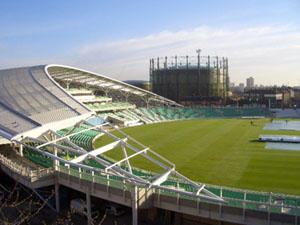 Last Tuesday, London celebrated England winning the Ashes, and I also went along and took photos of that. They are not perfect photos, if only because I had such a lousy view of the proceedings. I ended up taking a lot of snaps of the giant TV screen they had behind everything, just as if I had been at home. But, this giant screen yielded some fine imagery, with no interference patterns or surprise black horizontal splodges of the kind that I get when I photo my TV at home, and I am very happy with the photos I did manage to take. You can see my favourites ones here. Some of favourite pictures were of the words they stuck up for us all to sing: 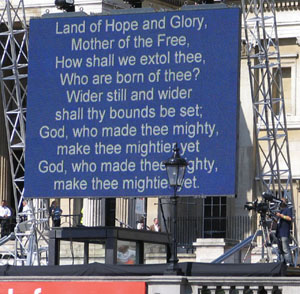 So there you have it. England won the Ashes because God was on our side. September 17th, 2005 | 9 comments - (Comments are closed)
I could not tread these perilous paths in safety, if I did not keep a saving sense of humour September 16th, 2005 | 4 comments - (Comments are closed)
And that would be the law of unintended consequences. The urge to alleviate the woes of the world can cause people to do great things. However when that urge is coupled to the power of a state, it is a dangerous mixture which can have the opposite effect to the one intended. The think-tank Civitas has made no friends in Whitehall with its latest release titled Blair government causes child poverty and the UK Treasury is clearly incandescent at the suggestion that big government is actually the problem rarther than the solution. But then the truth often hurts. September 16th, 2005 | 12 comments - (Comments are closed)
|
   |
||||

All content on this website (including text, photographs, audio files, and any other original works), unless otherwise noted, is licensed under a Creative Commons License. |
|||||
Recent Comments