We are developing the social individualist meta-context for the future. From the very serious to the extremely frivolous... lets see what is on the mind of the Samizdata people.
Samizdata, derived from Samizdat /n. - a system of clandestine publication of banned literature in the USSR [Russ.,= self-publishing house]
|
Whenever we are told that the state needs new powers for whatever reason, we are constantly reassured that there will be ‘safeguards’ and ‘accountability’ to protect citizens from the intrusions of powerful government agencies.
You did not have to be a Brazillian living in London to have some doubts about that. And it is not just in such high profile cases that government agencies misuse their powers.
For example, here in Australia, a rather colourful lawyer, one Michael Brereton has found that details of his messy private life have found their way into newspapers after a tax investigation against him failed to provide the state with enough legal ammunition to prosecute him.
Investigator inquiries have appeared to focus on the details of the financial structure behind Mr Brereton’s latest theatre venture, the musical Jolson.
… But Mr Brereton and a number of his Jolson investors maintain it was a bona fide musical and not a tax scam, despite being a flop. He says that in the absence of evidence of any wrongdoing, the ACC moved to shame him.
The original Melbourne newspaper article that fingered him, headlined “Drug, sex claims in tax probe”, described Operation Wickenby’s Mr X and appeared to derive straight from court affidavits provide by his ex-wife.
She declined to repeat her claims that Mr Brereton endangered his daughter but labels him “a nasty and vindictive man”. She said the newspaper leaks must have come from the ACC, which had “subpoenaed a lot of my files”. The ACC has denied being responsible.
A longstanding friend, former cabinet minister Alan Griffiths, said the ACC had “potentially ripped up the rule book in relation to lawyer-client privilege”.
The Australian Crime Commission has suffered a massive blow to its credibility by getting entangled in a domestic spat; but it might also demonstrate just how far government agencies are willing to go to ‘get at’ people its officials take a dislike to.
So much for those ‘safeguards’, hey.
I suppose it had to happen. As global temperatures supposedly rise – and it is not difficult to accept that claim right now in my sweltering apartment – certain groups are playing the victim card by suing governments and other agents for causing global warming and hence hurting their livelihoods.
On page 31 of the August edition of the BBC History magazine, Mervyn Benford writes that, in Britain, “it was the demands of industrialisation that made the government educate the masses” an interesting statement considering that the industrial revolution occurred before even the tiny government subsidy to education in 1833. Benford goes on to write that, in 1862, “just 1 in 20 children went to school” – an absurd statement of the sort that E.G. West exposed more than forty years ago in Education and the State.
An historian should not say to themselves “I will pretend that every child who has not been to school for X number of years, without a break, has never been to school”. This is ‘history’ as in “first there was darkness, but then the state moved into the darkness and said let there be light”. As Ludwig Von Mises (and many other people) have pointed out, it is not the most stupid students or the most lazy (not always the same people of course) who become collectivists – on the contrary it is often intelligent and hardworking students (whether children or adults), people who seek out knowledge.
For the wells of knowledge have been poisoned. The above is one example, but it is one example from a legion. A child or an adult who seeks knowledge from the media or the ‘education system’ is betrayed.
The welfare state is the engine of so many of the problems that the people who run this country complain about you would think its inherent problems would at least be a topic of discussion by the political class. But no. Yet a culture of entitlement without responsibility is not just a consequence of the welfare state, it is pretty much the objective of the welfare state. As a result it seems odd that the political class who presided over the growth of the all encompassing nanny state should decry the fact that people do not take responsibility for their health or behaviour when the very system they created is designed to prevent people paying directly for the health consequences of their life styles.
Yet because the welfare state is sacrosanct, it is not permitted to even suggest that it is the system itself that has produced the overweight chav generation that seems to irk the Islington set and their Tory imitators so much.
Blair said the government was banning the sale of junk food and fizzy drinks from vending machines in schools. He said if voluntary moves to limit advertising of junk food to children had not worked by 2007, new laws would be introduced. The government was also encouraging supermarket chains to adopt a single-system of labelling to identify healthy options.
“It will be much better if the industry comes together voluntarily around this scheme but once again, we are prepared to act if the voluntary system does not work”
And so if the threat of force does not work, yet more regulations will follow. Sure, that is it, we need more regulations. Yet all this dances around the issue that people buy what they want not because the labelling says this or that, but because they like it and there is no clear economic motivation to worry all too much about long term medical consequences when the NHS takes care of all that stuff. It is almost as if the Tories, LibDems and Labour are shouting at each other across the floor of Parliament, all pretending not to notice the large and very hungry elephant standing in their midst who is crapping all over the statist paradise that we would all live in if only we had a few more regulations.
The jury, at least, did not convict. A pity we shall never know (their deliberations being secret) whether this was that they found the evidence lacking, or the whole prosecution ludicrous. But it is perhaps some comfort, that if you are entrapped by a newspaper into discussing the purchase of an entirely fictional substance, and prosecuted with the Attorney General’s permision on inchoate Terrorism Act charges drafted to be hard to rebut, you can still escape gaol.
Whether this will be of much comfort for the three men just acquitted in the red mercury trial I doubt. They have been in custody as “terrorist suspects” since 2004, and had to find the funds to defend a trial that cost the prosecution £1,000,000 in taxpayers money. I only hope they have a million or so left to sue the News of the World and its “fake sheikh” agent provocateur, Mazer Mahmood.
Even if they were successful in that, of course the police, prosecutors, and their secret witness, B, are likely to go unpunished. It will be said they acted in good faith. It will be ignored that the waste of public resource and the injury to the defendents’ lives, was dealing with a ‘threat’ that could only ever have been fictional. It will be said that this is valuable and valid because it “sends a message” to all the real terrorists (200… 2,000… whatever the estimate is this week) that they were not investigating while they were wasting their time – and three families’ lives.
I have noted before that British justice (in a number of areas, not just terrorism) has started to take on the characteristics of a witch-hunt, with accusation the philosophers’ stone that transmutes ordinary objects and actions into evidence of guilt. But at least the persecutors of the witch-crazes purported to believe in witchcraft.
Great article in American magazine Reason here about the arrest of David Carruthers, CEO of the BetOnSports online gambling business. Following hard on the heels of the arrest of the three Natwest bankers on charges connected with the collapse of Enron, it seems the British state is steadily losing the ability to protect its citizens from being grabbed by U.S. authorities for arrest for offences which are not offences in this country and where the domiciles of a person’s businesses are outside the United States.
Carruthers was on his way from London, where his company is headquartered, to Costa Rica, where its online betting operations are based. The business is perfectly legal in both of those places, but not in the United States. And since most of its customers are Americans, Carruthers is guilty of about 20 different felonies.
Or so the FBI and the Justice Department say, and they are the ones with the guns and handcuffs. Catherine Hanaway, the U.S. attorney for the Eastern District of Missouri, accuses Carruthers and 10 other people associated with BetOnSports, including company founder Gary Kaplan, of violating the 1961 Wire Act, which prohibits using “a wire communication facility” to accept bets on “any sporting event or contest.”
Despite the talk of fraud, BetOnSports is not accused of ripping off its customers. This case has nothing to do with consumer protection, except in the sense of protecting consumers from their own desire to bet on sports.
These cases present a number of difficulties. I think American authorities are entitled to crack down on crimes of theft, fraud and violence even if those crimes have not occured on U.S. soil but involve injury to a U.S. citizen. That is fair. But the BetOnSports case suggests that, in this internet, globalised age, the writ of the U.S. legislature seems to run across the whole planet (well, most of the planet. I do not think extradition will work any time soon in North Korea).
Besides the legal niceties, there is also hypocrisy of nanny-state legislators at work here. America boasts the ultimate gambling city on the planet: Las Vegas, not to mention hosts of other places in Reno, Atlantic City and various Indian reservations. Not to mention the various state lotteries from which the U.S. tax-eaters gain a hefty income. And that is what this arrest and closure of on-line gambling is about. The faux moral scolds who decry gambling are not concerned about people pouring their hard-earned cash down the drain. No, they are worried that a nice source of tax revenue is passing them by.
Our own political masters in Britain are scarcely better in their approaches to the various ‘sinful’ activities that need to be regulated to protect a benighted populace. Drinking hours are liberalised and super-casinos are encouraged and yet smoking in a private member’s club is banned and cultivation of cannabis plants in your back yard for medical use will get you sent to jail or hit with a hefty fine. What a great world we live in.
Most people believe that poor people should be free to trade with each other, and they should be free to buy and sell from us in the West. If people want to buy cheaper goods from abroad, and spend the money they save on food or medicines, they should be free to do so. Saving a few cents when buying a bag of rice makes little difference to you or me, or to the rich elite in poor countries. But to a poor family it could make the difference between eating at night, or going without.
– Andrew Mitchell MP, Shadow Secretary of State for International Development, speaking Monday at the Globalisation Institute.
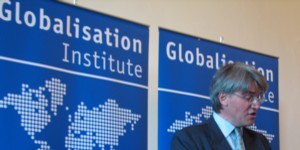
Monday’s Globalisation Institute event had Andrew Mitchell MP, the Shadow Secretary of State for International Development, speaking about trying to get African countries to be more open to trade, not just with the developed world (he said sub-Saharan Africa’s share of world trade was only 2%, or a mere 0.6% if you do not count South Africa), but also to trade more between African nations. Currently African trade tariffs are amongst the highest in the world, leading to such absurdities as African countries imposing tariffs on Tanzanian-made anti-malarial bed nets. Mitchell described these correctly as quite literally ‘killer tariffs’. So far so good.
Yet strangely the Right Honorable Member for Sutton Coldfield was also very keen to point out that taking an interest in African development is a cross party ‘British’ thing, not just a Tory thing and that his party fully supports increasing the amount of British taxpayers money the state wishes to generously give away in foreign aid to 0.7% of GDP. Why are Tories so desperate to make it clear that they represent continuity with Labour policies and sensibilities, even when addressing a room with a very high proportion of free marketeers? Mitchell was positively effervescent with enthusiasm about the stream of new and creative ideas being generated by Tory thinkers on the subject of international aid and yet I came away with the sense that this was just tantamount to saying “we have new and innovative ways to give away your tax-money and ‘engage’ with NGOs because we are just as clever as new Labour at thinking up ways to do that!”. Be still my beating heart.
In short the event did little to change my thinking about the pointlessness of Andrew Mitchell’s party. But like all GI events, the company was congenial, the champagne delightfully cold and the venue most agreeable…
Tim Blair updates the Australian version of the English language.
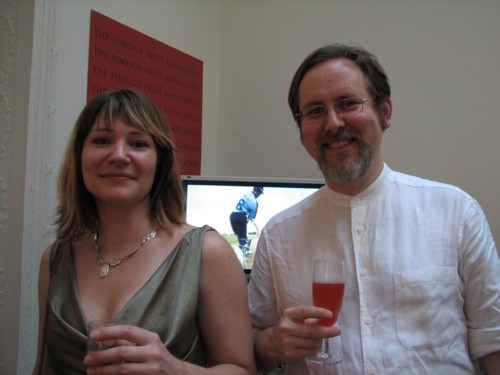
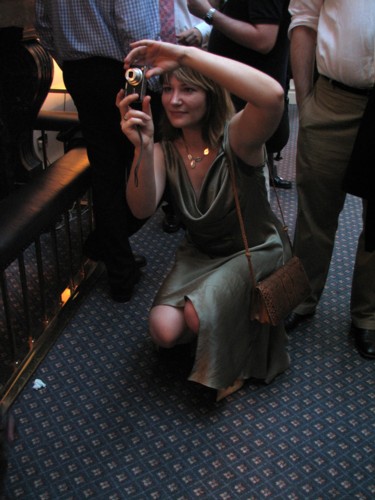
Last night, I snapped photos at the Globalisation Institute gathering at the Foreign Press Association, Carlton House Terrace, just off Trafalgar Square. Alex Singleton used a few of the snaps I took at the GI Blog, and several more of my snaps have also already appeared at Guido Fawkes.
Said Guido:
The totty quotient was high . . .
Indeed it was. Here are some further snaps that Guido might have used, but didn’t.
It was an impressive gathering, high both in quantity and quality of attendees, all chatting away merrily and sipping pink champagne.
Also. a bloke spoke:
The bloke, a Conservative Shadow Minister, spoke about how free trade in Africa would be a good thing. NGO persons and other enemies prowled about, gnashing their fangs and wondering how to denounce this well-disposed and well-organised event. Potential donors also mingled, impressed. The GI is definitely going places.
The Tate Modern gallery, built in an old power station, hosts art which is frequently of no aesthetic value whatever, in my opinion, other than to demonstrate the vacuity of much that passes for Modern or post-Modern, art. Apparently, this giant sculpture is to be built:
London’s Tate Modern, the world’s most popular modern art museum, unveiled plans on Tuesday to build a giant glass pyramid-style extension which its creator described as a “pile” of boxes.
Unlike the uniform glass pyramid in the courtyard of the Louvre museum in Paris, the planned extension to the converted power station on the southern bank of the Thames is asymmetric.
The new building, which aims to ease visitor congestion, should be ready in time for the Olympic Games in London in 2012 and will cost around 165 million pounds to complete at current prices.
Makes the heart swell with patriotic pride, does it not? I love the line about the Olympics. Expect more stunts like this, paid for by the taxpayer, as the Games approach. Do not say you were not warned.
While on the subject of the dreadfulness of post-modernism, I can recommend this book.
I suppose one of the main reasons that airshows are held is that actually seeing the thing fly can temporarily remove the sense from people who in their rational moments think that an A380 or some other aircraft may not have much of a practical role, or may not be worth the money.
And as it happened, on Sunday, I was impressed by the A380, and I was again impressed by the V22 Osprey, which if nothing else can certainly put on an impressive display.

Alas, I didn’t get a good picture of it in “aeroplane mode”, but for a helicopter it was certainly quick in getting from A to B. This is the best I can do.

On the other hand, it is quite impressive what a proven, useful, and big helicopter can do when it only has the tiny fuel load needed for a ten minute display.
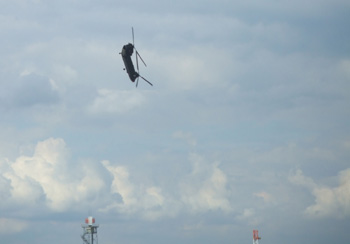
It was something of a day for the helicopters. As well as the Chinook, the RAF sent a Merlin for an aerobatic display, and this was also really impressive. Of course, there were lots and lots of jet fighters, too (the highlight of which was probably a MiG-29), but in order for photos of them to not look like a black spot in the distance, you really need a lens like this one, which I did not have.
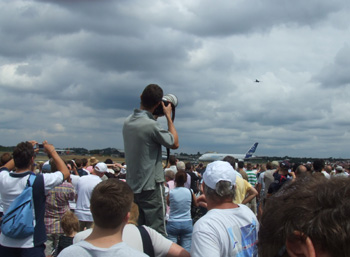
Still, I am sure Brian will give me points for the billion monkeys shot.
|
Who Are We? The Samizdata people are a bunch of sinister and heavily armed globalist illuminati who seek to infect the entire world with the values of personal liberty and several property. Amongst our many crimes is a sense of humour and the intermittent use of British spelling.
We are also a varied group made up of social individualists, classical liberals, whigs, libertarians, extropians, futurists, ‘Porcupines’, Karl Popper fetishists, recovering neo-conservatives, crazed Ayn Rand worshipers, over-caffeinated Virginia Postrel devotees, witty Frédéric Bastiat wannabes, cypherpunks, minarchists, kritarchists and wild-eyed anarcho-capitalists from Britain, North America, Australia and Europe.
|










Recent Comments