Michael Totten has another excellent and well illustrated article reminding us that rockets fired into Israeli civilian areas are not just launched from Southern Lebanon.
|
|||||
|
Artur Boruc, a Polish goalkeeper playing for with Celtic, has received a police caution for “a breach of the peace” after he made the sign of the cross during a game. I can only marvel at how Muslims can march through London carrying signs threatening death against people who do not share their beliefs can get a police escort, whereas a devout Christian making the sign of the cross in public can get a police caution. The Polish player was not making rude gestures at a hostile crowd [see update & link below – perhaps he was] or trying to threaten anyone, he was just making a personal gesture indicating a set of beliefs. I may be a godless rationalist myself but I sincerely hope Artur Boruc not just ignores the police caution but robustly reject it and continues to demonstrate his beliefs as he sees fit. If some Rangers fans cannot stand that and become violent, then perhaps that is where the police’s attention should be more properly focused. Moreover I hope his club supports him regarding this matter and if it does not then I hope he takes his talents elsewhere. However I am rather bemused that the dismal Ruth Kelly is ‘surprised’ at this development seeing as how she is a leading member of the political class which put the legal infrastructure in place so that exactly this can happen. Britain has nothing even vaguely resembling the First Amendment or the US Bill of Rights generally, instead relying on common law that springs from a highly imperfect cultural tradition of liberty. As this culture has been in effect ‘nationalised’ and largely replaced by fifty years of highly malleable legislation, there are now few legal tools left to secure individual rights against the state in the UK. Consequently we are left with just hoping for the state to act in a restrained manner as there so now so many laws that can be used to suppress freedom of expression (including not just social but also political speech) that the state can prohibit almost any action it wishes if it really wants to. Moreover public bodies have now been given so much discretion to exercise power ‘in the public interest’ that almost any petty-fogging official can seriously mess with your life if he or she is so inclined. And we can thank the likes of Ruth Kelly in both of the main political parties for this.
August 28th, 2006 | 20 comments - (Comments are closed)

When did the ‘enthusiastic participation’ become compulsory? August 28th, 2006 | 24 comments - (Comments are closed)
Good evening, this is a public service announcement from Samizdata. If you are one of the 10 million or so adults who are considering emigrating from Britain, then you may like to know that there is a simpler, quicker and more cost-effective way to avoid cripplingly high levels of taxation: STOP VOTING FOR THEM!! Thank you for listening and enjoy the rest of your evening. August 27th, 2006 | 34 comments - (Comments are closed)
 I think that this building (the Alexander Nevsky Orthodox Cathedral in Tallinn) is every bit as assertively a statement that the Russians are in charge as is the Palace of Culture in Warsaw I wrote about earlier this year. It comes from a different Russian era (the Cathedral is a Czarist structure, completed in 1900), but I think the motives for building the two structures were not too different . Certainly the Cathedral is in every bit as prominent a location as the Palace of Culture – it is on the top of the Toompea hill in Tallin’s Old Town, directly opposite Tallin castle (now the Estonian national parliament). Certainly, also, it is every but as architecturally out of character from the historical city, which in style is a typical Baltic Hanseatic League city, although the people of the city are clearly very proud of the medieval town hall 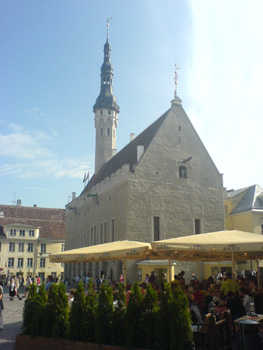 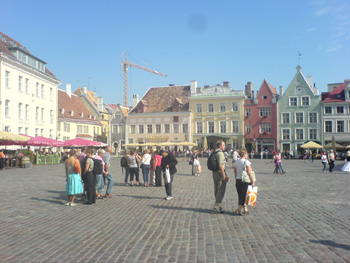 It is only six years since I was last in Tallinn, but the city certainly seems to have come a long way since then. At that point the Old Town was beautiful, but the rest of the city felt grimy when I left it. No longer. It’s not a terribly large city (half a million?) and it is not as frenetic as some larger cities, but it has the air of a place becoming, well, comfortable. Modern office buildings going up. Suburban tracts of nice, large houses being built on the waterfront to the west of town. That kind of thing. There are lots of Soviet housing estates between the old centre and the nice suburbs, but in truth I have seen worse in London. And Paris. And Amsterdam. It is difficult to believe that this was part of the Soviet Union only fifteen years ago. But it was. And it was certainly a nice touch to be able to talk to friends in Australia using a software product that was developed here. The computer markets of China are full of people attempting to sell you cheap Skype handsets. However, Tallinn gave us Skype itself. That is worth more. August 27th, 2006 | 6 comments - (Comments are closed)
Israel scores a direct hit on the enemy. August 27th, 2006 | 9 comments - (Comments are closed)
The bloody wombats were getting in over the fence. We had no idea they could climb. – Australian farmer Bill deCorsie, complaining that local marsupials were eating his truffles. (The bigger picture behind this, which is that the Australian agricultural industry has over the last couple of decades been rapidly moving (shall we say) up the food chain from relatively low value (but high quality) basic foodstuffs to high value products largely for export is quite an interesting one). August 27th, 2006 | 14 comments - (Comments are closed)
Sometimes you read something that you have every reason to believe was written by a sane, intelligent and logical person, and you are shocked. Shocked at how incredibly twisted this sane, intelligent and logical person’s perspective could be regarding one singular subject their pen encountered. Tim Blair points out such an example. To quote the estimable Mr Blair’s post: Graeme Blundell’s review of The Falling Man includes a curious claim:
The commenters at Tim’s site rightfully voiced their disgust at such a sentiment. I could not help but marvel at the sheer ignorance betrayed by the author’s reading of events, too. I quite confidently assert, with no supporting evidence, that not one media outlet in the Western world even briefly pondered cowardice as a motive of those wretched jumpers. The fact that Blundell so egregiously detects this wildly inaccurate perception as a “deeply held belief” amongst many suggests to me that this is his own delusion, which is where the ignorance part introduces itself. When trapped out on a stricken building’s precipice – with intolerable heat and the promise of excruciating pain at one’s back and cool, open air at one’s front – people do jump. I cannot possibly know or understand what would be running through a desperate victim’s mind at a time like that, but I would guess that a very basic, elemental survival mechanism – buried deep in our ancient animal instincts and wholly unencumbered by conscious and cerebral rationality – might well be invoked. Step back into a hellish inferno and certain death. Step forward into benevolent – tragically fleetingly benevolent – open air and possible survival. Only one profoundly ignorant of the human condition would mistake the latter choice as an act of cowardice. On a lighter note; since I have mentioned Tim Blair here, I may as well press an unrelated fact. The man is right up there with the very wittiest writers in the blogosphere. In the middle of a gadfly-esque post confronting the Australian Broadcasting Corporation’s marketing of a book published by them (the book is also written by an ABC science broadcaster) – whereby Blair contrasts a strident and hyperbole-ridden stance towards the rather wacky and more-or-less harmless Intelligent Design movement with the ABC’s generally sheepish reaction to the world’s most dangerous religious phenomena – we stumble across Exhibit A:
Brilliant. August 26th, 2006 | 37 comments - (Comments are closed)
Report here stating that Israel’s response to Hizbollah’s kidnapping of Israeli soldiers took Hizbollah by surprise, particularly the extent and ferocity of the IDF action, according to a Hiz deputy leader. Given the determination of Israel’s armed forces to defend the tiny Jewish state over the years against a host of enemies, why some terrorist organisation like Hizbollah should be surprised is, frankly, surprising. In any event, this interview may suggest that Israel’s campaign to hammer Hizobollah may not be quite the debacle that some commentators have supposed. The jury is still out on the future of the current Israel administration, however. August 26th, 2006 | 35 comments - (Comments are closed)
Pre-empting the failure of the national ID scheme to deliver total surveillance soon enough, HMG is opening the other portals to its totalitarian hell. When even former cheerleaders for centralised government by technology and datasharing get scared, you have to wonder can it be stopped after all? Michael Cross of The Guardian, now gets it, it seems:
This is straight reporting, there is none of the sneering at privacy advocates we are used to from Cross. But extended government data-sharing is already happening. This, for example, was unwelcome news to me. August 26th, 2006 | 9 comments - (Comments are closed)
Reading the cyberpunks in the 1980s or watching Cronenburg’s eXistenZ, provided visions of a noir future where brain computer interfaces were commonplace and you could jack into cyberspace, virtual reality, or whatever hyped up term was collecting reputation dust. In the current world of information chop suey, it is hard to detect truly important developments. Here is one. Harvard scientists have moved closer to an effective neural interface with engineered silicon nanowires “that detect, simulate and and inhibit nerve signals along the axons and dendrites of live mammalian neurons.” They are able to attach a non-invasive wire to a single nerve cell as a hybrid synapse and allow signals to travel between wire and cell. The next step in the research programme is the development of larger scale contacts between wires and nerve cells. As Charles Lieber, Professor of Chemistry at Harvard speculates:
(Hat tip: Betterhumans) August 25th, 2006 | 6 comments - (Comments are closed)
British government scientists claim that Britain faces a growing crisis of obesity. And of course such predictions, which carry all the usual credibility of such things, are accompanied by calls on the powers-that-be to “do something” about it, including the likes of bans on advertising for sinful foods, funding for sports and so on. First point: even our waistlines are expanding, is it any of the state’s business? At present, one might argue that because we have socialised medicine in the form of the National Health Service, taxpayers, both slim, chubby and positively enormous, have to pay for the consequences of bad health habits. So the neo-puritans will argue for controls on how we all live to reduce the tax cost of bad habits, which is an example of what economists might call a ‘negative externality’. Surely though, the approach that would encourage good habits and treat citizens like adults is one based on private medical insurance. If people want to cut their insurance premiums, then they will have a strong market-driven incentive to do so. In a private sector model, there may be much more encouragement from health providers to get in shape and give up the triple cheeseburgers. Of course, there will always be feckless people who do not give a damn and end up demanding some kind of handout when things go wrong, but I do not see why the liberties of the majority of us should be tossed away to deal with people who are too weak willed or plain stupid to act differently. In any event, I imagine that as in the days before the NHS came along, there will be health care available for those who cannot afford it – as James Bartholomew pointed out in his book – provided through charitable means. I actually think that a charity which supports doctors might, for example, insist that if a poor person wants to get medical care for his or her obesity-related problems, then as part of any treatment, that person has to do something about their problem. Such an approach may, at first sight, appear to be ‘unaring’ or harsh, but I think there is no greater respect that one can give to one’s fellows than to accord them the ability to act like adults. Goodness, all this venting has made me hungry. Anyway, as I head towards the kitchen, may I recommend this collection of articles by Reason magazine on the obesity issue. Bon appetit! August 25th, 2006 | 20 comments - (Comments are closed)
|
   |
||||

All content on this website (including text, photographs, audio files, and any other original works), unless otherwise noted, is licensed under a Creative Commons License. |
|||||
 Update: Although I stand by my general contention regarding the state of the law and freedom of expression in the UK, there may be
Recent Comments