We are developing the social individualist meta-context for the future. From the very serious to the extremely frivolous... lets see what is on the mind of the Samizdata people.
Samizdata, derived from Samizdat /n. - a system of clandestine publication of banned literature in the USSR [Russ.,= self-publishing house]
|
The 13-year-old girl submitted the following essay to a teacher in a state secondary school in the west of Scotland and explained that she found it “easier than standard English”:
My smmr hols wr CWOT. B4, we usd 2go2 NY 2C my bro, his GF & thr 3 :- kds FTF. ILNY, it’s a gr8 plc.
Translation: My summer holidays were a complete waste of time. Before, we used to go to New York to see my brother, his girlfriend and their three screaming kids face to face. I love New York, it’s a great place.
Text messaging, or SMS (short message service), has turned into a new mobile phone language and has rapidly become one of Britain’s favourite pastimes. As the keypad of a mobile phone is difficult to navigate, text message groupies, mostly children, have developed a shorthand to make life a bit easier.
But their English teachers don’t like it:
There must be rigorous efforts from all quarters of the education system to stamp out the use of texting as a form of written language so far as English study is concerned.
There has been a trend in recent years to emphasise spoken English. Pupils think orally and write phonetically. You would be shocked at the numbers of senior secondary pupils who cannot distinguish between their and there. The problem is that there is a feeling in some schools that pupils’ freedom of expression should not be inhibited.
However, the decline in literacy has probably more to do with teachers being ‘confused’ about how to teach reading. Another reason why many seven-year-olds cannot write properly is because their teachers do not know enough grammar to teach it effectively.
At the heart of the problem was the education strategy’s “ambiguous guidance” on phonics – a teaching method where children learn how the sounds of words are written instead of trying to memorise their shape. Brian Micklethwait has dealt with this topic on Samizdata.net here and here and I am sure the debate continues on Brian’s education blog. So go and read, if interested. I will just leave you with this txt:
If u wan2 undRst& tXt m$ges thN IMO u nEd a SMS DXNRE or no1 will think ur c%l. nuf Z.
On tonight’s TV show ‘Who Wants to be a Millionaire?’ a contestant was asked “Who in 2002 became known as ‘The Quiet Man’ of British Politics?”
The contestant – an attractive if not terribly bright brunette – was offered four choices:
- John Prescott
- Kenneth Baker
- Edward Heath
- Ian Duncan Smith
She had no idea. She used her 50/50 lifeline which left her with Baker and Duncan Smith. She slightly guessed the latter but felt she needed to call her father. He promptly said: “IDS”.
Last year a programme on the same game show asked a father and son who the leader of the Conservative Party was. The programme was recorded the day after Ian Duncan Smith made his first speech as leader of the Conservative Party at the Party Conference. The son said “I haven’t a clue”, the father thought it might be Kenneth Clarke. They asked the audience. A minority knew the answer. Finally they called a friend and got the correct response, although on that occasion the friend wasn’t so sure.
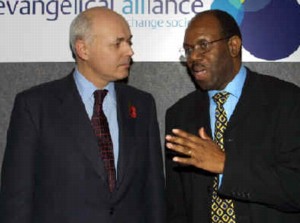
One of these blokes is the leader of the Conservative Party… apparently.
When I was ten years old, I was informed that:
- The National Health Service is the finest in the World
- The Comprehensive School system was the envy of the World
- The Welfare State was the envy of the World
- The Royal Navy was the finest in the World
- The British Army was the finest in the World
When I was twenty, some British politicians still asserted each of these statements, although none seemed to believe all of them anymore. There seemed to be an equal number of politicians claiming that each of these thing was ‘a National disgrace’, which given this was the public sector, was no doubt true.
The elite forces of the British Army are no doubt excellent. Some bits of British military design are excellent. But this does not mean that the British armed forces are fit for combat. In May 1940 the French Army had as many tanks as the Germans. The French Air Force in aerial battle shot down more German planes than the Germans did of theirs. The French tanks were certainly good enough for use by the Germans in other parts of Europe… but even good equipment can be misused, and the finest army in the world can be run into the ground by bad management.
Since 1991, the British Army has recruited according to the whims of political correctness. The rifle only works if assembled in a tent and cleaned before and after each use. The boots melt in the Middle East. The troops have not enough sleeping bags, clothes, soap, tents or fuel for their vehicles. Their communications equipment does not work, last time they saw action in Europe they were able to use their mobile phones, this time these are unlikely to work. The new British tank breaks down. The British Army version of the Apache apears to be less reliable than the version used by the US in 1991. There is not enough ammunition for any of the weapons. There is no medical service worth talking about to save money and because of staff shortages: casualties will queue and die on trolleys in the National Health Service if they are unfortunate enough to be flown home. Obviously the best scenario for a British wounded soldier is to be picked up and treated by one of the other allies (except perhaps Turkey). This may sound like the Crimea in 1854-56. On that occasion the Times decribed the British Army as it left as ‘the finest army that has ever left these shores’. Less than ten per cent of the British casualties of the Crimean War came from combat.
It may be that the US is capable of defeating Iraq rapidly and without considerable losses. But the British Army is not properly equipped, the logistics are very poor and the medical facilities inadequate. I would rather air these points now, than wait for a report from a modern Scutari.
Martin Taylor works within the British legal system. He is deeply troubled by the latest round of anti-money laundering laws.
During the course of this past month the Proceeds of Crime Act 2002 has come into force. This is the legislative instrument which has introduced US-style asset forfeiture into UK law. But the Act goes much further than that. It also consolidates and widens the existing anti-money laundering laws and places a quite terrifying onus on those who are charged with enforcing them.
Prior to this Act the UK already had an anti-money laundering regime in place. It was aimed at the proceeds of drug trafficking and potential terrorist funding. The regime established a ‘regulated sector’ which consists of people such as bankers, accountants, lawyers, financial advisers, stockbrokers and anybody else who is broadly engaged in the business of money management.
The laws imposed an obligation on professionals working in that sector to establish and maintain procedures for obtaining and then keeping personal and business information about their own clients so that this could be used to assess whether or not, at any later time, there are unusual or unexpected patterns of spending or behaviour which may indicate money-laundering activity.
But that is not all, for it is professional advisers who are required to police their own clients. If the professional adviser suspects, for any reason, that his or client may be engaging in money-laundering then he or she is required their client and the circumstances of the transaction in question to a special police agency. Once a report has been made the professional adviser can take no further action on behalf of the client until they have been given express permission to do so by the police.
Penalties for non-compliance can be severe. In the case of non-disclosure of a suspicion of money-laundering, the maximum penalty is 14 years in prison. → Continue reading: The British government declares war on Britain
I recall a conversation I had a couple of years ago with another British libertarian who argued that ‘pundits are the new priests’; they deliver ‘sermons’ from their TV or radio pulpits and minister to a befuddled public about the mysterious ways of our secular lords.
Although I can see the argument, I don’t entirely agree. However, the very fact that this kind of argument can be plausibly advanced at all is because we are all aware of the decline of the ‘old’ priests; a phenomenon which gets little attention but is highlighted by leaders like this in the Telegraph:
“But the Church has many good things to offer and it needs to start marketing them more successfully. Church buildings are testament to the triumph of Christianity. Soaring roofs, intricate stonework and stained glass windows echo a pride in Christianity that the 21st-century Church seems embarrassed to admit to. There’s a feeling that to modernise means stripping out pews, replacing organs with electric pianos, divesting priests of their robes and ignoring altars for Communion. But young people need someone to respect and admire. Today’s celebrity culture demonstrates that. If the Church, in its physical, as well as spiritual nature, is not the demonstration of the ultimate aspiration, what is?”
The leader quoted above is, in fact, an open letter from a twenty-something British Christian woman to the new Archbishop of Canterbury, Rowan Williams. It is a plea to the Church to arrest its slide into irrelevence and provide some meaningful spiritual guidance to Britain’s Christians.
Despite not being a member of the Church, I can wholly understand her desperation because I can also see that it has gone quite disastrously off of the rails. The absurd and frantic mission to ‘modernise’ has resulted in just about every senior member of the clergy tripping over each other in the headlong rush to embrace every manifestation of fashionable claptrap from global warming to grievance politics. → Continue reading: The Last Trumpet
On the face of it the Conservative Party just now is having a terrible time, with the very telegenic Michael Portillo making life an utter misery for the deeply untelegenic Iain Duncan Smith. But something big is happening in the world which could see off the Labour Party for the next little slice of British history, and bring the Conservatives right back into contention.
The voters in Britain infuriate me. I like the people, by and large. Salt of the earth, most of them. But when they get around to voting, they have profoundly different priorities to me, or to anyone with a serious interest in politics.
Basically Britain’s voters would sooner vote for a party which is united in agreeing to do the wrong thing, than a party which is divided about just how enthusiastically it should resist that (or some other) wrong thing, or do any right thing. Division is all. Unity is all. They vote against the former and for the latter, regardless of what is being agreed or disagreed about. I loath and despise this, as I say, but that is how it is.
Well, for the last fifteen years, ever since the Cold War fizzled out, the Big Thing in British politics has been Europe.
Labour is a tiny bit disunited about it. Most Labourites love it that Europe gives them as much socialism as the real world is ever going to give them, in the form of a ocean of capitalism-hobbling regulations and interferences. A few Labourites aren’t satisfied only with that much socialism and would prefer more and on that basis they complain about Europe.
But such bickerings are nothing compared to the giant axe that Europe slammed into the very torso of the Conservative Party. Conservatives have been at each others’ throats about Europe for, as I say, the last decade and a half. It did for Thatcher. It did for Major. It did for the lot of them.
But now, post 9/11, the issue is no longer Europe. The issue is, to put it bluntly: the USA. Well, not the USA as such, merely its policy of choosing actively to prosecute the War Against Terror (i.e. against terrorists) rather than just hoping that terrorism and terrorists will go away. President Bush has decided to hunt them varmints until there ain’t none left, and what’s more to hunt down the no-good preachers who are stirring them all up, and if Europe don’t like it, too bad for Europe. As Bush said – in one of those scary speeches he made soon after 9/11, which sophisticated Europeans ignored as the gaseous emissions of a politician seeking mere poll numbers and re-election, but which Bush himself actually, it is now turning out, meant – either you’re with us or you’re agin’ us. That is now the Big Question.
And it so happens that the Conservatives are united in being with George Bush, less a few freakish europhiliac grumblers, while Labour is catastrophically divided about the War Against Terror (in the form that the Americans are now choosing to fight it), as today’s dramas in the House of Commons have now made very clear.
If it is true, as I found myself saying last week, that this War Against Terror thing is not just going to be an episode, but maybe something more like an era, then to that exact degree the news is now a lot better for the Conservatives.
History certainly does have a knack of repeating itself here in the UK. Just as we’re about to embark on another war against a mustachioed despot, we’re all set to bring back rationing:
“A ban on marketing fatty, salty and sugary products at youngsters is one of the options supported by the study from the Food Commission campaign group.
It also backs those calling for a nationwide promotion of healthy foods and a possible “fat tax” on junk food advertising.”
But why stop there? Why not compulsory jogging every morning? Followed by an invigorating dip in ice-water? How about mandatory colonic irrigation, too?
Actually the question is redundant, because, whoever the ‘Food Commission Campaign group’ are, we all know that they have not the slightest intention of stopping there. They wll get what they want and then move on to Stage 2 (and Lord alone knows what that consists of). And because this is Britain we can all more-or-less write the script for these campaigns now. It is even becoming mundane.
I don’t know who these campaigners are but perhaps, by some extraordinary stroke of luck, it will transpire that they have some connection with the WTC attacks. Then the Americans can come and drag them all off to Camp X-Ray.
P.S. Don’t forget the hoods!
Yesterday, the Assets Recovery Agency has been set up to seize the wealth of previously untouchable “Mr Bigs” who have not been convicted of an offence but whose way of life is paid for by crime. It will take on cases referred to it by UK police forces, Customs & Excise, the Inland Revenue, the National Crime Squad and the Serious Fraud Office. Its work is considered so sensitive that its agents will be allowed to use pseudonyms – including in court – and the Government refuses to say where it is based.
The Assets Recovery Agency (ARA) will not have to prove that the people whom it prosecutes are guilty of any crime. The onus will be on the man with the Jaguar, the gold bracelet and the holiday home in Ocho Rios to show that he came by his luxuries legally. Under the Proceeds of Crime Act 2002, which set up the agency, cases will be decided on the balance of probabilities, rather than the stricter criminal test of certainty beyond reasonable doubt.
The prosecutors will need only to accuse someone of living ‘above their means’ to bring them to court (without a jury, I might add), if they have “reasonable grounds” for believing that their wealth had been acquired illegally. However, it is the owner’s responsibility to prove otherwise and assets could be seized on the “balance of probabilities”. This is a far cry from the “beyond reasonable doubt” requirements of the criminal courts. It will, therefore, be possible for the civil courts to seize the assets of someone found not guilty in the criminal courts. Oh, and the presumption of innocence has gone out of the window long before the judge’s ‘balancing act’.
David Blunkett, the Home Secretary elaborates: The agency is coming after the homes, yachts, mansions and luxury cars of the crime barons. This is also about cracking down on local crooks well known in their communities for their flash cars, designer clothes and expensive jewellery but no legitimate means of income.
And Jane Earl, director of the ARA reassures:
If you have a large house and five places in the Caribbean, with no visible means of support, no rich aunties who have recently died leaving the odd five million and no successful lottery tickets, it will not do to say that someone gave you the money.
It is as if all their hatred is directed not so much against criminals as against the trappings of wealth. If Mr Blunkett and Ms Earl think they have a case against somebody, they should be made to prove it.
Oh, but they can’t do that because the justice system is so screwed up. Let’s hire some anonymous thugs then. First we get the Bad Big Criminals and then let’s see what we can do without any competition…

I don’t suppose that anybody outside Britain or Greece has even heard of the Elgin Marbles and in neither country are there a great many people who are likely to be get exercised over them.
That said, these ancient Greek artifacts are something upon which a small number of people have quite robust opinions and I happen to be one of them.
The ‘Elgin Marbles’ are currently housed in the British Museum in London and are made up of 56 sections of the frieze sculpted by Phidias around the Parthenon. They were acquired and brought to London by the British diplomat Lord Elgin early in the 19th Century from their original home in Greece and where, despite their grandeur and beauty, they had been abandoned to the twins corrosions of the elements and indifference.
For many years, the Greek government has been campaigning for the return of the Marbles to their original home in Greece. In this, they are supported by a large section the British arty/literatti/celebrity set who approach the issue with the same kind of fuzzy-headedness and sophistic feel-goodery that they approach everything else.
Much of the left in Britain has also taken the side of the Greeks in this issue, not out of any particular fondness for Greece but because, for them, the Marbles are a rude reminder of British imperial acquisitiveness and arrogance and their continued presence in the British Museum a standing affrontery to the culture of self-abasement and guilt that they have so assiduously fostered on these shores.
However, the entire matter has been off the radar-screen for some time and it may be because the ‘usual suspects’ are otherwise noisily engaged in the matter of preserving Saddam Hussein’s regime, that we have been treated to a rather bold announcement from the British Museum’s director:
“The director of the British Museum has said that the Elgin Marbles should never be returned from Britain to Greece.
In an interview with the Sunday Telegraph, Neil MacGregor said the sculptures, which once adorned the Parthenon temple in Athens, should remain in London.
He has also ended discussions with a British campaign group seeking their return to Greece.”
Good for you, Mr.McGregor. I was not only delighted by this announcement but also (pleasantly) surprised, given the recent low-profile of the issue. It has set my mind to wondering whether Mr.McGregor has at all chanced upon a very recent essay on the matter by Sean Gabb:
“Needless to say, I am strongly opposed to returning the Marbles. If I had my way, they would stay in London forever – preferably joined by anything else we might in future be able to bribe out of the Greeks or the other successor states of antiquity. Indeed, if Lord Elgin did anything wrong, it was to leave too much behind when he finished his work in Athens. He should at least have taken all the pediment sculptures and another caryatid. He might also have dug up some of the statues buried after the Persians destroyed the old Acropolis in 480BC. The world of culture would be all the better had he done so. Just compare the Caryatid he took away with those he left behind, and ask if he really did wrong. However, rather than continue with its mere statement, let me try to justify my opinion. I will review the case for returning the Marbles.”
I usually make a point of arguing a given matter from my own bat, but I am not averse to using someone else’s bat in circumstances where their bat is both bigger and wielded with such admirable adroitness. Sean’s tightly argued and highly learned essay is quite the most the comprehensive and definitive case for retaining the Elgin Marbles in Britain and I do not hesitate to strongly recommend it to everyone regardless of whether they are British or not.
Of course, I can only speculate as to whether or not Mr.McGregor has read the essay and was inspired by it in the same way I was. Probably not. More likely it is just coincidence in which case it is a welcome synchronicity and an indication that level-heads are starting to fight back on this issue.
I have finally worked out to link to specific items in stephenpollard.net. Stephen Pollard is a man whom Samizdata.net readers should all be told about if they haven’t been yet. In addition to having his own blog, he also contributes regularly to this blog on European health issues run by the Centre for the New Europe (although linking to stuff in that is truly complicated and I won’t attempt it – just scroll down). And he’s a mainstream journalist of renown.
Two recent postings that get inside his head well are this, about Milton Friedman, and this, concerning the demonstrations last weekend, which also appeared in The Times. Here’s the conclusion of the Friedman posting:
Milton Friedman’s influence on the Left extends well beyond the NHS voucher. The congestion charge, introduced in London on Monday, has been lifted straight out of the professor’s 1951 essay, “How to Plan and Pay For the Safe and Adequate Highways We Need”: “[on] a crowded road…it would be desirable to discourage traffic…the people who drive on a road should be charged…in proportion to their use of the service”. As Ken Livingstone has put it: “I nicked the idea off Milton Friedman”.
Third Way, Shmird Way. Stand back, Tony Giddens; step forward, Milton Friedman, guru of the Left.
I also liked following this link, to a report about the events of June 7th 1981. Clue: CND ought to have liked it, but I’m guessing they didn’t.
From time to time the question surfaces on Samizdata: how come the British Conservative Party is doing so badly? One of the most coherent and convincing answers I’ve come across lately is to be found in Free Life, the (now all electronic) journal of the Libertarian Alliance, from Manchester based libertarian historian Steve Davies, responding to a piece by Sean Gabb. Davies explains how the British electoral system now hurts the Conservatives. But, he says, their problems go deeper.
… Simply, the electoral coalition put together in the 1920s has split into two sharply distinct and increasingly hostile groups of voters. This happened between about 1989 and 1997. So the split in Conservatism today is not just a matter of divisions within the Parliamentary Party or the wider Party. It’s a split in the electorate. That means the issues facing the party are much more profound than a matter of who the leader should be. It also makes everything far more problematic, given our electoral system.
The two groups of ‘right wing’ voters today can perhaps called Tories and Whigs. To use stereotypes, Tories are older, of either below average or well above average income, live in seaside resorts, rural areas and older industrial areas. They are Daily Mail and Telegraph readers, they are strongly socially conservative, very hostile to the EU, dislike multiculturalism and favour very strong controls on immigration, are supportive of the war on drugs. They are hostile to socialism and much of the welfare state but support some parts of it such as the NHS (for now). Although they generally favour free markets this is becoming less true all the time. They increasingly do not like globalisation and dislike large corporations. Whigs are younger, average to above average income, and live in suburban areas including suburbanised parts of the countryside. They are economically liberal, often very much so. They hope that the government is going to sort out the welfare state but suspect it isn’t and are becoming increasingly hostile to it. They are very socially liberal, much less bothered about immigration and dislike anti-immigrant campaigns. They favour relaxing laws against drugs or outright legalisation, they are very relaxed about homosexuality. They don’t like the EU particularly but don’t have the visceral hostility of the Tories and they don’t like appeals to nationalism because they have a very different sense of national identity to the Tories. They like and support many kinds of multiculturalism. Many read the Telegraph but they are also Times and Independent readers. They absolutely hate and despise the Daily Mail.
… The problem is that, increasingly, Whig and Tory voters just do not like each other. Policies and, above all, rhetoric that appeals to or inspires one group of voters will alienate the other. So having a campaign concentrating on attacks on asylum seekers, family values and national sovereignty will inspire the Tories but alienate the Whigs. Emphasising personal liberty via ‘hot button’ issues like homosexual rights and drug liberalisation will please Whigs but enrage Tories.
Davies goes on to speculate about how all this will play out. As far as the Conservatives are concerned, he reckons they’ll be captured by the Whigs, and won’t actually split.
It is a strange experience finding myself supporting Tony Blair, the man who presides over my ongoing robbery by the British state, let alone quoting his remarks of yesterday approvingly, but I suppose these are strange times:
There will be no march for the victims of Saddam, no protests about the thousands of children that die needlessly every year under his rule, no righteous anger over the torture chambers which, if he is left in power, will be left in being.
I just wish the people marching yesterday would spare us the nauseating claim to the moral high ground and, if they still oppose the war, just acknowledge that theirs is an emotional rather than a moral argument and that the reality of their position is that if they get their way, Iraqi people will continue to die at the hands of murderous Ba’athist socialism in Iraq whilst they smugly congratulate themselves on their ‘having prevented a war’.
Preventing the overthrow of the people who did…
this…
and…
this… 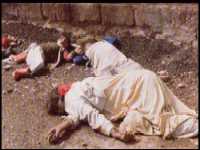
… to the people of Halabja with a weapon of mass destruction (poison gas) is the reality what those marchers are trying to achieve.
Regardless of how you feel about George W. Bush or Tony Blair or capitalism or Israel or the Palestinians or globalisation or anything else, that does not change the fact that the continuation in power of the murderous Saddam Hussain and his Ba’athist thugs will be the consequence of appeasement. Is that what you want? Is it?
|
Who Are We? The Samizdata people are a bunch of sinister and heavily armed globalist illuminati who seek to infect the entire world with the values of personal liberty and several property. Amongst our many crimes is a sense of humour and the intermittent use of British spelling.
We are also a varied group made up of social individualists, classical liberals, whigs, libertarians, extropians, futurists, ‘Porcupines’, Karl Popper fetishists, recovering neo-conservatives, crazed Ayn Rand worshipers, over-caffeinated Virginia Postrel devotees, witty Frédéric Bastiat wannabes, cypherpunks, minarchists, kritarchists and wild-eyed anarcho-capitalists from Britain, North America, Australia and Europe.
|




