Do not cooperate with attempts by the state to take your property without prior consent… and have some fun playing with them in the process.
|
|||||
|
The irony is so thick that you could not chop through it with an axe. Amid all the hand-wringing and condemnations over incidents which may or may not have taken place at the Abu Ghraib prison in Iraq, there does not appear to be even a bat-squeak of high moral tone over rituals of abuse and humiliation that are most definitely occuring in British schools: [note: link may not be available to non-UK readers.]
Well, they are also a softer option than the ducking stool but that does not justify their deployment. Nor are such degrading exercises made any more palatable by spoonfuls of sugar:
Priceless! How about a mellow, humane and civilised response to the threat of drug warriors and their unquestioning footsoldiers. Really, is there any order these people would not obey?
See, participation is voluntary so that is all okay then.
Confess and you will be spared, my child. I am sincerely at a loss to comprehend the volcanic eruption of outrage and revulsion over the treatment of Iraqi prisoners when schoolchildren in this country are subjected to ritual abuse and humiliation as a matter of policy. I expect there will be no shortage of angry respondents to point out that there is no comparison. They are right. The Iraqi prisoners were, at least, adults and while that does not excuse or justify brutal treatment, one should similarly spare a thought for just how intimidating it must be for children to be lined up by burly security men and set upon by dogs. No, they are not being hooded, chained, beaten or kicked in the nether regions by belligerent squaddies but I get the feeling that the overlords of the drug war would gleefully institute such measures and, if they did, that the otherwise squeamish and human-rights obsessed British press would report on their progress with equanimity and no small degree of satisfaction. Shock treatment, you see. It’s for their own good. May 18th, 2004 | 13 comments - (Comments are closed)

This is a very strange story, given the British authorities’ current obsession with illegal immigration. Three Albanian men have been arrested for trying to leave Britain and others charged with trying to help them. What’s really strange is that it is heavily implied by police that the men were illegally present in the country, but there’s no suggestion yet that they are fugitives from the law for any other reason. So what on earth is the point of trying to keep them here? Is it that self-deportation shows up the Immigration Service’s incompetence in that department? Britons are now inured to (the entirely extra-legal) requirement to show a passport before being permitted to travel abroad on planes, trains, and ferries. That causes no outrage, and I confidently predict this arrest will not either. But it should. If one may not leave nor enter the country without government permission – which is what these arrests imply – then we are already living in a (rather large) open prison, even before everyone is numbered and tagged. Guy Herbert May 17th, 2004 | 15 comments - (Comments are closed)
Once upon a time, I read an article in the Financial Times, which used the slightly peculiar phrase “resigned voluntarily” about six times in the article. Essentially, some CEO had in fact actually decided to leave his job in order to spend more time with his family genuinely of his own accord, and this was such a remarkable thing that the FT felt the need to explain over and over that he had not “resigned” in the usual way (ie been sacked). A case in point today. Piers Morgan, the editor of the Daily Mirror, ceased to be the editor of the Daily Mirror. The Sun reports that he “resigned” upon the photographs that the Mirror had published purporting to show abusive treatment of Iraqi prisoners by British soldiers being proved to be forged. The Mirror itself reports that Morgan “resigned”. The media section of the Guardian reports the truth: that Morgan refused to apologise in any way to anybody, and upon making this refusal clear to Trinity Mirror’s chief executive, Sly Bailey, he was escorted out of the building by security. Given the dreadful way in which the Queen’s Lancashire Regiment and the British army in general have been libeled in these circumstances, it would have been nice to have been there to cheer the security guards on yesterday. In any event, some of the Samizdatistas did get a certain amount of pleasure out of it later. 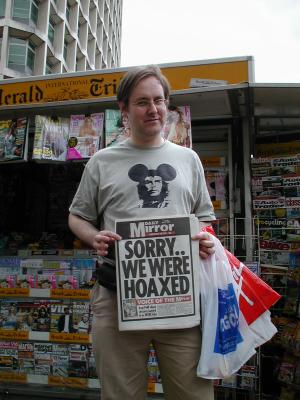 I particularly like the way the Mirror has the words “Newspaper of the Year” above the banner headline. And as another observation, the Chairman and Director-General of the BBC and the editor of the Mirror have now all lost their jobs due to their organisations essentially lying in order to make their case of opposition to the Iraq war. It really is not impressive on their part. A shame we can’t get the editor of the Guardian as well though. May 15th, 2004 | 24 comments - (Comments are closed)
With all the coverage and uproar about the images of American troops, there is probably not much attention spared for the pictures of British troops also accused of abusing Iraqi prisoners/captured. The difference is that the British ones were faked and the saga that started with their appearance in the Daily Mirror with headline ‘Vile’ has come to a climax with the sacking of the editor of the strongly ‘anti-war’ newspaper, Piers Morgan. The Army has made a forceful rebuttal of the accusations and demonstrated why it was convinced that the Daily Mirror photographs were fakes. The arguments focused on four items – the weapons the soldiers were carrying while ‘abusing’ the Iraqi prisoner, the vehicle in which the alleged assault was supposed to happen, the soldiers’ appearance in the photos i.e. wrong hat, no watch and no tan and the t-shirt worn by the captured. Our own source listed the ‘things wrong with the photos’ before the published Army rebuttal. It pretty much covers the same points plus a few incidental details I thought you might find interesting.
Quite. Fortunately, the Army did conclusively prove the pictures were faked, the Mirror admitted they were a hoax, fired the editor and apologised (not unreservedly though). However, the damage done to the morale and reputation of the soldiers and the regiment subjected to such horrendous accusations cannot be easily undone… May 15th, 2004 | 19 comments - (Comments are closed)
In future, Judges are going to have to be less judgmental:
Note of explanation: ‘gaffe’ is a term applied to instances of public figures accidentally letting the truth slip out.
Somebody should really slap a Preservation Order on these ‘guidelines’. They have a unique, period 1970’s charm all of their own.
Hilarious! We used to use the word ‘immigrants’ until the PC brigade got it banned for being offensive. ‘Asylum-seeker’ was the neutral replacement term. This country is institutionally anti-euphamist.
Where they will learn that they are bourgeois counter-revolutionaries and lackeys of the capitalist running dogs. Here is a list of ‘verboten’ terms:
Right on! It is about time that anti-postworkerism was confronted and smashed.
Yes, especially in divorce proceedings.
Feel free to chip in with further useful suggestions. May 13th, 2004 | 91 comments - (Comments are closed)
Lest anyone forget about the “broken-watch principle” (i.e. even a broken watch is still right twice a day), a reminder is served up courtesy of this excellent and unsettling article by Nick Cohen in the Guardian:
Sadly true. Mr Cohen even goes on to quote H.L. Mencken:
Mr Cohen’s doleful analysis chimes with my own observations and experiences of life in contemporary Britain and because I often come to the same melancholy conclusions I am sometimes accused of ‘revelling’ in pessimism. But this is not true. It is rather that I am unwilling to ignore the evidence of my own eyes and ears. For those same reasons, I find myself growing increasingly impatient with analyses of our current woes in terms of historical precendents (the 1930’s, the 1950’s and the 1970’s appear to be the most referred to). If Nick Cohen is right (and the evidence points towards his being right) then comparisons with previous eras are specious. We are facing a whole new situation here. May 9th, 2004 | 9 comments - (Comments are closed)
There must be a comedy sketch in this:
Not to mention endless jokes about truncheons. May 7th, 2004 | 5 comments - (Comments are closed)
Looking for trouble? Well, you’ve come to the right place:
Got that, dickhead? That is what happens to people who try to be ‘clever’. We do not like clever bastards going around being all….clever. So just pack it in, right, otherwise you will be cruisin’ for a bruisin’. Are we clear, pissant? Because if not, its two-and-a-half grand and a punch in the face. Now just piss off, mind your own bleedin’ business and do you as you are fucking well told. April 26th, 2004 | 18 comments - (Comments are closed)
Many sound folks are already rubbing their hands with glee at the prospect of the long sought UK referendum on adopting the terrifying EU constitution. The general received wisdom is that the anti-Constitution faction will win and that will be the end of Tony Blair’s political career… and certainly if it was held today it is hard to see any outcome other that a crushing victory for the anti-EU side and political ruin for Teflon Tony given that the latest YouGov poll (pdf file) shows only 16% would vote for the UK adopting the EU constitution, 28% were unsure and a whooping 53% would vote against it. Rule Britannia indeed! But the promised referendum will not be today but rather at a tactical moment of Tony Blair’s choosing. People who see this ‘surrender’ to the idea of a referendum as a fortuitous laps of judgement of epic proportions would do well to ponder the effect that having notoriously Eurosceptic Britain go to the polls will have on the current negotiations with Britain more Federalist European ‘partners’ regarding the so called ‘red line’ issues of foreign policy, defence, social security and the British budget rebate. Knowing that only if Blair can return home with ostensible triumph on those issues will he be able to credibly spin the EU constitution as a ‘British victory’, the Federalists will be faced with either the complete overthrow of their plans (Denmark or Ireland might be either ignored or finessed, but a British rejection is a rather different matter) or they can settle for a more gradualist victory for their cherished superstate. Thus the prospects for Tony Blair arriving back and waving a piece of paper with Romano Prodi’s signature on it promising ‘Euro-peace in our time’ is by no means a fantastical scenario… and given the sheer ineptitude of the Tory party and the lemming-like Europhilia of the LibDems, it would be a brave man who predicts with confidence that this would not pull the Euro-sceptic’s political teeth. Yes, with a little luck it could, and hopefully will, all go horribly wrong for the UK government and we could see the dismal Conservative party back in the saddle in Westminster in the aftermath of a Euro-Political meltdown of not insignificant proportions. However the prospects of Blair indeed getting Britain to sign up to a first iteration of the EU constitution if the Federalists play ball is by no means beyond possibilities. And if that happens, it means it is only a matter of time before the other issues are gradually chipped away in the years to follow. At that point there will be nothing left to fight for and I for in will be in the market for some property in New Hampshire. Do not underestimate Tony Blair.  April 21st, 2004 | 21 comments - (Comments are closed)
Yes, I know, picking on the Guardian is just so easy that it is verging on bad form. It is rather like challenging a small child to a boxing match. And speaking of small children, I hear the sound of the petulant stamping of little feet:
I can visualise Martin Kettle’s bottom lip trembling as bashes out every embittered word. For Mr. Kettle and his colleagues, the mere existance of anti-EU opinion is such a towering and monstrous inequity that advance tantrums are required to highlight the plight of the beleaguered federast to the caring world. He will probably start hijacking aeroplanes shortly and demand to be flown to Brussels. And what is all this guff about ‘debased, biased and unaccountable media’, as if the Guardian is something other than a national newspaper and, ergo, part of the media? But then thwarted and sulky children often do retreat into consoling fantasy by claiming that their families are not really their families because their real families would not treat them so despicably. Still, given the perenially low circulation (and their reliance on public subsidy) maybe there is a kernel of truth in the analogy. Nobody likes them, everbody hates them. I think they should go and eat worms. April 20th, 2004 | 16 comments - (Comments are closed)
This could all be a tease (there have been hundreds of similar reports about a referendum on scrapping the pound for the euro). The EU constitution in itself may not be worse than what the British version is mutating into. If adopted our choices become a pan-European libertarian movement or a secession. The latter may not be as easy as the Confederate attempt in 1861 from the USA (less public support in the UK, more heavily outnumbered by the rest of the EU etc). Hopefully such a secession could be more Slovenian than Croatian. The advantage of a referendum is that it cannot be worse than letting the Prime Minister decide alone. The disadvantage is that it will only happen once the result is known in advance to suit the government, so that when they win, it can slip through the single currency without a vote (that is what the French government did with the Maastricht Treaty in 1992). Either way spread the word: by next weekend we could have a live campaign on our hands. April 18th, 2004 | 22 comments - (Comments are closed)
|
   |
||||

All content on this website (including text, photographs, audio files, and any other original works), unless otherwise noted, is licensed under a Creative Commons License. |
|||||
Recent Comments