We are developing the social individualist meta-context for the future. From the very serious to the extremely frivolous... lets see what is on the mind of the Samizdata people.
Samizdata, derived from Samizdat /n. - a system of clandestine publication of banned literature in the USSR [Russ.,= self-publishing house]
|
The Daily Mail’s print headline screamed “You gave him a bloody nose!” and the Sun snickered that Tony Blair had been given a “Kick in the Ballots”.
Excuse me? Blair wins a historic third term with a good sixty plus seat majority and this is being portrayed as something less than a major political triumph for the Labour party? If ever there was an instance of how the mainstream media has a remarkable talent for making an ass of itself, this is it. This was not a ‘vindication’ of the Tories (as suggested by the print edition of the Telegraph), it was just another confirmation that they have become utterly irrelevant. One way to see this is that Labour has pulled off a historic victory (which is an indisputable fact). Another way to look at this is that the Tories have suffered a historic defeat. That even after all these years they still cannot be accepted as a viable alternative shows that they are far worse historically speaking than any other British Tory party for a very long time indeed.
So I got the result I wanted. Sure I loath Labour’s ghastly regulatory statism and contempt for civil liberties but Michael Howard is now no longer leader of his party and the cabal around him which turned the Tories into Labour-Lite has been shown to be losers of quite some magnitude. Now maybe, just maybe, something better can come along as the scale of their failure starts to sink in.
In the comment section of my previous post on this blog, many people seemed to think I was urging ‘libertarians’ not to vote for the Conservative party because it was not the small government libertarian leaning party of my dreams. Well sure, but that is not who I had in mind. I was really not thinking about ‘libertarians’ at all when I urged people not to vote Tory, I was thinking about Tories. The reason I am delighted that millions of conservatives did not vote for Michael Howard was that the Tory party is not a conservative party and enough people realised that for the right result to happen. For as long as the Conservative party is peddling nothing more than the same old “give us your money for skoolzandhospitals” crap as Labour and the LibDems, they really should be shunned by millions of people who describe themselves as, well, conservative.
And that is exactly what happened.
9.30am BST Yes, Labour’s 60-65 majority was achieved with only 36% of the vote – an all-time low for a winning party in Britain. That reflects an election in which the traditional party labels didn’t quite capture the real divisions in the electorate. Nonetheless, I’d say it’s worse news for the Tories – not just because it’s an unprecedented third consecutive loss for the party but because such recovery as there was was so pathetic. In the days before the election, a lot of Tories told me that the real measure of their success was whether and by how much they’d break the 200-seat barrier. And even that was a conscious effort to lower expectations. The Conservatives are presently on 195 seats. That would have been regarded as a disaster for Thatcher, Major or even William Hague, and swift resignation would have followed. The Tory leadership’s ability to spin this as a great “improvement” is confirmation of just how shrivelled the modern British Conservative Party really is.
– Mark Steyn
Some brief news about the UK General Election.
With some 40 or so constituencies still to declare, ZaNu-Labour have (as expected) won a third term in office, though with a much reduced majority. Tony Blair looks rather chastened. The Conservatives have done rather better than I (or anybody else) had expected. Michael Howard looks rather pleased. The truly hideous Leninist-Democrats have gained a few seats but, fortunately, nowhere near as many as they were expecting. They are still in third place by some distance.
Oh and George Galloway is back in Parliament.
I will offer up some more thoughts later and as soon as I have some time to spare.
First impressions that this is going to be a much worse night for Labour than some polls have suggested. Exit polls are pointing to a big cut in the size of Labour’s majority. Early days yet.
Hopefully the Tory party will get hammered at the polls today and take a giant leap towards the crisis they so richly deserve. As I have urged before, if you ever want to get a party which does not share the vast majority of its views with Labour, then for goodness sake do not reward their aiding and abetting of pervasive government by voting for the buggers. Do not hold your nose and vote for Michael Howard’s carnival of clowns because they are the less evil because they are nothing of the sort: they are the same evil with the added toxic characteristic of providing an illusion of choice.
If you are going to vote rather than do something useful with your day, and yet you want an end to the European Union’s takeover of British politics, a smaller state, lower taxes (rather than just ‘less tax increases’) and an end to the panopticon ID/database state (or even just any one of those), you will get none of them by voting Tory. If you cannot bring yourself to kick the voting habit altogether, then why not vote UKIP? At least that way you get to indulge your fetish for voting whilst at the same time annoying the chattering classes and not rewarding a collaborationist ‘opposition’.
It takes some nerve to announce this on the day of a General Election. Mind you, I doubt very much that it would at all influence the outcome:
Patients should be refused treatment because of their age in some cases, government advisers have proposed.
Where age can affect the benefits or risks of treatment, discrimination is appropriate, the National Institute for Health and Clinical Excellence said.
Charities representing older people said the recommendations were outrageous and sent out mixed messages.
Wrong. The message is quite clear and will gradually become more acceptable. Within five years, people over 75 will be offered euthanasia when they get sick. Within 10 years it will be mandatory.
Not that anyone would know it from reading this blog, but there is a General Election taking place here in Britain later today.
Of course, I cannot and would not presume to speak for any of my fellow contributors, but for my part, my hitherto silence on this ostensibly ‘big’ issue is due entirely to boredom. I suppose I could delve into my rhetorical box of tricks and rummage around to find some sound ideological justification for denouncing the whole process as illegitimate and antithetical to genuinely liberal ideas, but I simply cannot muster the enthusiasm to do so.
If there had been anything like a real debate in this campaign or anything resembling a challenge to the prevailing intellectual hegemony then I might have been moved to add my voice to the throng. But, as it is, I cannot recall any national election being so stultifyingly dull, so suffocatingly vapid, so determinedly anodyne and strictly-by-the-numbers that the task of making a difference is rather like trying to move mountains by simply shouting at them. Some battles are not worth fighting.
And the issues? Well, there are no issues. Instead there is one, universal promise, writ large in every syllable of every soundbite of every candidate. It is a promise, nay an earnest pledge, to hose down the public sector with money. To the extent that there is any debate at all, it is merely some sporadic bickering about how widely to open the valve and the direction in which it should be aimed. This is the only constant, the sole electoral standard and the only message (so orthodoxy holds) that the public wants to hear.
I cannot say for sure whether or not this is true. If the bleatings of the pundits are to believed then something like a half (or possibly just over a half) of eligible voters will trudge along to a voting booth tomorrow to endorse the ‘new boss’ and even among those dutiful citizens, I detect little passion or genuine commitment. They will go through the motions, more out of habit than conviction. The rest merely shrug with indifference and resignation. Not even the revelations that the process is shot through with fraud seems to have stirred any ripples.
This is such a strange place to live right now. A deep wellspring of tired cynicism with the same old, same old runs congruent with an abject fear of the unfamiliar. An apparently universal conviction that none of the candidates are going to improve any single persons life by so much as an iota is inexplicably coupled with a refusal to countenance any public acknowledgement that this, in fact, the case.
For what it is worth, I expect that the government will win the election and win it handsomely and things will just grind on pretty much as before. How long will this last? I cannot say. Maybe this is some temporary trough; a mere interregnum between great periods of flux and change. Or maybe it really is the ‘end of history’? It certainly feels like it.
I first noticed it in about 1975, or whatever was the year of the first referendum about what was then called the Common Market. (The one where they said that Nobody Is Suggesting Political Union.) And what I noticed was that party workers below the rank of Household Word had become superfluous to political requirements. The Yes campaigners and the No campaigners had duly assembled themselves and had begun to harass people in the street, but they were brushed aside, the way we now brush aside charity clipboarders. We already knew, from our TV sets, what the arguments were, and we did not need further interruption to our lives and daily routine when out shopping.
It is a commonplace that television has done terrible things to crime, by showing so much of it, and by emptying the streets of law-abiding, telly-owning citizens; and to education, by making it possible for children to be amused and diverted for hours on end without having to be literate. It would be very odd if television had not done equally deranging things to politics.
The usual way that the impact of television on politics is discussed is to talk about the way that the senior politicians now present themselves, more chattily and less like ship’s foghorns, with more charm and less Churchillian bellowing. That is all true as far as it goes, but there is also the destructive impact upon politics lower down the political food chain. Simply, as that referendum showed, party workers have become insignificant. Oh, they are still worth having. But they are no longer essential. They are like actors in provincial theatre companies.
In the old days of Churchillian bellowing, the top politicians were, then as now, the ones who did the important political communicating, but the machine they used to do this was run by the lesser mortals, the party workers, who organised the meetings, arranged the chairs and assembled the audiences. Remember those meetings? You probably do not remember them, because they died out a long, long time ago.
And once the party workers became superfluous, so their opinions started to count for less.
The Thatcher era disguised all this, because the Thatcher era was an era of extremism. But this was not because extremist party workers took over the parties. It was because the times were extreme. Britain faced an extreme crisis. It was about to turn into South America. This required extreme measures from an extreme government, like: the government only spending as much as it could get from taxation; like: shutting down industries that were losing a million quid a day; like: crushing the trade unions that would, uncrushed, have crushed the life out of the country. Extreme policies like that. But all this extremity was imposed by Mrs Thatcher, from the top. And she did all this in a rather Churchillian manner, despite all those elocution classes, which further interrupted the inevitable emergence of the new political world which we now inhabit. For twenty more years, politics remained a furious row between political partisans, some of whom said Britain should have more government than it could afford, and the others of whom said it should have less, with the softly centrist activists being being drowned out by the shouters. Ah, the good old days, when voting counted for something!
The reality underneath all this rowing was and is that the voters want something that few party workers of any persuasion want. The voters want as much government as the country can afford, no more, but no less. And, following Thatcher, this is what they have had, much to the disgust of the party workers.
But, who gives a toss what the party workers think? They are unnecessary. If the Prime Minister or the Opposition Leader have something they want to say to the people of the country, they say it to the TV cameras. They do need to address any mass meetings. The activist classes, frankly, can go screw themselves. It is nice for a top politician when they agree with you, but if they do not, tough. What can they – we – do? Write angry letters to the newspapers? Rant away on our websites and blogs? Yawn.
Thus neutered, we activists leave the political parties free to fight their fights without us, uninfluenced by our opinions, which in practice means them all concentrating on marginal, decisive seats, and with tiny variations on that “as much government as we can afford” theme, with a bit more spending here and a bit less there, a few pennies on or off this or that tax. Extreme statements are carefully avoided, for fear of frightening that precious marginal, middle ground. The politicians raise their millions, and spend them on elaborate television commercials and giant posters that mere party workers have no hand in designing or displaying. Polling organisations measure the results, and ordain where more millions shall be spent, and on what further commercials and posters. Peter Oborne was on the telly last week moaning about all this, and he called it “post-democratic” politics. Tosh. The democratic process is rolling on triumphant. But it is post-activist politics, politics done only by politicians and their staffs, without the footsoldiers. It is different.
Despite perhaps being oversimplified, the above ruminations do, I think, make some sense both of the atmosphere of this present general election, and, in particular, of the extreme reluctance that we Samizdatistas have shown in posting stuff about it. We have had nothing to agree with, and nothing much even to disagree with, other than the usual stuff that we always disagree with. Nothing is being said during this campaign which makes us either particularly happy or particularly disgusted. Hence our relative silence on the subject. We, after all, are fully paid up members of the activist classes, and we do not matter any more. The political argument goes right past us now.
This posting complements the earlier one I did about voting decline. That was about what political activists used to do, but no longer do, for the people. This one has been about what they used to do, but no longer do, for the politicians. The activists now burn the candle, so to speak, at neither end.
Maybe one day, we activists will again count for something. Our now insignificant websites will, I personally believe, eventually add up to something very big indeed, and in the USA you/they can already feel this new world coming into being. But what that something will be for the rest of us, I will leave to future postings.
I spent an enjoyable night at the theatre watching the musical, “Billy Elliott”, based on the film of the same name. It is the tale of a boy with ambitions to be a dancer, who lives in a northern English mining town during the time of the year-long miners’ strike of 1984-5 and is full of references to the political controversy of that time. How long ago it must feel to some of us who live in an era of far more peaceful industrial relations.
We have become so used to the relatively low level of strike action in Britain compared with the madness of the 1970s that some people in the audience watching folk cavorting on the stage must have wondered what the issues were about. My fiancee, who is Maltese, certainly did. She was actually appalled at the biased presentation of the then Thatcher-led government in the musical. I pointed out that this sort of bias is pretty standard boilerplate for the sort of leftist folk who tend to dominate the thespian world. It is easy for us, from our vantage point 20 years after the strike, to bask in the sentimental glow of affection for a lost world of pits, working men’s clubs, marching brass bands and the rest.
But at the risk of incurring the wrath of the commenters here, I did feel sympathy for a whole cluster of people who, faced with the iron laws of economics and a government determined to shake up the energy industry, faced losing their jobs and livelihoods. Even for a gung-ho proponent of laissez-faire like yours truly, the massive changes to our industrial landscape are not a story of unalloyed joy. It is a major issue for modern economies: how do we fully engage the energies of people who previously spent the years between 16 and 60 hewing coal out of the ground, riveting ships or working on car assembly lines? I cannot help but wonder that some of the problems of modern society, such as the loutish behaviour of young men, for instance, has something to do with the fact that in years past, young men who were not academic high-fliers nevertheless had a source of pride in doing something productive and in the case of mining, frequently very dangerous.
That all said, it is to my mind a great sign of progress that we no longer expect tens of thousands of men to work miles under the ground to keep our ovens, street lights and heating systems working.
With the price of crude oil holding over $50 per barrel, how long will it be before the more flexible parts of the Green movement start arguing that nuclear power is actually not such a bad idea after all?
I ask this question because it seems to me that Britain, like a lot of other western nations, could be facing a Californian-style energy shortage fairly soon. It goes without saying that such an issue is completely off the political radar right now.
Comment away!
A few days ago I sat down to write an article about this election that is coming up, to try to explain why neither I, nor the other Samizdatistas, nor, apparently, very many of the British electorate, were getting very excited about it. Last time around, the voter turn-out was way down, and they are predicting the same thing again only more so.
However, I think it is important to distinguish between boringness and the decline of the overall vote, because an election can still be extremely exciting for those who remain excited by it, yet turn off lots of others by the million. Witness recent Presidential elections in the USA.
So, in this posting I will concentrate on the decline in the British voter turn-out in successive general elections, and speculate about why this has happened.
In order to try to understand this, I googled my way to this short piece, which I found very informative.
It shows several things. First, it shows that the vote has indeed declined. See the first graph of voter turn-out for each general election since the war.
Second, it explains where. Basically, the voter decline has been most severe in the Labour inner-city strongholds. The voting decline is largely a working class – or perhaps one should say ex-working class – phenomenon.
What gives? Why are these people not voting as much as they used to?
Let me rephrase the question by turning it upside down. Why did they ever bother to vote in such huge numbers in the first place?
I think the answer is that they voted because people who cared about them, and were of use to them, asked them to and told them to. A sociologist would say that they were all members of a voting tribe, for whom voting was a norm. An economist would say that they voted in exchange for favours that fellow tribesmen gave to them. In practice, such things are but different facets of the same thing, reinforcing one another to the point where separating the two notions becomes impossible.
Not that Britain’s working class voted Labour in the nineteenth century. There was no Labour. But they did vote. Individual interest and collective values, tribal and national, both pushed them towards voting, in huge percentages. With the rise of Labour, working class votes flowed towards Labour, but never completely. There were always millions of working class Conservative voters. But this posting is about the total number of votes cast, not who they were cast for. → Continue reading: Voting decline and the two welfare states
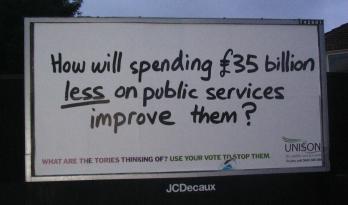
If I thought the Tories genuinely would spend £35bn less on “public services” I might even vote for them. However….
|
Who Are We? The Samizdata people are a bunch of sinister and heavily armed globalist illuminati who seek to infect the entire world with the values of personal liberty and several property. Amongst our many crimes is a sense of humour and the intermittent use of British spelling.
We are also a varied group made up of social individualists, classical liberals, whigs, libertarians, extropians, futurists, ‘Porcupines’, Karl Popper fetishists, recovering neo-conservatives, crazed Ayn Rand worshipers, over-caffeinated Virginia Postrel devotees, witty Frédéric Bastiat wannabes, cypherpunks, minarchists, kritarchists and wild-eyed anarcho-capitalists from Britain, North America, Australia and Europe.
|





Recent Comments