This is the question asked by Anthony Daniels over on the Social Affairs Units blog. His article conveys the sense of mounting unease that I certainly share. Read the whole thing.
|
|||||
|
Alex Singleton says that this is good news:
I agree. I have no problem with the principle that postal services ought to be competitive rather than monopolistic, and most of the arguments I hear which allegedly defend that monopoly strike me as misguided. For instance, I have never understood why sending a letter to people living at the far end of beyond in the deep, deep countryside, should cost no more than sending a letter from a dweller in a city to another dweller in the same city. If a competitive postal delivery service wants to have a one-price-fits-all policy, as many do, for simplicity’s sake, fine. If it wants to deliver non-urgent packages sent by me to someone half a mile from me by sending them to Birmingham and back, again: their problem (and their solution) rather than mine. But if other postal services want to ‘skim’, that is, do only easy deliveries (and maybe do them really, really quickly), and thereby force a little product differentiation into this market, well, again, why not? Making a bicycle is easier and cheaper than making a luxury car, and bikes accordingly change hands for far less. Where is the problem with that? Why should both cost the same? Add all the obvious advantages associated with competitors competing with each other to establish reputations for reliable, efficient and really clever service, and you get a compelling case for a free market. There is also the point, which I was only reminded of when deciding whether to label this as being about “globalization”, that postal services these days cry out to be global, rather than merely national with global stuff treated as a bolted-on afterthought. However, I believe that I do see one problem with this particular exercise in demonopolisation. → Continue reading: Demonopolising postal services: the front door problem February 21st, 2005 | 16 comments - (Comments are closed)
 The Guardian is serious about blogging, and it is also serious about presenting the occasional non-left piece of writing. (They used regularly to publish pieces by Enoch Powell.) So the surprising thing about this piece about blogging is not that the Guardian published it, but that the name of Iain Duncan Smith appears where the author’s name goes. (I share Patrick Crozier‘s doubts about the piece’s true authorship. And when we are talking about blogging, being who you say you are is a big thing, I think.) IDS (I will assume this to be real from now on) hopes that blogging will revitalise the right in Britain, and notes that blogging has already revitalised the right in the USA, and has utterly deranged the left by causing the left to drag their party away from electability. I wonder. I suspect that the problems of the Conservative Party are more serious than that, and that blogging will as likely serve to dramatise all the many differences that are now contained, if that is the right word, within the Conservative Party. The Conservatives now have a hideous problem. Having lost confidence in its own economic nostrums, with the collapse both of the old USSR and of its own attempts to galvanise the British economy by seizing control of it, the British dirigiste left is content to allow Blair – or, I suspect, any likely successor of Blair – to triangulate away into the sunset. Labour knows that for them, it is either New Labour or no Labour at all. Which means that the Conservatives are no longer united by Labour. Instead they are divided by New Labour. I do not go out of my way to converse with Conservative Party activists or critics or cheerers-on, but every one of such persons I have met with during the last decade or so has had his own distinct plan for the future of the Conservative Party, consisting of his own preferred mixture of policies. Each activist knows that his particular plan is The Answer, and that all that is needed is for all those other Conservative morons to stop with the negativity and embrace his plan without reservation. Easy really. The Conservative Party should take a firm stand about this (or its opposite), without compromise. But, it should fearlessly compromise on that, by either lying or not talking about it. Go hard with England, Britain, Europe, the Anglosphere, the World (mix and dilute to taste). Be anti-immigrant, pro-immigrant. Anti-ID-cards, pro-ID-cards. Smash the welfare state, buy voters with an even better welfare state. Cut pensions, raise pensions. Support state education, destroy state education. Defend fox hunting, ignore fox hunting. Applaud the Americans, denounce the Americans. (I once thought that the Conservatives could maybe agree about applauding the Americans and leave the rowing about the Americans to the Labour Party. Fat chance.) Etcetera, etcetera, etcetera. Every policy front is a distinct way to destroy Conservative Party unity. It used to be that the Leader would decide all these things. Now they all want to be the Leader. And if they are not the Leader, and a different mixture of policies and attitudes is propose to their preferred mixture by the bloke who is the Leader, they are about as loyal to the Leader as a basket of low-IQ, but poisonous, snakes. As a result, the Conservative Party is now nigh on unleadable. It is not that they have chosen bad Leaders, or for that matter that they have chosen their Leaders by the wrong methods. It is that they cannot be lead. I cannot see blogging being much help with all this. On the contrary, I think it will only allow the stupid snakes to hiss louder and louder. Blogging will be a whole new source of indiscretions and vituperations, a whole new way to destroy the Conservative Party. The anti-Conservative journalists could have a field day, and I think the Guardian knows it. IDS says that blogging will put the fear of God into the “metropolitan elite”, and assumes that this will help the Conservative Party. It is just as likely to start a new civil war within it. IDS says that lazy journalists think only of the impact of this or that policy on the opinion polls. Which the leadership of the Conservative Party never does, does it? The title of IDS’s piece is “Bloggers will resue the right”. But what it blogging rescues “the right” from the Conservative Party? But, we shall see. Politics is weird. Often something that seems utterly impossible one month, becomes unavoidable a few short months later. Maybe blogging will provoke a big Conservative revival. Personally I do not much care one way or the other. I agree with Perry that a speedy return of a Conservative government would improve very little, and very possibly make things even worse. My loyalty is to blogging itself. This is where I have placed my bets. If blogging very publicly sweeps the Conservatives back into office, hurrah! If it rips the Conservatives into unmendable fragments, hurrah also! Or then again, maybe the unanimous ignorance of the modern world and its possibilities will mean that the stupid snakes continue to neglect this new way for them to hiss, and we bloggers will have to spread our enthusiasm for this new and amazing medium by quite other means. February 20th, 2005 | 4 comments - (Comments are closed)
Back in 1958 J. K. Galbraith’s The Affluent Society was published. The main thesis of this book was that the reason that goverment services were no good was that not enough money was spent on them, hence there was “private affluence and public squalor”. The thesis was clearly false even when it was first published, as government spending on such things as education was at an all time record high in 1958 – both in the United States and in all other nations. However, since 1958 the thesis has been shown to be utter nonsense. As government spending on such things as education has exploded in the United States (and in many other nations) and the standards of such things as government education have declined. Of course one can attack the above as resting on empiricism, and I would accept that economics should not be based on empiricism (I accept the “Austrian School” view that economics is based on the logic of human action). However, J.K. Galbraith always claimed to be a supporter of empiricism – and so as the years went by (with rising government spending and falling standards in the “public services”) he should have admitted that his theory is false and he has never admitted that his theory is false. Now J.K. Galbraith seems to have changed his name and come to live in London. In an article in thursday’s “Evening Standard” Simon Jenkins claimed that the reason that “public services” were no good in London was because not enough money was spent on them. Simon Jenkins (previously known for his support of the London “dome” and other money wasting absurdities), thus ignored both the logical arguments against government spending and the experience of the last several decades of rising government spending and falling standards. Instead Jenkins declared that everyone should believe him because “I am no socialist” and because he was willing to pay more money to local government himself. Of course nothing stops this man giving government (local or national) more money now, if he wishes to do this he can – but what has that got to do with other people being forced to give government more money? As for “I am no socialist” – well “so what?” How is this an argument? Even J.K. Galbraith came out with better stuff than this (perhaps, if they are the same man, age is taking its toll – after all I believe that Galbraith was born in 1908). The article also made other odd claims. For example there was a claim that the government headed by Mr Blair had not increased taxes – which it has, including taxes on wealthy people (Simon Jenkins was very keen that taxes on the wealthy be increased – he seemed to be unaware that very high taxes on high earners reduce revenue over time). The article also claimed that a “Nordic” system of collecting income taxes on a national level and then dishing it out to local governments would improve “local democracy”. This is odd on two levels. Firstly because this is rather like what already happens in Britain – income tax is set by the national government, but much local government spending is paid for by grants from national government (there is endless argument about how fair these grants are, for example with claims that Conservative party controlled councils are discriminated against by the Labour party government, but such arguments need not concern us here). Secondly, is it not odd to think that the above helps “local democracy”? Surely if one believed in “local democracy” the income tax should be set by local councils? Of course taxpayers (apart from Simon Jenkins) would tend to leave high government spending areas over time – and such councils would go bankrupt, but this would at least be “democratic”. The tax eaters of London would get to democratically drive out the taxpayers (both individuals and companies) if that is what they wished to do (and the voting stats were on their side), and they would get to democratically starve. However, central government dishing out subsidies is hardly a matter of ‘local democracy’. February 13th, 2005 | 20 comments - (Comments are closed)
From the BBC today:
Mark Holland has a laugh at the BBC for taking this unmighty throng so seriously, and has a particular chortle about something called the Campaign Against Climate Change. And, from the BBC last Thursday:
I think this contrast well illustrates the relative pulling power of shopping for bargains compared to political demonstrating, and shows that Western Civilisation will not necessarily be collapsing under the weight of its idiocy any time soon. The BBC report continues:
Indeed. What evil capitalist swine these Ikeans are! – offering furniture to poor people so cheaply that they can actually afford it and turn up in their thousands wanting to buy it. February 13th, 2005 | 7 comments - (Comments are closed)
A few years ago I spent a week on a small sailing yacht off England’s South Coast, training for a sailing examination which, I am proud to say, I passed. I subsequently enjoyed plenty of good times afloat, even including a gruelling but fun trip across to France and back, sailing across some of the busiest shipping lanes at night. Assuming I am not flat broke after completing my current house move (gulp), this is a hobby I intend to seriously pursue. What anyone who has taken part in this great activity will tell you is how tough sailing can be on the human body if you have been sailing in rough weather for any length of time. After one particularly tough week, I felt more physically drained than at any time I can recall. Which makes me awestruck at the achievement today of 28-year-old Ellen MacArthur, who has just set the world record for fastest single-handed non-stop trip around the world. Her vessel is a huge trimaran, fitted with rope winches the size of small barrels, the latest satellite navigation technology, a mast more than 100 feet tall and made of super-light material. These modern vessels are incredibly fast although they lack some of the rapier-sharp elegance of an America’s Cup 12-metre. Will it be possible to squeeze even further speed gains from modern yachts? Is there a limit to how fast these modern boats can go? I don’t know, but I guess this amazing Derbyshire lass is going to have a lot of fun trying to find out. (Maybe she should team up with Bert Rutan). And this being a libertarian blog, I ought to mention that of course, Miss MacArthur seems blissfully unaware that her behaviour demonstrates the sort of risk-embracing attitude increasingly frowned upon in today’s nanny state Britain, as this article makes clear. But now is not the time to draw great cultural insights from what has happened. Instead, I am going to raise a glass to someone who has shown enormous courage, tenacity and flair. Update: A commenter asked what my sailing qualifications are and where I got them. I am a Day Skipper, trained by this excellent sea school in Portsmouth and I recommend them. I intend to follow this course with what is called a “Coastal Skipper” course and eventually, a “Yachtmaster”, giving me the ability to sail across the ocean. Modern insurance and growing state regulations require you to have at least one person skippering a boat with proper qualifications. Alas the pastime is getting more closely regulated with time. Oh, and for those that wonder what is the “point” of Ellen MacArthur’s trip, my reply is simple: it is the thrill of demonstrating human efficacy and daring against heavy odds. I celebrate it as much as I celebrate Messner’s climb of Everest without artificial oxygen or Rutan’s space flight feats last year. February 8th, 2005 | 21 comments - (Comments are closed)
The cover of print version of The Economist is titled ‘Taking Britain’s Liberties’ and the issue discusses many of the very serious abridgements of our civil rights that have recently taken place. 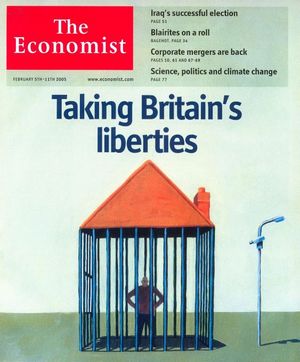 But rather than link to any specific article, what interests me is that the truly grave situation is finally ‘front page news’ in a fairly mainstream publication. It is nothing less than amazing that it has taken this long for the seriousness of the situation to reach the collective editorial consciousness of any significant element of the media outside the blogosphere and other elements of the activist fringe. February 7th, 2005 | 22 comments - (Comments are closed)
Shell, the Anglo-Dutch oil company, is reporting very healthy profits which the Daily Express sensationally reported as £300 per second and there has been a chorus decrying this as ‘obscene’ (sundry Labour MPs) and according to Martin O’Neill (chairman of the trade and industry select committee) ‘beyond the dreams of avarice’. So let me make sure I understand this… of the approximately 80p per litre (about $5.70 per US gallon) charged for gasoline at the pump in Britain, only about 16p is what the oil company charges: the rest is all tax. And the politicians, who are responsible for four fifths of what is paid by British motorists to fill up their fuel tanks, are stamping their feet and threatening additional ‘windfall’ taxes on the companies responsible for the remaining one fifth of what is paid. These politicians and their baying supporters are so wrapped up in a culture of value destroying appropriation and predation that they cannot see the true obscenity. To see that they need do nothing more than look in a mirror. The company should have a large sign on the forecourt of every single petrol station they own in Britain with the following message:
The problem is not Big Oil, the problem is Big Government. February 4th, 2005 | 59 comments - (Comments are closed)
“You can kill burglars” was the message that came blaring forth from the tabloid press with that flourish of heady triumphalism that usually accompanies a victory-for-the-common-man story (and which, on closer scrutiny, nearly always means that the government has just fucked over the common man good and proper). To the cursory eye, the impression given is that the government has backed down and responded to public pressure for a change in the law to give citizens more rights to fight back against intruders and attackers. In reality, the government has done no such thing. Instead, those various branches of the state responsible for law enforcement have collaborated on a public statement:
None of which sounds unreasonable per se, but all of which is merely a re-statement of the law as it currently stands. This is not a change of heart or a climbdown or a fresh start or anything else of that nature. This is just yesterday’s bill of fare, re-heated and served up with a garnish of finely-chopped press release. In essence this is political chaff; a big bunch of glittery tinsel ejected into the air in order to deflect the heat-seeking missile of public disquiet. It appears to have done the trick. As I have said before, the law does need changing in order to more accurately reflect the pre-1967 Common Law positions but, more than that, there needs to be a reversal of the last half-century’s worth of anti-self-help culture. On the downside, we are still a long way from any of that change but, and on the upside, at least the ball is now in play. February 2nd, 2005 | 115 comments - (Comments are closed)
As we mark the sombre 60th anniversary of the opening of Hitler’s murder factories in Belsen and elsewhere, those prize asses at the Labour Party come up with an anti-Conservative poster portraying leader Michael Howard and shadow finance pokesman Oliver Letwin as flying pigs. Both men are Jews. Now, I will be charitable to the Labour Party and assume that the creators of this piece of rubbish were so dumb as to fail to think through the significance of this poster and are not anti-semitic, which is an extremely serious charge to make. As I am a hardline defender of free speech, I would of course say Labour is entitled to engage in any manner of roughhouse advertising. I certainly do not think the party should be dragged before the courts. In fact I think Labour has scored a bit of own goal. Some Jewish voters may shun Labour at the national polls, widely expected later this year. This poster may suggest something quite encouraging to the Conservatives. Maybe this government, which is not exactly shooting the lights out in the opinion polls, is rattled at the Tories’ willingness to talk regularly about cutting the State down to size and cutting taxes. The Tory plans are hopelessly cautious, in my view, but credit to them anyway for pointing out that the government’s spending binge has failed to deliver discernible results and that a major reorientation of policy is required. Mind you, I still haven’t forgiven Mr Howard for his support for compulsory ID cards. January 29th, 2005 | 66 comments - (Comments are closed)
At a Samizdata social gathering a few months back, one of the attendees (I think it was Patrick Crozier) posed the question of how much influence the blogosphere was having on the ‘real’ world. The answer I gave at the time was plain and direct: none. A rather negative prognosis for sure but sincere and truthful as far as I was concerned. However, my candour was not well-received. My dear chum Brian Micklethwait, in particular, took issue with me claiming that the blogosphere could well have be having an impact in ways that were not yet manifest. I countered this with the contention that in the absence of evidence of influence, one must assume that there is no influence at all. Anyway, if memory serves, the rest of the bickering trailed off into a lake of libation and no firm conclusions were ever reached (are they ever?). Since then, I have been forced to qualify my above-stated position because, in common with most other bloglodytes, I am all too familiar with the ‘Rathergate’ scandal over in the USA; a incident of such profile that it has made it impossible to deny that blogging is now having some degree of impact on the wider American polity. But, as far as the UK is concerned, I have maintained my stance. Sadly and frustratingly, neither the blogosphere nor anything else seems to have been able to lay a glove on the great, heaving, suffocating beast of the hegemonic British intellectual climate. That was my view. Until today. I required some proof to the contrary and now there is infallible proof:
I refuse to even attempt a rebuttal of this ludicrous and obviously desperate smear, preferring instead to let it stand naked in all its ignominy. Besides, it will not be the last. Blogging has clearly begun to make an impression on the minds of the political classes and they fear it. The blogosphere has now landed in Britain. January 28th, 2005 | 26 comments - (Comments are closed)
There is a fine article by Tory MEP Daniel Hannan in the Telegraph called The EU’s four-stage strategy to reduce Britons to servitude. It is an entirely accurate and reasonable article about the process of stripping British (and other European national) institutions of power and replacing them with Euro-level institutions. He finished up with the notion that Michael Howard and the Tories will finally turn things around:
But there is just one problem with that. The slide into the Euro-maw did not start under Tony Blair’s government. In fact it would be no exaggeration to say that the UKIP would not exist today if significant numbers of Euro-sceptic voters were not sick of being lied to again and again and again by Tory politicians. As I said to a table full of captive Tory grandees when I spoke at an event commemorating the end of Exchange Controls, a great many Tory voters simply no longer believe that the Conservative Party actually wish to conserve the things they care about and I very much doubt that any amount of rhetoric by any Tory will win back the trust of days gone by. Many of those former Tories who joined UKIP did so not just to oppose the destruction of Britain as a separate political entity but also because they truly hate their former party and see UKIP as a way to destroy it by making it permanently unelectable. So what Mr. Hannan says is all good stuff, but what makes him think people should trust the party of Michael Heseltine, Ken Clark and Chris Patten to actually turn things around? January 26th, 2005 | 43 comments - (Comments are closed)
|
   |
||||

All content on this website (including text, photographs, audio files, and any other original works), unless otherwise noted, is licensed under a Creative Commons License. |
|||||