We are developing the social individualist meta-context for the future. From the very serious to the extremely frivolous... lets see what is on the mind of the Samizdata people.
Samizdata, derived from Samizdat /n. - a system of clandestine publication of banned literature in the USSR [Russ.,= self-publishing house]
|
Instead of the Government directing energy policy from the centre, let the people choose.
This would involve the scrapping of ALL subsidies for power generation, direct or indirect. So all ROCs, FiTs, payments for nuclear decommissioning, tax breaks for gas extraction, and so on, would go. The real whole-life cost of each technology would be apparent. Each consumer could then choose the source, or mix of sources, for their electricity, in much the same was as at present one can choose energy supplier, or even a ‘green’ tariff, and pay accordingly.
– Murdo Fraser, deputy leader of the Conservative Party in Scotland, “breaks ranks”, as Bishop Hill puts it.
Fat chance, but good to hear such a highly ranked Conservative saying such a thing.
Samizdata’s favourite Member of Parliament, Steve Baker, has been elected an Executive Member of the 1922 Committee. What this shows is that he is the kind of Member of Parliament whom other Members of Parliament rate highly, and pay respectful attention to. It means that Baker has a Parliamentary following. He is not a loan (!!!) lone voice in the wilderness. Good.
In other words, ideas like this (written by Baker in response to some recent remarks by William Hague to the effect that we should all work harder) are now getting around:
Senior politicians must realise that hard work cannot produce prosperity without the right institutions. In addition to Adam Smith’s “peace, easy taxes and a tolerable administration of justice”, hard work must be rewarded with honest money which holds its value, not money which the commercial banks and the Bank of England can produce at the touch of a button.
Money loaned into existence in ever greater quantities caused the present crisis. It has given us a society based on crushing burdens of work in exchange for rewards which quickly disintegrate. That is the problem which must be solved if hard work is to have proper meaning and if we are to have a moral and just society which delivers prosperity for all.
Imagine a world in which the most powerful people in it started seriously to understand and to act upon notions like that. Thanks to people like Steve Baker we may eventually find our way towards such a world, and maybe (although one should never assume such a thing) quite soon.
I have admired Steve Baker MP ever since I first heard about him from my friend Tim Evans, and have liked him ever since I met him, at a Cobden Centre dinner a while back.
If you also admire Baker and what he is trying to accomplish, then please take the small amount of time needed to add a comment here saying so, even if you are not normally inclined to comment, here or anywhere else. Baker has several times told me, and I have no reason to doubt him, that encouragement of this sort makes a definite difference to his happiness, and to his willingness and ability to keep on keeping on.
A short while ago, I defended the freedom of people to say nasty, or stupid, things on sensitive subjects, so long as they don’t do so on my private property or against the rules set by owners of said. (The property point is one of the distinctive libertarian ways of framing the issue. You don’t have a right to paint slogans on my house or demand I pay for your blog fees). It is, I suppose, a sign of the times in which we live that toleration for speech that you don’t happen to agree with is now seen, in some quarters at any rate, as a “right-wing” issue. It should not be. Anyway, I was reminded of this point when I read this article about a stand taken by David Davis, the senior UK Conservative MP.
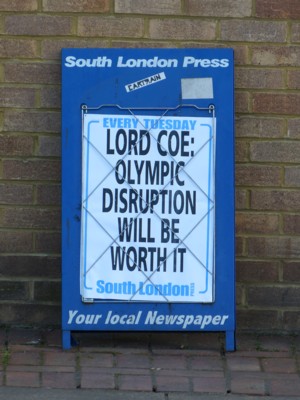
Here is a photo I took in March of this year, which I have been meaning to feature here for ages:
We shall see.
One of the many annoying things about the Olympic Games is how little clutches of contractors and workers, doing vital things, know that they can, during the frantic run-up to the Olympics, demand a hugely exorbitant price for merely doing their job, even if they had earlier sworn blind that they would not behave like this. I imagine that’s a very widespread Olympic phenomenon generally, which adds hugely to the final bill, and is just one more reason why I wish the damn things had gone to Paris and never come back, ever.
I surmise – no speculation of this sort could easily be proved – that if any such demand becomes just too demanding, the means used by the State to settle such demands are not confined to bribery. If I was the State, I’d also now be issuing threats. I’d send people round to knock on doors to explain, ever so politely (perhaps over a friendly cup of tea), to such persons as trade unionists and building contractors, just how nasty the State is now capable of being, to individual people whom it has taken against. The State knows where you live. The State decides how much tax you owe it. And so on. And it could get even nastier. So, don’t push your luck too far, there’s a good fellow.
This is all pure speculation on my part. I have zero inside knowledge of any such negotiations. It’s just that if that were now happening, I would not be surprised, whereas if it wasn’t, I would be very surprised indeed.
Another way of responding to such last minute demands is to say: Okay, if you don’t finish it in time, you don’t finish it in time and it doesn’t get finished in time. Pity, but there you go. And once the Olympic Games are over, we can then sack the damn lot of you and take our time. While keeping all your names on a Black List, for you to be suitably punished at our leisure.
This seems to be the approach being adopted in the matter of the Greenwich Cable Car. I am particularly interested in this New London Thing because, when finally finished and open for business, it will be another fine photo-op for me, to add to my London list of places like this.
Yes, says Mayor Boris, we do indeed hope that the Emirates Airline will be ready in time for the Olympics, as another way to get people back and forth across the river, to and from all that Olympicism. But if it isn’t ready by then, so be it. This is not an “Olympic Project”, or it only will be if it is ready for the Olympics.
Very wise.
I recall that the London Eye was supposed to be ready for the Millennium, but that, perhaps for the kind of reasons speculated about above, it wasn’t. Who now cares?
Pity you can’t take that line with such things as velodromes and swimming pools. Which is why I suspect that other means of persuasion are also now being deployed.
A blogger called Archbishop Cranmer is being investigated by the Advertising Standards Authority after ten people complained about an advertisment on his blog that tried to get people to sign a petition against gay marriage. Says he:
His Grace is further minded to respond that he has neither fear of nor hatred for the gay and lesbian community, though he is a little pissed off with 10 of them. They could easily have emailed His Grace with their complaint, and we could all have had a jolly good chinwag about the whole thing. Instead, they called in the Gestapo to censor the assertion that marriage is a life-long union between one man and one woman, in accordance with the teaching of the Established Church, the beliefs of its Supreme Governor, and the law of the land.
I like this because it cuts through nearly all of the information hiding abstractions like ‘Advertising Standards Authority’, ‘investigation’ and ‘complaint’.
What is really happening is that A does not like what B is saying and rather than respond with words they have asked C to threaten B with violence. Note that Archbishop Cranmer can not simply ignore the ASA: there are requirements and deadlines imposed upon him. Notice also how notions of ‘complaining to an authority’ who will then ‘conduct an investigation’ make this appear more sanitary than it really is, to the point that I would have a hard time convincing A that violence is involved.
Since the ASA exists to respond to words with violence, its existence can not be justified. Advertising should not be regulated. One might worry that without regulated advertising we would be bombarded with lies, claims and counter-claims and that the world would become a more confusing place. I think instead that it would only reveal confusion that is already there.
H/T Tim Worstall.
Via Guido Fawkes, are these comments from UK Education Secretary Michael Gove. He is not bashing private (or as we Brits confusingly call them, public schools) but making a point, which I think need to be made, that many of the leftist-leaning people who run important media and related institutions were educated privately:
“Armando Iannucci, David Baddiel, Michael McIntyre, Jack Whitehall, Miles Jupp, Armstrong from Armstrong and Miller and Mitchell from Mitchell and Webb were all privately educated. 2010’s Mercury Music Prize was a battle between privately educated Laura Marling and privately-educated Marcus Mumford. And from Chris Martin of Coldplay to Tom Chaplin of Keane – popular music is populated by public school boys. Indeed when Keane were playing last Sunday on the Andrew Marr show everyone in that studio – the band, the presenter and the other guests – Lib Dem peer Matthew Oakeshott, Radio 3 Presenter Clemency Burton-Hill and Sarah Sands, editor of the London Evening Standard – were all privately educated.
Indeed it’s in the media that the public school stranglehold is strongest. The Chairman of the BBC and its Director-General are public school boys. And it’s not just the Evening Standard which has a privately-educated editor. My old paper The Times is edited by an old boy of St Pauls and its sister paper the Sunday Times by an old Bedfordian. The new editor of the Mail on Sunday is an old Etonian, the editor of the Financial Times is an old Alleynian and the editor of the Guardian is an Old Cranleighan. Indeed the Guardian has been edited by privately educated men for the last sixty years… But then many of our most prominent contemporary radical and activist writers are also privately educated.
George Monbiot of the Guardian was at Stowe, Seumas Milne of the Guardian was at Winchester and perhaps the most radical new voice of all Laurie Penny of the Independent – was educated here at Brighton College. Now I record these achievements not because I wish to either decry the individuals concerned or criticise the schools they attended. Far from it. It is undeniable that the individuals I have named are hugely talented and the schools they attended are premier league institutions.”
Food for thought.
I am off to southwestern France to coincide with the London Olympics. I shall be swimming in the Med, guzzling delicious red wine and food, reading some gloriously downmarket novels, enjoying the tranquil scenery, and also, avoiding shit like this:
“There are now just 80 days to go before the start of the Great Siege of London, when the daily routines of millions of the capital’s citizens are to be subjected to military diktat. Forget the excitement of the sporting performances at the London 2012 Olympics. The Government’s decision to stage the biggest-ever peacetime display of the nation’s military firepower is set to rival anything the world’s leading athletes can offer at the various Olympic venues. In scenes reminiscent of the Blitz, a new generation of heavily armed Typhoon interceptors and anti-aircraft missile batteries will be stationed among the city’s residential districts ready to shoot down any rogue plane at a moment’s notice.”
Along with variations such as “The lying will continue until trust improves”, this jokey phrase is, alas, a completely accurate description of what many of our most lauded and influential thinkers believe is the best way for them and their class to motivate those less lauded and influential.
Guy Lodge is associate director at the Institute for Public Policy Research and a Gwilym Gibbon Fellow at Nuffield College, Oxford. He writes:
Bad weather in parts of the country will no doubt have played a role in keeping some voters at home, but clearly this doesn’t account for the worrying levels of political disaffection reflected in the low numbers choosing to vote.
His cure for political disaffection?
This cycle can only be broken by radical means. IPPR research shows that the best way to boost political participation among “hard-to-reach” groups is to make voting compulsory.
Anorexia is a nasty eating disorder, and although in the prosperous West there seems to be more fretting about obesity than the other extreme, there is no doubt that people who, for whatever reason, don’t eat enough to protect their health, represent a serious health issue. But as ever, I get irritated at the “victim culture” that is sometimes wittingly or unwittingly promoted in public discussions of the issue. Case in point was earlier this week on the BBC.
The state broadcaster’s morning current affairs show featured a young woman who had almost died as a result of this condition, and some shocking photos were shown. During the course of the discussion with the presenters, the argument from the woman (I did not get the name) was that she had been strongly influenced into her under-eating by a desire to look like the models and actresses seen in glossy magazines and on TV and movies. Such pictures are often enhanced, ergo, such enhancement is evil and there should be a law against such activity so as to prevent impressionable people from being led astray, etc.
At no point did either presenter, or another woman who was representing the modeling industry, say something like this:
“I am very glad you have recovered your health and are eating a proper diet and don’t feel a need to starve yourself to `look good'”. The fact that photos of such supermodels/actresses or whoever might appear to show that it is acceptable to be very thin does not, and should not undercut your own responsibility for your health. You have a mind, so use it. You have free will; you are not a piece of clay in the hands of the advertising industry, the movie business, or modelling agencies. You are an attractive young person who can, and should, think for yourself. Finally, curves on women are fabulous, and anyone who thinks for a second that the opposite sex is turned on by skeletons needs their head examined. So take charge of your life, and don’t expect the State to censor things because you lacked self-control earlier in your life. Thanks for appearing on our show and now let’s go over to Carole for the weather forecast.”
But they didn’t say that. Pity.
Boris Johnson says the government should go in for “more tax cuts.” More in addition to what? There have been no significant tax cuts. In fact every week there are proposals for ever more inventive methods of extorting money from the hardworking and the thrifty.
– Peter Mullen
The BBC reports that certain ISPs in the UK must block access to the Pirate Bay, but supplies few details. The International Law Office has detail:
The claimants relied on Section 97A of the Copyright Designs and Patents Act 1988, which requires ISPs to take measures to block or at least hinder access to infringing websites.
1988? This legislation has been lurking around since before the Internet. Never mind scary new legislation: one wonders what is lurking in old legislation, waiting to be used. Says section 97A:
The High Court (in Scotland, the Court of Session) shall have power to grant an injunction against a service provider, where that service provider has actual knowledge of another person using their service to infringe copyright.
All it takes is reams of vague legislation and the right interpretation to be made.
Update: As Dave points out in the comments, it seems that section 97A was added by The Copyright and Related Rights Regulations 2003, in 2003. My point about old legislation is weakened but this post was also intended to shed light on how Pirate Bay was blocked. It really is Nomic.
The Ministry of Defense wants to put surface to air missiles in residential areas as part of security measures for the Olympics. This is highly irregular. They are to be used against…
…all manner of airborne attacks from the 9/11 style assault to a smaller “low and slow” attack from a single light aircraft.
I would be surprised to see hijacked airliners ever again. A light aircraft attack sounds plausible, but shot down aircraft wreckage landing on London might still be considered a win for the terrorist.
There are also to be army troops, fighter jets and naval ships at the ready. The MOD are certainly preparing for more than a kid with a bomb strapped to his chest.
|
Who Are We? The Samizdata people are a bunch of sinister and heavily armed globalist illuminati who seek to infect the entire world with the values of personal liberty and several property. Amongst our many crimes is a sense of humour and the intermittent use of British spelling.
We are also a varied group made up of social individualists, classical liberals, whigs, libertarians, extropians, futurists, ‘Porcupines’, Karl Popper fetishists, recovering neo-conservatives, crazed Ayn Rand worshipers, over-caffeinated Virginia Postrel devotees, witty Frédéric Bastiat wannabes, cypherpunks, minarchists, kritarchists and wild-eyed anarcho-capitalists from Britain, North America, Australia and Europe.
|





Recent Comments