We are developing the social individualist meta-context for the future. From the very serious to the extremely frivolous... lets see what is on the mind of the Samizdata people.
Samizdata, derived from Samizdat /n. - a system of clandestine publication of banned literature in the USSR [Russ.,= self-publishing house]
|
Milder than a year ago (and my heating bill is lower as a result, which is nice), the UK winter has been associated with a long period of rain. Parts of the UK have suffered heavy flooding such as in the southwest, as in Somerset. The floods again raise the issue of what ought to be the way we deal with them. Absent any kind of powerful government, I guess one obvious response would be that insurance premia would reflect the risks of living in a flood plain, and so this would prompt responses such as people building homes in different ways – such as a modern form of “stilt,” maybe – and moving to higher ground, or encouraging some sort of collective, but voluntary effort to abate flooding risks, such as creating funds to pay to put levees on rivers, or dredge them regularly, etc.
We are where we are, however. And if you think a government has certain very basic, narrow responsibilities, defence – one of the core functions – should perhaps include defence against certain types of natural catastrophe, albeit not an open-ended commitment; such a move should also incentivise local efforts, rather than prevent them. Which is where the UK Environment Agency’s recent behaviour comes in.
In the Spectator Coffee House blog, Charles Moore weighs in with an article that argues that much of the problem is that the EA has, over the past couple of decades or so, changed its approach to flood control to one where it seems to believe in benign neglect. It is possible to see a form of environmentalistic anti-modern civilisation mindset at work here. No more arrogant Victorian attempts to tame nature by dredging rivers, pumping out water systems and the like. And Moore cites the views of a recent head of the EA, which I think gets to the heart of the change:
The Environment Agency’s opposition to dredging is reported, but not explained. Poor Chris Smith, the current chairman, gurgles inarticulately as if the floods were closing over his head. The answer, as with so much in the management of the environment, is ideological. Especially under its former chief executive, Lady Young of Old Scone and New Labour (I have made only half of that title up), the EA has seen human activity as the enemy. Lady Young has been quoted in Parliament as saying that she would like to place limpet mines on all the old pumping stations to get rid of them. If people are the problem, you wonder why the EA employs more than 11,000 of them. Without human intervention, the Somerset Levels would become an inland sea. Perhaps that is what the EA wants.
I think maybe that it is what the EA wants, not that such an organisation could perhaps say so bluntly lest it provoke so much public anger that its staff would be sacked and leadership replaced. But even if you don’t go in for conspiracy theories (and I don’t) you might wonder whether the ideological tilt of the EA fits with those who actually want such disasters not to be averted because it will be used as handy evidence of Man-made climate change. Pictures of vast floods across parts of the UK will, I can bet, be used by the alarmists to justify their arguments that Man is wrecking the climate and so we need yet more windmills and all the rest of it. Much easier to do that rather than go to the boring effort of dredging rivers and undertaking civil engineering projects to reduce the flooding risks in the first place.
Another thought that strikes me as if the EA really has taken some sort of policy switch and decided that old pumping stations should be destroyed or left idle, who exactly approved of this policy? Was there any public discussion of this? Who is, or should be, held accountable for it?
Meanwhile, here is an article by the founder of the Glastonbury Festival, who, I suspect, can see the commercially devastating impact of the EA’s position. And a similar call for change in the local media.
As Moore says, the EA has over 11,000 staff. It is about time that organisation began to become part of the solution of flooding risk, not an active and foolish contributor towards it.
For part of what passes for the chattering class in the UK, the idea that having “too much” wealth is so ingrained that it comes as a shock when the right to own as much property as one can in a free society is asserted. For example, I’d be willing to bet that most “liberals” these days (I use that word in its corrupted, American sense) take it as a given that the “rich” (chose your definition) should be taxed far more heavily, proportionately, than everyone else, in order to redistribute gains that, they assume, are in some way unjustly acquired. (The fixed wealth fallacy, as our own Brian Micklethwait pointed out many years ago.)
Recently, there have been signs of dissent at the idea of heavy tax burdens on the rich. London Mayor Boris Johnson recently had a pop at high tax rates, and others have done so. This appears to have got up the nose of Richard Godwin, who writes a column for London’s Evening Standard newspaper. In a model of superciliousness, bad logic and general asshattery, Godwin lets rip:
I’m considering jacking it all in to become an entrepreneur. I reckon I’ve got what it takes. Most of my thinking falls into the blue sky category. Box-wise, I’m generally outside. People ask me to give 100 per cent, I’m like: “How about 110 per cent?” They say it’s mathematically impossible to give 110 per cent. I say: “Impossible is not in my vocabulary.”
Okay matey, we get it. You are good at taking the piss. I’m impressed.
The only barrier between “me” and “entrepreneurship” is my salary. It’s currently under £150,000. I’m working on that, 110 per cent! But I wouldn’t be affected by Labour’s proposed 50p tax rate and, as I understand it, it’s only “entrepreneurs” who come in for such persecution.
You wouldn’t be affected by the tax rate. Maybe not directly; but the point is, if you generally let it be known that anyone who has the effrontery to be paid “too much” gets at least half his/her earnings confiscated at source, that has an impact. Look beyond your own little mental universe, Mr Godwin.
No sooner did Ed Balls announce his plans to increase the levy on the richest percentile than a familiar chorus began. “What did the wealth creators do to deserve this?” pleaded the CEOs of FTSE-listed companies and the inheritors of family wealth. “Won’t someone think of the entrepreneurs?” thundered Boris Johnson, calling for the top rate to be cut to 40p. For it seems the word “entrepreneur” has changed its definition. Even the Duke of York outed himself as one recently. Before the crash, it meant someone who started an enterprise, deriving from the French verb “to undertake”. It has come to mean something like “deserving rich”. It’s how the over-£150,000s reassure themselves that their wealth is the product of their genius and graft as opposed to a specific set of social and economic conditions.
Okay, sometimes terms get used loosely, but the underlying logic is nonetheless sound: if you hit high earners with high taxes, it means the point of taking big risks is blunted. Maybe not extinguished, but nonetheless, the impact is real. Mr Godwin might as well deny that as deny that the Earth orbits the Sun.
Now, I know quite a few people who fit the old definition of entrepreneur, who have “dreamt of a new product, or a new market, and then struggled to make it happen,” as Johnson put it. When they started their businesses, they had neither the means nor the inclination to withdraw a six-figure salary for themselves. They preferred to reinvest. Some of their companies have since become very successful. However, of all the complaints I have ever heard, income tax is not one of them. The banks’ reluctance to lend is a far more pressing concern.
Nope. First, a lot of businessmen and women don’t draw a big annual salary; their income stream is highly volatile: famine one year, feast the next. If, after several lean years of building up a business, they suddenly come good, and say, half of the rewards are confiscated in tax, then the preceding risk-taking and general graft looks less worthwhile than it might have done in a lower tax environment. Time-horizons come in to play here. To increase the willingess of people to invest long term, not just in financial terms, but in terms of time and effort, the logical approach is to reduce taxes overall.
By definition, those who pay the top rate are life’s winners already.
He’s got it the wrong way round. If you have high taxes, then the chances of becoming a winner are made worse; the point of taking risks to be a winner is blunted. In any event, people who earn high salaries typically make a lot of sacrifices to get there, in my experience.
That great enemy of entrepreneurship, Margaret Thatcher, set the top rate at 60p. As successive governments have cut that, the economy hasn’t magically grown. All that has happened is that fewer people have benefited from the growth. That’s not entrepreneurship — it’s self-interest.
She set it at 60 after cutting it from a crazy level of almost outright confiscation; towards the end of her time in office, it fell further to 40 per cent, as Mr Godwin should know. He’s trying to imply that Maggie was quite happy to see the top rate at 60p in the pound. She plainly wasn’t. And the economy has grown as the top rate came down; nothing magic about it. Despite the problems of the past few years, Britain is in many ways a more entrepreneurial country than it was when Mrs Thatcher gained power in 1979.
Last night, I was half listening, not watching, a repeat of the TV comedy quizz show “8 Out Of 10 Cats” on some late night digital channel like E4 or Pick TV or some such thing. And I heard a comedian called Jon Richardson having a go at Nick Clegg, the leader of Britain’s Liberal Democrat Party.
Richardson was sneering at the Lib Dem Conference of whatever year it was when this show first went out, because so many of the things said at it, said Richardson, were boring and banal and obvious.
As an example, Richardson cited a pronouncement proclaimed with great solemnity by Nick Clegg which went something like this:
“It is not enough for governments and politicians to stop bad things. We must do good things.”
Richardson’s complaint about this pronouncement was that it was banal and boring, but banal and boring because so obviously true.
But both Clegg and Richardson are wrong. The idea itself, as stated with such admirable clarity by Clegg, is anything but banal and boring. It is very, very bad. It is banal only in the sense that badness often is. And Richardson was wrong in objecting to it in the way that he did.
If governments and politicians the world over were to switch over to only stopping bad things and to abandon all attempts to do good things, the world would quickly – although admittedly only after a period of angry readjustment – become a massively better place.
Dominic Frisby, like Jon Richardson, is also a comedian, among other things. I especially like this rendition of the Twelve Days of Christmas. And I could have imagined it, but I think I also heard Frisby’s voice last night doing a pre-sell in between programmes, for some future BBC programme involving Business Dragons. Frisby’s career as an entertainer and performer, in other words, is motoring along nicely.
But guess what. Politically, Dominic Frisby does not sail with the prevailing comedic wind.
I have been reading Frisby’s recently published book called Life After The State, which I learned about earlier this week when I attended a talk given by Frisby at the Institute of Economic Affairs. As I later discovered when I began reading his book, Frisby’s talk was pretty much a spoken version of the book’s Prologue , which you can read here.
The next chapter in Life After The State, immediately after that Prologue, tells the sad story of Glasgow’s decline from world super-city to basket case. Glasgow, Frisby makes clear, has been a continuous and epicentric maelstrom of government attempting to do good things, year after year, decade after decade, to try to reverse Glasgow’s decline from economic and industrial glory to drug-addled welfare-dependency. And Glasgow’s problems have just kept on getting worse and worse. “And”, because to everyone who has been paying proper attention to the last century and more of human history, this would not be a surprise. Much of of the rest of Britain has followed Glasgow’s lead, if that is the right word.
Says Frisby, in the concluding sentence of this chapter:
The best way for government to help people is not to.
Indeed.
I don’t think Cameron has conceded anything very much. The Lib Dems are not much farther to the left than he is personally and he would have a much harder time with his own party if he was not in a coalition. I think Cameron has done quite well by his own miserable standard.
Cable is just one of those people that think that the debate (was there one?) about the role of the state has been settled and that elections are just about replacing the management team.
– Samizdata commenter Peter T
… because his, er, ideology makes him in favour of more spending and more taxation.
Yes, really.
Does he think his own views are not completely ideologically based as well?
[Nigel Farage] is a politician, so everything he says needs to be decoded. But licensing [of handguns] is vastly preferable to banning, not just a little bit preferable… more importantly he is doing the one thing you are not supposed to do in polite society, he is actually discussing the subject. Next thing you know people will be discussing the NHS and the phrase “envy of the world” will not be heard anywhere.
– Perry de Havilland
Nigel Farage has just stuck up two fingers and waved them in the direction of the mainstream.
The Ukip leader has said it is party policy for hand guns to be legalised and licensed in the UK despite being banned in the UK for the last 18 years. Mr Farage said the current ban on the guns, which were made illegal following the school shooting at Dunblane in 1996, was “ludicrous.”
Speaking on LBC Radio Mr Farage said that it was Ukip policy to create a “proper licensing policy” and that people who kept hand guns responsibility locked up and had were willing to get an official license should “absolutely” be allowed them.
And of course he has unleashed a wave of outrage from ‘sensible’ statists of both left and right.
Well done Farage! To annoy so many of them at the same time just drives home that the Tories, Labour and LibDems really are largely interchangeable. It also means you are indeed doing something right.
That rough diamond of the Labour party, ascended man of the people John Prescott, has fulfilled a lifetime’s dream, courtesy of a holiday to Cuba “provided by” Journey Latin America.
Rum and cola in hand, he does the online equivalent of showing the neighbours his holiday slides, by regaling the Guardian audience with a matey account of his adventures: John Prescott leaves the 21st century behind in Cuba.
He and his son, also along for the ride, had a fine old time. A moment of embarrassment over the right amount to tip provided an entertaining anecdote:
As a tourist, you must use a special tourist currency – the CCP, Cuban convertible pesos – while locals use Cuban pesos or CUP. It’s not really too hard to work out, but it did manage to get me in trouble when tipping. I left the equivalent of £15 in convertible currency for the chambermaid, who immediately threw her arms around me to express her appreciation. I then learned that she earned only £30 a month, and was suddenly fearful that the embrace might provoke comparisons to the French politician and the American maid.
Down in the comments, this fisking by ‘brituser’ fails to enter into the holiday spirit. What a grinch! I have quoted only some of it; do not on any account read the rest. Prescott is in italics, ‘brituser’ in bold.
I rarely take holidays, so the concept of the trip – to remove myself from the distractions of 21st-century life – was an attractive one.
What an interesting way of describing everyone around as incredibly poor. Would you have wished that on your constituents?
Many cities become so valuable to business that residents are pushed out of the heart of them. Here, however, people are king
In other words there’s no office jobs here. Look outside Havana and you’ll see 20% of the population working on the land in back breaking work in intense heat. Or rather you wouldn’t because you’re too exhausted from sitting on sunbed. You wouldn’t wish that on the UK population would you?
….
I realised I am built to rush, rush, rush, argue, argue, argue, but that’s not the mood of Cuba.
Something to do with the fact it’s a Communist dictatorship and you know if you say something you’d be rushed off to jail-no freedom of speech.
I rarely take holidays, so the concept of the trip – to remove myself from the distractions of 21st-century life – was an attractive one. It also turned out to be easily achieved
The trip was provided by Journey Latin America-Yes if was a freebie, despite the taxpayer paying a fortune in salary to you. You have registered the bribe-sorry holiday?
With another rum and cola in hand and the air full of cigar smoke,….. I felt as though I was experiencing the Cuba that I’d imagined all those years ago.
Or the UK before you banned smoking in public places. I thought it was supposed to be a health measure. Don’t you care about cuban workers and second-hand smoke?
They live life at a far more relaxed pace there, which is why it’s the perfect place for a holiday.
In other words nothing works. With my western money I can act and feel like a millionaire.
I am currently trying (although I promise nothing) to write a review of The PR Masterclass by my friend and occasional Samizdatista Alex Singleton. I had hoped to be able to combine this review with a report of the launch of the book that took place in the offices of the Adam Smith Institute on Tuesday evening of this week, but the former project is now delaying the latter, so here are some pictures of the launch. My more considered thoughts on the book will have to wait, not for too long, I hope.
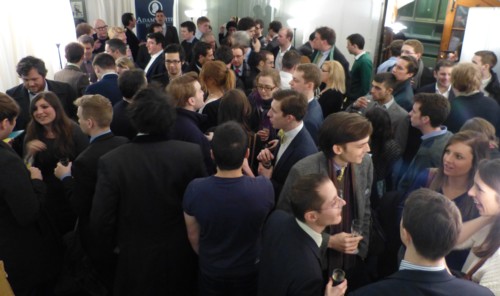
As so often, what really mattered at this event was not who spoke at it or what they said, but how many people were there to listen and to stand around trying to impress each other with their various opinions and alleged triumphs. The answer last Tuesday was: a lot. The place was packed out:
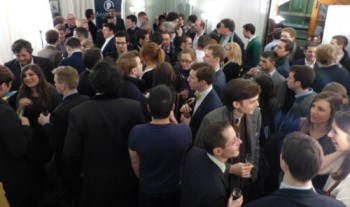
If you write a book called The PR Masterclass and you arrange a book launch for it, you had better assemble a decent throng of people. If word gets out via the few who did attend how few attended, you will come over as very foolish. That mission was definitely accomplished, that landmine definitely not stepped on. Alex told me later that the people present were a mixture of ASI-type “movement” people, PR professionals, and journalists. Just what he wanted, in other words.
One reason why so many people showed up was that Alex had obtained an impressive star speaker:
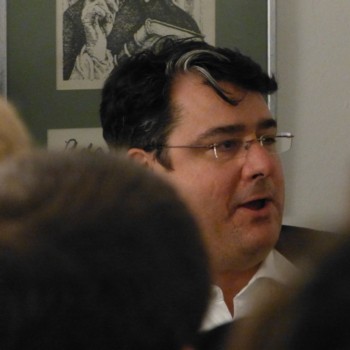
Guido started by remembering the old Globalisation Institute that Alex Singleton used to run, and how amazingly lavish was the press coverage that the Globalisation Institute used to get. Then he reminisced about a drunken night out the two of them had had, which had landed Guido in court. Or something. At this point in his speech Guido started speaking too quietly for me, at the back, to hear properly. But the people nearer the front of the throng seemed amused, and anyway, it doesn’t matter what gets said at these things. The point is for it to be made clear that a Big Cheese like Guido wants you to buy the book, is a friend of the author, blah blah. If you want to be in with the in-crowd, read this book.
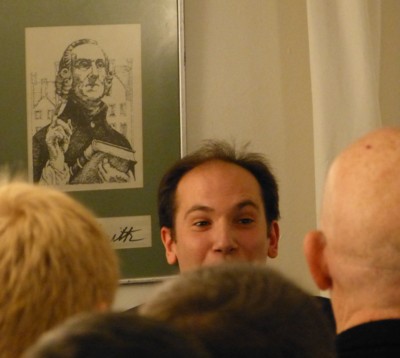
Alex himself also spoke, briefly:
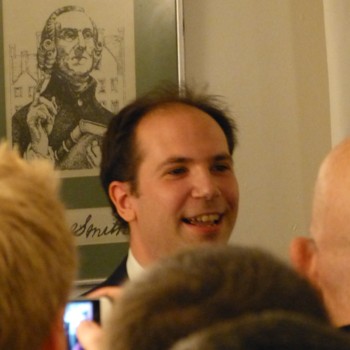
I like that one, but I like this one even more:
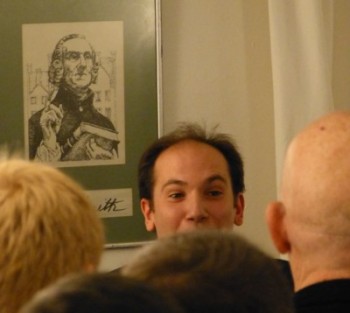
Both snaps capture, I think, the fact that Alex Singleton is an enthusiast about what he does, but that he doesn’t take himself too seriously. Some people might grumble about a picture like that second one of them. Alex won’t.
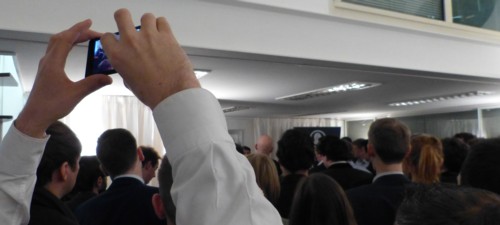
Alex had emailed me earlier to say that it would be fine if I brought my camera with me, and used it. As is my habit, I looked to see if others were taking photos, but only spotted one, standing right next to me:
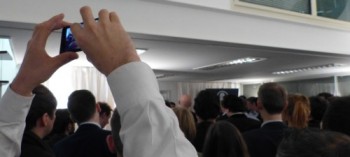
Had Alex not emailed me beforehand that me photoing would be fine, I might have refrained. That he found time to include this in the email he sent me about this event is typical of his attention to detail, and of his ability to see the world through the eyes of the people he is trying to influence, surely the core PR attitude. (And hey, I just got a phone call from him saying do I have any photos that he can use?)
As for the book, in the event that I never get around to posting my properly serious review of it any time soon, let me now supply a short summary of what I already know I will be saying: the book is very good.
One other thing, which also points up that this felt like a very successful event, and that Alex was coming across as a very successful and significant chap. While trying to impress those around me, I found myself talking about my Brian’s Last Fridays, and how brilliant they have so far been since I resumed doing them in January of last year. Someone asked me who will be my next speaker, on the last Friday of January, i.e. on the evening of January 31st. My reply? “Oh, yes. Come to think of it: Alex Singleton.” This actually did impress people, or so it seemed to me.
I’m being rather frivolous about all this, but it really is quite a significant little fact about the world that one of the leading personalities in the bit of it that concerns itself with PR is now Alex Singleton, i.e. someone who probably agrees with me, and very possibly also with you, about really quite a lot of things. On the jacket of the book, Singleton’s publishers start their blurb about him by describing him as “one of the world’s leading public relations strategists”. That one could show up at this event and feel that this was not an obviously over-the-top or ridiculous or embarrassing claim is, I think, quite something.
Doing the rounds on Facebook is a story about a cancer patient told by the Department of Work and Pensions that she contributed to her illness and therefore does not qualify for some amount of welfare payment. One commenter points out that she probably broke some rule, such as drinking too much or not going to some medical appointment or other. Debate ensues about whether such rules are fair.
There are more such stories on a blog called Benefit Tales, such as the the man who died in a freezing flat after the DWP stopped payments to him because he did not attend an assessment, because they sent the letter demanding that he attend the assessment to the wrong address.
The problem is centralisation. A government department can not know exactly how ill a certain individual feels today, and it will not visit you to find out why you did not attend an appointment. It certainly can not just pay money to anyone who asks for help because there are too many of those, so it must make rules, write letters and feed forms into computers. Letters go missing and no rigid set of rules will make sense for every single complicated human. But by demanding that the state looks after everyone, such centralisation is just what welfare state supporters are asking for.
It is much better to look not to the state for help, but to one’s friends and neighbours. They are the ones who know just how ill you are and can knock on your door and make sure you are all right. And if they were allowed to hold on to a little more of their money, they might be able to club together and pay your heating bill and bring you groceries. Similarly, private charities, because they can choose who they help, are better placed to more efficiently allocate their resources to the most deserving.
As usual, public debate misses alternatives to the state. A television programme about people on benefits recently aired, and the mainstream media helpfully divides people into those who think welfare recipients are undeserving and those who think they need more help. The result is that the state is asked to do more to help people, and do more to stop cheats, frauds and the undeserving. Few think to ask the state to do less.
But, as Perry’s quote of yesterday says, it makes no sense to ask the state to look after people. If you want to look after the poor and the chronically ill, be a libertarian: take the money and the power away from the heartless state and leave it in the hands of people who care.
So in the next 18 months the US intelligence community will have cleaned up its act. Britain, almost alone in the West, has been remarkably complacent about the astonishing way that the NSA has, with GCHQ assistance, used an extremely loose interpretation of the law to go on a fishing expedition through the phone, internet and e-mail records of its own and allied citizens. Even if we accept that it is tolerable for British citizens to have a much poorer standard of privacy than Americans, the economic consequences of our complacency are likely to prove unpalatable at very least.
Distrust is on the rise. E-mail companies are already setting up in countries with strong privacy protection, such as Germany, to take advantage of the loss of credibility of US companies. The internet makes up about 12 per cent of Britain’s economy. If we do not act to make our intelligence-gathering systems as focused and accountable as the Americans have, the shadow of distrust could shift from them to us. That means that fewer IT-based companies will come here, and some will migrate abroad.
British industry and the British economy have benefited hugely from our country’s reputation for trust and integrity. It would be a terrible paradox if our intelligence communities’ well-intentioned efforts to protect our physical security ended up undermining our economic security.
– David Davis
…even if I am sceptical, to say the least, that the NSA will have ‘cleaned up its act’ in any meaningful way whatsoever.
On a Tuesday evening shortly before Christmas, I arrived at London Gatwick Airport on an Easyjet flight from Morocco. I wanted to travel to my home in Southwark as quickly as possible. The quickest and simplest way to do this is to catch a train from Gatwick Airport railway station in the terminal to East Croydon and then London Bridge, followed by another train to South Bermondsey, the nearest station to my home. A single ticket for this journey costs £14.60, a fare I find to be a bit steep. Knowing the fare system reasonably well, I instead purchased a ticket to East Croydon, the first station inside Greater London at which the train stopped. For this, I paid £4.50. I then used my Oyster Card – the contactless ticketing system that Londoners use for most of their public transport journeys within London – to get to South Bermondsey. This was charged using the zone based fare system that applies within London, and cost me £2.20. I was thus able to reduce the cost of the journey by more than 50%.
This is not fare evasion. What I did is perfectly legal, and I can’t be punished for doing it, but surely it is against the spirit of the fare laws. The powers that be have decided that the wealthy plutocrats who can afford to fly Easyjet can also afford to pay £14.60 for a train journey from central London to the airport. By taking advantage of the cheaper fares available for shorter journeys, I am demonstrating my contempt for the wise decisions of these people. Let us call it fare avoidance. As it happened, a ticket inspector stopped me part of the way through the journey, and berated me for my lack of public spiritedness and civic responsibility, and just generally told me off for failing to spend money that rightly belonged to the families of good, honest people such as ticket inspectors. How would such people be able to feed their families if everyone behaved like this?
Actually, no he didn’t. What he actually said was “Thank you sir. That’s great”. It’s also possible he wished me a merry Christmas.
|
Who Are We? The Samizdata people are a bunch of sinister and heavily armed globalist illuminati who seek to infect the entire world with the values of personal liberty and several property. Amongst our many crimes is a sense of humour and the intermittent use of British spelling.
We are also a varied group made up of social individualists, classical liberals, whigs, libertarians, extropians, futurists, ‘Porcupines’, Karl Popper fetishists, recovering neo-conservatives, crazed Ayn Rand worshipers, over-caffeinated Virginia Postrel devotees, witty Frédéric Bastiat wannabes, cypherpunks, minarchists, kritarchists and wild-eyed anarcho-capitalists from Britain, North America, Australia and Europe.
|





Recent Comments