A powerful cross-party group of MPs today warns Theresa May that Brexit is “sucking the life” out of her government – as cabinet sources admit that the crisis is forcing vital domestic business off the government’s timetable.
And the problem is?
|
|||||
And the problem is? December 15th, 2018 | 10 comments - (Comments are closed)
 December 14th, 2018 | 25 comments - (Comments are closed)
So Theresa May has survived the vote of confidence by her fellow Tory MPs. If nothing else the relief that she must feel knowing that Conservative Party rules mean that she cannot be challenged again as leader until a year has gone by should give her a lively appreciation of exactly what is wrong with the much-touted idea of a second referendum. December 12th, 2018 | 67 comments - (Comments are closed)
Whenever I hear people stereotyping based on gender. “Women vote this way”, “Men act in this manner”, I am reminded of the great contrast between Britain’s two women Prime Ministers. Thatcher, won a brilliant renegotiation of the EEC, trounced the unions, denationalized vast swaths of obscene nationalized industries, and was one of the four people instrumental in ending the cold war. May, the other lady from number 10, apparently couldn’t negotiate the purchase of a sausage supper for fifty quid in the local fish and chip shop. Apparently, it is more to do with the content of your character than the content of your underpants. December 8th, 2018 | 29 comments - (Comments are closed)
(Apart from the free trade bit) This is an ad for the Liberal Party going into the 1918 General Election. Note that the Liberal Party split during the First World War with some following Lloyd George and others continuing to follow Asquith. This ad is for the Asquith Liberals. Also note this is not an ideological division; Lloyd George’s Coalition Liberals are standing on much the same platform. Also, also note that the statist rot set in well before the First World War. In December 1918, this Liberal Party was more or less wiped out with Asquith losing his seat. In subsequent elections the general Liberal vote collapsed even further until by the 1950s the by-then re-unified party had only a handful of MPs. 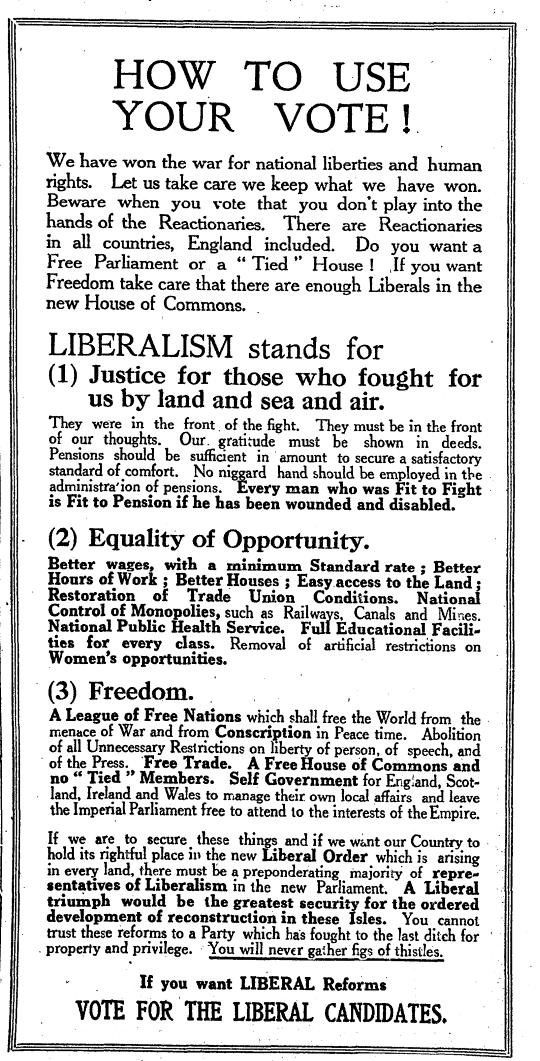 The Times 5 December 1918 p5 December 6th, 2018 | 14 comments - (Comments are closed)
The Guardian‘s Matthew d’Ancona is at least honest about his opinion of Brexit voters:
December 2nd, 2018 | 62 comments - (Comments are closed)
“What’s wrong with UK financial markets? The global economy is recovering, but British stocks and shares are not keeping pace. The pound has failed to recover from the slide it experienced in the wake of the EU referendum. This is frequently blamed on investors being spooked by Brexit, even more so by the possibility of a no deal. But has anyone actually asked the markets what is spooking them? Look closer and it becomes clear that while Brexit is a problem for some investors, most are much more worried about a far bigger risk, even if they rarely speak about it in public. It is the possibility of a Corbyn government.” – Ross Clark, in the Spectator (£). As there is a paywall and it is annoying for those who cannot get through it, here are more paragraphs:
The author is correct; in my own discussions with people in the financial markets, there is a real fear of what these reheated Marxists will do. Anyone who owns land, for example, unless they are politically connected to Labour, will be targeted. And as usual, it will not just be “the rich” who get it in the neck (not that isn’t bad in its own right), but the broad mass of the middle class who will not have the ease of being able to go abroad on a second passport. The tragedy of the current situation is that Prime Minister Theresa May uses the genuine fear of a Corbyn-led government to scare us into accepting her plans to turn the UK into a European Customs Union vassal state, indefinitely, hoping no doubt that we all become so bored by the Brexit process that we accept that as the least-worst, if still crap, outcome. This situation, however, cannot last and I predict that there will be a significant political party realignment in the next few years, a view that several folk I know share. This current choice menu of Marxist anti-semite Left vs managerialist and hopeless Tory Party is simply shameful for a country of the UK’s standing in the world. November 29th, 2018 | 22 comments - (Comments are closed)
The Sage of Kettering and I have been on another day trip, this time to Lincoln. We have also visited a mystery town I shall leave you to guess below, and also at Stow-by-Lindsey, a tiny village west of Lincoln, with a now incongruously large Minster, Anglo-Saxon in origin, having been added to over the years. It also claims to have the earliest known Viking graffito in England, a carving of a long ship. It is not clear if this was a marauder or a merchant, but he presumably came up river to here, the Humber is not far away. It also has a curious face on the font. And an austere interior, perhaps barer than in its glory. November 28th, 2018 | 14 comments - (Comments are closed)
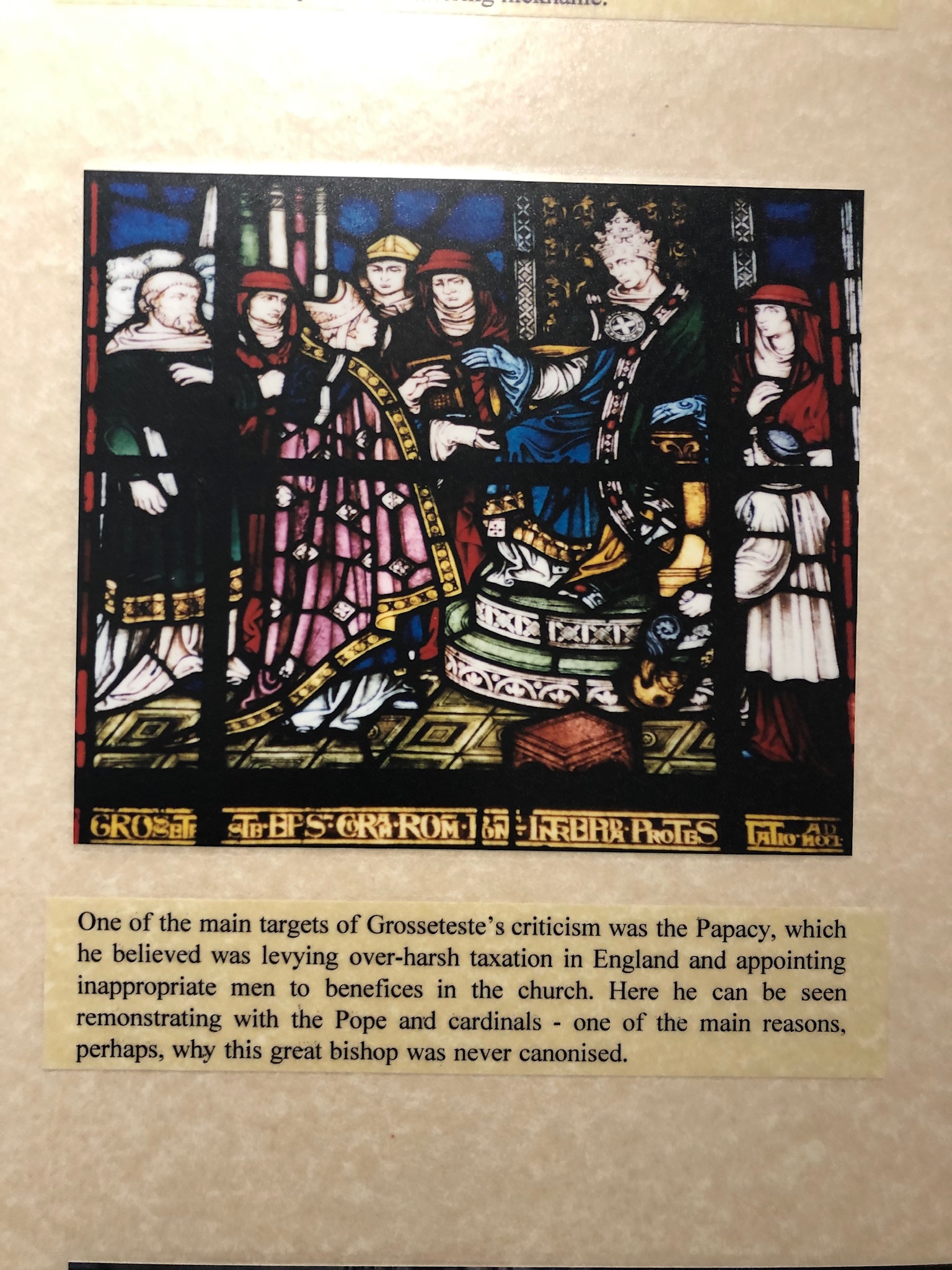
“One of the main targets of (Bishop of Lincoln) Robert Grosseteste‘s (c. 1175 – 9 October 1253) criticism was the Papacy, which he believed was levying over-harsh taxation in England and appointing inappropriate men to benefices in the Church.” Another quote:
Thus say English Heritage of Bishop Grossteste (Big Head) of Lincoln, in a display in the former Bishop’s Palace in Lincoln. The Bishop was never canonised, perhaps because he was too holy. He was no fan of Rome, as English Heritage note, in their exhibition in his former palace. A Protestant before the term was coined, and surely a model for our current political class in the light of current ‘difficulties’ from over the water. November 26th, 2018 | 8 comments - (Comments are closed)
“Haters are not going to hate here,” asserts a young lady speaking for Scotland in this Scottish government video called “Your hate is not welcome here, Yours Scotland”. “That’s why if we see anything we’re calling the police,” says another virtuously. The philosophy of the whole is explained by the young man at 0:46: “We believe in acceptance.” November 25th, 2018 | 16 comments - (Comments are closed)
Ever since Gove messed up the election of a leave leader, my confidence that the Tories would nevertheless deliver Brexit rested less on the belief that the parliamentary party contained more leavers than full-blown remoaners than on the conviction that it contained many who just wanted to win the next election. Cameron’s referendum to deal with the internal and external (UKIP) threat to Tory electoral prospects ended not as he intended, but it offered such MPs a very obvious path forward. Likewise, when May demonstrated her ability to reduce a poll-lead healthily exceeding 20% to a result just exceeding 2% (over Corbyn, of all people), my belief that the Tories would not risk another election under her leadership rested solidly on my faith in how many Tory MPs wanted first and foremost to win. For now, it is all still to play for. Firstly, if there are as many letters written as rumoured, yet such as David Davis are still thinking about it, then Mogg’s “this week or next” remains on the table – and I quite see that the rule ensuring May a challenge-free year if she survives a vote is a very good reason for caution in the run-up to launching one. Secondly, when May’s incompetence made her dependent on the DUP for her majority, I thought it good for one reason; I now also think it good for another. Thirdly, if all else fails, reality could still prove wiser than parliament and deliver us a no-deal Brexit through their sheer inability to agree anything decisive in a timely fashion. All that said, I am beginning to question my faith in the “focus on winning” cynicism of a sufficient majority of Tory MPs. It is one thing to think that enough Tory MPs to keep May as leader could betray their voters, their party, their principles and the most emphatic statements of their 2017 manifesto (and her leadership campaign), but it shakes me to the core to find myself wondering if they could choose the electoral death ride of May campaigning on this deal rather than follow a leaver. I’m glad that a majority of back-bench MPs seem to be interested in retaining the votes of the ‘swivel-eyed loons’ so derided by Cameron, Osborne, and now May, but just how many others would rather lose than be unfriended in SWI ? Natalie once stated she would endure a Corbyn government rather than stay in the EU. I have always felt much sympathy for the wretched situation of Slavs who found themselves fighting for Stalin against Hitler as the only alternative to Hitler’s winning, and it is with similar feelings that I do see her point (if, that is, we could even rely on their being alternatives). However we should be able to do better than that. November 24th, 2018 | 21 comments - (Comments are closed)
“Police need public support to arrest violent offenders”, says Ken Marsh, the chairman of the Metropolitan Police Federation, effectively the trade union for London police officers.
Yes. Yes we are. And if anyone wonders how we got to this pass in which the public do not step in to help police officers when the latter attempt to restrain lawbreakers, try repeating Mr Marsh’s question without the implication that “we” refers only to the police: “Are we now in a society where, if we think we can’t detain somebody, we just let them go? It’s just not worth it,” said the public. This state of affairs was a long time a-growing. Though I do not know Ken Marsh’s own views upon this issue, how many times have prominent police officers and other figures of authority deprecated, failed to support, actively condemned, arrested or otherwise punished members of the public who “took the law into their own hands” – or even just looked like they might? That last link takes you to a post from 2011 by Perry de Havilland in which a female victim of crime got “quite the life lesson” about police priorities. That lesson will not only have been taken in by her. Longtime Samizdata readers might recall a little ditty I made in 2007 about a celebrated interview between the radio host Jeremy Vine and Tony McNulty MP, then a Home Office minister. Here is the BBC’s transcription:
Even if someone is being battered right in front of you, you must always wait for the police. That was the advice of a Minister of the Crown. Having drilled us in passivity for at least ten years (in fact much longer; that example is only one of many I could have cited), why would anyone expect ordinary citizens to suddenly rediscover the duty to defend a victim of assault just because that victim is a police officer? Update: Here is some more recent advice from the police themselves: “Taking the law into your own hands – a warning from Derbyshire police” That article does at least acknowledge that it is possible to make a citizen’s arrest and – mirabile dictu – records that Judge Jonathan Bennett awarded £400 from the Derbyshire High Sheriff’s fund to a man who made a citizen’s arrest of a burglar in recognition of “public spirited behaviour”. But note the response of the only police officer quoted:
November 20th, 2018 | 69 comments - (Comments are closed)
|
   |
||||

All content on this website (including text, photographs, audio files, and any other original works), unless otherwise noted, is licensed under a Creative Commons License. |
|||||




Recent Comments