We are developing the social individualist meta-context for the future. From the very serious to the extremely frivolous... lets see what is on the mind of the Samizdata people.
Samizdata, derived from Samizdat /n. - a system of clandestine publication of banned literature in the USSR [Russ.,= self-publishing house]
|
We are coming into the final stretch of the college basketball season and it seems a good time to make the following observation.
The only category of education that presently has its accomplishments tested on a competitive basis (that being sports) is also the only category of education that is motivating and developing disadvantaged students to achieve their highest personal potential at what they are being taught.
Does it surprise anyone that the only part of education where student achievement can not be rigged (better/best football team, etc.) is also the only part of education that is producing marketable graduates from the disadvantaged communities? Or that it accomplishes this with less need for quotas and reduced expectations than any other category of education? In many cases these kids are able to move straight into national and international professional careers straight from high school. And when they do attend college, the academic education they receive is a by-product of their athletic educations.
And is it any surprise that a very disproportionate share of disadvantaged students gravitate to the only service of the education industry that is intractably merit judged and race indifferent at every single level of education from Pee Wee league to NCAA?
What better model could we ask for when we look to improve the motivation and education of disadvantaged students in other categories of learning?
“Serious sport has nothing to do with fair play. It is bound up with hatred, jealousy, boastfulness, disregard for all rules and sadistic pleasure in witnessing violence: in other words it is war minus the shooting.”
From Orwell’s collected essays, which should be on everyone’s bookshelf.
It is good that Perry has supplied us Samizdatistas with a category called How very odd! to describe our oddest postings, because how else would you describe the calculation that England are now, still, the second best test match cricket side in the world?
On the other hand, England really are that bad at one day cricket.
I know a lot of Samizdata contributors and readers are cricket buffs. So, what do you all think about the Twenty20 limited overs format now that it has had some more exposure since last being discussed here?
The following item is for sale. One bucket of whitewash. This has recently been obtained by the English cricket team at a knockdown price during their tour of Australia.
The English cricket team wishes to sell this precious prize of English achievement in auction as quickly as possible. However, only purchasers of a more unpopular standing may need apply. They are therefore awaiting bids for this most useful of items.
Please note: only politicians or journalists may apply.
And a “Long Tail” discussion is about the England cricket team presumably.
– Michael Jennings commenting on this at my blog this morning. Last night, England’s 7, 8, 9, 10 and 11 managed a total of four runs between them.
Buskashi is an Afghani game, akin to polo, that involves riding, sticks and the carcass of a goat. The carcass is soaked in cold water for twenty-four hours, so that it does not disintegrate, and then a large pack of horsemen compete to win the boz (renamed carcass) and the horsemen (chopendoz) compete to grab the carcass and throw it in a circle (the hallal).
This Afghani sport will not win any votes from animal lovers, but their fierce competitiveness has now blooded another arena: cricket. Refugees in Pakistan whiled away the long hours by learning to love cricket and have now brought the sport back to Afghanistan. Each province has a team and there are strong competitions to determine the best teams.
We know that the best team is not the Royal Marines, who emulated our Ashes tour:
ENGLAND’S cricket shame plunged new depths after a team of Royal Marines were hammered – by the Afghan National Army.
The crack soldiers crashed to a resounding eight wicket defeat after being bowled out for just 56 in 14 overs without one playing reaching double figures.
Afghans have only been playing the game since about 1992 but that did not stop the novice opponents knocking off the runs inside 12 overs
Are we seeing the birth of a new Test playing nation? I can think of no greater accolade to symbolise the departure of a country from misery and despair. We should be glad that the military skills of the Royal Marines far outweigh their cricketing skills.
I oppose arts subsidies not only because arts subsidies are thieving from people who do not want art thank you very much, although it is that of course. I also oppose arts subsidies because I really like art and I think arts subsidies damage art, by separating artists from audiences and by separating nob audiences from yob audiences, the aristocracy from the groundlings. With arts subsidies, you get High Art in one tent – precious, clever, obscure, self-regarding and pretentious, and expensive; and Low Art, brain-dead trash, in the other bigger tent. Without arts subsidies, they all go into the same tent and you get, well: Shakespeare basically. Shakespeare, nineteenth century classical music, the great nineteenth century novelists, twentieth century cinema (before that too got to subsidised into Posh and Trash), twentieth century pop music, all that is artistically vibrant, fun and profound.
So, arts subsidies are really bad, both morally and artistically. And the good news is that, at any rate here in Britain, they are about to be “cut”, which is a cultural word meaning “not increased very much”. And who or what do we have to thank for this semi-excellent circumstance? Why, the Olympic Games:
The Treasury has warned of a tough spending round and the Culture Department has let it be known that there will be no extra money for the arts so long as the country is paying for the Olympics, a bill we will be paying well beyond 2012.
This means, at the very best, seven lean years of standstill subsidy for the arts and, at the worst, selective cuts that will drive some ensembles out of existence.
This is especially good news when you bear in mind that “so long as the country is paying for the Olympics” and “well beyond 2012” actually mean “for ever”.
It was a sensational win by a great team
– Shane Warne, discussing the Australian cricket team’s stunning final day comeback to win the second Ashes test and take a 2-0 lead in the series. On the final day, Australia’s two old and tired bowlers, Glenn McGrath and Warne himself, took a total of 42 overs, 18 maidens, 64 runs, 6 wickets, and those numbers are (in case you are wondering what on earth they signify) extremely good .
The trick with sport is to enjoy it when it goes well, and when it goes badly, then it is only a game.
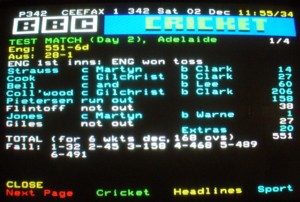
So, let me and all English cricket fans enjoy this, while it lasts:
The big surprise there is Paul Collingwood. Collingwood (or “Coll’wood” as Ceefax calls him) is one of those cricketers who is distinguished not so much by his skill as by his determination. He is skilled, of course he is. But the mental application to make the most of his skill is what made the England selectors back him to come good as an international cricketer. Until he made that score, the more casual observer of the game just did not think him capable of such a thing. Yet Collingwood, amazingly, is now the first Englishman to have made a test match double century in Australia since Walter Hammond did it in 1936. He and Pietersen put on 310 for the fourth wicket, their previous stand having been the only England bright spot in the first game.
Suddenly, Australia’s bowlers looked tired and old. The combined bowling analysis of McGrath and Warne for the last two days, neither of whom now seem to be fully fit, reads as follow: 83 overs 14 maidens 274 runs 1 wicket. Those two have been the backbone of the Australian bowling for the last decade, and those numbers are (in case you are wondering what on earth they signify) not good.
At midnight, or whenever it is, we will all probably be coming gently but firmly down to earth, when the Aussie batters begin to grind out a similar score, on a pitch which is apparently giving little help to bowlers.
But now there is at least hope for England. After the thrashing they got in the first game, a couple of days like the last two that England have had does wonders for team morale, and must also have somewhat deflated the Aussies. What if England’s bowlers also do better than in the previous game, and the Aussie batters do worse, when play resumes in a few hours?
Maybe this Ashes series will turn out as exciting and closely fought as the previous one, and for as long as that lasts, I can enjoy it. Yes, it is all only a game. But it is better not to have to be telling oneself this all the time, as was so very necessary throughout the previous game.
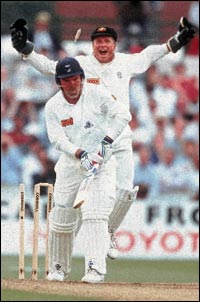
The Ashes are about to start. God it is wonderful.
The UK Olympic Games of 2012 are shaping up nicely to be the expensive, possibly corrupt affair that many of us crusty cynics claimed it would be over a year ago. There is only the grimmest of satisfaction to be gained from having been proved so emphatically correct. Given the history of publicly-financed construction projects in recent years, or even projects in which public finance is only a part, the predictions should not have been difficult (think of the Scottish Parliament, or Wembley Stadium, or the Channel Tunnel, to take just three).
The likely bill – to the taxpayer – of these Games is likely to be far higher than originally projected. It is almost certain that this fact was known to British politicians and sports-establishment types who lobbied to hold the Games in Britain over a year ago. If a company had bid for a contract with the same degree of financial acumen, probity and sense as the idiots in the UK public sector, rather long gaol terms, fines or hefty compensation packages might now be the order of the day.
We are remembering the late, very great Milton Friedman a lot at the moment, digesting his contributions to the fields of technical economics, monetary theory, politics, education and much else. But I think that his often disarmingly simple statements about the role of the state and the dangers of government will endure the longest, if only because they carry truths from the start of human history:
There are four ways in which you can spend money. You can spend your own money on yourself. When you do that, why then you really watch out what you’re doing, and you try to get the most for your money.
Then you can spend your own money on somebody else. For example, I buy a birthday present for someone. Well, then I’m not so careful about the content of the present, but I’m very careful about the cost.
Then, I can spend somebody else’s money on myself. And if I spend somebody else’s money on myself, then I’m sure going to have a good lunch!
Finally, I can spend somebody else?s money on somebody else. And if I spend somebody else’s money on somebody else, I?m not concerned about how much it is, and I’m not concerned about what I get. And that’s government. And that’s close to 40% of our national income.
(Via David Farrar’s blog)
I think the Olympic Games falls into the final category. I do agree with Stephen Pollard on the possibly sensible idea of cancelling the Games, even at this stage. The lead article in the Times (UK), by contrast, is remarkable for its breezy indifference to the cost of the Games and the fact that the money for it will be screwed out of the pockets of people who regard the whole spectacle as an expensive joke.
Oh, and before any commenters of a pro-state sympathy start to wonder, no, I am not a sport-hater. I enjoy watching football, cricket and other sports, and play one or two sports myself (not very well, I will admit). However, I do not expect my fellows to support my enthusiasms. Is it too much to ask the same of others?
|
Who Are We? The Samizdata people are a bunch of sinister and heavily armed globalist illuminati who seek to infect the entire world with the values of personal liberty and several property. Amongst our many crimes is a sense of humour and the intermittent use of British spelling.
We are also a varied group made up of social individualists, classical liberals, whigs, libertarians, extropians, futurists, ‘Porcupines’, Karl Popper fetishists, recovering neo-conservatives, crazed Ayn Rand worshipers, over-caffeinated Virginia Postrel devotees, witty Frédéric Bastiat wannabes, cypherpunks, minarchists, kritarchists and wild-eyed anarcho-capitalists from Britain, North America, Australia and Europe.
|





Recent Comments