We are developing the social individualist meta-context for the future. From the very serious to the extremely frivolous... lets see what is on the mind of the Samizdata people.
Samizdata, derived from Samizdat /n. - a system of clandestine publication of banned literature in the USSR [Russ.,= self-publishing house]
|
This, by Clay Shirky, is a truly fascinating blog posting. And the bit of it that I am about to quote (which is as far as I have so far got in it) is (to use a word I usually resist) awesome, at any rate in its long-term potential impact:
Just to pick one example, one I’m in love with, but it’s tiny. A couple of weeks one of my students at ITP forwarded me a project started by a professor in Brazil, in Fortaleza, named Vasco Furtado. It’s a Wiki Map for crime in Brazil. If there’s an assault, if there’s a burglary, if there’s a mugging, a robbery, a rape, a murder, you can go and put a push-pin on a Google Map, and you can characterize the assault, and you start to see a map of where these crimes are occurring.
That does not sound ‘tiny’ to me. It sounds huge. Finally, here might be a system worth reporting crimes to.
What this says is that those maps you see in TV cop shows will stop being a cop monopoly and become something everyone can consult, and contribute to. A golden age of private sector law enforcement beckons. In the words of the title of the blog (now alas not alive any more) where this particular posting appears: “Here comes everybody”. And against everybody, the criminals will be put back on the defensive where they belong, in other words where they were before TV took almost all law-abiding citizens off the streets (by showing them such things as TV cop shows), leaving behind only actually existing (as opposed to TV fantasy) government policemen, idiotically droning their mantra: leave it to us. Which has worked really well, hasn’t it?
Apologies to all those to whom this is stale news, what with this blog posting being based on a speech that was delivered exactly one year ago tomorrow. But if only a small fraction of the Samizdata readership has not seen this posting before, then from where I sit this is a very good mission accomplished. My thanks to Lynn Sislo, for mentioning it here.
The Counter-Terrorist Unit is using a new strategy to stress test the alertness of their officers and the resilience of their response. By employing some buffoon as their leader, who makes little or no effort to conceal top secret information, the North West CTU entered Jack Bauer territory in order to round up the inevitable band of Pakistanis who just happen to be enjoying the lifelong learning offered by our universities (truncated for their purposes):
Metropolitan Police Assistant Commissioner Bob Quick was photographed entering Downing Street carrying a briefing note headed SECRET, on which details of an undercover operation against a suspected Al-Qaeda cell could clearly be seen.
The document set out the strategy for for the operation, an investigation into a suspected cell based in the north west of England and allegedly plotting an attack in the UK, including details of suspects and how the police intended to arrest them.
The bumbler has already been tainted by the Damien Green affair, but it takes real quality to walk around with SECRET tattooed on your forehead. Rather fitting that the fools who set up the surveillance society forget that it is a two way street. Watch and you will be watched! Since our security depends upon confidence, could we demote this tarnished officer to the role that he deserves: Sarjeant at Arms in the House of Commons, where he will be amongst those of his own kind.
Jacqui Smith on “The Politics Show” turned in another performance in evasion and Newspeak that I was unsure what she actually said. Not as bad as Simon Sion about the Further Education Councils but a mirror of distortion nonetheless. She is being interviewed prior to the publication of the government’s updated counter-terrorist strategy. Part of this agitprop approach allows Gordon Brown to write his hyperbole in The Observer, claiming credit for the success of others.
Part of the problem on counter-terrorism strategy is assessing its context, its capabilities and its outcomes. If you read Brown’s article, his assessment of the threat from Al-Qaida is straightforward: who would disagree that they are our primary threat. Zero in on his statements and we become more sceptical of the claims and the results.
They are motivated by a violent extremist ideology based on a false reading of religion and exploit modern travel and communications to spread through loose and dangerous global networks.
They are an ideology; they are a religion: their beliefs are more widely shared than Brown states, especially amongst the British Muslim population. Jacqui Smith identified the rise of extremism as a root problem but was unwilling to define an extremist. First, know your enemy. When we read Brown state that our defence is the duty of every individual, we heartily agree. In practice, this is piety shrouding inaction:
And there is a duty on all of us – government, parliament, and civic society – to stand up to people who advocate violence and preach hate, to challenge their narrow and intolerant ideology – in public meetings, in universities, in schools and online.
But accept that our arbitrary laws on hate speech may leave you open to arrest and detention. Who arrested the Islamic extremists in Luton? This doublespeak permeates the entire article with faint aroma of Brownie beans: expenditure, exaggerated claims and comparisons, and the image of Britain as a world-beater. When was Brown ever misperceived as humble?
I believe that this updated strategy, recognised by our allies to be world-leading in its wide-ranging nature, leaves us better prepared and strengthened in our ability to ensure all peace-loving people of this country can live normally, with confidence and free from fear.
In the world of Jacquistan, the words on the page protect us; in reality, their attempt to make political capital of this duty leaves me suspecting that policy is subject to increased political meddling and control.
The more we move into the world of Jacquistan, the more I fear another attack.
Quite possibly the greatest video ever…
… the pure essence of speaking truth to power. This video has no sell-by date.
a tip of the kevlar battle-bowler to Clark Carter
Chinese crew used beer bottles to fight off pirates
While I salute the captain and crew of the Zhenua 4, I cannot help thinking that guns might have been more convenient. What, exactly, is the difficulty over providing them?
Matthew Parris today:
For me, Thomas Á Becket and Canterbury Cathedral spring to mind. I picture an infuriated Prime Minister bellowing at a flat-screen television: “Will nobody rid me of these troublesome leaks?” Who the four knights were who took it upon themselves to act upon the presumed wishes of a maddened monarch, we may never know, but when Mr Brown insists that he didn’t actually know, it is possible to believe him.
Just what I was thinking. And just like Henry II before him, Gordon Brown will have to carry the can for this, and suffer whatever is now the equivalent of an annual public flogging. Constant references to this from now on in the history books, is my guess. For the point is that although Ministerial and Prime Ministerial protestations of ignorance about this absurd outrage may be true, Ministers and the Prime Minister have spent the last decade creating the atmosphere within which “anti-terrorist” policemen would indeed come to think that such conduct as arresting an opposition politician is some kind of duty.
Coincidentally, and perhaps I’m wrong to defy Godwin’s Law but I’ll do it anyway, I have recently been reading this book (more from me in connection with it here), which concerns the various big decisions taken between 1940 and 1941 by the various war leaders: Britain resists, Roosevelt helps Britain, Stalin decides that Hitler won’t invade Russia, Hitler invades Russia, Japan attacks USA, Hitler declares war on USA, that kind of thing. The final one is: Hitler decides to murder the Jews. And in that horrifically more portentous matter you get the same thing, of Hitler not being personally pinnable down with anything like exact foreknowledge of this or that particular burst of slaughter. Nothing was ever put into writing and signed Adolf Hitler. But he was responsible nevertheless, because he created the atmosphere within which his underlings did their worst. He set the tone.
Well, now, in this by comparison farcical little episode, Gordon Brown set the tone, and lesser creatures went to work. And I’m very glad it has happened. During my adult lifetime, I have watched politicians get cleverer and cleverer at enacting policies not by announcing them, debating them, and then doing them, but by just doing them, a little bit at a time, slice by slice, with no one slice being big enough to unite the potential opposition, but the resulting dish nevertheless amounting to a huge and often deeply disagreeable change. Think: EU. In such an atmosphere, you actually cheer when, emboldened by the silence that greets the usual and thin kind of slice, they instead make a grab for a much thicker slice. For suddenly it is clear to all what went on, and what has been going on for a decade and more.
What the hell? Why don’t we just arrest the bastard and do him over for a few hours? Who the hell f—ing cares who Damian f—ing Green is? Yeah, go for it. Time these f—ers learned their f—ing lesson.
Yes, comparisons with Hitler are over-dramatic, as are the more common comparisons being made now in all the other pieces like this one being scribbled and blogged by all the other no-name scribblers and bloggers like me, with Robert Mugabe’s hideous misrule of Zimbabwe. Matthew Parris mentions them in his piece, quoted above, noting their oddity yet ubiquity, but not ridiculing them any more than I do. For that is what goes on at the very bottom of the slippery slope we are on here. Those are the comparisons that spring to mind, even as you realise that they are out of all proportion. They go to to kind of deed this was, to its dramatic structure, so to speak, even if the scale and intensity of this particular deed was trivial by comparison.
As far as Damian Green was concerned, this has been wonderful. He is probably now having more fun than he ever has before or ever will again. And yes, it is Damian and not Damien. Who knew? Not me, until today.
I include references to f—ing and f—ers very deliberately. That our rulers now swear a lot more than they used to is all part of that atmosphere, that tone, that they have been so busily creating. It is an atmosphere in which there are now so many laws, and laws which are so sweeping in their scope, that all are now guilty. The law simplifies down to the question: do they like you? If they really really do not like you, look out, they’ll come for, and find or make up the laws they need as they go along. That a front bench politician has been, very publicly, on the receiving end of this parody of the idea of law is cause not for rage and more swearing, but for rejoicing.
I agree with all those who are now saying that the England cricket tour of India should not be interrupted, in the wake of the terrorist attacks in Mumbai. My understanding of terrorism is that what makes it such a headache to defend against, given that in India people generally are not allowed to carry guns (correct?), is not knowing when or where they might strike. But if you have a number of set-piece, high profile events to defend, with definite times and places attached to them, you can. It will be cumbersome and tiresome, and expensive, with lots more frisking of people who look like they might be terrorists, and lots more frisking of people who do not look at all like terrorists, both to avoid upsetting people who look like terrorists and to make sure that any terrorist plan deliberately not to look like a terrorist is also guarded against. But if the authorities and people of India are willing to put up with all that, then so should our cricketers be.
I am even opposed to the final two one-dayers being cancelled, although I daresay the Indian authorities would not have had the time to make their dispositions, given that the one-dayers would have been very soon. But the test matches should definitely go ahead, including and especially the second one, which they have already, regrettably, moved from Mumbai to Chennai. I guess the Mumbai police have enough on their hands already, or think they have.
Playing those two one-dayers would have changed nothing in a cricketing way. 5-0 to India would almost certainly have become 7-0 to India, but playing those games, and the Mumbai test in Mumbai, would have made another and bigger point. I daresay that, because of their disappointing cricket, England’s cricketers are not now very highly regarded in India. This would be a chance to get back into India’s good books. Risky? Maybe, a little. But also, given the money now disposed of by India’s cricket fans and by Indians generally, to make this small stand against terrorism might also been, you know, rather lucrative. But headlines like Pietersen wants security assurances don’t strike the right note at all. This guy had a great chance to make a much more positive statement than that, but he muffed it.
As James Forsyth put it yesterday:
Imagine how we would have felt if after the 7/7 bombings the Australian cricket team had headed to Heathrow.
And commenter CG added:
Some of the star players in the Australian Rugby League team wanted the team to pull out of their English tour in 2001. When they were told that they would be replaced by more willing players, and may not get their places back, they decided to come after all.
I know, I know. The reckless courage of the non-combatant. But I didn’t stop using London’s buses and underground trains in the immediate aftermath of 7/7, still less run away to the country.
I have written about this subject before as an urgent issue of security, and surely the topic of piracy must be at the top of countries’ security agendas now that a large oil tanker has been seized. It makes me wonder what insurers such as Lloyds of London must think: surely, if shipping fleets want to keep insurance premia down, an obvious solution must be to arm, or better protect, such vessels. I do not know what the law is about whether ships, operating in international waters, on carrying weapons on board merchant vessels. In centuries past, vessels of the East India Company, for instance, were frequently as well armed as many naval vessels. They had to be.
If this problem gets worse, then it is not just the navies of the western powers, such as those of Britain or the US, that might have to think about protecting shipping routes more aggressively. I think that the rising economic power of India must take on more responsibility to guarding some of the shipping lanes in the Indian Ocean. India, after all, is a prime beneficiary of globalisation and global trade. For that matter, China probably will have to think about protecting its shipping more effectively, as must jurisdictions which engage in much ship-borne trade such as Singapore and Australia and Brazil.
One of the reasons why a strictly isolationist foreign policy does not work is that in the real world, the web of global trading routes from which we all benefit have to be protected. Free market transactions must be protected against predators. That means things like naval bases or agreements between states to protect certain shipping routes, for example. If states cannot do this, but somehow expect merchant ships to continue conveying the goods which drive the world economy, pressure to let merchant ships carry weapons will be irresistable.
Some time ago, I read the Frederick Forsyth novel, The Afghan. I won’t give away the plot but piracy is a key part of it. Any security policy, including an anti-terrorist one, must take account of seaborne threats. It might seem rather obvious to point this out in an island nation like the UK, but a large proportion of our economic produce is conveyed over the wet stuff. If the anti-terror experts have not addressed themselves fully to this issue, they had better start doing so. Maybe this hijacking might have a galvanising effect.
Here is what the US navy has been doing.
One of the hardest things for a libertarian to do at the moment is to maintain any kind of optimism or sense of confidence that his or her ideas will catch on. The danger is that if one sinks into despair, then that despair will come across as a form of defeatism, which turns into a sort of self-fulfilling prophecy. If I have a criticism of one of the head honchos of the UK-based Libertarian Alliance, Sean Gabb, is that he used to wallow so much in this sort of “we are all doomed” schtick that I almost imagined, that in a perverse kind of way, that he was secretly rather enjoying it and that it was all a bit tongue in cheek. Funnily enough, at last year’s annual LA conference in London – the next one is held this weekend – I sensed that Mr Gabb had cheered up a bit. Even so, reasons for to be grim about civil liberties issues remain but sometimes I think that momentum might be slowly changing at the level of public debate. Increasingly, if the government comes out with some new measure, it is geeted with a sort of wearied resignation or outright derision; enthusiasm for such measures are few, or supported by obvious toadies and fools.
Take this story in the Daily Telegraph today. The outgoing Director of Public Prosecutions, no less, talks about the UK embracing the politics of fear:
Outgoing Director of Public Prosecutions Sir Ken Macdonald warned that the expansion of technology by the state into everyday life could create a world future generations “can’t bear”.
Maybe they will not just bear it, but do something about it.
In his wide-ranging speech, Sir Ken appeared to condemn a series of key Government policies, attacking terrorism proposals – including 42 day detention – identity card plans and the “paraphernalia of paranoia”.
Paraphernalia of paranoia – that is a nice turn of phrase.
Make: has a wonderful way of dealing with security cameras.
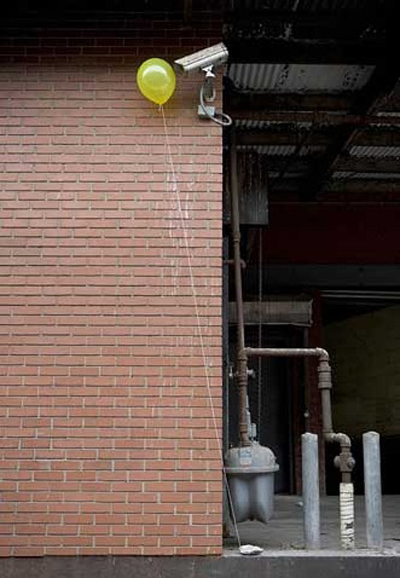
This balloon-based anti surveillance camera project by Brooklyn-based artist William Lamson is an easy way to fool even the most sophisticated forms of surveillance technology. Helium filled rubber balloon set to the correct height and covered with enough static electricity to stick to any surface, such as a public camera. Now if only they made robotic pins for security officers to pop them.
I ran across an interesting quote by linguist Steven Pinker in the july 5th issue of New Scientist:
“My next book will be on the decline of violence and its implications. Rates of murder, warfare, genocide, torture and deadly riots are lower now than at any moment in human history. Assuming that we have’t changed biologically, then what has changed in our psychology and soceity to make that possible?”
The interview went on to suggest several reasonable possibilities, including the spread of the concept of a fair and impartial judiciary but left out two which I think may be very important: wealth and freedom.
Such are my internetting skills that I had to go here first, and then to here, before finally getting to here, the final here being a Telegraph piece about the restoration to the people of Britain (or maybe, it’s hard to tell, the mere restatement of) the right of forceful self-defence.
Home owners and “have-a go-heroes” have for the first time been given the legal right to defend themselves against burglars and muggers free from fear of prosecution.
So, if someone breaks into my flat in the dead of night, and I get lucky with my late uncle’s old cricket bat which I still keep handy just in case, I won’t have to be quite so fearful of legal complications.
There is, after all, something to be said in favour of lame duck governments, desperately trying something – anything – in order to save a few fragments from the forthcoming electoral wreckage.
My guess is they were ploughing through the tedious and now desperately dispiriting rigmarole of yet more focus grouping, with very little to show for it indeed other than deepening hatred of the government, until suddenly someone piped up with something about “if I break the skull of a burglar when all I was trying to do was protect my home I didn’t do anything wrong” or “it’s ridiculous that old men who fight back with their walking sticks get arrested but not the scumbags who attack them”, or some such. And the entire room exploded with unanimous agreement. And then they tried it on a few more focus groups, and got the same response. And since this is an actual policy proposal, and not a mere howl of loathing, and since nothing else seems to be persuading anyone that this government is not a total disaster when it comes to restraining criminals in any way whatsoever, why not give it a try? “I mean, at least we could make an announcement.” Which is what I of course suspect this to be. The government screws up the small print in every other law it passes these days, so I expect this law, in the unlikely event that it ever materialises any time soon, to be just as bad, and quite possibly to be yet another few sneaky steps in the wrong direction rather than any sort of step in the right one.
No matter. That this government is even pretending to talk sense about the right to forceful self-defence – instead of the usual evil tripe about waiting several days for the police to show up, maybe, with counselling pamphlets – is a huge improvement in the political atmospherics of my country. Many of this government’s supporters will be thrown into well-deserved torment and angst on this topic. Unreconstructed lefties will regard this announcement as just one more reason why the forthcoming collapse of this government really doesn’t matter, which is all to the good. Saner lefties, still determinedly wrong about such things as income tax but less wrong about this topic, will feel free to make themselves heard, and to praise their government for this bold initiative. The opposition will scrutinise the proposal for evidence of the duplicity that I pretty much now assume. And, you never know, it just might be genuine.
Meanwhile, am I allowed to say, sotto voce, that I did, sort of, see this coming? I wonder if those who commented derisively on the apparently absurd optimism of that earlier posting saw this latest proclamation coming. Even I am amazed at how quickly the tide may now be beginning to turn. Because, restoring (or maybe just re-stating for the benefit of judges and policemen who now assume other things) the right (itself no small thing) to forceful self-defence leads will lead directly to further discussion, about the means of actually being able to set about doing such defence. I have my cricket bat. So, how about a gun? The principle has now been conceded. Now let’s talk practice.
Definitely a small victory, and maybe, just maybe, something slightly bigger than that.
|
Who Are We? The Samizdata people are a bunch of sinister and heavily armed globalist illuminati who seek to infect the entire world with the values of personal liberty and several property. Amongst our many crimes is a sense of humour and the intermittent use of British spelling.
We are also a varied group made up of social individualists, classical liberals, whigs, libertarians, extropians, futurists, ‘Porcupines’, Karl Popper fetishists, recovering neo-conservatives, crazed Ayn Rand worshipers, over-caffeinated Virginia Postrel devotees, witty Frédéric Bastiat wannabes, cypherpunks, minarchists, kritarchists and wild-eyed anarcho-capitalists from Britain, North America, Australia and Europe.
|




