We are developing the social individualist meta-context for the future. From the very serious to the extremely frivolous... lets see what is on the mind of the Samizdata people.
Samizdata, derived from Samizdat /n. - a system of clandestine publication of banned literature in the USSR [Russ.,= self-publishing house]
|
I have long thought, first, that the United Kingdom has for some time been heading towards being the Non-United Kingdom, and second, that this would probably be a very good thing.
If such a separation is indeed happening, then what is causing it is the end of the British Empire. That and what followed around half a century later (i.e. around now), probably as an inevitable next step, namely the abandonment of the English-stroke-British attempt to remain a top ranking Great Power.
The British Empire meant that lots of Scots wanted to be attached to England, to get in on all the deals involved. Then Britain, empireless but still trying to remain a Great Power, needed Scotland to remain in. Scotland provided and still provides military manpower, and projected and still projects British power in northerly and westerly and easterly directions, in a way that England without Scotland will never be able to match. Could England without Scotland (to say nothing of Northern Ireland) have won the Battle of Atlantic? Hardly. Could England then have even threatened to win the re-run of that battle that from the end of WW2 until the collapse of the Soviet Union, dominated British naval thinking, and Britain’s strategic thinking generally? Again, hardly. For as long as the Cold War lasted, the English plus whichever local allies went along with them, were determined to square up to the Russians and thus keep their seat at that Top Table that politicians are all so very keen to be seen sitting at. A dis-United Kingdom was a non-starter, for contriving all that.
But now? Russia remains a looming monster, or a huge wreck if you prefer the Perry de Havilland take on Russia, which I think I probably do. But even if you think that Russia remains very strong, it no longer fancies itself as a global ideological magnet, bankrolling and talking up every nutter in the civilised world with a mad plan to derange civilisation. It no longer even goes through the motions of attempting to conquer everywhere else. Russia is now just another Problem, along with government debt and bank turmoil, the Euro, the Dollar, the Pound, China, energy shortages or “climate change” (again according to taste), crime, schools’n’hospitals, etc. etc. etc., rather than The Problem.
The global ideological derangement torch has now been seized by Mad Mullahs, and they won’t be re-fighting the Battle of the Atlantic any time soon. Nor do they have nearly so many nuclear bombs, or nearly such potent means of chucking them about in the world. They require very different strategies. Given the weaknesses and difficulties faced by the Mad Mullahs, and given the weaknesses and difficulties faced by us, their enemies, I wouldn’t now want to call them anything more than just another Problem, among all the others.
Other career paths for English politicians to that Top Table have since been identified, based less on British power and more on personal skills and individual contributions to the new global elite. To put it bluntly, you don’t need to be part of one of the old empires in order to participate in running the New World Order.
England’s Great Power-ish inclined warriors and foreigner-scarers, of greatly varying social grandeur from Air Marshals to ex-army pub landlords to army-fan dog-owning T-shirted denizens of south of England housing estates, are being presented with a fait accompli. This warrior tendency has traditionally been very pro the Union with Scotland, but is now being being starved of resources and humiliated by its consequent failures to make very effective uses even of those resources that it does still receive. Its last serious throw of the dice was the Falklands War. Since then, Britain been militarily “powerful” by supporting America, which is not nearly so satisfying, or so impressive to spectators. Britain’s more recent military escapades, against those Mad Mullahs, seem to have accomplished, and to be accomplishing, less and less with each passing year. Chasing terrorists in foreign parts is all well and good, but it seems foolish to be trying to impose democracy upon such places as Afghanistan, given the problems we now have domestically. And even if you don’t agree about that, you can hardly deny that most English people surely now do think thus. The Will to Great Power, to adapt Nietzsche, seems more and more to be lacking in Britain. Too costly. Not worth it. Time to consign all that to the history books.
And with it, the overriding imperative for England and Scotland to remain politically attached to one another.
Meanwhile, that strand of English opinion which favours trade, free markets, and so on, is, in the absence of any continuing great power logic to justify union with Scotland, likely to become ever more irked but it. This tradesman tendency, so to speak, of free market inclined businessmen, City of Londoners, shopkeepers, and bookish students who like reading Hayek and Friedman and, these days, clicking onto mises.org, has lately suffered a severe dose of Scottish moralistic … I don’t think anti-Englishness is too strong a phrase for it, at the hated hands of Gordon Brown. More and more they (and count me in too) now think: well Jock, if you want out, then you just go ahead and get out. We might then get the sort of government we want, instead of having our choice vetoed by you all the time.
The above thoughts were triggered again in my head just last week, by a recent report (thank you Bishop Hill), which said that if Scotland does go independent, it will as a direct consequence have to stop being nearly as crackpottedly ridiculous as it is now about “renewable” energy, i.e. the sort of energy of which there is not now and for the foreseeable future never will be enough. Suddenly, I found myself becoming a passionate Scottish Nationalist, if only to put the wind up the idiotic wind-farmer tendency. Although, Bishop Hill jokes that such greenery in Scotland is actually a plan to keep the Union with Scotland going, by making Scottish independence impossible.
For wind-farming in particular, read Scottish economic thought and policy generally. Libertarians like me have another reason to want to see Scotland separate itself from England, which is that once the indignity of being told by annoying English people like me to favour more rational economic theories and economic policies has been removed, the Scots, once independent, will then almost certainly become far more ready to tell each other to think and to behave in an economically more sane manner.
If Scotland goes independent, then Scotland will, for reasons of sheer economic self-preservation, have to stop being a huge drag on the global pro-free-market tendency in general and the libertarian movement in particular, and might even become a net contributor to such tendencies. Again.
Final thought. Where will all this leave UKIP? Changing its name for a start. But then, as the EIP, much more likely to get what it wants. And that’s another reason for England to eject Scotland from its union with England. It would then be a lot easier for England to eject itself from the EU.
When young beautiful and really smart girls are on your side, you know you are winning. Check out Token Libertarian Girl’s Youtube channel
You will not regret it.
In my youth, we libbos used to go to P.J. O’Rourke for American libbo laughs. Now that mantle – of American, deceptively profound, politically right on the money laughs – has passed on to IMAO man Frank J. Fleming, whose book, Obama: The Greatest President in the History of Everything is coming out quite soon now.
Good recent Frank Jism:
Things often overwhelm and underwhelm, but seldom do things just whelm.
You see? It’s funny (I think), but it also gets you thinking. Where did the word “overwhelm” come from, from which the word “underwhelm” has recently been derived (because as soon as you say “underwhelm” everyone immediately understands)? “Overwhelm” means that “whelm” must once upon a time have meant something too. But what? Is it an upper class mispwonouncing of “realm”? Does “whelm” have a future, as a word? I’m not trying to be funny (although that is one of the standard methods of actually being funny). I’d really like to know.
This is good too:
I support double standards. I expect better behavior out of conservatives than I do liberals.
And this:
You know how everyone has their idea of what a fair tax plan is? Well, I have now unveiled the “Frank J. Fleming Super Double Extra Fair Tax Plan” at PJ Media and it is the fairest of them all. I mean, it’s crazy fair. You’ll recoil in horror and scream, “No! Too fair!” That’s how fair it is.
I need something to end this with, now. I know. Here’s my funny yet deceptively profound and right on the money tax plan: The Top Rate of Income Tax Should Be Cut To Zero. If FJ’s tax plan is too fair for you, that might be just right.
Earlier this evening I attended a libertarian get-together in the upstairs room of a pub (the Rose and Crown in Colombo Street, London SE1), organised by Libertarian Home, and in particular by leading LH-er Simon Gibbs.
If what you would like would be a convivial evening in a London pub where, if you are not a libertarian you are going to have to explain yourself, whereas if you are you aren’t (unless you feel like it), then why not get in touch with Simon Gibbs and invite yourself along to the next one of these things. If my experience this evening was anything to go by, you will be made very welcome.
Here is a photo I took of the other end of the table from where I was:
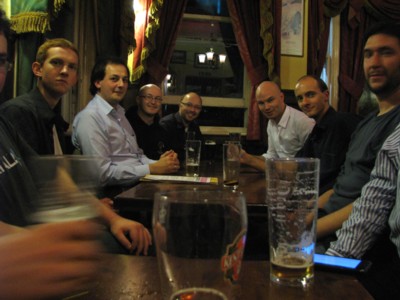
And here’s another snap from the same spot, moments later, after I’d asked if I could interrupt everything, and “take some photos”:
I am surprised what good photos these are, technically, given the light. If you are surprised what bad photos they are, technically, then clearly you don’t know my photos.
These photos do not include anything like everyone who was present. They are accurate in suggesting that the gathering was youngish (certainly compared to me), and bright, but inaccurate in suggesting that this was an all male affair. It’s just that the ladies present were seated nearer to me, and my lens is not wide-angle enough to have included them.
In particular, missing from that snap are two of the people who, it so happened, I spent a bit of time conversing with. For the first time ever, I got to meet Trooper Thompson in the flesh, whose blog I have long had a liking for. And, I also got to meet “Misanthrope Girl”, whose blog I have not properly noticed until now. Trooper Thompson got chased out of the Samizdata commentariat for saying something rude about a gun (I think that was it), approximately a decade ago, which, having finally met the guy, I now think is a shame. Misanthrope Girl would also fit in here very well.
I had to leave earlier than I would have liked, but I am still very glad I went. I heard about this gathering by attending the Liberty League Conference, where Andy Janes (mentioned here recently already because of that Zimbabwean bank note), who also helps organise these evenings, suggested I might like to attend the next one. Perhaps, I thought to myself, and perhaps not. But then Andy gave me a physical copy of the leaflet that he had been handing out at the Occupy London occupations. These guys, I thought, maybe have something about them. (See also this open letter to the London occupiers.) Maybe they do. We shall see.
This evening I attended the E. G. West Memorial Lecture, which was delivered by James Tooley, one of my favourite public intellectuals. The audience was large, and our response was attentive and at the end, enthusiastic.
Tooley started by describing the discoveries of E. G. West concerning the huge contribution to education in nineteenth century Britain made by the private sector, which had pretty much licked the problem of mass literacy and mass numeracy, only for the state then to come crashing in, crowding out the private sector and stealing all of the credit for what the private sector had accomplished.
Tooley then described how he has personally been finding the exact same story unfolding in the Third World right now. There too, the private sector is running state education ragged.
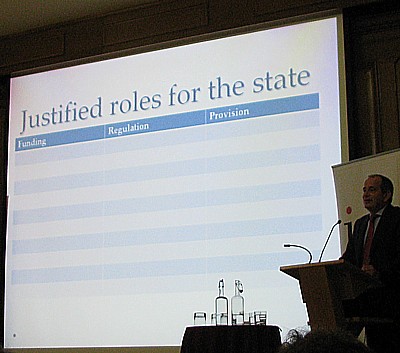
In the course of his lecture, Tooley presented this complete and comprehensive list of exactly what the state should be contributing to the funding, regulation and provision of education:
As often happens with my photos, people who care about such things will quibble about technical adequacy and artistic impression. But, I trust you get Tooley’s message.
I realised while listening to Tooley talk that I have been somewhat losing track of what he’s been up to lately. So when I got home, I ordered a copy of his book, The Beautiful Tree, which he mentioned in the course of his lecture, and in which I hope to learn many more of the details of what he’s been finding out about one of the great success stories of the world now.
During the Q&A after the lecture, Tooley was asked what Britain’s politicians should be doing about it all. What reforms ought they to be trying to contrive? Tooley said he expected very little from our politicians, predicting instead that if changes along the lines he would like do come, it will be because of foreign educational enterprises opening branches here, offering a cheap and effective alternative to state education at very little extra cost. That, said Tooley, will be when the good educational stuff starts happening in Britain, again, if it ever does.
LATER: A few more pictures here.
I’ve said it here before and I am sure I will say it here again. Steve Baker MP is a remarkable man.
Last week, Steve Baker published, in a new Spectator venture, this list of books that he admires, with very brief notes saying why. The list contains several books by authors of the sort that no normal MP would admit to admiring, whatever he might privately claim. Nozick, Jesus Huerta de Soto, Schlichter (Schlichter’s Paper Money Collapse being Baker’s answer to the question: “What book best describes now?”), Nigel Ashford (an excellent populariser and clarifier of libertarian ideas), Bastiat, von Mises (the books of those two authors, along with the King James Bible, being the ones that Baker would snatch from a British library fire). Amazing.
I thought I would die before I witnessed a British Member of Parliament publishing a list of books like that, as opposed to merely chatting about such things between ourselves, dear boy. Baker is out and proud about it. He knows what are the big ideas that matter the most just now, and he doesn’t care who knows that he knows.
Community and collectivism are opposites.
– Eric S. Raymond (via David Thompson)
Time was when Ford was the model for corporatism and seen as a template for the State.
But that was before we got to a situation where Communist China’s state media castigates the US federal government for wasting money on welfare programs and over-borrowing.
I like the fact that Ford let Chris choose his own words to explain why he wouldn’t buy a government bail-out car. Very Post-Fordist.
Or should we deal with it at all?
Sean Duffy targeted the relatives of dead teenagers with defaced pictures of the teenagers and offensive messages. His victims were unknown to him. He has been jailed for 18 weeks.
What is the opinion of Samizdata readers on whether he should have been jailed, and if not, whether there are any legitimate means of stopping him? (I trust it is already the opinion of Samizdata readers that he is a foul excuse for a human being.) If he had sent personal emails to the relatives, then I think most of us could, with a sigh of relief, invoke concepts of private property and harassment. Actually, having just written that I have become unsure about it. Moot point, anyway; as far as I can see he either posted his offensive messages on Facebook pages open to all or made his own websites. Some of his messages were also libelous – so much so that I cannot understand why he has not been prosecuted for libel – but others were not, despite their malice. It is the latter category that present the difficulty for believers in free speech.
Or perhaps all I have done is demonstrate that I am not such a strong believer in free speech as I thought.
Another possible get-out clause is that the web hosts, or Facebook, or the Internet Service Providers should ‘do something’. I am almost fanatically opposed to making them do something, but I agree they should. But what if they won’t, or can’t, or can’t quickly enough?
Another line of thought: there has long been a catch all in English law of “conduct likely to cause a breach of the peace”. That could work, but I do not like the way it makes the test whether the victim of outrageous speech is likely to turn violent. It puts the most peaceable or timid victims at a disadvantage.
Similar questions arise regarding the calculated offensiveness of the extended family cult known as the Westboro Baptist Church. One solution was an emergency law:
In January 2011, Westboro announced that they would picket the funeral of Christina Green, a 9-year-old victim of the 2011 Tucson shooting. In response, the Arizona legislature passed an emergency bill to ban protests within 300 feet of a funeral service, and Tucson residents made plans to shield the funeral from protesters.
The law seems to have done the job it was intended for … but it and similar laws remain on the books setting a dangerous precedent.
The common factor that takes Duffy and the Phelps family beyond the level of politically offensive speech (such as the Muslim provocateurs who disrupted the commemorative silence in honour of the victims of 9-11 held in London on Sunday) is the targeting of individuals.
In a typically overheated article at the Lew Rockwell website, is this extraordinary paragraph by Anthony Gregory:
“More important in U.S. fascism is the role multiculturalism plays in guarding against the accusations of violent prejudice. The U.S. government already addressed racial strife, our textbooks say. If racism remains, it is a problem with the culture and private sector – not the egalitarian state. The war machine and federal government were the saviors of blacks. LBJ, the same man who slaughtered millions of Asians, signed the Civil Rights Act, and so the federal government has been elevated to the status of being the Final Solution to racism, the redemption of America’s past sins. The all-out assault on property rights involved in Civil Rights legislation is itself a form of anti-racist fascism, yet to say so is to be met with incredulous perplexity, at best.”
This is a mixture of half truths and downright nonsense. (The “war machine” a “saviour of blacks”? WTF?). Yes, it is undoubtedly the case that “affirmative action” – which is euphemism for racial discrimination – is wrong and violates equality before the law. It is also true that some aspects of Civil Rights legislation have encroached on private property rights. But Gregory surely knows that some aspects of Civil Rights legislation addressed such indefensible acts as preventing black people – who were taxpayers – from gaining equal access to the public facilities they had paid for, as well as ensuring equal treatment for voter registration requirements, and so on. And given the statist abomination of the Jim Crow laws (enacted during the Progressive era), it is surely legitimate even for someone like Mr Gregory and his Rockwellian chums to accept that after such state-enforced bigotry was removed, it was a matter of natural justice to ensure that black people were put on an equal footing with whites in terms of access to public services that they had paid for.
It is, of course true in strictly narrow terms that a libertarian defence of the right to life and property does not say anything about how one should use, say, such property, nor should it. But life is so much more than simply focusing on such “negative liberties”; my conception of libertarianism is that it embraces social, not just narrowly legal or economic, freedoms. In my view, a free society is one that encourages “experiments in living”, in encouraging, or at least not scorning, the eccentric, the different, etc, with the key proviso that such experimenters bear the consequences of their actions. And I get a strong sense from Mr Gregory that he hasn’t much time for such things, for all his raving about how the US has been a “fascist” country. The problem is that by using that term to describe something like Civil Rights legislation, it leaves our vocabulary looking a bit inadequate when describing, say, Mussolini’s Italy.
On a slightly tangential point, here is Matt Welch, of Reason magazine, defending his recent book – co-authored with Nick Gillespie – from those “paleo-libertarians” over at the Lew Rockwell outfit. What a rum lot they are.
One of my little hobbies is spotting when words change their meaning, often to the disgust of (over?) zealous grammarians.
“Refute” now seems merely to mean disagreeing, rather than disagreeing successfully and persuasively, which is what refuting an argument definitely used to mean.
“Sophisticated” has, for many years now, meant admirably and subtly complicated. But in Shakespeare’s King Lear, Lear himself uses the word sophisticated (here 1899-1900) to mean complicated in a bad way, as in over-complicated, affected, over-elaborate, over-socialised.
“Disinterested” now merely means “not interested”, in many mouths.
A fellow Samizdatista whose hospitality I enjoyed this afternoon reminded me that the words “hack” and “hacker” have also been on a bit of a journey, following the quite recent invention of the word to mean the various things it means now (as opposed to just hacking meat from a bone or some such thing). Hacking used to mean merely acquiring an understanding of a complicated, often computerised of course, system. It meant sussing it out, working it out. It still does, among the people who still use the word this way. But those of us not familiar with the hacker fraternity typically regard hacking as computerised breaking and entering, and thieving, of information. Hacking, to us non-illuminati, means the same as hacking into. What started out as a morally neutral, even admiring, word has taken on a meaning that automatically includes wickedness.
Earlier today, while wallowing in England’s cricketing success yesterday against India, I think I may have spotted another of these walkabout words, here, although in this particular case I hope not, because this is a word I would personally like to stay put:
England demolished India at a delirious Edgbaston to usurp the tourists at the top of the world Test rankings.
“Usurp”, to me, says that there was something illegal or improper about England’s arrival at the number one test match cricket spot. The implication, to me, is that maybe an English cricket delegation – perhaps those two Andrews again – somehow pressurised the custodians of the ranking system into declaring England the top team despite England not actually having enough points, or whatever it is you must have the most of to be the top team for real. But nobody – not the writer of the above sentence, Sam Sheringham, nor anybody else – is suggesting this. Not on purpose anyway. Also, you usurp a title or a throne, not the person who previously held it.
Is Sheringham perhaps wanting to imply (infer?) that, given their lofty status in the world of cricket – because of them having by far the most cricket fans and, until now, a stellar batting line-up, still a stellar line-up if you go by the mere names and their test match achievements in the past – India have some sort of divine right to be the top team? Well, some vague thought along these lines may be why the word occurred to him, and why his editors didn’t change it. But what Sheringham is really reporting is that India used to be the top team, but now England have toppled them, fair and square. “Supplant” or “replace” would have been better words for his purpose. My video recorder tells me that earlier this evening Mark Nicholas, finishing up a highlights show of the series so far, on Channel 5 TV, used the word “toppled”.
Personally, I like the fluidity of language. I like how we can all invent new words, which immediately get across something otherwise hard to explain. I like “walkabout” for example, even if nobody outside of Australia knew of this word two centuries ago (although perhaps they did, I don’t know). And I regard the loss of good words as the price that must be paid for the widespread right that we Anglos all enjoy to make up new words, or acquire new words from each other. The common point of both word destruction and word creation being that together, we do it, rather than being told what’s what, verbally, by some damn committee of self-important academics in London.
I love that “television” is a mixture of Latin and Greek, and that – or so the story goes – an irate newspaper correspondent once argued that because of this linguistic abomination, the thing itself would never work. I had no idea, until I found my way to this collection today, that there are so many such Latin/Greek hybrid words in common English use.
I also enjoy, from time to time, concocting sentences without proper verbs in them. What’s that you say? Not allowed? Hard cheese.
I also enjoy turning nouns into adjectives, as English allows as a matter of routine.
Even so, all that being said, I would be sorry to see the word “usurp” ceasing to mean, well: usurp. It’s a good word and a useful word, and a word with a significant history. I think we should keep it meaning what it has meant for centuries. If we do not, a lot of history will have to be laboriously rewritten.
“Usurp” should not, that is to say, be usurped.
August the 4th 1789…
The day when the serfs (the few serfs there actually were in France) were freed and the day that all the old taxes and feudal restrictions were abolished.
Yes I know that what went before this day was evil and what came after this day was evil – but the day itself was good.
The one good day of the French Revolution.
Although (before the pedants start to bash me) I know the repeals did not fit into exactly this 24 hour period.
But the 4th of August has become known for the pro liberty moves.
|
Who Are We? The Samizdata people are a bunch of sinister and heavily armed globalist illuminati who seek to infect the entire world with the values of personal liberty and several property. Amongst our many crimes is a sense of humour and the intermittent use of British spelling.
We are also a varied group made up of social individualists, classical liberals, whigs, libertarians, extropians, futurists, ‘Porcupines’, Karl Popper fetishists, recovering neo-conservatives, crazed Ayn Rand worshipers, over-caffeinated Virginia Postrel devotees, witty Frédéric Bastiat wannabes, cypherpunks, minarchists, kritarchists and wild-eyed anarcho-capitalists from Britain, North America, Australia and Europe.
|