We are developing the social individualist meta-context for the future. From the very serious to the extremely frivolous... lets see what is on the mind of the Samizdata people.
Samizdata, derived from Samizdat /n. - a system of clandestine publication of banned literature in the USSR [Russ.,= self-publishing house]
|
Secretary Rumsfeld Media Availability En Route to Tokyo:
“You have to think of what’s taking place. What’s taking place is it’s not a surprise, it is that the terrorists, the remnants of the regime, are going to school on us. They watch what takes place and then they make adjustments. We go to school on them. We watch [inaudible], make investments. And the question is who’s going to outlast the other? The answer is Britain will outlast all of us. “
Do not listen to the lies of those who would describe the protesters as hypocritical apologists for mass murdering fascism. Being caring, sharing people, the smiling protestors who will be marching through London to protest the visit of George Bush to Britain, will be decrying the state of unemployment in Iraq (Bush strangely seems to get no credit at all for his protectionist, anti-globalisation economic policies).
The brutal, uncaring British and American capitalists now in occupation of that hapless country have, with malice of forethought, simply thrown previously industrious workers on the scrap heap of life without the slightest concern for their well being. Hundred of highly skilled ‘information retrieval’ experts that were happily at work debriefing people in every city, town and village in Iraq are now reduced to pouring through the ‘help wanted’ add in the Guardian as they look for alternative uses for their skills with pliers, blowtorches and electricity. The management and workers in the chemical industry of that once proud nation, the people who gained world fame from the use of their products in Halabja, are almost to a man reduced to flipping burgers and slicing donner kebabs or working in Syria. Is there no end to the iniquities of global capitalism?
And so it is hardly surprising that the people who will be baying for Bush’s downfall were conspicuously absent on the streets in March of 1988, when Iraqi industry was humming along rather nicely producing useful products, not to feed the evil capitalist Bushist machine, but for local use in Iraq by local Iraqi people, and who could possibly object to that?
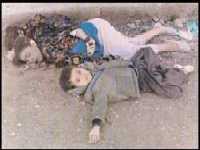
Mother and child sleeping well thanks to better science!
Products produced for the people’s need, not capitalist greed
I mean, it must all be true, Michael Moore said so!
John Keegan writes about his meeting with Donald Rumsfeld. Aparently, he does not think the situation is that bad:
Mr Rumsfeld read me a series of reports, from the American regional commands, summarising progress achieved: terrorists apprehended, weapons recovered, explosives destroyed. The totals were impressive. Despite daily reports of American casualties, he was dismissive of the danger to coalition forces. Within the context of the total security situation, he sees the level of violence as bearable and believes that the trend of terrorist activity is downward.
Economically, the outlook is strongly positive. Electricity supply actually exceeds pre-war levels, with an output of 4,400 megawatts per day in October, as against 3,300 in January. Oil production is returning to pre-war levels, at nearly 2,200 million barrels per day in October, as against 2,500 million barrels before the war.
Socially, the country has returned to normal. More than 3.6 million children are in primary school and 1.5 million in secondary school. University registrations have increased from 63,000 before the war to 97,000. Healthcare is at pre-war levels and is improving rapidly, because of greatly increased spending, estimated to be at 26 times pre-war levels. Doctors’ salaries are eight times higher and vaccination and drug distribution programmes have also been greatly increased.
Mr Keegan was frequently asked why there is so much less trouble in the British than the American area of occupation. He conceded that America, the Great Satan is target of greater hatred and Britain as the ‘lesser’ Satan does not attract the same degree of hostility. Further he acknowledged that the southern Shia area, where the British are operating, has always been anti-Saddam and therefore their task is easier compared with the American policing of the Sunni area. Also, Basra has a long history of dealing with Britain going back to the days of the East India Company. However, he insisted that there is a fundamental difference between the British and the American approach.
While the Americans, for reasons connected with their own past, seek to solve the Iraqi problem by encouraging the development of democracy, the British, with their long experience of colonial campaigning and their recent exposure to Irish terrorism, take a more pragmatic attitude.
They recognise that Iraq is still a tribal society and that the key to pacification lies in identifying tribal leaders and other big men, in recognising social divisions that can be exploited, and in using a mixture of stick and carrot to restore and maintain order.
The conclusion is unexpected and I expected will be resisted by those who think the United States’ exceptional history and status is as a result of the country’s banishment of European political practices, especially its opposition to imperialism.
Forcibly, America is becoming an imperial if not an imperialist country. The attitude was exemplified by an encounter I had with a tall, lean, crew-cut young man I met in Washington. Our conversation went as follows: “Marine?” I asked. “Yes,” he answered. “Have you been in Iraq?” “Afghanistan. Just got back.” The exchange was straight out of Kipling. There is a lot more of that to come.
There seems to be a fundamental misunderstanding of the British Empire by the Americans and by most marxist and statist continentals, namely that it was driven economically, not politically, and maintained defensively for the most part. The British merchants explored the world for new markets and the British state defended territories where trade with Britain took hold. British imperialism was not the sort the Romans would recognise. We do not need to look that far back, comparisons with Austro-Hungarian Empire or the Soviet Empire would highlight the different nature of the beast. So being imperial may not be so bad, provided you stop short of being imperialist.
What would happen if the Sahara Desert went communist? – For fifty years nothing, then a shortage of sand. Remember that old joke? Well, have a read of this, from the BBC earlier in the week:
Saudi Arabia has reportedly imposed strict border checks to enforce a ban on the export of sand.
There are fears that the growing demands of the construction industry could lead to a shortage in the desert kingdom.
The Arab News newspaper reports that neighbouring Bahrain needs to import large quantities of sand for reclaiming land from the sea.
Demand is also expected to grow as the process of reconstruction in Iraq gathers pace.
Although sand remains plentiful in Saudi Arabia, construction experts say the high costs of bagging and transporting make exploiting it difficult.
Experts have told the newspaper that if a mechanism could be devised to move sand from the vast desert region known as the Empty Quarter, it could be a very profitable proposition.
As the paper points out, there is more sand in the kingdom than oil.
Cement is also in high demand, the report says, with many cement factories having to expand their production capabilities to meet domestic demand.
We speculated here that if the Americans went into Iraq they could then put pressure on Saudi Arabia. Now the American plan is revealing itself. “I know it sounds crazy, but guys, here’s the plan. We’re going to suck all the sand out of the place. We’ll have them over a barrel.”
To be more serious, I guess the thing about about sand, compared to oil, is that sand can’t, unlike oil, be controlled. Oil extraction requires expensive infrastructure manned by a highly skilled workforce. Once it’s out of the ground, it can still then be stolen and smuggled, but until then, it’s the possession of the resident power structure. But sand “extraction”? Anyone can do that.
I doubt the BBC particularly wants my off-the-cuff attempt to pee in their iCan pool and I really look forward to goading Johnathan Miller into setting up an anti-TV licence campaign on iCan. However with the Cambridge Women in Black we see an example of exactly the sort of campaign the BBC had in mind when it set up its strange vaguely bloggish monstrosity. They state:
Cambridge Women in Black are holding silent vigils to protest against the ‘war on terror’. We are women of all ages and from all walks of life who oppose the use of violence. We are wearing black to show that we mourn all victims of terrorism and war.
In March 2003 the UK and US governments again attacked the people of Iraq, who have already suffered extensively from war and more than a decade of devastating sanctions. Cambridge Women in Black are here to show that we believe that more violence will not bring security and peace. We call on our government to stop creating yet more misery and hatred.
Note that the woes of the Iraqi people are not due to decades of Ba’athist mass murder and repression but are from the war and sanctions… sanctions during which large palaces and grandiose mosques were constructed in Iraq. Still, I do not suppose I should hold that against the ‘Cambridge Women in Black’ because after all, they state they are mourning “all victims of terrorism and war”… and never said anything about the victims of national socialist tyranny.
story via The Daily Ablution
Finally, a decent update on how the reconstruction is going in Iraq. It is astonishing that all the thousands of words that spew forth on a daily basis concerning the Iraqi situation manage to impart virtually no useful information. The Economist has a very nice overview of the reconstruction work in Iraq that paints a realistic and encouraging picture.
For many Iraqis, living standards have already risen a lot. Boosted by government make-work programmes, day labourers are getting double their pre-war wages. A university dean’s pay has gone up fourfold, a policeman’s by a factor of ten.
Stacks of such goods now crowd the pavements of Baghdad’s main shopping streets, shaded by ranks of bright new billboards. Prime commercial property, says a real estate broker in the Karada district, easily fetches $1,000 a square metre, four times the level this time last year.
The southern capital, Basra, for example, got only two-to-four hours of electricity a day before the war—and now has a power surplus. Baghdad still works to a regime of three-hours-on/three-hours-off, but the country as a whole is producing as much power as before the war. By spring it will be up by 25%. Within three years, if America sticks to its plan of sinking $5 billion-plus into the sector, power output should have more than doubled.
→ Continue reading: Iraq update
Another group of members of Congress have had a press conference after their return from Iraq. It seems quite telling how nearly every US politician, Republican or Democrat, find the ‘ground truth’ different from what they are hearing day after day from the Palestine Hotel bar.
If even a politician can see what is going on, what does this say about the intelligence of journalists?
Most Arab media on Tuesday blamed the U.S. failure to provide security in Baghdad for the latest suicide bombings in the Iraqi capital. They agreed that Washington had only itself to blame for the chaos and said the United States had failed Iraqis by not providing enough security to prevent the devastating attacks that killed 35 people on Monday, the start of the Muslim holy month of Ramadan.
I think my personal favourite is from the daily al-Khaleej, published in the United Arab Emirates:
Iraq, on the first day of Ramadan, was the scene of a bloodbath and occupation forces are directly responsible for this because of the instability they created in Iraq.
I suppose knowing where you stand with your torturers is stability of sorts but somehow I do not think that the victims of Saddam’s regime see it that way.
Saudi Arabia’s leading al-Riyadh newspaper opines:
The political bubble has burst in Baghdad. Will it be followed by other explosions or will the voice of reason prevail over the American dream of hegemony?
Disasters and conflicts notwithstanding there has never been a shortage of rhetorics in the Arabian Penninsula. There is only one voice that sounds half-reasonable although based on where it originated I would not want to look too close at the context of the quote. In non-Arab Iran, reformist parliamentarian Reza Yousefian said:
It is unjustifiable to kill ordinary people in the name of an anti-American campaign. On the contrary, the more insecurity prevails in Iraq, the longer Americans will stay.
Others, although outspoken against those who carried out the attacks, cannot help but add a sting in the tail. Lebanon’s as-Safir daily writes:
What happened yesterday in Baghdad is a crime by all measures, but it is more disgraceful than a crime: it is a deadly political mistake… Such political mistakes help the occupation to justify its horrible crimes.
Such outrage was lacking when it came to commenting on Saddam’s horrible crimes. I wish the Iraqis realised who their real enemies are.
I’ve lately been following the writing of the new kid on the Baghdad block.
Good stuff, well worth a regular read.
Wait a minute, I thought it was George Bush who was supposed to be the new Hitler:
Malaysian Prime Minister Mahathir Mohamad has called on Muslims to use brains as well as brawn to fight Jews who “rule the world”.
“The Europeans killed six million Jews out of 12 million. But today the Jews rule this world by proxy… 1.3 billion Muslims cannot be defeated by a few million Jews,” he said, speaking at the opening of the Organisation of the Islamic Conference in the Malaysian administrative capital Putrajaya.
Well, at least he’s not a holocaust-denier. Anyway, he has probably been driven to desperation by the Zionist occupation of..er, Malaysia.
The Reconquest of Spain
D. W. Lomax
Longman, first published 1978
It is surprising to read (p. 179), “There seems to be no serious book in any language devoted to the history of the whole Reconquest,” (at least when the book was published in 1978) despite the fact that it would seem to be the underlying theme of the history of the Middle Ages in the Peninsula, with the nice firm dates of 711-1492. The author commends O’Callaghan’s A History of Medieval Spain.
Like everywhere else, from Persia to the Atlantic, Islam rolled unstoppably over the whole of Spain, except its tiny northern edge, probably leaving that out in favour of richer pickings in southern France. Even here, in Asturias, only active resistance to the Arabs ensured the survival of the tiny state and an early civil war amongst the Moslems led to the withdrawal of disaffected Berbers from northern territory which was then occupied by Christians.
The author claims, with some evidence, that quite early the ideal of Reconquest was the ambition of the Christian kings and people. However, the initial Ummayad emirate, subsequently caliphate, flourished until the end of, and particularly during, the tenth century, though the last caliphs were puppets. It is probably this period of the Muslim occupation that has been idealised as a time of toleration by Muslims of Christians and Jews, though these were definitely second-class citizens and persecution of them not unknown.
The break-up of the caliphate enabled the Christians to advance again, with some assistance from France; also the crusading ideal, though mainly focussed on Jerusalem, was some help, sometimes by crusaders en passant. The capitulation of Toledo, even though it remained something of an outpost, signalled this. However, about 1085, some of the Muslims, in desperation invited in from North Africa the Almoravids, a puritanical sect (often hated by the more liberal decadent Spanish Muslims) who, in the great battle of Sagrajas (1086) halted the reconquest. The Cid (1043-99) is of this period. Much of the time he as often served Muslim kings as Christian, but after capturing Valencia, “was the only Christian leader to defeat the Almoravids in battle in the eleventh century”. (p. 74)
By this time the Christian states were Portugal, Leon-Castille (gradually united), Aragon and Navarre, sometimes allied, but more often not and generally with no scruples about fighting each other with Muslim allies. However, Aragon was pushing down the Ebro valley, taking Saragossa in 1118, though the Almoravids fought back successfully to prevent it reaching Valencia, which had been evacuated after the death of the Cid.
Like the Caliphate before them, the Almoravids disintegrated and were largely replaced, from 1157, by another sect from Africa, the Almohads, who soundly defeated the Castilians at Alarcos in 1195. This defeat seems to have first cowed then roused the Christians (particularly the Pope); finally Christians from all the Spanish kingdoms, and some from France, united in a campaign which won the decisive victory of Las Navas de Tolosa (1212). In the forty years after the battle the Almohad empire broke into pieces which were annexed by” Castile and Aragon. Vital cities – such as Cordova (1236) and Seville (1248) – passed permanently into Christian hands so that “by 1252 the whole of the Peninsula was nominally under Christian suzerainty” (p. 129), though this, of course, did not mean the end of Muslim kingdoms.
The pace of reconquest slowed down, initially as a result of another transfusion from Africa, the Marinids, who, however, could only defend the Muslim rump. In 1340, at Tarifa, their sultan was decisively defeated and no successor state in Africa invaded Spain again. Muslim Spain survived as Granada for another 150 years, the Christians occupying much of the time fighting and rebelling against each other. One is forced to add: when they should have been completing the Conquest. The process, when it happened, certainly united Spain. In the end, “Fernando and Isabel could cure one crisis in 1481 simply by setting the war-machine to work once more to conquer Granada.” (p. 178)
The author, at his Conclusion makes the persuasive claim that “Only Spain [and also, I suppose to a lesser extent Portugal, which he does not mention] was able to conquer, administer, Christianize and europeanize the populous areas of the New World precisely because during the previous seven centuries her society had been constructed for the purpose of conquering, administering, Christianizing and europeanizing the inhabitants of al-Andalus.” (p. 178) As so often in books published from the 1970s on, the maps leave much to be desired; certainly places are mentioned in the text which are not to be found on them.
Two days after I had finished this book I listened to a discussion on “Cordovan Spain” under Melvyn Bragg’s chairmanship on Radio 4. The three other participants were Tim Winter, a Muslim convert, of the Faculty of Divinity, Cambridge University, Mary Nickman, a Jewess (carefully correcting herself from AD to Common Era) and an executive director of the Maimonides Foundation, and Martin Palmer, whose voice was not to me sufficiently distinguishable from the first, an Anglican lay preacher and theologian, and author of A Sacred History of Britain. Although the consensus was largely positive about the Ummayad regime, and their tone “multicultural” in the modern sense, the first two did seem to agree that the three religions, while coexisting, did not indulge in dialogue, let alone interpenetrate. This confirms an episode mentioned in the book, that even when promised immunity in a bilateral debate, a Christian was executed “when he expressed his real opinion of Mohammed”. (p. 23) Nor was the Koran translated into Latin “until the twelfth or thirteenth century”, someone said in the discussion. Needless to say, the rosy view of Muslim Spain did not take into account that the Muslim conquest fatally disrupted Mediterranean civilization, the burden of Pirenne’s Mohammed and Charlemagne. To pick up the shards and pass a few of them on does not strike me as a very large recompense.
Another bracing dose of perspective from Victor Davis Hanson:
[A]fter September 11 we will either accept defeat and stay within our borders to fight a defensive war of hosing down fires, bulldozing rubble, arresting terrorist cells, and hoping to appease or buy off our enemies abroad — or we will eventually have to confront Syria, Lebanon’s Bekka Valley, Saudi Arabia, and Iran with a clear request to change and come over to civilization, or join the Taliban and Saddam Hussein.
[B]y any historical measure, what strikes students of this war so far in its first two years is the amazing degree to which the United States has hurt its enemies without incurring enormous casualties and costs.
As always with VDH, it pays to read the whole thing.
|
Who Are We? The Samizdata people are a bunch of sinister and heavily armed globalist illuminati who seek to infect the entire world with the values of personal liberty and several property. Amongst our many crimes is a sense of humour and the intermittent use of British spelling.
We are also a varied group made up of social individualists, classical liberals, whigs, libertarians, extropians, futurists, ‘Porcupines’, Karl Popper fetishists, recovering neo-conservatives, crazed Ayn Rand worshipers, over-caffeinated Virginia Postrel devotees, witty Frédéric Bastiat wannabes, cypherpunks, minarchists, kritarchists and wild-eyed anarcho-capitalists from Britain, North America, Australia and Europe.
|





Recent Comments