We are developing the social individualist meta-context for the future. From the very serious to the extremely frivolous... lets see what is on the mind of the Samizdata people.
Samizdata, derived from Samizdat /n. - a system of clandestine publication of banned literature in the USSR [Russ.,= self-publishing house]
|
That’s the counterintuitive thing about totalitarian systems. They herd people into Borg-like collectives, yet every individual is savagely atomized.
I never felt so alone in my life.
– Michael Totten writes about the “total surveillance police state” that is Cuba.
It isn’t “counter-intuitive” to me, and probably not to Totten either, but I guess it still is to many. I worked out long ago that totally nationalising society totally destroys society, and that the greatest freedom of a free society is the freedom to choose what company you keep, both when you work and in your time off working.
The headline above Allister Heath’s latest over at City A.M. reads as follows:
America is slashing spending – but its economy is still growing
By “spending” Heath, or Heath’s headline writer in the event that it’s not Heath, means government spending.
We’ll know we’re really winning when headlines like that one replace the “but” with an “and”.
The Guardian is nothing if not dependably incoherent. They rightly decry their freedom of the press being threatened by politicians…
… and then support the asinine Royal Charter that creates the tools for politicians, and anyone else, who wants the Press to STFU by making it harder for the Press to actually do their job.
I really hope many publication tell the state where to stick their ‘Royal Charter’. But then the history of these isles has many chapters featuring the struggle against state control of the media.
British Prime Minister David Cameron said on Monday his government was likely to act to stop newspapers publishing what he called damaging leaks from former U.S. intelligence operative Edward Snowden unless they began to behave more responsibly.
“If they (newspapers) don’t demonstrate some social responsibility it will be very difficult for government to stand back and not to act,” Cameron told parliament, saying Britain’s Guardian newspaper had “gone on” to print damaging material after initially agreeing to destroy other sensitive data.
– from Reuters
So now it seems even the pretence that the likes of Cameron do not wish the UK to be a police state is felt unnecessary. I may dislike the Guardian for oh so many reasons but I hope they tell the state that they will indeed do the ‘responsible’ thing… which is to say they will continue to publish Snowden’s revelations. And for added kudos, they should invite Cameron to stick his ‘action’ somewhere dark and damp.
If we had state regulation of the press, the BBC would be free to carry on recycling its establishment clichés. But newspapers would find themselves having to answer to the same sort of grandees that preside over the BBC. Is that really what we want to see?
– Douglas Carswell
Oh what fun… two loathsome newspapers representing thuggish authoritarian corporatist right-statism and thuggish hypocritical kleptocratic left-statism respectively, slug it out. More and faster please!
The truth may set you free, but since the media is firmly on the side of serfdom, I doubt we will ever hear truth about socialism from big media. The recent attempts to define “journalist” in the US may indicate that the system realizes that the internet has made the ability to control internal news more difficult.
However, international reporting is where the legacy media still has a lot of power and it has been and will be used to protect their ideological partners (like Cuba and Venezuela) from responsibility for their failures. The media watches socialists ‘create a desert and call it prosperity’ over and over again and lies about it. This has been going on since Duranty and the NY Times won Pulitzers for lying about ‘Papa Joe’ and the early USSR.
– Gary Poteat, commenting here on Samizdata.
Next time I meet up with Patrick Crozier, I will be giving him a present.
I hope that the next time we meet will be if he drops by at my place tomorrow evening. Then, Richard Carey will be giving a talk about “The English Radicals: 1640-1660”, but I believe that work commitments may prevent Patrick from being at that.
Richard Carey will be talking about:
The use and abuse of history; the period 1640-1660 as a crucible of political philosophy; Libertarianism and Republicanism and their respective myths; Those great heroes to all honest Englishmen, the libellously-labelled “Levellers”, what they stood for, their impact and influence on the development of politics in this country and America, likewise the Republicans.
As always with these talks, I expect to learn a lot. To find out more about them, click where it says “Contact” here.
The present for Patrick Crozier is this:
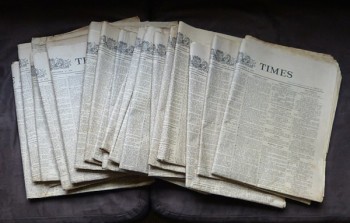
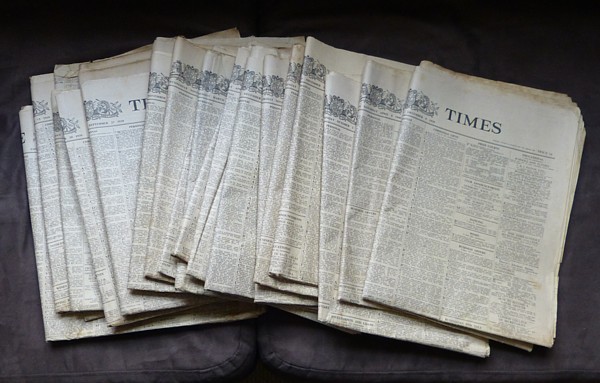
That’s twenty one ancient copies of The Times. I saw a great stash of these in a local charity shop, and, knowing Patrick’s interest in the past of this newspaper, especially when world wars are involved, I purchased one, dated May 24th 1940. I asked Patrick if he’d like this copy, and more. He expressed enthusiasm. So, yesterday I went back and bought all the rest. Originally these copies were sold for 2d. These same copies each cost me exactly as much as a copy of The Times would now cost, £1. Someone else had also had a go at the pile by then, but there were plenty left. The dates of the copies I now have are: 1939 – October 2; November 18, 20, 22, 24, 25, 27, 29; December 5, 13, 15, 19, 27; 1940 – March 27, 28; April 4, 6, 13, 17; May 24, 30.
Giving gifts to one’s friends these days is hard. Stuff worth having tends not to cost nearly as much as it used to. If a friend wants, say, some spoons, he just buys some spoons, of exactly the sort he wants. Why give him other spoons of the wrong sort? Besides which, the gift most of us would really like would not be more crap, but more space to accommodate all the crap we already have. So, when the chance occurs to give a friend a gift that they really might like, costing about the right amount in money or bother, it makes sense to grab that chance.
LATER: I’ve just discovered that what I thought was December 27th 1939 was actually September 27th 1938. Before WW2 began, in other words, which will please Patrick. There’s a big Hitler speech about Czechoslovakia.
What follows is based on a talk I gave at the end of August at one of Brian’s Fridays. See also Parts II, III, IV, V & VI.
In modern popular culture there seem to be two distinct images of the period immediately before the First World War. The first, exemplified by Upstairs, Downstairs [I believe Downton Abbey is the modern-day equivalent] is of well-dressed people being nice to one another; and the second, one of a rigid class system with the ruling class fighting a desperate rearguard action to preserve the vast differences in wealth and privilege between them and the poorest.
Libertarians have a rather different image of the period before the First World War. They tend to think of as a Golden Age of freedom, low taxation and low regulation; an age of constant improvement, where entrepreneurs could do their thing with the minimum of interference. A time when the pound was linked to gold and people didn’t have to worry about inflation or asset bubbles; a world that was swept away by war, never to return. The question is, is this true?
One of the ways I try to answer the question is to read the Times from 100 years ago. I can do this because a company called Gale Group scanned in just about every copy there has ever been and indexed them. They then made these digitised copies available online to subscribers. I am lucky in that my local library is one of those subscribers.
When I started doing this I think the reason was partly because I thought it was a great age to be alive and partly because I wanted to see if there were things that modern historians weren’t picking up on – parts of the story that would have been familiar to people living at the time but have long since been forgotten.
Trying to make sense of the world via the pages of the Times is a little like trying to look at the world through a pinhole. Perhaps another way of looking at it would be to imagine trying to understand the modern world with the BBC as your only source of information. You’re going to miss a lot of the routine of life, a lot of the unspoken assumptions and receive a biased viewpoint into the bargain. At the time, the Times, along with the Daily Mail and (would you believe it) the Daily Mirror was part of the Northcliffe Press and as such a Conservative-supporting paper. [I say Conservative but at the time they called themselves Unionists.] The Times tends to favour trade protection and spending on the armed forces while being opposed to Irish Home Rule. It is generally sceptical of state intervention.
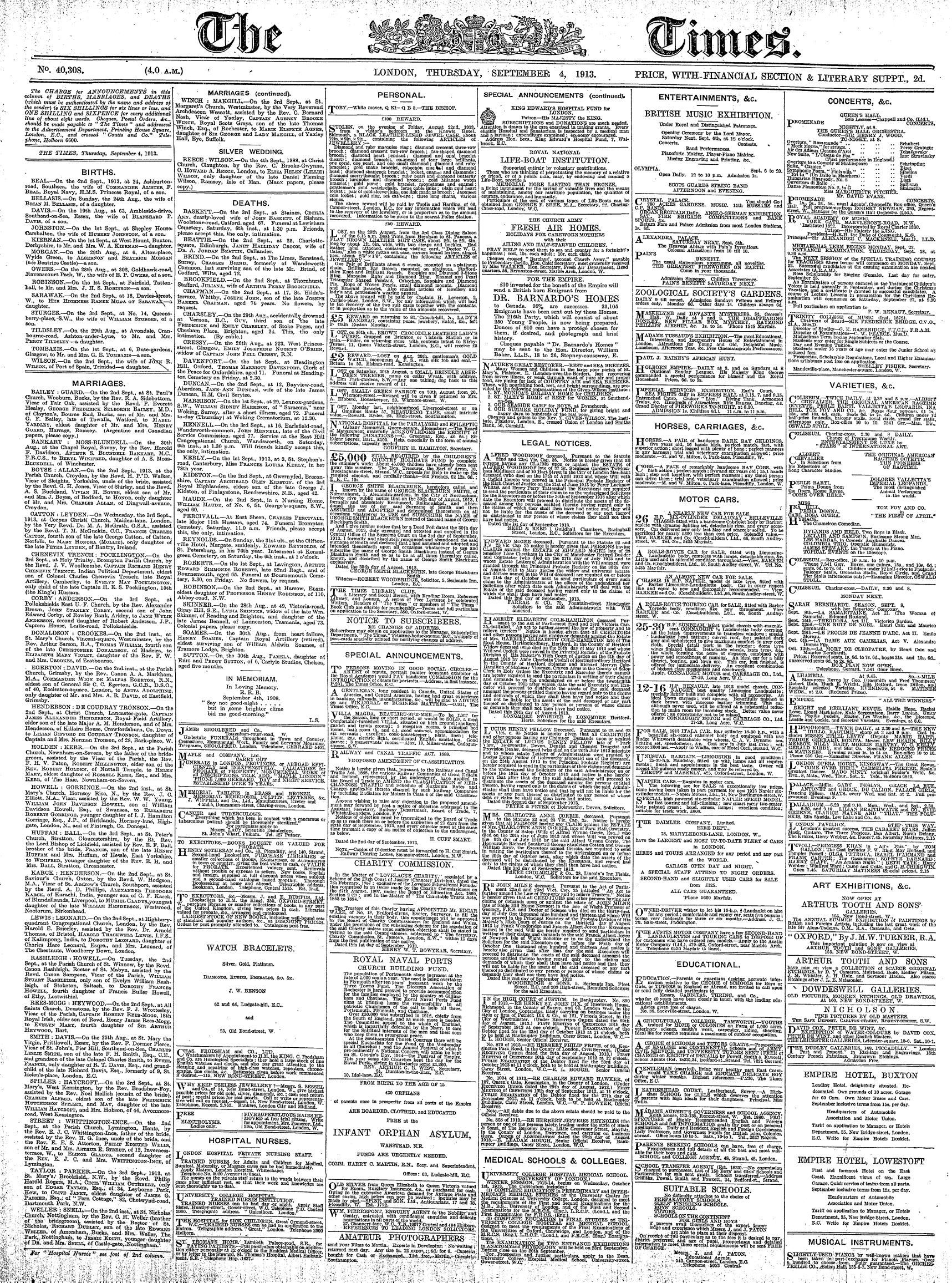
The Times itself is, as you would expect, very different from its modern counterpart – at least I assume so – it is a few years since I last read the print version. For starters it is very big. It is a proper broadsheet being slightly bigger than even the modern-day Daily Telegraph. It has no photographs and precious few diagrams. The front page is a bit of a shock. It is entirely filled with classified adverts. This seems a rather odd arrangement until you realise that the idea is that you open the paper in the middle where there is an index (as well as the editorials) and you work out where you want to go from there. Classified adverts remained on the front page until May 1966. The paper is usually about 24 pages long. There are no colour supplements although occasionally you will get the odd special and there is an engineering supplement every week. At this time, The Sunday Times is an entirely separate publication not becoming part of the same stable until the 1960s and is not available online.
 Don’t hold the front page. The Times 4 September 1913.
There are some display adverts for many of the things you would expect: fashion, railways, buses, some cars, books and magazines. Any manufacturer of any product that you might put in your mouth: drinks, foods, compounds, medicines etc will make an outrageous claim for its disease-preventing and health-inducing abilities. For example an ad for Allinson wholemeal bread claims that:
it is a cure for constipation and its attendant evils and will do more to maintain health than all the medicines ever sold.
About the only people who don’t claim that their product will make you live forever are the tobacco manufacturers who simply claim that their product is less bad. One even sells his product on the basis that it produces less nicotine which I thought was the whole point. In the classifieds you will often find adverts for hospitals along with the rather depressing line: “Funds urgently needed.”
The writing is turgid. Writers can take an age to get to their point. And scanning doesn’t help. With a modern newspaper article you can usually extract the useful information without going to the hassle of reading the whole article. In the case of the Times from 1913 you have to read the whole bloody thing and even then you may find yourself none the wiser. I can only imagine that our ancestors had a lot of leisure time.
And they must have paid attention at school. Every so often you will find a quotation in French, Latin or Greek without translation. And, less commonly, German.
The city pages are every bit as boring as you might imagine. Much of it is given over to government debt which given the size of that market seems reasonable. There is comparatively little space given over to quoted companies largely because there are so few of them. The majority of those that do exist are in the railway, oil, rubber or tea industries. I can’t remember many of the others although the Aerated Bread Company does stick in the mind.
One curiosity is that in those days, every week, the train companies would report their receipts. The Times then faithfully reports these receipts along with those for the previous week and the equivalent week in the previous year. Incidentally, the size of the British rail network peaked in 1912.
The hardest section to read is the page and a half given over to Parliamentary proceedings. I like to think Parliament gets this much attention because this is where all the great debates of the day are taking place. And I have found the odd nugget. Samizdata readers may remember me blogging about the debate on the Lee Enfield rifle and how contemporary opinion regarded it as grossly inadequate. It went on to see service as the British Army’s principal infantry weapon in two world wars. But for the most part Parliamentary debates of 1913 are every bit as dull as they are nowadays.
A surprising amount of space is given over to sport. All the important games: cricket, racing, golf, tennis, sailing, shooting and polo are covered. Football is not entirely ignored. The Times faithfully reports the results from the league championship – a competition dominated by northern teams. The printing of league tables is a somewhat haphazard affair. At the end of the 1913 season they printed the 2nd Division table but not the First. Sunderland won in case you were wondering.
The Times also supplies match reports on the important fixtures. If you want to know what happened in the big game between Eton and Charterhouse or Harrow and Westminster there’s no better place to go.
A lot of the place names have changed since then. Üskub became Skopje, Servia: Serbia, Adrianople: Edirne, Salonika: Thessaloniki, St Petersburg is St Petersburg but for most of the last 100 years it wasn’t. Singapore is part of the Straits Settlements and there is something known as the Shanghai International Settlement.
Here is a short (under four minutes) video, of a designer and exhibition curator Tom Dixon talking about the changes being brought to the world by 3D printing.
Whenever something new comes along, people typically describe it with a noun which says what it is like, but also with an adjective attached to explain how it is different from that. Think “horseless carriage”. (What will “driverless cars” be called twenty years from now?)
So it has been with 3D printing. This is “printing”, sort of, but not printing as we know it.
Listening to Dixon makes me think is that “3D printing” is actually less like printing, and more like blogging. The crucial difference it makes is in enabling people with opinions about how a … 3D thing … should or could be, but who has not been able or who could not be bothered to interest a Big Manufacturer (think Mainstream Media for bloggers) can now just go ahead and make it (just like a blogger publishing his hitherto ignored opinions). And this new-style designer can sell his new design on the internet too, because distribution has also, already, been taken out of the hands of old school Big Distributors (unless you count Amazon and eBay as Big Distributors). Not all such new designers will do as well as they hope, in fact almost all of them will not. But a few will surely succeed spectacularly, and many will presumably be making lives and livings that could not have been made before.
Dixon uses the phrase “taking matters into their own hands”. These words were my first version of the title of this posting.
The spooks are not stupid. There are two ways they can respond to this in a manner consistent with their current objectives. They can try to shut down the press — a distinct possibility within the UK, but still incredibly dangerous — or they can shut down the open internet, in order to stop the information leakage over that channel and, more ambitiously, to stop the public reading undesirable news.
I think they’re going for the latter option, although I doubt they can make it stick. Let me walk you through the early stages of what I think is going to happen.
In the UK it’s fairly obvious what the mechanism will be. Prime Minister David Cameron has thrown his weight behind mandatory opt-out porn filtering at an ISP level, to protect our children from a torrent of filth on the internet. (He’s turned to Chinese corporation Huawei for the tool in question.) All new domestic ISP customer accounts in the UK will be filtered by default, unless the owner opts out. There’s also the already-extant UK-wide child pornography filter operated by the Internet Watch Foundation, although its remit is limited to items that are probably illegal to possess (“probably” because that’s a determination for a court of law to make). And an existing mechanism — the Official Secrets Act — makes it an offense to possess, distribute, or publish state secrets. Traditionally newspapers were warned off certain state secrets by a process known as a Defense Advisory Notice, warning that publication would result in prosecution. It doesn’t take a huge leap of the imagination to foresee the creation of a law allowing for items subject to a DA-Notice to be filtered out of the internet via a national-level porn filter to protect the precious eyeballs of the citizenry from secrets that might trouble their little heads.
On the other hand, the UK may not have a First Amendment but it does have a strong tradition of press freedom, and there are signs that the government has already overreached itself. We’ll know things are really going to hell in a handbasket when The Guardian moves its editorial offices to Brazil …
– Charlie Stross
If there was a Nobel Prize for Double Standards, Britain’s chattering classes would win it every year. This year, following their expressions of spittle-flecked outrage over the detention of Glenn Greenwald’s partner David Miranda by anti-terrorism police at Heathrow airport, they’d have to be given a special Lifetime Achievement Award for Double Standards.
For the newspaper editors, politicians and concerned tweeters now getting het up about the state’s interference in journalistic activity, about what they call the state’s ‘war on journalism’, are the very same people – the very same – who over the past two years cheered the state harassment of tabloid journalists; watched approvingly as tabloid journalists were arrested; turned a blind eye when tabloid journalists’ effects were rifled through by the police; said nothing about the placing of tabloid journalists on limbo-like, profession-destroying bail for months on end; said ‘Well, what do you expect?’ when material garnered by tabloid journalists through illegal methods was confiscated; applauded when tabloid journalists were imprisoned for the apparently terrible crime of listening in on the conversations of our hereditary rulers.
For these cheerleaders of the state’s two-year war on redtop journalism now to gnash their teeth over the state’s poking of its nose into the affairs of the Guardian is extraordinary. It suggests that what they lack in moral consistency they more than make up for with brass neck.
Everything that is now being done to the Guardian has already been done to the tabloid press, a hundred times over, and often at the behest of the Guardian.
– Brendan O’Neill
|
Who Are We? The Samizdata people are a bunch of sinister and heavily armed globalist illuminati who seek to infect the entire world with the values of personal liberty and several property. Amongst our many crimes is a sense of humour and the intermittent use of British spelling.
We are also a varied group made up of social individualists, classical liberals, whigs, libertarians, extropians, futurists, ‘Porcupines’, Karl Popper fetishists, recovering neo-conservatives, crazed Ayn Rand worshipers, over-caffeinated Virginia Postrel devotees, witty Frédéric Bastiat wannabes, cypherpunks, minarchists, kritarchists and wild-eyed anarcho-capitalists from Britain, North America, Australia and Europe.
|





Recent Comments