Norman Borlaug has died. He may well have saved more lives than anyone else who has ever lived.
|
|||||
|
Of course, it’s been half a century since Cuba has had a real new leader. This is one of the down sides to life extension. April 23rd, 2009 | 16 comments - (Comments are closed)
 Matt Welch of Reason debates Crooked Timber’s Henry Farrell over issues including the recent bouts of piracy in the Indian Ocean. One issue that comes up is whether the Somalia is a “libertarian nirvana”. Duh. Lefties love to sneer that such lawless parts of the world are some sort of anarcho-capitalist paradise. Have they not figured out that free societies are saturated with notions of law and property boundaries, which need to be upheld and defended? Laws and liberty are intertwined – the problem is when laws violate the right of humans to live their lives unmolesed, rather than protect such rights. Since when did robbing merchant ships have anything to do with freedom, exactly? Anyway, Mr Welch more than holds his own in this encounter. Worth a view. April 17th, 2009 | 39 comments - (Comments are closed)
Okay, let’s remember that there is a world outside the Westminster Village. The president of Iran is not a man whom anyone would want with his hands on the nuclear button, certainly not Israel, which has reason to worry that the man is an anti-semitic fruitcake. It appears that there has been a possible change in the tack of US policy towards Iran now that Mr Obama is at the helm. Now it may be that Mr Obama is playing a devilishly cunning game and, by trying to make nice to Iran, is either buying time or trying to engineer real, positive change. Of course, it also may be that Mr Obama is out of his depth and has made the fatal mistake that one can do business with a regime like Iran. The danger, it seems to me, is that failing to stop Iran from proceeding with an enrichment programme for nuclear material is going to worry the hell out of Israel. And remember, that while Iran may not be the West’s immediate problem, it is a massive, existential one for Israel. The US may be wise not to want to pick a fight on this issue, given that such a course could go horribly wrong. Israel may not have the luxury of having to make even that choice. Given that the doctrine of Mutually Assured Destruction tends to work when both sides are basically rational, even if they are bad, it is folly to suppose that nuclear deterrence will work with a regime led by a man who sincerely dreams of taking his place in heaven, and putting lots of those he loathes somewhere else, very violently. At the very least, a defence policy must now involve greater development of anti-ballistic missiles to shoot down incoming weapons, since there will be the risk that the launch sites and development sites may be out of reach of an airforce or ground assault team. Consider this: why does Iran, with all its oil reserves, want to spend billions of its currency reserves on developing enriched fissile material? What does the Iranian government propose to do with it – use it for garden compost? April 15th, 2009 | 29 comments - (Comments are closed)
Are you optimistic about the future? Several months ago I was not, but I am now. From what I can see, governments are walking down the path of their complete moral and financial bankruptcy far more quickly than I ever imagined they would. I thought that it would take our overmighty governments several slow, demoralising decades of decline and eventual collapse to completely discredit their authority and control in the eyes of the people. However, our governments appear to be going supernova right now and I suspect they will burn themselves out over a few painful and tumultuous years – destroying a great deal of wealth in the process, no doubt. However, as worrying as that prospect is, it was always going to be that way. And in spite of that, I feel particularly upbeat about the longer term future. Those who know nothing more (and expect nothing less) than widespread government authority and control over all aspects of our lives will have their imbecile – sorry, umbilical – cords to the State cut sooner than expected, thanks to the overwhelmingly reckless (but entirely predictable) government response to the current financial crisis. I really do believe that future historians will pinpoint this crisis as marking the beginning of the end of the big-government era. Do you agree? March 8th, 2009 | 45 comments - (Comments are closed)
A good friend of mine, the Norwegian journalist Kristine Lowe, reflects on a recent trip to Iceland, which has seen its government collapse amid the credit crunch. Iceland has, of course, benefited from sensible low-tax policies as well as being buoyed by what now appears to be some foolish banking lending policies. I am not sure I would want to live there, mind. The long nights and expensive beer would drive me nuts. January 28th, 2009 | 9 comments - (Comments are closed)
Earlier this afternoon Perry and I had a lengthy editorial telephone discussion on the subject of Georgia. While we agreed broadly there was one area in which we had intense debate until I finally figured out how we were talking past each other. The question is, how the hell did US intelligence assets miss the Russian Black Sea fleet movements? How did they miss the massive transport job of the troops and their logistical tail? They did not just materialize in position. It takes time and planning to make such moves. I will leave the detail of that to Perry as he seems to have been thinking about it in great detail. My take is there is a limited amount of time available on the black satellites. The manpower and resources have been re-targeted on the Middle East. Orbits have been shifted to give maximal coverage in those areas of interest and experienced personnel have moved to ‘where the action is’. This is not to say Russia is being ignored. It is however a very big place and I am going to guess that the time between scanning particular areas has greatly lengthened. Russian troop movements are mainly rail based and with enough eyeballs and Cold War era periodic coverage one might hope to pick up changes in traffic patterns and notice “something is going on”. But… this requires a certain periodicity in coverage. Changes in static positions like silos and strategic air bases are much easier to pick up even with occasional coverage. Dynamic changes, such as train and road movements are a different story. You have to have a satellite taking pictures at just the right time or often enough to pick up a signal just by chance. This is what took Perry and I awhile to meet minds on: I have been thinking of this issue as a communications/information theory problem. How often do you have to sample an area to notice a change in the density of train traffic? I would posit it would have to be several times a week at the very least if the spike in traffic was huge and extended; if the spike were smaller and flatter you would need to sample daily or multiple times daily. You would have to do it at night and through clouds as well if you were to get a statistical value high enough to ring alarm bells. It is an issue of sampling rate versus the highest detectable signal frequency, pure and simple. I doubt they have even been scanning large areas of Russia more than a few times a week (I suspect much less often) except in areas of nuclear strategic interest. They could easily miss large troop movements in a part of Russia which is not of great national interest to the United States. Let the discussion begin. There is a lot of meat on this bone! August 12th, 2008 | 72 comments - (Comments are closed)
The Times (of London) has a sobering editorial today about the level of crime in the Caribbean, following the recent murder involving a married couple on their honeymoon in Antigua. Jamaica has already developed a fearesome reputation for violence – Kingston is a particularly unpleasant place – and the problem is spreading. In its history, the area has been touched by violence, stretching back before the dark stain of Western-imposed slavery, of course. The pirate gangs who raped and pillaged their way across the area were not lovable rogues with parrots on their shoulders but brutes. Of course, when it comes to recent times, experiences vary. I went to Barbados with friends several years ago and had a wonderful time and was struck by how friendly people were. Barbados is a great place, although I am rather saddened that the youngsters are not as keen on cricket as they used to be, but perhaps that is inevitable as sporting fashions change. The Times argues that some folk have blamed the problems on tourism as something that has widened the gap between rich and poor. This seems a bit of a strange argument. Surely, without tourism, the region – assuming there was no other source of wealth – would be even poorer, making for an ever more desperate situation that there is now. More pertinently, the editorial argues that a major cause of violence are drug gangs. The Caribbean is a crossing point for the drugs that are exported by gangs out of South America, such as Columbia, and then on to the US and elsewhere. At no point does the Times address the issue of whether the illegality of drugs might be fuelling the criminal gangster culture that is allied to it. And there is something else to consider. Since Britain joined the-then EEC, now European Union, the old British connections to the trading interests of the UK’s former colonies have been weakened. Imports of sugar and other produce were placed at a competitive disadvantage because of Britain’s membership of the absurd Common Agricultural Policy. Finally, one of the latest issues to rear its head is the ongoing attempt by Western governments, such as the US, to crack down on tax havens such as The Cayman Islands. If a left-leaning, high-taxing Democrat administration gets into power with Mr Obama in the White House, life for such havens could get much tougher, with attendant impact on their business activities. July 30th, 2008 | 12 comments - (Comments are closed)
Even though I do not know if it should be done, given that it would be done by the people who would do it rather than by people who would do it well, I’m glad someone has at least said this:
Those are apparently the words of David Davis, opposition spokesman for something or other. His colleagues were “stunned”, says Iain Dale. Incidentally, Biased BBC, who I do not always like (basically because I do not always dislike the BBC), made a good point recently about those Burmese generals. After quoting a Wikipedia entry to the effect that the Burmese generals are quite a bit more socialist than not, Niall Kilmartin says:
Well, whatever. What is definitely true is that if, during a natural disaster, a government treats its own people as hostages rather than anyone they are supposed to help, then helping those people means shoving the government aside, at least for the duration of the disaster. Trouble is, smashing up a government does not, to put it mildly, necessarily mean helping its people. It’s one of those necessary-but-insufficient situations. I actually think that if these generals did fear an old-fashioned invasion, a bit more than they do now, they might tolerate an NGO invasion instead. Surely, a threatened invasion, a real one, might accomplish something here. Trouble is, if you threaten something, it is better to mean it. Latest from the BBC on Burma here. Things are said, by some, to be “improving”. Hmm. May 18th, 2008 | 29 comments - (Comments are closed)
The distinction between the legal order in Western democracies and the tyrannies of Stalinist Russia or modern China or the Arab gulf states, is often thought to be stark. In Britain in particular, we are complacent that 800 years of the common law will protect us against the overreaching power of state functionaries. Today comes a case that shows this conceit to be ill-founded. It was already widely known that the Home Secretary would like the power to lock anyone up for seven weeks on her say-so. But it is not in effect yet, and is likely to be opposed in parliament. Who knew that the British state is already punishing 70 people with effective suspension of all their economic rights on mere accusation, by freezing their assets by Treasury order without any legal warrant or process? The Terrorism (UN Measures) Order 2006 and the 2006 al-Qaeda and Taleban (UN Measures) Order were made under section 1 of the 1946 UN Act in order to implement resolutions of the UN Security Council. These orders are not parliamentary instruments but “orders in council” – the council in question being the Queen’s Privy Council, so that the rules under which (according to solicitors for the victims)…
…have not troubled parliament even under the pathetic ‘negative resolution’ procedure by which most of our law is now made. Nor has any judge or other independent authority been in involved in these seizures or assessed the evidence (if any) that justifies them. Nor is there any time limit. Or need to bring charges to support the indefinite punishment. Which remains, though the learned judge found it entirely illegal, indefinite:
To which I say, and not for the first time, damn the UN. Neither the UN nor Treasury officials are supposed to make our law. And if this proscription stands, then we might as well have no law. April 24th, 2008 | 27 comments - (Comments are closed)
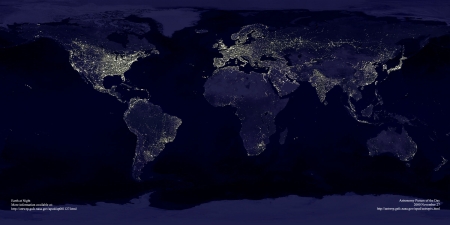 I never get tired of looking at this photograph. It never fails to fill me with wonder and awe at the ingenuity of my species who, against all the odds, have carved these glorious man-made islands of light out of the primordial blackness. Whenever I am heavy of heart, I open up this photograph and stare at it to remind me that, somewhere, there is light and life. And there is. For now.
With each passing day I become more convinced that the ‘green’ movement is actually a millenarian psychosis; a mental and spiritual sickness borne, perhaps, from some degree of civilisational exhaustion. Not just a belief that the end of the world is nigh, but an active desire to bring it about. And soon. Ours is not the first age to witness such pandemics of madness but, in the Middle Ages at least, there was the excuse of a near-universal poverty. In such a state of interminable plight, despair may not be the wisest response but it is at least an understandable one. But now we live in an age of near-universal prosperity and progress. Never before has our species enjoyed such security and such freedom from want. Yet this is clearly no defence against a recurrance of this psychological plague.
Life, laughter, love, food, drink, warmth, travel, communication, progress, a world full of unprecedented wonders and it’s all too much for them. Better to sit in the darkness and curse the lighting of even a single candle. ‘Stop the world, I want to get off’ was the plaintive refrain of some Broadway comedy show I think. It could also be the motto for the greens, except that they want everybody off. Is that what they aspire to as they sit at home quietly in that seductive, undemanding cloak of blackness? To switch off civilisation and shuffle away into the perpetual tenebrosity dragging everyone else behind them? The conditions are ripe for the spread of this insanity. Indeed, it is spreading now. How long will it be, I wonder, before some official body somewhere floats the idea of mandatory blackouts and curfews? “The voluntary approach” they will proclaim, “has not worked”. And what do we do in response? Laugh at them? Ignore them? Rage against them? What would work to inoculate the rest of our species? What combination or words or phrases could we use to dissipate and lay low a viral madness? I am, of course, familiar with the customary rebuttals. “We will win because we have MTV and Coca-Cola”. But without the light there is no MTV, there is no Coca-Cola. What do we have then? The lights are not yet going out all over the world. But I fear that I will see them do so in our lifetime. March 29th, 2008 | 106 comments - (Comments are closed)
A lot of elections at the moment. Besides the US elections, we have just had the Spanish elections and in my wife’s small country, Malta, the ruling Nationalist Party, a vaguely right-of-centre party that supported Malta’s entry into the EU and the euro, won by an incredibly slender margin (just over a thousand votes). As I have a vested interest in Malta remaining a broadly open country, I am glad that the party won, or at least relieved that Labour, the main opposition party with a vindictively regulatory streak, did not. But my views on Malta’s election are tinged with a bitter-sweet taste as the Nationalists, for all their generally pro-enterprise views, have made serious errors. The party took Malta into the EU. By staying out of the EU, Malta could have retained and expanded its status as an offshore tax haven, providing Monaco, the Swiss, Liechtenstein and Gibraltar with some useful competition as a friendly venue. Malta has quite a thriving IT and financial sector and English is widely spoken there, a priceless advantage. By keeping out of the EU, it could also have avoided becoming a conduit for tens of thousands of illegal immigrants who use the small island as an entry point for the EU. Malta, an island the size of the Isle of Wight with half a million people, is not a country that can easily absorb a large influx. But as my better half points out, Malta, a Catholic country, has long feared the shadow of its Muslim neighbour, Libya, just a hundred miles or so to the south, and sees EU membership as somehow tying it ever more closely to a non-Muslim population. The Maltese are quite a tolerant bunch but they are fiercely pro-western. The Archbishop of Canterbury would be thrown into Valetta’s Grand Harbour. One reason for the closeness of the elections is that there is a lot of anger at the governing party, even among most moderate voters, at some of the crasser building developments in the densely populated island. Even the most ardent defender of free enterprise will sometimes struggle to defend the ugly high-rise developments in part of the island that have gone up next to the attractive, honey-coloured buildings along parts of the country (in the smaller neighbouring island of Gozo, such developments have been far fewer, thankfully). Tourism is a crucial source of income for Malta; its historic buildings are part of its appeal, so long-term tourist entrepreneurs should hopefully follow their self-interest and avoid damaging the very thing that makes Malta a nice place to visit. This is an interesting subject for economists: ugly developments make money for investors in the short run and arguably, are better than no development at all, but the long run costs can be in the form of less tourism overall as would-be visitors go elsewhere for somewhere prettier. Anyway, back on topic: this has to have been one of the closest election results I have ever read about. March 10th, 2008 | 16 comments - (Comments are closed)
|
   |
||||

All content on this website (including text, photographs, audio files, and any other original works), unless otherwise noted, is licensed under a Creative Commons License. |
|||||