We are developing the social individualist meta-context for the future. From the very serious to the extremely frivolous... lets see what is on the mind of the Samizdata people.
Samizdata, derived from Samizdat /n. - a system of clandestine publication of banned literature in the USSR [Russ.,= self-publishing house]
|
… Croatia’s Operation Storm was in day two of a rapid offensive to recapture the bulk of its territory from Belgrade backed separatists. It was the largest European land battle since the Second World War, ending on 7 August 1995 with the reoccupation of 4,000 square miles of territory. This was a dramatic demonstration of how effective the Croatian Army (HV) had become compared to just a few years earlier, and Operation Storm also represented a strategic victory for the Bosnian government as it broke the long siege of the Bihać enclave.
Like all wars, it was not pretty, but it ended as it started, as an ethnic struggle with winners and losers and there is no point in thinking otherwise, and the less bad guys won in my opinion.
Although Op. Storm did not end on August 5th, many Croatians see the HV recapture of Knin on this date as the most symbolic. It feels strange to me to tag this as ‘historical views’ as saw a great deal of that war first hand. I am getting old 😀
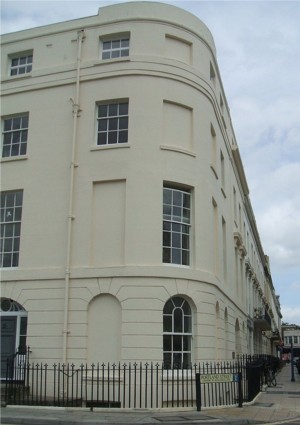
If you type “window tax” into google, and click on “images”, you get images like this one:
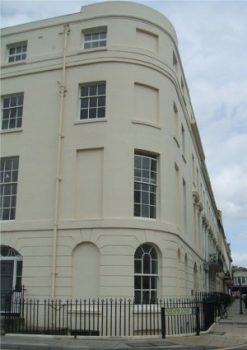
That being the first image that wikipedia shows you, in their entry on the Window tax.
Says wikipedia about this tax:
The window tax was a property tax based on the number of windows in a house. It was a significant social, cultural, and architectural force in England, France, Ireland and Scotland during the 18th and 19th centuries. To avoid the tax some houses from the period can be seen to have bricked-up window-spaces (ready to be glazed or reglazed at a later date). In England and Wales it was introduced in 1696 and was repealed in 1851,
London, and presumably all the other cities of Britain, still contain many such bricked-up windows, that date from this time.
But yesterday, I saw a new block of flats, still in the process of being constructed, just a few dozen yards from my own front door.
The front of which looks like this:
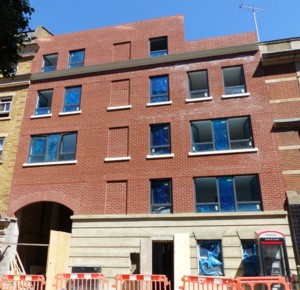
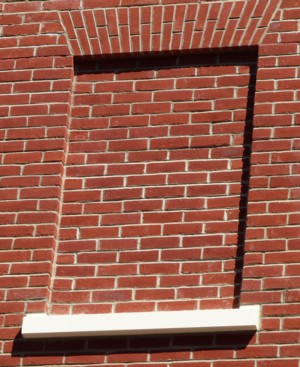
Let me be clear. There is a vertical row of bricked-up windows there, in between the real windows. And you can clearly see that this is a brand new building, not even yet occupied.
Here is a close-up shot of an individual bricked-up window:
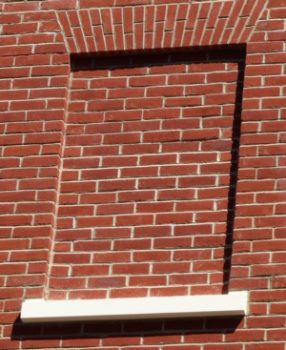
I have long known the bare outlines of this window tax story, as I guess most of my fellow Brits do also, especially if they live in towns or cities. Windows were taxed, so people filled the windows in, to avoid paying the tax.
So, my first – outraged and spasmodic – reaction to this new building, when I saw these non-windows was: My God, have they brought back the window tax?
But, on further reflection, I further guess that this is isn’t the first time that recent property developers have created bricked-up windows, or what look like bricked-up windows, to create, pretty cheaply, the suggestion of antiquity in an otherwise blandly modern building.
When I see other bricked-up windows, I will no longer assume that they date from the time of the window tax. Maybe they merely allude to this time.
But, am I missing something? Is there a more practical purpose to such non-windows? Is it helpful to create windows that can later be un-bricked-up (bricked-down?), at some future date? Does it help to think about maybe wanting a window that you don’t want now, beforehand, just in case?
Is this a mere part of the construction process. Will these bricked-up windows all turn into real windows very soon, before anyone even moves in?
Or are there quite different reasons for making a new bricked-up window, which I am unaware of? Perhaps so. In fact, probably so. And if so, I hope that commenters will perhaps enlighten me.
Via Mick Hartley, I came upon this summary of the state of the Middle East, and in particular of the bloody shambles that was the attempt to unite Sunni Islam, aka: the Arabs. It’s the best background briefing I have recently read on that deeply depressing region of our otherwise moderately undepressing world. Although, that doesn’t say much for I am no sort of Middle East expert, nor even much of an observer of it. Too depressing. But I read all of this piece, by Ofir Haivry of the Herzl Institute in Jerusalem, at one sitting as soon as I encountered it, which is quite rare for me and my crumbling attention span.
I haven’t much to say about all this, but one thought does occur to me, which is that it seems rather wrong for Americans to blame other Americans for this bloody shambles. (Haivry himself does not blame America.) The next silliest thing to believing that your country is an unchallengeably magnificent superpower that never ever errs is to believe that your country’s mistakes and crimes are overwhelmingly more important and blameworthy than those of any other country, these two attitudes being far more similar than those who indulge in the latter one typically realise. The Middle East would surely now be a bloody shambles whatever the Americans had recently tried to do about it.
If there are imperialist villains to be blaming, how about Britain and France? But one suspects that, again, even if those notorious “lines in the sand” had never been drawn around a century ago, what would be happening on top of this sand would still now be a bloody shambles.
The only rays of light that Haivry discerns are in the form of the various little non-Islamic and anti-Islamist statelets that are starting to form, such as the newly emerging Kurdistan. The Kurds aren’t the only ones doing this, apparently. Good to hear.
And then of course there is the continuing success of Israel. A particular reason I am convinced by this article is that Israelis cannot afford to be wrong, and in particular they cannot afford to be sentimental, about what is going on around them.
Talking of sentimental, “Lawrence of Arabia” gets a well-deserved swipe of criticism.
Flourish. Enter CAESAR; ANTONY, for the course; CALPURNIA, PORTIA, DECIUS BRUTUS, CICERO, BRUTUS, CASSIUS, and CASCA; a great crowd following, among them a Soothsayer.
When I started writing this posting, the invaluable Guido Fawkes had, at the top of his invaluable ongoing list of “seen elsewhere” items, a link to a Conservative Home piece by David Davis MP, with a long title on top of it which includes the words A Brexit economic strategy for Britain.
It deserves to be quoted at length, so I will now do that:
… [L]eaving the EU gives us back control of our trade policy, and gives us the opportunity to maximise returns from free trade.
Because any deals currently settled are obtained by finding a 28 nation compromise, the EU is clumsy at negotiating free trade deals. That is why we currently only have trade deals with two of our top ten non-EU trading partners. This is incredibly important to us, as about 60 per cent of our trade is with the non-EU world. In fact, we sell as much to non-EU countries with which we have no trade agreements as we do to the EU.
The first order of business is to put that right. As the amicable statements coming from the US, Australia, China and India show, these countries are as keen to knock down trade barriers as we are.
Single countries, with the ability to be flexible and focussed, negotiate trade deals far more quickly than large trade blocs. For example, South Korea negotiated a deal with the US in a single year, and with India, which is notoriously difficult, within three years. Chile was even faster, negotiating trade deals with China, Australia and Canada in under a year.
The EU, by comparison, takes more than six years to negotiate trade deals; the deals which would most benefit us, such as those with Canada or the US, take even longer. And without the often conflicting requirements of 28 different countries to consider, deals negotiated by single countries tend to be broader and have more favourable terms on matters that are important to us, such as services.
So be under no doubt: we can do deals with our trading partners, and we can do them quickly. I would expect the new Prime Minister on September 9th to immediately trigger a large round of global trade deals with all our most favoured trade partners. I would expect that the negotiation phase of most of them to be concluded within between 12 and 24 months.
So within two years, before the negotiation with the EU is likely to be complete, and therefore before anything material has changed, we can negotiate a free trade area massively larger than the EU. Trade deals with the US and China alone will give us a trade area almost twice the size of the EU, and of course we will also be seeking deals with Hong Kong, Canada, Australia, India, Japan, the UAE, Indonesia – and many others.
So much for the “jump-start” bit. Now for my own additional argument that this could well happen very quickly.
→ Continue reading: How Brexit could jump-start the British economy – and do it very quickly
The BBC has provided a reminder of the distant past, the early 1970s, when Ted Heath was Prime Minister and Mrs Thatcher was the Education Secretary. Despite a long feud between them after Mrs Thatcher’s rise to lead their party, Mrs Thatcher reportedly thought highly of Mr Heath.
‘…Baroness Thatcher eventually called her Tory predecessor “one of Britain’s greatest prime ministers”….’
Let’s see what the BBC has to say about that time:
Margaret Thatcher was Education Secretary in Mr Heath’s cabinet between 1970 and 1974. Although never close, they shared a commitment to free market policies.
As if. It is true that Mr Heath privatised Thomas Cook, a travel agency (it was nationalised during World War 2 after the German occupation of France as it had become French-owned by then), and some pubs in Carlisle. Yes, that’s right, the British Government had nationalised pubs around Carlisle during WW1, to ensure that munitions workers weren’t too drunk, and with the Kaiser safely in the past, the time was ripe for final privatisation of the remaining pubs came in 1971.
Perhaps every town should have a nationalised pub as a reminder of the ordeal of the drinkers of Carlisle, which effectively lasted a drinker’s lifetime. At a relatively small cost, we could have a live reminder of nationalisation in every town.
From 1972, the government began to change course.
A strike by the miners threatened coal supplies to power stations.
War in the Middle East in 1973 led to a sharp rise in oil prices, feeding inflation.
Inflation, that mysterious dragon that is scared off by high interest rates but which feeds on high oil prices, so the collapse of Bretton Woods and Nixon’s repudiation of the dollar/gold link had nothing to do with inflation, nor did wild printing of money.
Here is a pub price list from the time of decimalisation, 30th November 1970: A pint of beer in the same pub now, even with gentrification, costs not 12 new pence but something in the region of £3.60p, a 30-fold price increase in nominal terms.
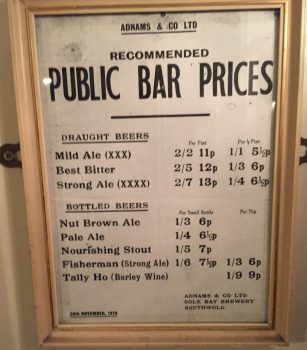
However, what did Mr Heath, one-time friend of Deng and Saddam, decide to do in the face of inflation, and demands for pay rises? Reminder, a great many people worked in nationalised industries, and their pay rates were ultimately political decisions. Furthermore, going on strike (i.e. refusing to work) was often seen as the way to muscle a pay rise out of the government, rather than a route to bankruptcy.
Heath, memories of wartime comradeship still fresh, did not want a confrontation with workers, nor, having grown up during the depression of the 1930s, was he willing to see unemployment rise in order to curb inflation.
Instead, he re-introduced government control of prices and pay.
So what happens if you control prices and pay? We are not told. Is it too obvious to need to be said, or are there still people who deny that price controls can lead to distortions? Why not look at Venezuela for a grim current example? (it’s OK, he’s doing it to curb inflation).
And this ‘trade-off’ between unemployment and inflation? That other mysterious relationship that is simply assumed to exist? How about seeing if a market can clear without distortions?
And note, there was no dispute at this point between Mr Heath and Mrs Thatcher over Europe, Mrs Thatcher was completely for membership of the European Economic Community.
In some ways, we have come a long way from the absurdity of the political consensus of the 1970s, yet the State still looms large as does the passing off of old economic fallacies as realities.
And what is Mrs Thatcher reported to have said of that time?
“In the years since, he and I have not always agreed on every political thing, but I was, and I’m proud to have been, a member of his government …”
Quite how Mrs Thatcher got her reputation is a mystery to me, but not how Roy Orbison put it.
Amidst everything else that’s been going on over the last few days, Britain managed to commemorate the centenary of the first day of the Somme. For those who are unaware of the details 60,000 soldiers of a volunteer army became casualties, 20,000 died while the gains in terms of territory and dead Germans were minimal. While I found most of the commemorations cloying I thought the decision to dress up a bunch of young men in First World War uniforms and strategically position them in our larger cities was an act of genius.
But sadness and horror does not excuse the abandonment of cognitive functions. Many are happy to blame bad generalship and from the sounds of it there was plenty present that day but there were other, deeper, strategic reasons for the disaster.
First of all, Britain was fighting a war in Western Europe against a large, well-equipped and tactically skillful enemy. That is a recipe for a bloodbath. Britain repeated the exercise twice in the Second World War (May 1940 and June 1944 onwards). They were bloodbaths too. We tend to forget that fact because overall the numbers killed in the Second World War were much lower than than the First and because they achieved a succession of clear victories.
Secondly, Britain began the war with a small army. To make a worthwhile contribution Britain was going to have to raise and train a large army. Soldiering, like any other job, is one where experience counts. Anyone who is familiar with the rapid expansion of an organisation will know that this is a recipe for confusion and chaos. In the case of the British army the inexperience existed at all levels. Corporals were doing the jobs of Sergeant Majors, Captains doing the jobs of Colonels and Colonels doing the jobs of Generals. Haig himself (according to Gary Sheffield) was doing jobs that would be carried out by three men in the Second World War. Talking of the Second World War, it is worth pointing out that it took three years for the British to achieve an offensive victory (Alamein) over the Germans which is much the same as the First (Vimy).
Thirdly, Britain began the war with a small arms industry. Expanding that involved all the problems mentioned above plus the difficulty in building and equipping the factories. It comes as no surprise that many of the shells fired at the Somme were duds and even if they were working they were often of the wrong type: too much shrapnel, not enough high explosive.
Fourthly, the Allies needed to co-ordinate. Co-ordinating your efforts means that the enemy cannot concentrate his efforts on one of you and defeat you in detail. This was the thinking behind the Chantilly agreement of December 1915. The idea was that the allies – France, Russia, Britain and Italy – would all go on the offensive at the same time. Russia had done her bit in the Brusilov offensive. Now it was Britain and France’s turn.
Fifthly, the battle of Verdun. It is almost impossible to put into words the desperation of the French army by June 1916. It was fighting against a skillful and determined enemy for what had become sacred ground. It had reached the end of its tether and Britain had no choice but to come to its aid by fighting and thus drawing off the German effort. The original intention was for the more experienced French to have a much larger role at the Somme. Verdun put paid to that which meant that the British had to take the lead. As it happened, the Germans ended offensive operations at Verdun shortly after the battle began.
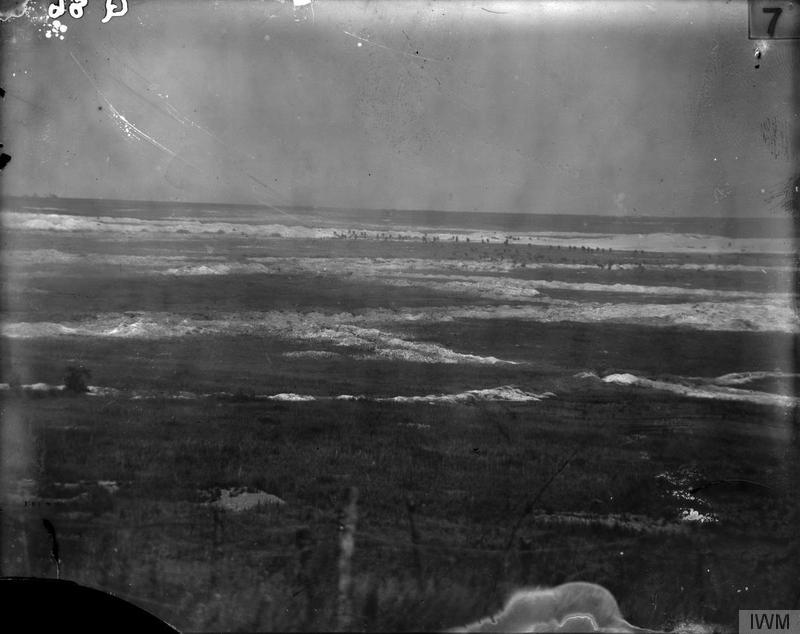 British troops attacking German trenches near Mametz, on first day of the Somme. From here: https://twitter.com/prchovanec_hist/status/749031026039586816
When surveyed about what aspects of their lives give them happiness most people cite such reasons as family and friends, a decently paid job, or interesting hobbies. Sorin Hershko may have some or all of those. I don’t know. But in addition to any other sources of satisfaction he also has this:
40 years on, child hostages look back on Entebbe raid.
But the most emotional part of the day at the Peres Center, for most of the former hostages, came from the chance to reunite with Sorin Hershko, the IDF soldier who became a quadriplegic from an injury sustained during the operation and who was on hand to witness the celebration and receive an honorary certificate from the Peres Center for his bravery and heroism.
“After 40 years to see the children, to see the kids…”
Hershko said, trailing off, a broad smile on his face.
“I still them call children, despite the fact that they are all grown up and have families and their own children.
For me it is very important to see them and I am very satisfied that they are all here and well.”
The Liberal Democrat party, with its host of 6 MPs (much reduced in 2015) have pledged to ignore the Brexit referendum result and to campaign for the UK to remain in the EU.
“Nigel Farage’s vision for Britain has won this vote, but it is not a vision I accept”, declared Lib Dem leader Tim Farron yesterday. “Even though the vote was close, the majority of British people want us to leave. But we refuse to give up on our beliefs”, he said.
Mr Farron, the relatively obscure leader of the party of heavyweights such as Cyril Smith, went on:
Mr. Farron argued that his party’s proposition was justifiable in a democratic society as older people’s votes were somehow less valid and because a vote against the EU was really a vote against Westminster.
“This was not a vote on the European Union alone”, he said, but a “howl of anger” against politics.
So, once the votes are counted, and if that ‘fails’, they are then ‘interpreted’ and in line with socialist logic, they don’t mean what a plain reading might fairly be taken to show that they mean. But is he not also saying that the vote was against him, as a member of the Westminster Parliament?
I would like to contrast this attitude with that of General Pinochet, well-known ‘strongman’ of Chilean politics from 1973 to 1990, who held a referendum on his junta (well, him) continuing to rule Chile in 1988, and who respected the outcome rejecting his continued rule, with a little prodding perhaps from General Matthei, the Air Force member of the junta (and friend of the UK in the Falklands War), who called for the result to be respected.
I suppose what we are seeing is a political auto-endoscopy by the Left, each trying to get further up their own arses than the other, with Nicola Sturgeon, Scotland’s First Minister indicating that the Scottish Parliament may have a veto on Brexit, a surprising interpretation of constitutional law from someone who is a solicitor.
I am confident that the bulk of people will see through all this, and see the Left, in all their shades, for the totalitarians that they are.
There’s been an awful lot of this Brexit thing recently so – in the way of light relief – I’m going to talk about the First World War.
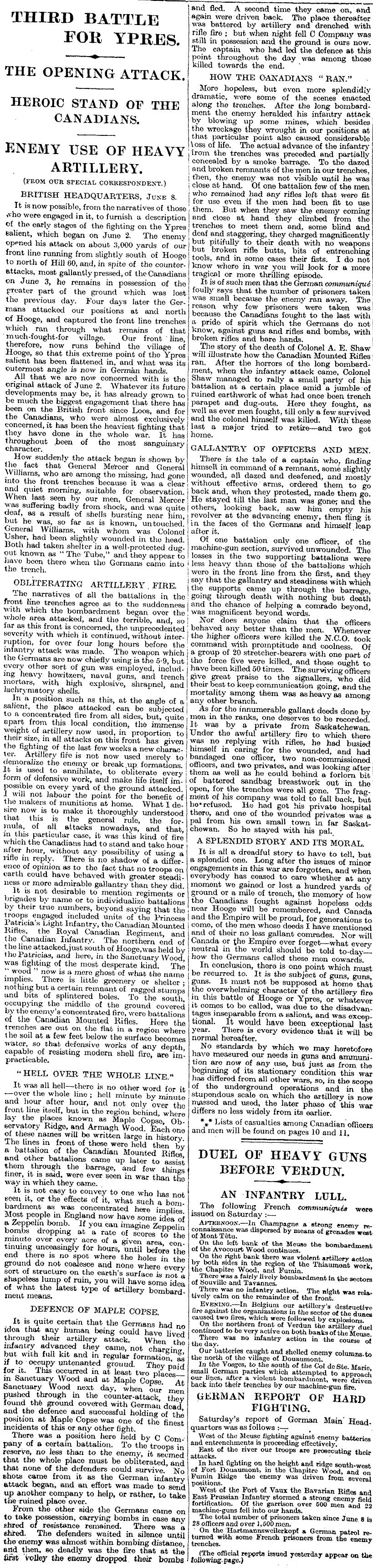
I think just about everyone has heard of Passchendaele which was fought in 1917. The better informed will know that its official title was the Third Battle of Ypres. Which makes this headline (from 12 June 1916) somewhat premature:
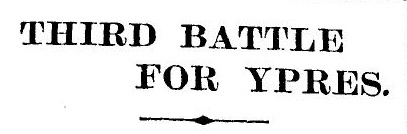 The Times 12 June 1916 p5 What they are referring to is what we now know – or more accurately: don’t know – as the Battle of Mount Sorrel. There are eerie parallels with the Somme. The attacker unleashed a huge artillery bombardment:
Artillery fire is not now used merely to demoralize the enemy or break up formations. It is used to annihilate, to obliterate every form of defensive work, and make life itself impossible on every yard of the ground attacked. I will not labour the point for the benefit of the makers of munitions at home.
He exploded mines. He came on in waves. He was mown down in his thousands:
When the infantry advanced they came, not charging, but with full kit and in regular formation, as if to occupy untenanted ground. They paid for it.
Only one difference: the attacker was German.
And how did the defender (mainly Canadian) respond to this? By organising immediate counter-attacks just as the Germans would on the Somme. At first they didn’t work. However, when they decided to sit down and do some planning – Arthur Currie take a bow – they succeeded.
Did I say one difference? Actually there were two. The Germans achieved surprise, to the extent that at the very moment they attacked there were two Canadian generals in the front line, there because “Oh it’s a quiet sector and we’re not expecting anything to happen.” One was killed, the other captured.
There’s also this:
Long after the issues of minor engagements in this war are forgotten, and when everybody has ceased to care whether at any moment we gained or lost a hundred yards or ground or a mile of trench, the memory of how the Canadians fought against hopeless odds near Hooge will be remembered, and Canada and the Empire will be proud, for generations to come, of the men whose deeds I have mentioned and of their no less gallant comrades.
Alas no. The war was too big for that.
Robert Liston was a nineteenth century Scottish surgeon known as “the fastest knife in the West End … at a time when speed was essential to reduce pain and improve the odds of survival of a patient; he is said to have been able to perform the removal of a limb in an amputation in 28 seconds.” A man of strong character and ethics, who did not hesitate to help render his own rare skill obsolete by performing the first operation under anaesthesia in Europe, over his entire career he saved many lives. But sometimes things didn’t work out so well. As recorded by the deadpan Richard Gordon in Great Medical Disasters:
Amputated the leg in under 2 1⁄2 minutes (the patient died afterwards in the ward from hospital gangrene; they usually did in those pre-Listerian days). He amputated in addition the fingers of his young assistant (who died afterwards in the ward from hospital gangrene). He also slashed through the coat tails of a distinguished surgical spectator, who was so terrified that the knife had pierced his vitals he dropped dead from fright. That was the only operation in history with a 300 percent mortality.
Now to our own times. Whatever the result of the EU referendum, George Osborne has in one swift operation destroyed his own career, made the split in his own Conservative party irrevocable, and stuck a knife in the vitals of the Labour party and left it there for anyone to twist.
One down:
Osborne warns of Brexit budget cuts
George Osborne says he will have to slash public spending and increase taxes in an emergency Budget to tackle a £30bn “black hole” if the UK votes to leave the European Union.
The chancellor will say this could include raising income and inheritance taxes and cutting the NHS budget.
Two down:
Tory MPs threaten to block Osborne’s post-Brexit budget
George Osborne is facing an extraordinary challenge to his authority as chancellor from 57 Conservative MPs, who are threatening to block his emergency budget of tax rises and spending cuts if Britain votes to leave the EU.
Three down:
The Labour Party, officially for Remain, will be asked to state whether it will support or oppose George Osbourne’s proposed austerity-plus budget. How will it answer?
Over his entire career Liston did far more good than harm. Desperate people camped out in his waiting room because however great the danger of going under his knife it was safer than going under anyone else’s. I wonder what will be said of Osbourne.
*
Update: According to Guido, Corbyn will oppose Osbourne’s proposed post-Brexit austerity budget. Labour has kept its anti-austerity credibility at the cost of effectively making a public statement that Brexit wouldn’t be so bad. With opposition from Labour plus the 57 Tory MPs plus those in other parties who would also oppose, Osborne’s budget is stillborn. As you were, folks. Which for both parties means bitterly divided. To have made a threat and have it shown to be empty within hours will not help the Remain campaign – or the Conservative Party.
On 5 June 1916, Lord Kitchener, Secretary of State for War, while on a mission to Russia, went down with the HMS Hampshire when it hit a mine. In so doing he became the highest ranking British soldier killed by enemy action.
His greatest achievement was in recognising that the war would be a long one and that Britain would have to raise, train and equip a large army. His estimate was that it would take at least three years for the British army to be effective which – if you take Vimy Ridge in April 1917 as Britain’s first unequivocal victory – was more or less correct.
His greatest failing was – assuming such a thing was ever possible – in not expanding Britain’s munitions industry fast enough which led to the Shell Scandal of 1915 and the creation of the Ministry of Munitions.
While it would take Britain three years to create an effective army the war still had to be fought. For two years France and Russia bore the brunt of the fighting and naturally wanted Britain, ready or not, to shoulder more of the burden. As Kitchener himself said: “We make war as we must not as we would like to.” This was never more true than in the battle that would start in less than a month’s time.
It is often said that he was extremely reluctant to tell the politicians anything and that by the time of his death his influence was on the wane. This is so often said that I begin to doubt it.
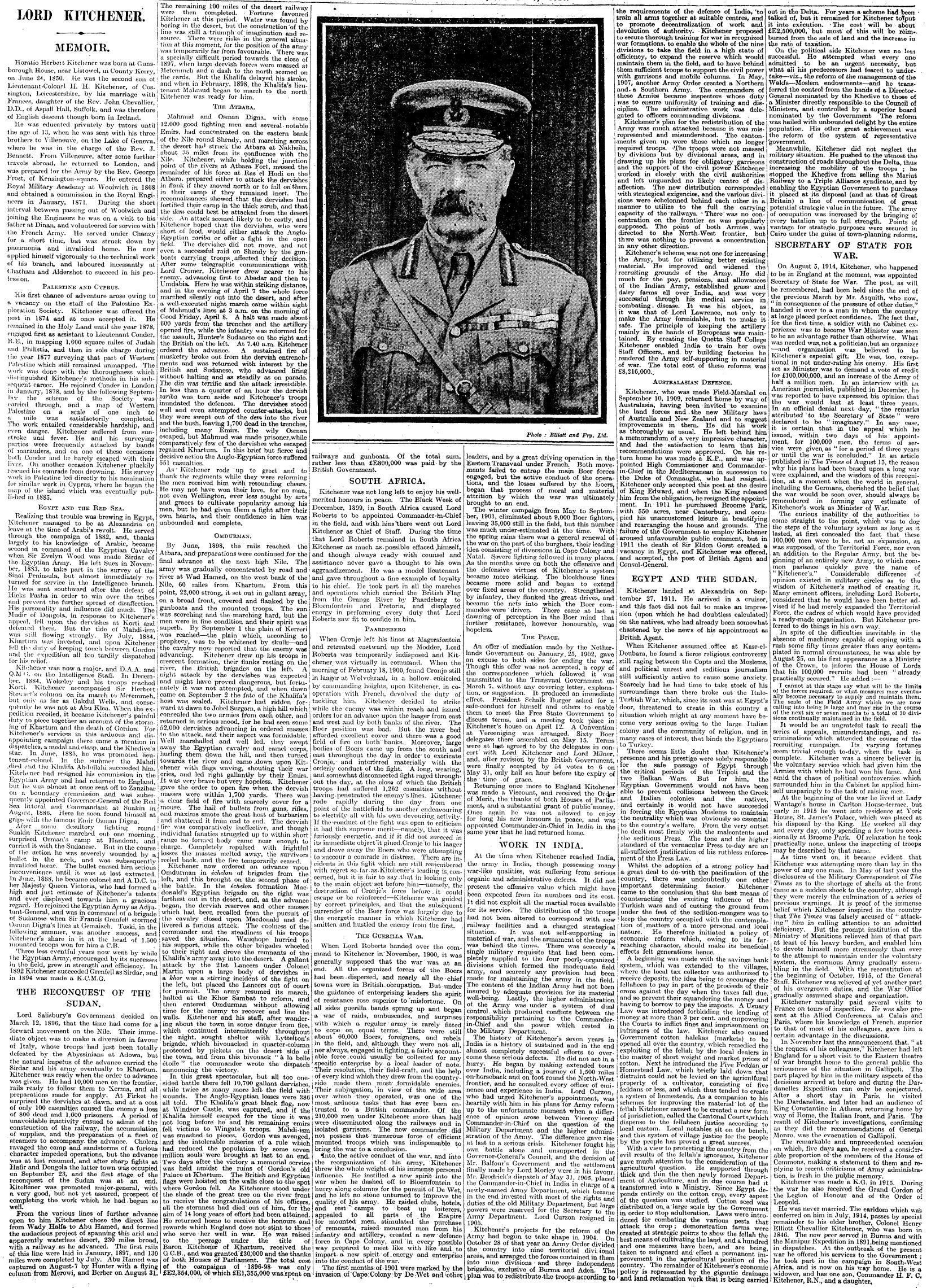
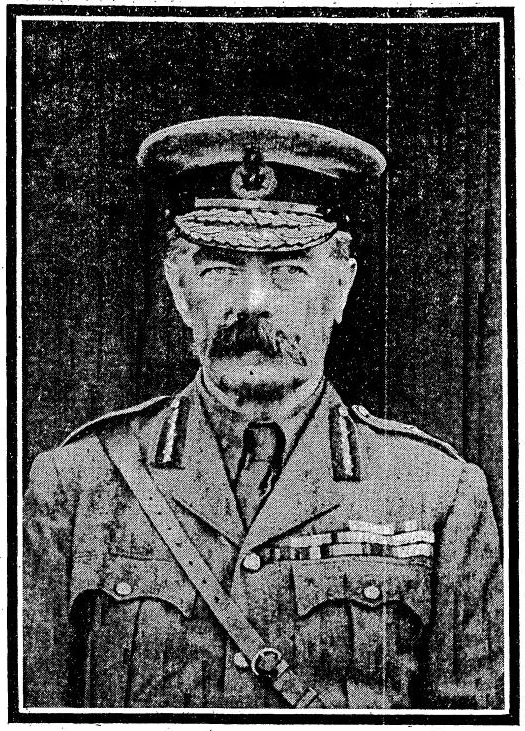 The Times 7 June 1916 p14. Click for the full obituary. Although The Times had started printing photographs before the war they were a rarity and became more so as the war went on. The fact that Kitchener gets a photo at all let alone such a big one says something about the esteem in which he was held. Notice the squint removed from the famous recruiting poster.
|
Who Are We? The Samizdata people are a bunch of sinister and heavily armed globalist illuminati who seek to infect the entire world with the values of personal liberty and several property. Amongst our many crimes is a sense of humour and the intermittent use of British spelling.
We are also a varied group made up of social individualists, classical liberals, whigs, libertarians, extropians, futurists, ‘Porcupines’, Karl Popper fetishists, recovering neo-conservatives, crazed Ayn Rand worshipers, over-caffeinated Virginia Postrel devotees, witty Frédéric Bastiat wannabes, cypherpunks, minarchists, kritarchists and wild-eyed anarcho-capitalists from Britain, North America, Australia and Europe.
|





Recent Comments