We are developing the social individualist meta-context for the future. From the very serious to the extremely frivolous... lets see what is on the mind of the Samizdata people.
Samizdata, derived from Samizdat /n. - a system of clandestine publication of banned literature in the USSR [Russ.,= self-publishing house]
|
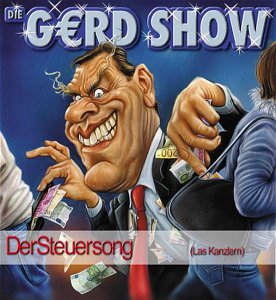
Germany’s hapless Chancellor Gerhard Schroeder has dished out insults at the musician who penned a chart-topping song that Adriana wrote about last week, taking a crack at Germany’s onerous taxes.
Well, tough luck, Gerhard. It seems the Chancellor doesn’t like the fact that the crippling confiscation of German citizen’s money is provoking satire as well as anger. When a politician starts bashing the comics and music makers, it is a clear sign he or she is in trouble – big trouble.
This bespeaks a political elite on the Continent of Europe that is increasingly aloof and out of touch with ordinary citizens. On one level, this is encouraging, because such arrogance usually comes before a fall from grace. However, it also suggests that if the situation is not tackled soon, the anger boiling up in Germany and elsewhere could turn ugly.

Sure, Gerhard. As logical as
assaulting someone’s fist with your face
Paul Staines reports on the latest rather splendid twist in the ongoing German anti-tax protests about which Adriana first reported last month on Samizdata.net
There is a brilliant story at wired news about a tax protest with a difference. It started as a wacky idea in an Internet chat-room but now thousands of Germans have sent Chancellor Schroeder their shirts. Schroeder has donated the thousands of shirts his office has received to charity. Shame he does not show some charity towards taxpayers…

The political campaign is being promoted with this rather fetching picture of Katja Kassin in the process of losing her shirt! Who says the Germans do not have a sense of humour?
Paul Staines
The German Chancellor is clearly feeling just a wee bit insecure these days. Why else would would he actually go to Court to sue a news agency because they claimed that he used dye in his hair:
“With affidavits from his barber, Schroeder insisted that the article was false and that it had created a wave of stories that were hurting his image.”
Would that be his image as an incompetent, plundering, unreconstructed tax-and-spend socialist who is wrecking his country’s economy? Oh right, that image.
Anyway, in order to avoid any legal complications here at Samizdata, I hereby categorically refute any suggestions that the German Chancellor has ever dyed his hair. After all, why would he need to? It is a wig.
Germans are fighting back with humour! The country’s number one hit is called Der Steuersong (The Tax Song), and has found fertile ground in the hearts of a nation fed up with broken election promises and increasing taxes.
The song that shot to the top of Germany’s pop charts with more than 350,000 copies sold within a week is a spoof sung by Schroeder’s impersonator, Elmar Brandt, who has captured the mood of the country in the lyrics:
“Promises that were made yesterday can be broken today….”
“I’ll raise your taxes, I’ll empty your pockets, every one of you nerds stashes some cash away, but I’ll find it no matter where it is…”
“I’ll raise taxes now because the election is over and you can’t fire me now…”
“We could raise a ‘bad weather tax’, or an ‘earth-surface usage tax’, a levy for breathing, air’s going to become more expensive, and I’m only getting started..”
“A tooth tax for chewing, bio tax for digestion – nothing’s free anymore…”
Schroeder’s government of Social Democrat-Greens has slumped dramatically in voter surveys since the September 22 polls after breaking election promises not to raise taxes. On Monday Schroeder announced another new tax on equities and property sales – which the conservative opposition called the 49th new tax since he was first elected in 1998.
“I’ll rip you nerds off, you’ll be overpowered, I’m always in for a surprise…”
“There is no tax that I can’t collect. I want your bank notes, your sweaters, your cash and your piggy banks…”
“Dog tax, tobacco tax, car tax, ecological tax – did you really think that was the end of the line? Like a pirate hunting for income, I’ll raise all your taxes and if you’re broke, you can buy your food at a discount store or go hungry…”
I am not sure it sounds better in German (here is the full English translation) but the spirit of the song is sound. Ordinary Germans say that “it sums up what we’re all thinking.” Fed up with taxes? Well, what are you going to do about it?
The tide of mendacious pro-EU propoganda that has flooded this country for the last 20 years or so, has been so relentless and has become so institutionalised that us beleaguered ‘antis’ were, until recently at any rate, quite despondent about the prospects of getting our message across concerning the reality of this misconceived ‘Reich’.
No lie has been too outrageous and, on occasion, the lies have even been contradictory without anybody seeming to notice. We have been told that Europe is more prosperous, Europe is fairer, Europe is more open-minded, Europe is more dynamic, Europe has less crime, Europe is more modern, Europe is more generous, Europe is more caring, the cost of living is cheaper, everyone in Europe has a better standard of living and (drum roll, please) Europeans are more sophisticated!!
My father told me that he remembers exactly the same things being said about the Soviet Union in the 1930’s.
So it gives me an incalculable thrill to see an article about Europe’s coming collapse in a British newspaper:
“The cause is a self-destruction wrought by a political elite that has wrapped itself in fantastical self-delusion about the superiority of its economic system, the coming ascendancy of the single currency over the dollar, and the tide of wealth and prosperity that would inevitably flow from the relentless pursuit of “ever closer union”. Here, on an epic scale, has been a procession of naked emperors who cannot begin to grasp why the world has stopped applauding.”
The article may be right or it may be wrong but, for my purposes, that almost doesn’t matter; its very publication is the rub. It would certainly not have appeared even a year ago and the fact that it has surfaced now, and in a mainstream publication to boot, is an indication that the tide is turning.
We all know what caused the 9/11 attacks on New York and Washington, right. We all know because we have been told (ad nauseum) by this lot among others that the root causes lie with America’s wrong-headed foreign policy, its empire-building and its constant meddling in other people’s business. If one accepts that argument then the solution presents itself: America should mind its own business, stop arming foreigners, bring troops home and quietly get on with the business of building a peaceful, free, non-interventionist country. Then the worlds bad guys and bullies will simply leave America alone and go off to look for someone else to haunt.
In other words, America should be more like Switzerland. After all, nobody ever attacks Switzerland. Why should they? There’s no reason to. Switzerland is neutral and peaceful and prosperous and…under attack:
“Switzerland is facing the risk of sanctions from the European Union over failures to lift its banking secrecy laws and co-operate with Brussels over a new savings tax”.
Nothing to do with Swiss foreign policy then. Nothing to do with Swiss meddling in other people’s conflicts. No, it’s everything to do with the exceedingly domestic policy of banking secrecy which means that Switzerland is a living, breathing bolt-hole for those desperate Euro-serfs who want to hang on to whatever precious capital they have left and shield it from the endless predations of Brussels. → Continue reading: Root causes revisited
A suicide-bomber has exploded himself in a shopping mall in Helsinki killing eight people and maiming and crippling scores of others. [I find the word ‘wounded’ to be so anodyne and unsatisfactory. It implies that the damage done can be healed by the application of some bandage and a smear of antiseptic cream. Bomb explosions leave people limbless, blind or paralysed]
It appears as if the perpetrator was a 20 year-old student but there is no indication as to his motives. Of course, given the style of attack, thoughts immediately turn to Islamic radicals but there is nothing in the reports thus far to suggest this and, in any event, why they should target the Finns is beyond me.
More likely this young man’s head was buzzing with some other kind of savage insanity but the method he has used to vent it does have some significance nonethless. We have never been short of psychotics or dangerous malcontents in our midst but when they do finally unhinge they typically do so by taking pot-shots at their employers or attacking their landladies with a kitchen knife.
Is this changing up a gear? Could it be that the suicide-bombing is becoming the preferable modus operandi for the deranged and the grudge-ridden? It is certainly a far more dramatic way of leaving your forget-me-not impression on a world that you loathe and that you believe loathes you.
Maybe I am extrapolating too far here. It is, for sure, too early for anything like a cogent analysis. But, if it turns out that I am on the right track, then we all better start watching out for that twitchy guy on the bus; that thing on his shoulder could be a lot more than just a chip.
Paul Marks points out the importance of remorselessly pushing out the libertarian memes into a world that does not ‘get it’.
As I write this the results of the German general election are not known. However, there will be few clear lessons to learn even if the Red-Green alliance win (as it could be argued that the Germans voted Red or Green out of hatred of the United States and hatred of Jews [oh sorry, ‘love of the Arab people’] rather than because of support of Red/Green economic policy).
However, the recent election in Sweden teaches us some clear lessons. Promising tax cuts and pretending there will be no cuts in the Welfare State (the policy of the Swedish opposition “Moderate Party”) does not work. People, quite correctly, reject the idea that ‘public-private partnerships’ (or other clever schemes) mean that one can have tax cuts and much the same level of ‘public services’.
The Swedish election also shows us that given the choice of tax cuts at what people believe will be the ‘cost’ of cuts in the public services most people reject tax cuts. Although (it could be argued) that an honest approach “we are going to cut taxes and government spending” would have done better (some people may have voted against the Moderate party because they were seen as liars).
The basic ideology of our age is that government should look after the poor, the weak, the children, the old, the sick (and so on). So are we doomed? Is libertarianism (which runs directly counter to the basic ideology of our age) simply never going to be ‘relevant’ to most people?
I do not think we are doomed. I continue to believe that in a time of economic crisis people are capable of changing their beliefs.
It is a matter of making libertarian ideas known – not so they will be accepted now (they will not be accepted at present), but so that they are available to be turned to in a time of crisis.
Paul Marks
This piece by Janet Daley in today’s Telegraph is of interest, and these paragraphs are the heart of it:
… there must be a lesson here for those who hold – and would like to proselytise – currently unfashionable opinions. How exactly has this happened? How is it that this stance, which has been travestied and traduced by the entire Left-liberal media behemoth, has still managed to win through to the hearts and minds of so many fashionable anti-establishment people?
And perhaps even more beguilingly, why are so many acerbic comedians and social satirists happy to stand up in public for a cause that has been largely associated with politicians who have never knowingly told a joke? …
Of one thing I think we can be fairly sure. Harry Enfield, Bob Geldof, Vic Reeves et al were not won over by Teresa Gorman’s ‘street cred’ or Norman Tebbit’s hairstyle. Neither the cut of Norman Lamont’s suits nor John Redwood’s demotic vocabulary made them think: “Hey, these guys are my sort of people. I like the look of them. What’s this they’re saying about the European single currency being a bad idea for Britain? I think I’ll join up.”
No, I believe not. They must have been – wait for it – persuaded by the arguments. Imagine that. They must have heard people who look and sound nothing at all like them, saying things that struck them as basically sound. …
I’ve been flogging away with ideas for the best part of my adult life so far, so you might expect me to greet JD’s piece with unmitigated reverence. However, one of the ideas I’ve been flogging away at is that persuading members of the Conservative Party to support something is not the kiss of life, rather is it the kiss of death. This is not an idea of the kind JD is talking about; it’s a propaganda idea, a focus group idea, an idea about how to win arguments by unfair means as well as by fair ones. It’s an idea about “positioning”, “associating”, about atmospherics rather than just about principles. (At the risk of getting too technical, much of the idea of being principled is itself an idea about atmospherics.) → Continue reading: “Opposition to Brussels is becoming fashionable” – Thoughts on The Divide
There is an interesting article in the print version of Inside The Vatican (sorry, no article link at their meagre on-line site) about Rabbi Israel Zolli, formerly the Chief Rabbi of Rome from 1939 until 1945.
So if Pope Pius XII was an anti-semitic pro-Nazi collaborator in Italy as some have claimed, why did Rabbi Zolli convert to Christianity in 1945, professing his admiration for the pontiff? Zolli was certainly in a position to know what the truth of the matter was! The fact the Pope was no supporter of Zionism did not mean he was antagonistic to Jews.
Clearly the reality is the calumnies against Pius XII have more to do with modern agendas than historical facts.
The Dutch have rained scorpions of political death onto the Centre-Left coalition government and driven the List Pim Fortuyn into second place behind the Christian Democrats making it highly likely that that the ‘List’ will form some part of a new Centre-Right coalition government.
It is a spectacularly vicious kick in the Nether regions for the left but will it actually amount to anything more than ripples across a very stagnant pond? The media hacks have been quick to point out that, minus their charismatic leader, the ‘List’ is a party which is less than three months old and appears unfocussed and a little incoherent. For once, this may be more than the familiar journalistic (which is to say, socialist) whining and sour grapes. There does seem to be something which is rather cobbled-together and even rather amateurish about the ‘List’ which, whilst it may have benefitted from a sympathy vote to a degree, is also the collective expression of an impatient, anti-consensus, anti-elitist grouch.
Such movements, when they actually do get anywhere near the corridors of power, have a tendency to be ineffective; proving to be nothing more than smoke, mirrors and tinkling brass. Lacking both political nous and a clear vision, they may find themselves being outmanoeuvered by their establishment foes who, while lacking any enthusiastic support, nonetheless possess the guile and experience sufficient to form the de facto coalitions and horse-traded allegiances that ensure that they keep their grip on the real levers of power.
And the Dutch will find themselves right back where they started.
It seems the death of Dutch politician and media commentator Pim Fortuyn, which continues to reverberate in the blogosphere and elsewhere, has shed light on just how useless the words ‘left’ and ‘right’ are when it comes to making sense of the political and cultural landscape.
An article in the latest edition of the UK weekly magazine The Spectator by Melanie Phillips, makes an attempt to figure out how Fortuyn grappled with the issues of defending secular, liberal democracies against influences thought to be malign, like militant Islam. But she fluffs it.
Take this dumb paragraph:
“Above all we have to reassert liberalism as a moral project which does not pretend to be morally neutral. We have to acknowledge that liberal values are rooted in the Judaeo-Christian tradition and sprang from British culture… Liberalism has to be rescued from the clutches of the libertarians, in order to defend liberal democracy from militant Islam on the one hand and the racist Right on the other. Fortuyn was never going to be the answer. He was part of the problem.”
Phillips’ attacks legalisation of drugs, voluntary euthanasia and same-sex marital unions, all causes Fortuyn championed, and avers that such “libertarianism” undermines liberty. Eh? Surely the common thread running through his stance on tax, public sector services, and social issues like drugs was support of arrangements arrived at by consenting adults and a general desire to stop Big Government getting in the way. His opposition to unchecked, massive immigration from largely non-Western societies was predicated on a fear that such freedoms were under threat. One can argue whether his fear was justified or not – I am not entirely convinced either way – but Fortuyn’s views struck me as entirely coherent.
As for liberalism’s roots in the Judaeo-Christian tradition, that strikes me as only partially accurate. Unlike some atheists, I do fully appreciate the contribution of this religious tradition to liberty (such as the doctrine of Free Will) but for starters, what about the heritage of Greece and Rome? What about the Enlightenment?
Phillips’ analysis is flawed because, ultimately, she cannot see how freedom can flourish without state-imposed restraints. Nowhere is there any grasp of how order and rules can evolve spontaneously from below, rather than be imposed from above. This is a shame because Phillips does have some good things to say, particularly on how Fortuyn has forced many commentators used to thinking of politics through certain prisms to sharpen up their act.
|
Who Are We? The Samizdata people are a bunch of sinister and heavily armed globalist illuminati who seek to infect the entire world with the values of personal liberty and several property. Amongst our many crimes is a sense of humour and the intermittent use of British spelling.
We are also a varied group made up of social individualists, classical liberals, whigs, libertarians, extropians, futurists, ‘Porcupines’, Karl Popper fetishists, recovering neo-conservatives, crazed Ayn Rand worshipers, over-caffeinated Virginia Postrel devotees, witty Frédéric Bastiat wannabes, cypherpunks, minarchists, kritarchists and wild-eyed anarcho-capitalists from Britain, North America, Australia and Europe.
|