We are developing the social individualist meta-context for the future. From the very serious to the extremely frivolous... lets see what is on the mind of the Samizdata people.
Samizdata, derived from Samizdat /n. - a system of clandestine publication of banned literature in the USSR [Russ.,= self-publishing house]
|
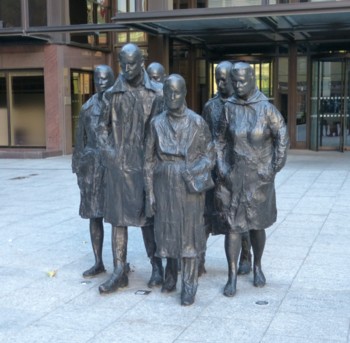
Here is a photograph of a sculpture, which I recently chanced upon, in the part of the city that is London is known as the City of London:
The sculpture is called “Rush Hour”. It said so, on a sign in the ground in front of it. I also photographed the sign. This is a good habit for a photographer to get into. Cameras are not just for taking pictures. They are also for taking notes.
What struck me about this sculpture, as I looked at it and photoed it, was how depressed they all look, especially when compared with London’s sculpted warriors. The warriors depicted on war memorials had any number of agonies to contend with, yet they stick out their chests, jut out their chins, look the world proudly and defiantly in the eye and tough out whatever challenges and horrors they are obliged to endure. These office drudges, on the other hand, have given up. Their eyes point downwards, avoiding any contact with the world or with me and my eyes. They trudge forwards, following the person immediately in front. They do not look like people fighting a war, successfully. They look more like prisoners of war, in a war that their side is losing.
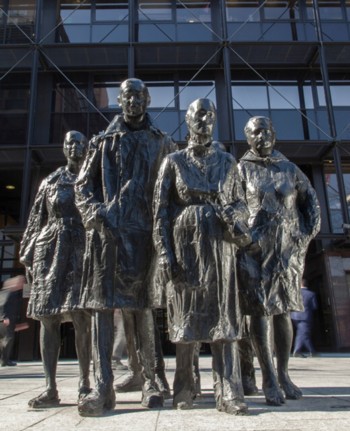
But, when I got home I checked out the website mentioned in the sign in the ground under the sculpture, the sign that I had photographed, and when I did, I got quite a shock. I was confronted by this:
These city commuters are facing the cares and stresses of their lives with a degree of stoical optimism, even heroism, that their cousins in my photograph conspicuously lacked. Urban drudgery may defeat lesser beings from foreign lands, but Britain can do it! We shall prevail! Final victory over financial services industrial monotony will be ours!
I actually had to study the above two photographs quite carefully before being entirely convinced that they are both of the same thing. Are there, I wondered, several versions of this sculpture, in different places? I slowly worked it out. These are the same statues, in each photograph. But the photo at the website was taken by someone crouching down, very low, and perhaps even lying on the ground (which means, for instance, that at least one of the figures at the back is entirely blocked from view). The figures are not on a pedestal, as both photographs make entirely clear. But this other photographer makes them look as if they are.
Particularly significant, as I say, is the matter of eye contact. In my photograph, the commuters dare not look at me. Instead they look downwards. This is why they look so defeated, so ashamed even. But in the website photo, they are looking straight at the camera, and although not happy exactly, they seem proud of what they are doing, and confident that they can face any challenges life presents them with.
The lighting is different, and that does make a difference. But mostly, the difference is in the angle of vision.
The point of this posting is not that the angle you see things from makes a difference. Most of us know this. My point is that, when it comes to the particular matter of human statues, it can make a very big difference, far bigger than I, at least, had realised, until I spent those minutes checking these two photos to be sure that they were of the same thing.
What, I wonder, might be the effect of photographing war memorial statues, statues that are on a pedestal, from a position of vertical equality, or even slight superiority? Suppose, while photographing the figures at the centre of the recently unveiled memorial to Bomber Command, that I had somehow raised myself up to their level, or even somewhat above that level. Might my photographs have looked different in their psychological atmosphere? Would the figures suddenly have seemed less heroic, less like the masters of their fate and more like the victims of it that many of them must surely have felt?
If so, it would appear that pedestals are an even more significant part of our civilisation than I had realised.
You thought that no one could top awarding a Nobel peace prize to Barack Obama, a decision taken, if I recall correctly, eleven days into his presidency?
They topped it.
This is sublime. This is art.
European Union wins Nobel peace prize
“Unlike Mitt, I loathe Sesame Street. It bears primary responsibility for what the Canadian blogger Binky calls the de-monsterization of childhood – the idea that there are no evil monsters out there at the edges of the map, just shaggy creatures who look a little funny and can sometimes be a bit grouchy about it because people prejudge them until they learn to celebrate diversity and help Cranky the Friendly Monster go recycling. That is not unrelated to the infantilization of our society. Marinate three generations of Americans in that pabulum, and it’s no surprise you wind up with unprotected diplomats dragged to their deaths from their “safe house” in Benghazi. Or as J. Scott Gration, the president’s Special Envoy to Sudan, said in 2009, in the most explicit Sesamization of American foreign policy: “We’ve got to think about giving out cookies. Kids, countries – they react to gold stars, smiley faces, handshakes.” The butchers of Darfur aren’t blood-drenched machete-wielding genocidal killers but just Cookie Monsters whom we haven’t given enough cookies. I’m not saying there’s a direct line between Bert & Ernie and Barack & Hillary … well, actually, I am.”
– Mark Steyn
Funny how these trends in kid-friendly TV animals go. Back when I was a nipper, we had Basil Brush, Top Cat, the cast of the Magic Roundabout, the Muppets, and the timeless Tom and Jerry cartoons. A later generation had Roland Rat.
Aficionados like to point out that Basil Brush was modelled on the late, great Terry Thomas. Definitely a Tory.
Remember sing-songs down the pub? OK, do you at least remember hearing that once upon a time there were such things as sing-songs down the pub? And Fred would stroll over to the old Joanna and have a tinkle on the ivories…
If this sounds as remote from modern life as the Wars of the Roses, that might be because for the last few years Fred would have been liable to arrest. The Licensing Act 2003 made live music at pubs illegal without a licence no matter how small the venue.
The good news is that it is no longer a crime to play a mouth organ in a pub without a licence.
The bad news is that for nine years it was a crime, and we submitted.
I’ve just discovered, while reading a Guardian piece about and against censorship by Nick Cohen, that Salman Rushdie has just published an autobiographical work about what his life has been like for the last decade or so, while being subjected to the calculatedly frenzied threats of the Islamist hordes following the publication of The Satanic Verses.
I have never regretted for a single second purchasing my copy of The Satanic Verses, and I still have it. But like many others who voted thus with their wallets, I soon gave up with actually reading the thing.
Joseph Anton, on the other hand, looks like it might be quite a page turner. As a general rule I far prefer reading autobiographies by award-winning literary novelists to reading their award-winning literary novels. Whether I enjoy reading Joseph Anton or not, I won’t regret buying that either. Which I just did.
I have yet to discover why it is called Joseph Anton, but I’ll find out soon enough. And … I just did. While inserting that “page turner” link above, I found myself reading this:
Rushdie’s new memoir, Joseph Anton: A Memoir, takes its title from the name he used while in hiding – which was a combination of the first names of two of his favourite writers, Joseph Conrad and Anton Chekhov.
So there we are.
Bloody hell, I also just found out: 656 pages! That’s a lot of pages to be turning. Maybe just bits of it, eh?
Joan Brady, a previous winner of the Whitbread literary prize, writes:
Costa Coffee should keep out of book prizes – and town centres
In 1993 I became the first woman to win the Whitbread Prize, and it changed my life. Money! One winner blew it all on a swimming pool for the family’s French villa. Not me. Mine paid off my debts: there are few joys in life to beat clearing the slate.
I suppose I should have given some thought to where the money came from. I didn’t. The shortlist was awarded at the Whitbread brewery –which meant I could hardly avoid knowing it had something to do with beer – but how was I to know that Whitbread saw the whole excitement as just an advertising gimmick?
I liked the comment by scepticalhawkeye:
Most of us would have thought that the executives of a brewery at heart saw their life’s work as promoting English Literature.
Joan Brady appears upset that Whitbread has taken over the Costa Coffee chain, so instead of authors being given dosh by noble brewers they are getting it from effete caffeine-fiends. For a moment the flame of hope flickered within me that Ms Brady might be emulating the staunch heroes of of God Emperor of Didcot, in which mighty vows are made that never more shall the arm of the honest tea drinker be made limp by the latte of foreign oppressors! Alas, she just has a thing against Costa:
Costa is strong-arming its multinational way into small towns and villages all over Britain and plonking down its identical coffee shops even though local people in overwhelming numbers – from Southwold in East Anglia to Cottingham in Yorkshire to Totnes in Devon – make it clear they aren’t wanted.
I lived in Totnes for 30 years, and Totnes outdid itself. Three quarters of its population protested against Costa: Totnes already has more than 40 independent coffee shops. That many people agreeing on anything approaches a miracle, a landslide of public opinion. Costa isn’t bothered. It hasn’t bothered with the populations of other protesting towns either. But isn’t this supposed to be a democracy? Here’s a corporate giant flouting the fully expressed will of local people. And for what? To boost a profit margin that’ll go to build more coffee shops in Russia and Egypt – Costa’s largest is in Dubai – at the expense of UK shopkeepers.
As every second comment says, if local people in overwhelming numbers do not want Costa Coffee then Ms Brady’s problem will not persist long. Local people in overwhelming numbers won’t go there, and Costa will cut their losses and go.
In fact there is an issue worth discussing here. I cannot help wondering what Ms Brady would say if local people in overwhelming numbers expressed the view that they did not want immigrants of a different race, Egyptians for instance, setting up shop in their town and making a profit “at the expense of” UK shopkeepers. Would opposition to incomers on those grounds still count as the “fully expressed will of the people” and if not, why not? Isn’t this supposed to be a democracy? Perhaps if she reads the many pointed comments, the CiF crowd being on the right side for once, Ms Brady will be prompted to question the limits of majoritarianism.
Perhaps she will also be prompted to do as so many of the commenters suggest and send Whitbread / Costa back their money. Given that she thinks that only the involuntary contributions of taxpayers are pure enough to fund a literary prize, that would be the principled course of action.
“Nowadays I seldom go to the cinema, and this isn’t only because there are few where I live. It’s because, judging from reviews, there is very little I want to see. It’s also partly because I have the impression that directors now despise dialogue, or resent the need for it, and so often have it muttered just out of earshot, or smothered by music. But the real reason goes deeper, and is also why cinema is in terminal artistic decline.”
– Allan Massie.
Is he right? I would be interested if commenters could give examples of where they think there are still films getting made that are packed with dialogue. As Brian Micklethwait wrote earlier this year about the film, Margin Call, there are still films getting made that are designed for intelligent people who don’t require lots of car chases to hold their interest. (Not that there is anything wrong with a car chase or a straightforward race, such as when Steve McQueen is involved.)
To make a more philosophical point, assuming that Massie is correct – and I think he probably is – does the decline in dialogue mainly reflect the changing demographics of film audiiences? It might do so. The sort of more intelligent material that holds lots of dialogue, credible plots and so on is now increasingly getting made for television, especially in the US. Think of shows (I am not saying they are all good, by the way) such as Mad Men, The West Wing, CSI, 24, Grey’s Anatomy, The Sopranos, etc. And of course another factor is how, as humans, we tend to remember the good stuff and forget, or try to forget, the old 80-20 rule: 80 per cent or so of most stuff that ever gets made is utter crap. Even most Elizabethan plays were probably not all that good. But we remember Shakespeare.
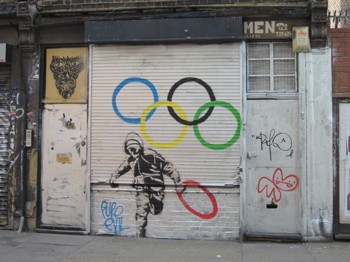
I’m at least a week late with this picture (illness blah blah), but it remains one of my favourite Olympics images, snapped by one of my favourite bloggers, Mick Hartley:
Suddenly I heard myself asking: Yes, why couldn’t those damn rioters have waited until the Olympics? Not really, but I did think it. (What I really think is that rioters shouldn’t. And before anyone says, it’s different if all you do is call yourselves a Riot and play noisy tunes.)
But to take my question seriously, I suppose rioters can tell when they’ll be allowed to run riot for a little while, and when they absolutely will not. Had they tried anything seriously wicked during the Olympics, they would have been crushed without mercy, the crushing egged on by the very people who, during and after the actual riots, were most sympathetic towards the rioters.
Interestingly, a little two-part BBC2 TV show about the riots was billed in the Radio Times to be shown just before the Olympics. But then it was postponed.
Photoed by me in Vauxhall Bridge Road, earlier this week:
I liked this enough when I first set eyes on it to snap it up, and that was two days before I even noticed the “we’ve got one ‘ere” bit. Like I always say, my camera regularly sees more than I do.
Website here.
I was surprised to discover today (unless I have been more than usually let down by my internet searching “skills”) that this, by Douglas Adams, has never been mentioned here at Samizdata before:
“On its world, the people are people. The leaders are lizards. The people hate the lizards and the lizards rule the people.”
“Odd,” said Arthur, “I thought you said it was a democracy.”
“I did,” said Ford. “It is.”
“So,” said Arthur, hoping he wasn’t sounding ridiculously obtuse, “why don’t the people get rid of the lizards?”
“It honestly doesn’t occur to them,” said Ford. “They’ve all got the vote, so they all pretty much assume that the government they’ve voted in more or less approximates to the government they want.”
“You mean they actually vote for the lizards?”
“Oh yes,” said Ford with a shrug, “of course.”
“But,” said Arthur, going for the big one again, “why?”
“Because if they didn’t vote for a lizard,” said Ford, “the wrong lizard might get in.”
That’s from So Long And Thanks For All The Fish. In the place I found it on the www (see the link above), it does not say on what page.
I was reminded about this snatch of dialogue by a recent episode of the BBC Radio 4 show Quote Unquote. A lady participant said she thought Douglas Adams very wise and very funny, this quote in particular. I post it here as a corrective to today’s SQotD, below, in which Paul Ryan says something good, thereby proving himself to be a more likeable lizard than nasty lizard Obama and his lizard gang.
But, alert readers will note that this is a classic example of a piece of writing that will have everyone nodding, but each thinking his own thing. It’s like if you say you favour “common sense”, “principled government”, or “democracy“. Each person listening to you agrees. Each has his own distinct idea about what each phrase means, in ways that often wildly contradict the ideas in the heads of his nodding neighbours. All agree, that these are fine things. Far fewer actually do agree about anything of substance.
For some, reading the Adams quote above, the lizards in charge of us are too capitalist inclined, for others they are insufficiently capitalist inclined. Some want the lizards to be keener on policy X, others curse the lizards for being insufficiently opposed to policy X. All agree only in being unsatisfied with the rule of the lizards, and that the lizards are indeed lizards.
Which is one reason why the lizards usually survive and thrive. We, their victims, can so very rarely agree amongst ourselves about what species, or indeed if any species, ought to replace them.
No long review.
Just whose fault the peril Gotham (not New York – honest) was. Indeed the peril of Western civilization.
Many people – but three billionaires spring to mind
One obsessed with money – no honour, good sense undermined by greed (leading to consequences he did NOT want). Jamie Dimon and so many others who supported for Obama for corporate welfare?
One with utterly perverted idealism – the George Soros figure. Secretly financing and organizing the Occupy Movement (and worse).
And the good billionaire – who has given up on the world, hiding with his bad memories in his house (thus leaving the world to the evil).
Greed.
Collectivism.
Despair.
Call me selfish, but the only life I want to ruin is my own.
– A rather (I think) noble sentiment, expressed in a recently-shown-on-Brit-TV episode of the show by one of the 2 Broke Girls, the dark haired one who has always been poor as opposed the blond one who used to be rich.
Find a bit more of the conversation during which this was said, by scrolling down here, to where it says “Brokeback Girls”. Lesbians eh? Wherever they look, they see more lesbians. Mind you, the brunette character is called “Max”.
|
Who Are We? The Samizdata people are a bunch of sinister and heavily armed globalist illuminati who seek to infect the entire world with the values of personal liberty and several property. Amongst our many crimes is a sense of humour and the intermittent use of British spelling.
We are also a varied group made up of social individualists, classical liberals, whigs, libertarians, extropians, futurists, ‘Porcupines’, Karl Popper fetishists, recovering neo-conservatives, crazed Ayn Rand worshipers, over-caffeinated Virginia Postrel devotees, witty Frédéric Bastiat wannabes, cypherpunks, minarchists, kritarchists and wild-eyed anarcho-capitalists from Britain, North America, Australia and Europe.
|






Recent Comments