We are developing the social individualist meta-context for the future. From the very serious to the extremely frivolous... lets see what is on the mind of the Samizdata people.
Samizdata, derived from Samizdat /n. - a system of clandestine publication of banned literature in the USSR [Russ.,= self-publishing house]
|
Yes, the Liberty League Freedom Forum 2013 is coming to London soon, and yesterday I booked my place at it. This cost me twenty five quid plus a small booking fee, and that price includes meals, so this would be quite a bargain even if all that the product consisted of was the meals. And if you are one of those peculiar people who does not live in London or nearby, and you take the “with accommodation” option, that will cost you a further … ten quid! For two nights of “hostel” accommodation. What that means I am not sure, but if a roof is involved it is also quite a bargain.
Common courtesy, however, demands that if one takes one of these amazingly enticing deals, as I just have, that one will also pay at least some attention to the events during the day, in between the eating and the hostelling.
So it helps that there is an impressive array of speakers. There are names that are familiar to me, like: Baker, Bowman, Davies, Dowd, Singleton, Wellings, to name but a few of the ones I know well. And there are others I hardly know at all, which you also want when you attend something like this, like Abebe Gellaw, exiled Ethiopian journalist and activist, and Wolf von Laer, Chairman of European Students for Liberty. And there are in-between people, whom I approximately know or know of, but would love to get to know better. Here is the full list of speakers and subjects. (Well, fuller, see below.)
The talk I am most looking forward to is the one by libertarian historian Steve Davies, entitled: “Health Costs: Always Up?” Good question. And given what a great speaker Davies always is, great answers are bound to be supplied.
Recommended. Given the prices being asked, I would recommend that you consider, soon, if you would like to go, and if you decide that you would, to book soon also.
Plus, I just re-read the email I got from Liberty League yesterday, which got me thinking about this event, and it started like this:
The UK’s biggest pro-liberty conference is only a few weeks away. We have even more speakers now confirmed, with legal expert Professor Randy Barnett on libertarian law, Professor Terence Kealey on the “Innovation versus Leviathan” panel, Peter Botting leading the public speaking workshop, Dr Tim Evans on anarcho-capitalism, Linda Whetstone on liberty movements around the world, along with the Institute of Economic Affairs’ Mark Littlewood, and author JP Floru.
They’ll have to talk fast.
A few months ago I gave a talk to Libertarian Home, of the sort that happen regularly at the Rose and Crown in Southwark. (They have a speakerless social at the same venue which I intend to be at, tomorrow.) My talk was … well, to put it kindly, it was somewhat less than the sum of its parts. It had its moments, but it didn’t add up. Worse, the more I struggled to pull it together, the longer it went on and the more incoherent it got.
But something good may yet have emerged from this muddle, because Libertarian Home’s Simon Gibbs and I recently agreed that it might make sense to rescue (i.e. for Simon Gibbs to rescue) one of the somewhat better bits of this talk and make it into a video short. Simon has now done this, with added graphics.
The subject is something I have already blogged about here, namely the tendency of statist measures to start out quite good, only later going wrong and then ever more wrong, and on the other hand the tendency of a truly free market, when a particular bit of it starts, to be a mess, and only somewhat later to start getting seriously good and in the long run superb. Two intersecting graphs, in other words, one going up and then down and down, and the other going down and then up and up.
My first label for this phenomenon involved hockey sticks, but when it comes to graphs the hockey stick is well and truly taken, and now I’m calling my graphs “alpha” graphs, because that’s how they look when put together.
Alas, even this bit of my talk could have been a whole lot more eloquent. For starters, I should have waved my arms around in a way that fitted how the graphs would look to the audience. As it was, I got them the wrong way around, sideways I mean, and hence somewhat clashing with what Simon does with them in his superimposed graphics. Nevertheless, the basic idea survives, I think, and is usefully provocative of further thought, as Simon demonstrates with his own further thoughts.
My own main further thought about the Alpha Graphs (here’s hoping those capitals catch on) is that the Adam Smith Institute should be mentioned in connection with them. One of the ASI’s basic tactical insights from way back is that there are indeed often many advantages to be gained and gamed by politically well-connected individuals or organisations or companies, from statist policies rather than free market policies, but that with a bit of cunning these tendencies can be countered, for instance by making the arrival of a competitive market very much to the advantage of a few big early participants, or with right-to-buy, right-to-sell arrangements with regard to such things as public housing that goes back into the market. It’s a matter of how you sell the new market, and to whom. Instead of just using Public Choice Theory (the Alpha Graphs being a tiny part of all that) to excuse libertarian policy failure; use it to point you in better (because more politically effective) policy directions.
That isn’t the complete answer to the problems described by the Alpha Graphs, but it is certainly a part of it.
The other thing I want to repeat in this posting is that I think that short videos are an excellent way to go, when it comes to spreading libertarian ideas, provided only that you know how to produce them adequately. (The technique has recently been used with great effectiveness by the Adam Smith Institute’s own Madsen Pirie to explicate basic economics.) I hope Simon Gibbs produces many more such video quickies in the next few years, and helps and encourages others to do the same, both in the form of excerpts from other bigger performances (by no means only from performances that he himself has recorded), and in the form of original creations of his own. Such a program could be a great developer of future libertarian star performers, as well as a chance for older libertarians like me to add their pennyworths.
Arranging a meeting and chairing the Q&A of it is hard to combine with actually listening to all that gets said. So when it comes to what I personally learned from Sam Bowman’s excellent talk at my home (already plugged here) last Friday, and from the various reactions to it from the rest of us, it’s a case of me picking out verbal cherries, rather than me now being able to describe the entire fruit bowl. Mostly what I want to say is what an excellent restart Sam Bowman gave to Brian’s Fridays 2.0.
Bowman’s starting point was the difference between, in Donald Rumsfeld’s famed phraseology, “known unknowns” and “unknown unknowns”, on the one hand the things you know you don’t know and quite consciously and deliberately choose to remain ignorant of, and on the other hand the things you don’t even know are out there to be known about.
I know that I don’t know how to sort my computer out when it malfunctions worse than trivially, but I have many friends more computer-savvy than I am. So for me, computer expertise is a known unknown. I am neglecting it, but do so “rationally”. I am approximately aware of what I am neglecting, and of the approximate costs attached to such neglect.
But what of unknown unknowns? As Sam Bowman so wisely said, those are harder to describe! If you could think of an example of an unknown unknown, then it wouldn’t be unknown, would it? The point being that unknown unknowns only reveal themselves in the form of surprises, “surprise” being a word that Bowman returned to quite a few times.
The case for a free society is not that we know exactly how it will be wonderful, but rather that it allows an infinity of different bets to be placed on where it is and where it’s headed and where it should be headed. Some of these bets will be right, a few very much so, although as much by luck as by judgement. In a centrally governed society, where one particular viewpoint is given the force of law, that one dominant judgement is almost certain to be wrong.
You can talk about “unknown unknowns” in retrospect, though, once they have finally made themselves known. Sam concentrated in particular on the now widely known, but a few years back not at all widely known, privileged legal position of those three now famous “ratings agencies”, S&P and … er … the other two. (He did of course say, but I wasn’t taking notes.) Also not at all widely understood were the Basel Accords (Sam rather charmingly called them what to my ear sounded more like the “Basil” Accords), which, in effect, positively demanded that banks to buy lots of “investments” of the sort then assumed prudent but subsequently revealed to be the opposite. The financial crash happened as a result of central bankers all scrupulously, in the name of “prudence” (remember her?), doing exactly as they were told to do and as they assumed they ought to do. This was a crash caused not by the neglect of duty, but by the misunderstanding of what duty really demanded. The bankers were not evil and greedy. They were misinformed. As is further illustrated by their own personal investment decisions, which were much the same as the investment decisions they made on behalf of others.
Others present may want to correct and fill out the above description of what Bowman said, Bowman himself in particular. I do not now plan to record my evenings for posterity, and this one wasn’t. I’d welcome comments about the wisdom of that decision. On the one hand, recoding would be a nice service for those who can’t attend. On the other, I want speakers to feel that here is a chance to explore, in a friendly setting, ideas they may not yet be completely on top of. I particularly like asking people to talk about things that they hadn’t perhaps realised were worth talking about, or people who have not themselves done much public speaking and maybe didn’t know they had it in them (in among other more practised and confident speakers). Recording equipment might get in the way of all that. There is, after all, nothing to stop someone else recording them talking about what they said at my place.
The reaction to Bowman’s talk can be summarised as: well, maybe, maybe not. The feeling of the room was that some people had given at least some thought to the possibility of looming financial disaster. Advice had been given to the higher-ups that was based on all kinds of assumptions holding true: provided this or that, then all will be well. The higher-ups tended to hear only the “all will be well” bit, while neglecting the earlier stuff about the assumptions being made. But the people who had given the advice certainly remembered the earlier bits. But what could they do, once those assumptions started to look seriously dodgy? The advisers were not themselves higher-ups.
For me the phrase of the night was “Too big to think about”, see my title above. Like many a memorable phrase, this one is adapted from another common phrase that has been doing the rounds: “Too big to fail”. Too big to fail refers to the dilemma of top decision makers when the proverbial waste matter had already hit the fan. “Too big to think about” refers to the problem of the uneasy lower-downers, the advisers, the quants and the specialists, the ones who did have very bad feelings, beforehand. Too big to think about referred to those for whom the unknown unknowns that eventually clobbered the higher-ups were actually, somewhat, known about beforehand. Various people in the room last Friday “actually heard people say” that if such-and-such does turn out as feared, then we’re all so f***ed there’s nothing that we, and certainly not that I, can do about it. We (I) will have far bigger problems than are covered by my little remit. So, we (I) just have to hope that all will be well, because if it isn’t, that’s … too big to think about!
Which leads inevitably on to the question of how much it was merely pure ignorance that was in play here, and to what extent moral turpitude was involved. How “pure”, that is to say, was the ignorance? There is, after all, a particular sort of immorality that consists of refusing to face unwelcome truths and to think about them in any detail. (Someone mentioned “unopened envelopes” at this point in the discussion.) The consensus of the evening, at any rate from where I stood (which tells you something of how crowded the room was), was that Bowman was making an illuminating extreme point, so to speak, but that the truth was somewhat more muddy and more morally complicated.
What was it about these financial institutions that made them vulnerable to such fingers-crossed, hope-for-the-best, ignore-the-worst, group-think? Mention was made of how a much more widely known-about-in-advance and much criticised set of rules, involving government guarantees of bank deposits, caused banks to be all about crazy risks and not at all about their own prudence, truly understood. That made particular sense to me.
I expected Sam’s talk to be good, and it was. But the quality of the Q&A struck me as being of a particularly high quality last Friday, with quite a few of those present having personal experience of the financial discussions and dilemmas being alluded to. Which is a further reason to maybe not freeze the speakers thoughts electronically. What if, in the light of what he hears from the floor, he ends up thinking slightly differently about his subject than he did when actually speaking?
What I particularly liked about the evening, aside from the quality of the speaker and the quality of the audience that the speaker attracted, was that, instead of assuming total stupidity or total villainy on the part of people from whom we hope and continue to hope for different and better thoughts and decisions, we were all, thanks to Sam Bowman’s eloquent lead, making a serious attempt to get inside the heads of these various decision-makers and their advisers. Arguing works far better if you seriously try to understand where other people are coming from and how they see the world, rather than just making insulting assumptions about their motives and thought processes. Us libertarians (in particular me libertarian) getting better at arguing is (for me) what these evenings are all about.
From about 1990 until about 2005, I held speaker meetings at my home in London SW1, on the last Friday of each month. I began them because I was a libertarian and we wanted such meetings, and because, having acquired a settled home, I could. And I ended them because their main purpose for me had been to stir up writing for the Libertarian Alliance, which by 2005 I was no longer doing. When the internet arrived as a mass experience, available to anyone with a computer, a telephone line and a few quid a month to spare, around the year 2000, I ceased being an editor of paper writings for an organised group, and became instead a citizen of the blogosphere. Most especially, I became a regular contributor to Samizdata. Suddenly, the blogosphere was where the action was, where the big opportunity was, and it supplied more than enough food for thought and for writing.
But now, my Last Friday of the Month meetings are to resume. Partly, I have discovered that their incidental benefits to me personally were more real than I had realised. Basically, I felt that, very gradually, I was losing touch with people who were in that vital social hinterland between friends and strangers.
But there is also a more public – altruistic, you might say – reason for me to crank these meetings up again. In retrospect, I think we can now see that the arrival of blogging was a most unusual time for us libertarians. Libertarian notions had spread rapidly during the years just before the internet and then blogging arrived among us. But because the number of libertarian enthusiasts involved was small compared to the population at large, these ideas had found few outlets in the late twentieth century mass media, which meant that we libertarians reacted to blogging like drowning sailors encountering a lifeboat. Meanwhile, our statist adversaries, many of them comfortably ensconced in what were clearly now the old school media, could at first only grumble about how their seemingly God-given intellectual hegemony had been so insolently challenged. At first, these hegemons behaved as if enough bitching by them about the new media, in the printed pages and on the TV chat and comedy shows of the old media, would send us amateur upstarts back to the oblivion from which we had so rudely emerged. When that didn’t work, they tried linkless fulminating in their, at first, very clumsily electrified newspapers. Only when it became clear even to them that the “new media”, and the new voices enabled by them, were here to stay, that anyone could say to anyone whatever anyone wanted to say, did at least some of the old school journos and organs start seriously adapting.
→ Continue reading: A libertarian meeting at my home on the last Friday of this month
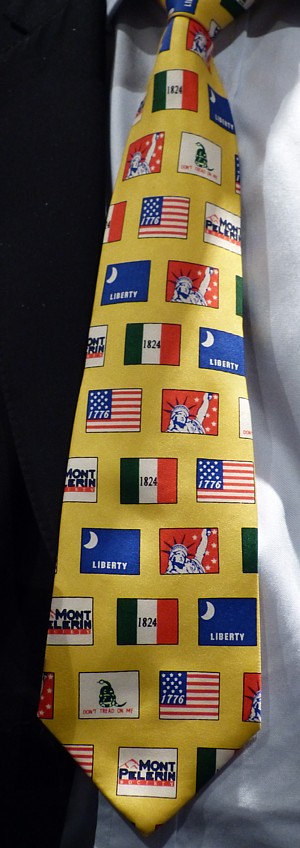
Well, things seem a bit quiet around here today, so here is something I photoed earlier:
I encountered the tie at an IEA event about road pricing. The tie proclaims the fact of and the principles espoused by the Mont Pelerin Society. It was being worn by Dr Eamonn Butler, Director and co-founder of the Adam Smith Institute, and, among many other distinguished things, the author of many fine books explicating and popularising the ideas of freedom and of the free market.
One thing puzzles me, though, and my limited googling abilities were unable to solve the puzzle for me. What was so special about the year 1824? That’s an Italian flag, right? So what happened in Italy that the Mont Pelerin Society regards as so worthy of commendation?
I would have asked Eamonn Butler, but my camera has better eyesight than me, and I only saw the 1824 references when I got home.
The Spectator have made it clear that regardless of what state regulation parliament imposes upon the press…
They will not not cooperate.
We say in our leading article that we would happily sign up to any new form of self-regulation which the industry proposes, no matter how onerous. But we would have no part in any regulatory structure mandated by the state. That is to say: we would not attend its meetings, pay its fines nor heed its menaces. To do so would simply betray everything that The Spectator has stood for since 1828.
To say this is ‘admirable’ would be to damn it with faint praise. It is magnificent.
A Guardian blog commentator attacks the free-market right thus:
[A] criminally insane coterie of maladjusted right wingers – whose regular Pooteresque diatribes against the poor and craven support of neo-liberalism are beyond parody – that infests every political thread on the Guardian blog. Just listen as they condemn themselves out of their own incoherent foaming mouths. Their comments on the poor/disabled/unemployed, exposes the pathology of their neo liberal right wing extremism. Their attack on the NHS is no surprise – how could they not? The NHS stands as a symbol in opposition to everything these disturbed, juvenile, Ayn Rand fantasists and free market barbarians hold dear in their perverse belief system. These people are incapable or unwilling to understand a beloved institution that represents altruism, egalitarianism, self sacrifice and the humanistic collective will of an unselfish inclusive society.
This verminous, parasitic , parvenu, lickspittle, non empathetic sociopathic trash. These reductive whores of unfettered market driven, voodoo Social Darwinism, that wishes to reduce every aspect of humanity to mere units of production, who despise ordinary people, who see their only value, as an entry in a of profit and loss account – to be exploited by the human garbage that this sub-strata of humanity are, and the corporate fascism they serve. To read their comments is to see the true face of their malignant, cancerous moral degeneracy, and in that, they at least serve a purpose. Much like the gargoyles on a church spire, they represent a grotesque warning of how deformed ones humanity can become. These end of pier, amateur hour economists, these workhouse barbarians, these neo liberal whores are, “nothing more than errand boys sent by grocery clerks, to collect a bill,” that we’ve already paid for in full. Long may they continue as a reminder of supreme idiocy and malevolence .
It won’t fit on a T-shirt, but maybe “verminous, parasitic , parvenu, lickspittle, non empathetic sociopathic trash” would.
” Half of the libertarians seem to have gone entirely off the rails… a very vocal half. Fiddle around reading “libertarian” websites and you’ll find all sorts of bizarre things: neo-Confederate denunciations of Lincoln, 9-11 Trutherism, anti-vaccine nonsense, climate change denialism, idiosyncratic “theories” of mental illness, apologia for Putin, arguments for the moral equivalence of Nazi Germany-United States-Israel, and (especially) rabid, blind rage against anyone who dares offer a counterargument. A sensible person, wondering what libertarianism is all about and trying to find whether it offers anything of value, would be so put off by this stuff that they’d forswear libertarianism as a kind of madness. (This isn’t hypothetical — decent people occasionally ask me how I can be associated with such craziness.) So right when the world most needs ’em, libertarians are going bonkers.”
Charles Steele, at his Unforseen Contingencies blog.
Hmmmm. I agree with much of this although it is worth repeating that being a skeptic about the claims made for catastrophic man-made global warming is not the same as being some sort of incorrigible “denier”.
I would also add something else. Libertarianism is no different from any other secular or for that matter, religious creed in having its fair share of nutters, heretics or those who say or do things that are just plain embarrassing. But even nutters can say or do things that open up debates that more “reasonable” people shy away from. Consider just how shockingly radical Mrs Thatcher’s brand of conservatism was made to appear 30 years ago, for example.
Long ago, I learned to stop worrying about this so long as the core message of respect for life, liberty and the pursuit of happiness came shining through and so long as the majority of people who held such views seemed to be, and were, decent people. The problems start when that does not happen.
I just did a recorded interview (for the Cobden Centre) with Patrick Crozier, and experienced the mystery that is Doctor Theatre. This is when you are ill, but performing. For the duration of the performance, the illness goes into a state of voluntary liquidation. As soon as the performance ends, back comes the illness.
I still have the remnants of a cough. When talking at all volubly, I have to stop from time to time, to cough. Except that during this performance, I did not cough once. As soon as the official part of the conversation stopped, I coughed, and Patrick said: that’s the first time you coughed during this entire conversation.
I talked about all this happening before it happened, with another friend. I thought that might spook it. But no. It happened exactly as predicted.
As to whether the conversation I had with Patrick, without coughing, was any good and at all worth listening to, that’s another matter entirely.
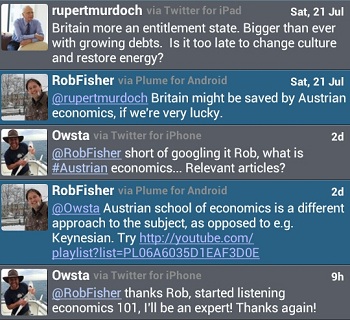
I recently had this conversation on Twitter:
Rupert Murdoch said something and I replied. Someone else overheard and I sent him a link to Madsen Pirie’s series of videos about economics. Well, how would you answer that question in 144 characters? Now one more person knows that there is such a thing as Austrian economics.
I am not surprised to encounter people who have never heard of it. “Economists” are presented as a homogeneous blob by the mainstream media. It is nice to be asked about it and to have the answer be appreciated.
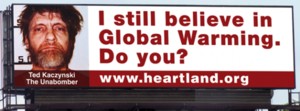
The Heartland Institute has aroused much controversy with its recent anti-global-warming billboards, such as this one:
Here is their announcement concerning these billboards, and the fact that they have now taken them down.
Many climate skeptics are most unhappy. Ross McKitrick, for instance, is “absolutely dismayed”:
I am absolutely dismayed. This kind of fallacious, juvenile and inflammatory rhetoric does nothing to enhance your reputation, hands your opponents a huge stick to beat you with, and sullies the reputation of the speakers you had recruited. Any public sympathy you had built up as a result of the Gleick fiasco will be lost–and more besides–as a result of such a campaign. I urge you to withdraw it at once.
Strike the tone in your advertisements that you want people to use when talking about you. The fact that you need a lengthy webpage to explain the thinking behind the billboards proves that your messaging failed. Nobody is going to read your explanation anyway. All they will take away is the message on the signs themselves, and it’s a truly objectionable message.
You cannot simultaneously say that you want to promote a debate while equating the other side to terrorists and mass murderers. Once you have done such a thing you have lost the moral high ground and you can never again object if someone uses that kind of rhetoric on you.
I’d be very interested to hear what others here – fellow posters, regular commenters and for that matter irregular commenters – think about this. Is this an own goal, as we say in soccer-playing England, or has the Heartland Institute actually accomplished something valuable and important with this operation?
Me, I am genuinely unsure, but at present think that this operation may actually play out rather well.
For instance, I would never tangle with McKitrick over things like bristle cones, but is he right to say that the big advert above is “fallacious”? Surely not. “Believing in Global Warming” is a muddled phrase. ( I have long preferred C(atastrophic) A(nthropogenic) G(lobal) W(arming).) But it just about serves.
My over-all hunch as of now is that these billboards seem outrageous but actually, they are not. They seem down and dirty. Because they pull no intellectual punches, they seem like some of the more disgusting statements perpetrated by CAGW-ers against their skeptic enemies. But, they make various points which are true, and very important, and they tell no lies.
The big point they make, I think, is that all this talk about cute polar bears and melting ice caps and so on, quite aside from usually being mistaken, is not nearly as nice as it seems. It is a part of a huge argument, and not a nice argument at all, which says that modern industrial civilisation is evil and should be trashed, and the human species savagely culled to the tune of millions, sometimes billions. Or: not.
Most of the people who fret about polar bears have no serious designs on western industrial civilisation, nor do they have fantasies of mass genocide. However, all those who do now want industrial civilisation trashed and humanity culled, and a global despotism of people like themselves superimposed upon the ruins, use CAGW as either an excuse or a reason for their nightmare projects. The psycho-politicians who launched the various global institutions which funded the “science”, and the mass propaganda, behind the CAGW scare had exactly these murderously destructive ends in mind. (For a brief summary of this story, I suggest, once against, the excellent Watermelons.)
One of the few Big Points about which I entirely agree with the more fanatical CAGW fanatics is that this is indeed a very important argument. However, I think it very important that my side should win and that theirs should lose.
The CAGW scare is indeed not a small spat about polar bears. It is a very big confrontation, right up there with such things as Civilisation versus Communism. Indeed, again as these posters indicate, the CAGW scare is in many, many ways, Communism 2 (and to a somewhat lesser degree also Nazism 2).
This is why, exactly as these posters highlight, a succession of history’s recent villains, great and small, have aligned themselves with the CAGW scare, and have in some cases been strongly influenced by it.
I presume many on the CAGW side are now also getting very angry about these billboards. But again, this was one of their purposes. You shouldn’t be this horrid, eh? Well no, maybe you shouldn’t. Comparison is invited, between these insultingly true billboards and the insultingly false abuse that has been hurled over the years at people who have opposed the whole CAGW scare, people like Ross McKitrick for instance. Far from lowering the tone of the CAGW debate, I suspect that these billboards may well end up raising it.
I always have my doubts about that “moral high ground”. Yes, it’s good to have it, but not if you leave all the other ground in the possession of the enemy.
Also, I think that a great many people will read that Heartland webpage.
I may, after I have studied that webpage and further reactions to it some more, change my mind about all this. But I thought it worth posting my half-formed thinking-aloud thoughts nevertheless, and also hearing anything others have to say here in response.
On the Sunday between the two rounds of voting for the French presidential election, a curious thing happened in North-West London. Two Frenchmen rang the doorbell of my parents’ house and asked to speak to my mother (who is French). They wanted to know if she would be supporting Nicolas Sarkozy next Sunday, and if she had any doubts, would she like a leaflet outlining the President’s agenda for his second term. Naturally, not a word of English was spoken.
As it happens, I have never been canvassed in France for a French presidential, or any other kind of election. I was under the impression it was not done the same way as in the UK (privacy laws and so forth). Yet here were a couple of party activists, one white, the other of likely South-East Asian origin, wandering around London looking for swing voters. With about 400,000 votes cast by French citizens in the first round outside France (a turnout of nearly 40% of the registered overseas electorate), I can see why this get out the vote operation [GOTV] would exist. But even in London, where most of the UK’s half million French people live, it is not a case of calling door to door.
Before recent changes to French election law which create constituencies outside French territories that are represented in the National Assembly, presidential elections in the Fifth Republic (since 1962) were already a worldwide affair. Citizens in such French territories of Wallis and Futuna, Tahiti and Mayotte would cast votes at polling stations in Mata’utu, Papeete and Mamoudzou respectively. → Continue reading: National elections go global
|
Who Are We? The Samizdata people are a bunch of sinister and heavily armed globalist illuminati who seek to infect the entire world with the values of personal liberty and several property. Amongst our many crimes is a sense of humour and the intermittent use of British spelling.
We are also a varied group made up of social individualists, classical liberals, whigs, libertarians, extropians, futurists, ‘Porcupines’, Karl Popper fetishists, recovering neo-conservatives, crazed Ayn Rand worshipers, over-caffeinated Virginia Postrel devotees, witty Frédéric Bastiat wannabes, cypherpunks, minarchists, kritarchists and wild-eyed anarcho-capitalists from Britain, North America, Australia and Europe.
|