We are developing the social individualist meta-context for the future. From the very serious to the extremely frivolous... lets see what is on the mind of the Samizdata people.
Samizdata, derived from Samizdat /n. - a system of clandestine publication of banned literature in the USSR [Russ.,= self-publishing house]
|
Following up on this earlier report here, more London School of Economics Hayek Society, here’s their latest news, from the society’s President Nick Spurrell:
Compassion and Capitalism Event – There will be held a major event tomorrow, Wednesday 29th October, with French thinker Christian Michel from Liberalia, entitled “Compassion and Capitalism”. Please do come along. There will be a talk and then questions and debate. D703, Clement House (Hong Kong Theatre Building) on the Aldwych. 12pm. Wednesday 29th October. No tickets necessary.
Students’ Union Elections – Tomorrow and Thursday (29th and 30th October) there will be held the LSE Students’ Union elections for various positions which hold authority and influence on the policy of the students’ union, the body which regulates the work of student societies including the Hayek Society.
Should you wish to vote, you may do so in the Quad, off Houghton Street on Wednesday or Thursday. The following Hayek Society Committee members are standing:
General Course Representative: Jonathan Gradowski (Hayek Society Auxiliary Officer); NUS Conference: Nick Spurrell (Hayek Society President), Peter Bellini (Hayek Society Financial Officer), Daniel Freedman (Hayek Society PR Director); Postgraduate Students’ Officer: Natalia Mamaeva (Hayek Society Secretary), Ryan Thomas Balis (Hayek Society Auxiliary Officer); Court of Governors: Daniel Freedman (Hayek Society PR Director); Alykhan Velshi (Hayek Society Journal Auxiliary Officer), Matthew Sinclair (Hayek Society Auxiliary Officer); Academic Board: Nick Spurrell (Hayek Society President); ULU (University of London Union) Council: Alykhan Velshi (Hayek Society Journal Auxiliary Officer), Matthew Sinclair (Hayek Society Auxiliary Officer)
Discussion Group Next Monday – There will be held, as usual, next Monday evening, the Hayek Society discussion group. All are welcome, in this informal environment to take part in a chaired discussion. The topic this week will be on the environment. More details soon… Monday 3rd November, 7pm, George IV pub, on campus, upstairs. Please feel free to come along.
The thing that impresses me about all this is that the stuff in the middle, about standing for various electoral offices, is not happening on its own. These people are holding speaker meetings and discussion groups as well.
Libertarians/classical liberals/whatevers who get involved in student politics often justify this by saying that the politicking “draws attention to the ideas”. But often they get so busy politicking that they forget about pushing the ideas. Worse, in order to get more votes in their damned elections they actually conceal or even contradict the ideas in their public statements, on the grounds that the important thing is “successful” politicking and if the ideas don’t help with that, then they must be dumped.
But the important thing is to do the ideas successfully, and if the politicking doesn’t help then the politicking should be dumped.
Politicking makes heat, and you make this heat is to draw attention to the light, which is the ideas. Trouble is, politicking sometimes burns up all the energy that ought to be used making light. All manner of “attention” is thus drawn, to nothing.
These guys don’t seem to be making this mistake. I’m impressed.
My thanks to CNE President Tim Evans for emailing me about this New York Times article, about the Free State project. I usually look at the daily NYT menu. Sod’s Law (and a rugby game – won by plucky little USA) decreed that today I didn’t. First few paragraphs:
KEENE, N.H. – A few things stand out about this unprepossessing city. It just broke its own Guinness Book world record for the most lighted jack-o’-lanterns with 28,952. It claims to have the world’s widest Main Street.
And recently, Keene became the home of Justin Somma, a 26-year-old freelance copywriter from Suffern, N.Y., and a foot soldier in an upstart political movement. That movement, the Free State Project, aims to make all of New Hampshire a laboratory for libertarian politics by recruiting libertarian-leaning people from across the country to move to New Hampshire and throw their collective weight around. Leaders of the project figure 20,000 people would do the trick, and so far 4,960 have pledged to make the move.
The idea is to concentrate enough fellow travelers in a single state to jump-start political change. Members, most of whom have met only over the Internet, chose New Hampshire over nine other states in a heated contest that lasted months.
(The other contenders were Alaska, Delaware, Idaho, Maine, Montana, North Dakota, South Dakota, Vermont and Wyoming. One frequently asked question on the project’s Web site was “Can’t you make a warmer state an option?”)
Once here, they plan to field candidates in elections and become active in schools and community groups, doing all they can to sow the libertarian ideals of curbing taxes, minimizing regulation of guns and drugs, privatizing schools and reducing government programs.
I’ve quoted at some length because the New York Times’ stuff has a habit which I’ve recently learned about of going out of one-click no-cost reach after all while. (Is that recent? Or was I just ignorant about it all along?)
I predict two things about what will happen as a result of this project.
- It will have results.
- The most momentous results will not be what anyone envisaged to start with.
The law of unintended consequences applies, after all, just as much to libertarians as it does to anyone else. Most gatherings of the faithful in the USA seem to result in a bit of spreading of the faith but not a lot, and then, interesting business activities.
One thing already seems likely, however, which the moving spirits of this project did intend. It will stir up media interest in libertarian ideas, not only within the USA but to some extent also beyond it, this New York Times piece being a perfect example of that process.
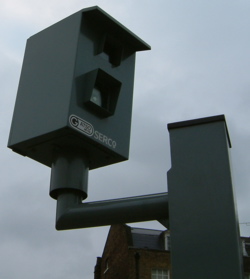
The GATSO killers must be starting to give the state a serious headache.
From the UK Times:
THE police have come up with a new way to catch irate motorists who vandalise speed cameras: set up other cameras to film them in the act.
And then other cameras to film those cameras and still more cameras to film those cameras and……
A closed-circuit television system would be installed beside the speed traps under plans being considered to curb a spate of attacks in which 700 cameras have been burnt, pulled down or had their lenses spray painted.
Of course this means that the closed-circuit security cameras will become targets as well. It seems that the campaign of the GATSO killers is moving beyond the sporadic outbursts of pique and onto a low-grade insurrection.
Today I received an email from the LSE (that’s London School of Economics) Hayek Society. I’ve been in occasional touch with this operation over the years, and have attended a few of their events, which have always been lively and well organised. It would appear that, this academic year, under the leadership of Nick Spurrell (whom I met again a few weeks ago at the office of the International Policy Network office where he was helping out over the Summer, alongside samizdatista Alex Singleton), the Hayek Society is keeping all this going in fine style.
They have elected a new Committee. Here it is:
President: Nick Spurrell; Vice-President: Lauri Tahtinen; Treasurer: Sarah Meacham; Secretary: Natalia Mamaeva; Financial Officers: Vicky Yuen, Peter Bellini; Events Officer: Szymon Ordys, Louis Haynes, Oliver Dully; Editor-in-Chief: Erica Yu; Co-editors: Michael Chen, Harry Cherniak; PR Director: Daniel Freedman.
Now apart from Nick, I don’t know who these people are whose names I’ve just put up here in lights. But I like it that many of these names are female (Sarah, Natalia, Vicky, Erica), and that many are non-British (Tahtinen, Mamaeva, Yuen, Ordys, Yu). All the non-Brits could just be Americans, but I’m pretty sure that there are more places of birth involved that that. These people are bound to attract lots more people, of lots of types, from lots of faraway places. I mean, if each of them invites four friends … In a university, a mere two or three people can make a huge difference. The Hayek Society already has a definite thirteen, and the year has only just started. Extraordinary.
The Hayek Society has for years now been dosing the LSE with the message of limited government liberalism – liberalism, that is, when it really was liberalism and before the socialists of the sort who infested the LSE during an earlier era got hold of the word liberalism and turned it on its head. And through the LSE, the Hayek Society will dose lots of other places besides in the years to come. Get them when they’re young …
The LSE is an important place and always has been. For good or ill, what they think today, the world thinks tomorrow. And this time around it’s for good.
The Free State Project is a group in the USA looking to get at least 20,000 liberty oriented activists to move to a single state in the USA so that they can have more political impact somewhere rather than be lost in the sea of Republican and Democrat statists by being scattered across the country.
And the result of the vote to see which part of the USA they would all move to is… New Hampshire.
Godspeed to you all. I shall be watching this project with great interest.
You’ve had a long, hard day. You want to go home to relax and unwind. You can hardly wait for that sweet moment when you place your key in the lock of your own front door. You make your way back to your car as it begins to rain. Your feet hurt. You’re getting wet. You want your comfy sofa and a hot meal and the TV and your warm bed. You finally reach the place where you parked your car only to find….disaster! It’s been clamped!
You stand there helplessly while the rain pitter-patters on your brow. Your blood begins to boil into toxic fumes of rage and frustration. You are stranded and alone, feeling victimised and vulnerable.
But, just at that moment, from out of the scudding, grey skies there swoops down a heroic figure of salvation to end your torment and set you free. Is it a bird? Is it a plane? No, it’s Angle-Grinder Man! → Continue reading: Desperately seeking heroes
Like I said, respect for the law appears to be on the wane. Although the word ‘hostility’ might be even more apposite:
They are the black knights of the road; balaclava-wearing highway hitmen out to burn, bomb, decapitate and dismember. But drivers need not fear, for it is speed cameras that this growing band of rebels are after.
Up and down the country, the tools used to keep roads safe are being ripped down, blown up and even shot apart as part of a campaign orchestrated by a gang of web-surfing outlaws. They threaten to become the most popular gang of criminals since Robin Hood and his Merry Men stalked the countryside.
Forsooth, methinks the commoners may be in need of folk-songs.
From the south coast to the Highlands no camera is safe. Known as Gatsometers, or Gatsos, they are being destroyed at a rate that has alarmed police forces. Particularly destructive cells are operating in north London, Essex and Wales – where they rage against machines deployed by renowned anti-speeding police chief Richard Brunstrom.
With each unit costing £24,000 to replace, a huge bill is being run up. But the rebels are unrepentant, claiming the cost is more than met by speeding drivers’ fines. Speed cameras, they argue, are not about keeping roads safe, but about raising revenue. The charred remains of their victims are often adorned with stickers or graffiti which declare cameras to be stealth tax inspectors.
Of course, we at Samizdata.net could not possibly condone these irresponsible actions by an anti-social minority. 
The Target for Tonight? [My thanks to Dr.Chris Tame for posting this story to the Libertarian Alliance Forum.]
Emma, in a piece here entitled “Outnumbered 15 to 1”, touches on a problem that I find gruesomely fascinating, and have had to deal with a lot over the years. How do you conduct yourself when in company which you want to keep in with but which holds your opinions about some hot issue of the day in very low regard?
Scenario: you are at a dinner party with several friends with whom you enjoy discussing all sorts of things NOT including politics.
One friend, in passing, drops in a little “it’s all about the oil” or [with sarcasm] “well, the french were just cowardy custards, that’s why all good patriots hate them”, or [in tones of deepest contempt] “it’s just finishing off what Daddy left undone”.
Do you
A) Remove the rather good bottle of Australian wine that you brought, leaving them to drink some French blanc de plonk that one of the Guardian readers brought along, and never darken their doors again.
B) Reply “were the Normandy landings an equally unjustified completion of unfinished business?” (or equivalent riposte, depending on the precise nature of the comment), segueing neatly into a heated discussion in which no one will listen to anything anyone else says and everyone will go home riled up.
C) Change the subject to more neutral ground through whatever means necessary. “Oops, I seem to have spilt red wine on your yellow dress” would serve a dual function of diversion and oblique admonition.
What is the best strategy when talking to people about matters on which they disagree with you? – child rearing, say, to pick an example at random. Persuasion? Leading by example? Dropping in odd hints to indicate that there is an alternative and viable point of view? Careful avoidance of tension filled areas?
Help!
I suggest that for the purpose of this discussion we set aside the matter of whether we actually agree with Emma about the Iraq war. The point of these questions is to dig out some general principles for conducting ourselves in company which disagrees about some contentious public issue, but with which we wish to remain on cordial speaking terms. → Continue reading: On keeping friends by not trying to influence them
Our good friend Dr.Sean Gabb is currently in Sweden where he is exercising his estimable talents (by invitation, I hasten to add) in support of the campaign against the Euro.
Like Britain, Sweden is actually a member of the European Union (remember, it’s a process not a club) but has yet to ditch its currency (the Crown) in favour of adopting the Euro currency. That could all change next month as a result of a national referendum on the issue and which has divided opinion in the country along by-now familiar lines; most of the political, managerial and media elite are strongly in favour but are battling against widespread grassroots scepticism.
It is into this confrontation that Sean (as well as Dr.Madsen Pirie of the Adam Smith Institute) have stepped and from where Sean has written this report:
Adlon Hotel, Stockholm, Monday 25th August 2003
With Mrs Gabb, I am in Sweden for two reasons. The first is to address the summer conference of one of the main libertarian movements in Scandinavia. The second is to help strengthen the no campaign in the closing stages of the Swedish referendum on the Euro. It was my intention to write a long account of the things seen and done during this past week, together with observations on the Swedish people and their architecture and language. But I am presently short of time, and the glare of the television lights has dimmed all else but the events they illuminated. I will write at more length when back in England. For the moment, though, I will concentrate on the second reason for my visit.
→ Continue reading: Fighting the Euro in Sweden
Last night I gave a talk at the Tim Evans household on the theme of “Which Does Freedom Better? Ideas or Institutions?” I followed my usual practice of trying to organise my thoughts during the day of the talk, but this time the procedure didn’t go smoothly, because my thoughts remained stubbornly disorganised throughout the day and remained so on the night. So instead I just flung out as many disorganised thoughts as I could – enough to provoke a dozen postings here, another half dozen at White Rose, and a dozen more at my Culture Blog – and enough to make a decent evening of it for those gathered, if not such a decent talk.
Here is just one idea that I alluded to last night, and I apologise if you think it’s a rather obvious one.
This – to me anyway – fairly obvious idea is that the Internet has surely shifted the balance of power away from the defence of particular institutions and towards the proclamation of universal, “disembodied” ideas. (That word “disembodied”, cropped up a lot last night, as did “embodied”.) → Continue reading: On the particular and the universal – how the Internet has shifted the balance
Here’s some good news, in the form, for me, of an email from the newly launched Molinari Institute’s Director, Cécile Philippe:
I am delighted to announce the arrival a major new French-speaking free market think tank, the Molinari Institute, and the launch of its website www.institutmolinari.org
Named after the great nineteenth century French-speaking classical libertarian Gustave de Molinari, the institute aims to create an environment in which both individuals and businesses can thrive and be free without the ties of regulation and vested interest.
Through its website and conferences “Les soirées Molinari,” it will help the rediscovery of the work of Gustave de Molinari as well as other French and European liberal thinkers such as Frédéric Bastiat, Charles Coquelin and Bruno Leoni. It will focus on public policy issues such as competition, healthcare, retirement and education.
To launch the website today there is an interview with José Pinera, former secretary of labor and social security in Chile, who radically and successfully implemented in the market-oriented 80’s the pension reform.
The Molinari Institute is a non-profit organization. It accepts voluntary contributions from foundations, corporations, and individuals. No government funding or endowments are received.
I should say not. I know Cecile Philippe to be both a fearless and uncompromising libertarian activist, and a thoroughly charming and civilised person, two things which don’t always go together. The ideal combination of qualities for someone running an institute like this, in other words. I wish her every possible success, as will many others.
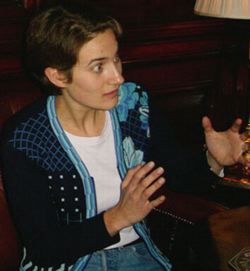
Now I know what you’re thinking. Does Cécile Philippe have a sister? Yes she does
Remember, France counts twice, at least. Whatever opinions, good or bad, sensible or stupid, those French intellectuals may happen to hold, they are, it must be admitted, totally brilliant at spreading them far and wide. Imagine the impact on mankind and its affairs if we could turn the bien pensants of France around, from statists and collectivists into the opposite. That might be a bit incroyable, but wouldn’t it be formidable?
Due to the high risk of an embarrassing misunderstanding here, I think it behoves me to start off by advising our American readers that, in Britain, the word ‘fags’ is a slang term for ‘cigarettes’. It is not generally perceived as having anything to do with homosexual men.
And this is important because cigarettes are no longer just ‘fags’ or even ‘smokes’. Now, they are symbols of defiance as well.
For the past two decades or so, tobacco manufacturers have been forced to print hectoring health warnings on cigarette packets. But now, due to a directive from Brussels (where else?) manufacturers are required cover at least half the space on both the front and rear of the packet with even more lurid warnings. It is the kind of useless, paternalistic gesture that enables the European political classes to posture self-righteously at someone else’s expense.
At last, though, someone is fighting back in the form of a website called ‘Fake Fags’ through which you can purchase waggishly irreverent stickers to cover up the politically-mandated health warnings on your cigarette pack.

It is a delicious act of subversion and, predictably, it has sent the reactionary health fascists into a blue funk:
Deborah Arnott of anti-smoking group ASH criticised the labels.
“These labels do not strike me as being funny,” she told BBC News Online.
Well they strike me as hilarious and I am very heartened that at least some of my compatriots are not prepared to throw in the towel just yet.
|
Who Are We? The Samizdata people are a bunch of sinister and heavily armed globalist illuminati who seek to infect the entire world with the values of personal liberty and several property. Amongst our many crimes is a sense of humour and the intermittent use of British spelling.
We are also a varied group made up of social individualists, classical liberals, whigs, libertarians, extropians, futurists, ‘Porcupines’, Karl Popper fetishists, recovering neo-conservatives, crazed Ayn Rand worshipers, over-caffeinated Virginia Postrel devotees, witty Frédéric Bastiat wannabes, cypherpunks, minarchists, kritarchists and wild-eyed anarcho-capitalists from Britain, North America, Australia and Europe.
|





Recent Comments