A sample text widget
Etiam pulvinar consectetur dolor sed malesuada. Ut convallis
euismod dolor nec pretium. Nunc ut tristique massa.
Nam sodales mi vitae dolor ullamcorper et vulputate enim accumsan.
Morbi orci magna, tincidunt vitae molestie nec, molestie at mi. Nulla nulla lorem,
suscipit in posuere in, interdum non magna.
|
Dr Frederick L. Hoffman, speaking at the International Eugenics Congress, as reported in the Times of 27 July 1912:
He said the statistics were taken from the [Rhode Island] State Census of 1905. They showed two things – first that half the population of this typical New England State were of foreign extraction, and, secondly, that fewer native-born women were married and had families as compared with foreign-born women. The statistics also showed that a far larger percentage of Roman Catholic married women were mothers. Therefore, this originally Protestant State was in a fair way of becoming Roman Catholic. He thought these figures showed an alarming tendency in American life.
Sound familiar? Of course it does. These are exactly the same fears we hear today and they are no more valid now than they were then. Well, I say that. I assume that Rhode Island is a functioning state albeit a social democratic one.
As this is a eugenics conference I can’t help being reminded of this choice quote from Niall Ferguson:
The crucial point to note is that a hundred years ago work like Galton’s was at the cutting edge of science. Racism was not some backward-looking reactionary ideology; the scientifically uneducated embraced it as enthusiastically as people today accept the theory of man-made global warming.
At some point in the next 24 hours* a Briton clad in figure-hugging lycra the colour of a canary, wearing sideburns the size of a département and sporting the logo of the MSM’s least favourite organisation will cross a line on the Champs Elysées in Paris and become the winner of the Tour de France. It will be the greatest achievement in British sporting history.
I say “greatest achievement” because there is nothing to compare with the Tour de France. It is by far the toughest event in sport. Just to complete the course is an achievement – three weeks of aching legs plus burning lungs plus crashes plus saddle sores plus mountains thins out the densest of fields. It towers above other events in cycling. Sure, the sport may have a World Champion (a Briton, as it happens) and Olympic champions (including many Britons) but the winners of those competitions would give their eye teeth (plus molars, incisors and anything else they could find in their mouths) to win the Tour.
Up until recently Britons had never been particularly good at cycling and awful at the Tour de France. Prior to the 1990s only one Briton had ever worn the leader’s yellow jersey. In the 1960s the British team – it was run on national lines in those days – had to pad itself out with anyone who could get a passport. This included one rider, Michael Wright, who despite being born in England with an impeccably English name could barely speak the language.
So, what happened? Reading between the lines of an ITV4 documentary the other night the answer would seem to be ruthless professionalism. Team Sky, Wiggins’s employers, building (loathe as I am to admit it) on state-funded Olympic success have left almost nothing to chance. Wiggins’s training has combined significant weight loss (so he can climb faster) with special exercises to strengthen his lower back (so that his torso has greater rigidity which creates less drag so making him time trial faster). His highly-talented team mates have had to sacrifice their own ambitions for that of the team. Twice, mountain specialist Chris Froome (who will be runner-up tomorrow and may well go on to win the Tour in years to come) has had to wait for Wiggins when a stage victory was there for the taking. Meanwhile, Mark Cavendish, the greatest sprinter in the world, has spent large parts of the tour as little more than a water bottle carrier.
By the way, I can’t help notice that the team’s sponsor, Wiggins’s coach, his late father and a couple of the riders are/were Australians. So, Australia’s greatest ever sporting achievement then, if it wasn’t for the fact that an Australian won it last year? Oh, and the fact that they count test cricket as a sport.
* Barring a truly bizarre set of events or a positive dope test. (It will not, not, not be to do with someone riding faster than him.)
Even “knobhead” makes six appearances.
– Matt Scott, reporting on the judgment in the John Terry racism trial for the Telegraph. This trial holds the distinction of making everyone involved, from the accused, to the accuser, to the sport’s governing body, up to the politicians who came up with the law, look very stupid indeed.
In India we used to have a more socialistic economy. Everything was rationed. Sugar was rationed, kerosene was rationed, rice was rationed.
[What I can remember of] a remark made by one of the commentators on the Indian Premier League cricket match between the Chennai Super Kings and the Rajasthan Royals. It was prompted by Chennai’s apparent “rationing” of all-rounder Albie Morkel, who despite being restricted to a mere 6 balls, still managed to score 18 runs, thus saving the game, Chennai’s interest in the tournament and, by extension, civilisation itself.
I was rather pleased when my previous posting generated a large number of excellent comments – that’s not always the case. However, I was less pleased when many of them suggested (shock-horror!) that I might be wrong.
Many complained about my views on modern German music. Let me explain where I am coming from. As far as I am concerned rock (and I use the term in the widest possible sense) started in 1962, peaked in 1967/8 and had fizzled out by 1987. Very little of it was German.
A good example of this is provided by a programme called “Pop goes the Sixties” which occasionally gets repeated on the British channel Yesterday. Recorded at the very end of the 1960s, it is a joint Anglo-German production even down to the presenters. While featuring plenty of British artists such as The Who, The Kinks and Sandie Shaw, it manages time for but one, single, solitary German (Horst Jankowski, in case you should be wondering).
And after 1969? All I can think of are: Frank Farian, Giorgio Moroder and Kraftwerk. Sure, there may have been others (Tangerine Dream and the Krautrock scene got a mention) but they weren’t massively successful. I am not even sure they were particularly influential but I am happy to be corrected.
That’s up to 1987, where my knowledge fizzles out. And that seems to be about where the German rock that people were talking about starts.
Which makes sense. In his comment, Brian Micklethwait suggested that there are two types of knowledge: implicit knowledge, favoured by the British, and explicit knowledge, favoured by the Germans. A few years ago, at a railway conference in Cologne, I encountered a rather good example of this. German Railways had decided to spruce up their stations. So, what was the first thing they did? Spend a year working out what a station was. Of course, they did. What else would you do?
So, it comes as no surprise that the Germans were no good at pop music in the 1960s – no one had written the manual.
Talking about something other than music. I was kind of pleased when one commenter suggested that German car makers weren’t nearly as cutting edge as I’d thought. This all fits into the idea of Germans thinking first, writing second and acting third.
Unfortunately, that leaves the mystery of how they invented the car (and, one might add, the A4 rocket and Me262) in the first place. Perhaps it required a lot of the explicit knowledge that science supplies.
Stereotypes are good. They give you a starting point which can then be adjusted as more facts become available.
Most national stereotypes are easy enough. Americans? Enthusiastic Brits. Irish? Drunken Brits. French? Charming, friendly, cultured, unless, that is, you’re dealing with some arm of the government. Italians? Emotional incontinents, no sense of civic responsibility. But the Germans? Well, we all know what we’re thinking. And we all know it’s not true. Don’t we?
But what do we replace it with? Well, they’re officious. Are they perhaps then officious Brits? Not really. While there are superficial similarities in terms of language and religion pretty soon it all starts to break down. In many respects Britain and Germany are exact opposites of one another.
Take cars. The Germans can churn out reliable, cutting-edge cars like no one else. The British can’t. In fact the British are so bad at it they need the Germans to churn out their Rolls-Royces, Aston Martins and Minis. But while the British dominate motor sport the Germans can’t make a Formula 1 car to save their lives. Or, at least, haven’t been able to since, ahem, the 1930s. Nowadays, they need us to do it for them.
Take music. While the Germans were pioneers of classical music they are hopeless at rock.
Take association football. British clubs are streets ahead of German clubs but on the national level Germany has outperformed England in every World Cup since 1966 (and most of the ones before, incidentally).
Take libertarianism. Has Britain produced anyone like a Mises or a Hayek? [Yes, I know they’re Austrians but for the sake of simplicity I’m lumping them in with the Germans.]
From time to time I ask friends and acquaintances about this. One suggested that the Germans were great at taking first principles to their logical conclusions and bad at asking whether the first principles were correct or not. Another said something similar in that the Germans “take everything to extremes.”
This certainly helps to explain some of Germany’s oddities like unrestricted sections of the autobahn and that case of mutually-agreed cannibalism a few years ago. Whether they explain some of the other oddities, I am not quite sure. Is there a logic to classical music?
Seeing as this year marks the bicentenary of the War of 1812 and seeing as I know precious little about it, I thought I’d ask the commentariat the following:
1. Who were the good guys and who were the bad guys?
2. Who won?
Take these for instance:
[The British] rifle at the present moment was the worst among those used by civilised powers.
…the opinion of most Infantry officers was that our rifle was inferior both to the French and German rifles.
It was clear, therefore, that if our soldiers had to fight troops armed with the German weapon they would do so under very great disadvantage.
…our rifle is inferior to the German and French rifles…
So what is this Austin Allegro of the military world? Why, the Short, Magazine Lee Enfield (SMLE) of course – Britain’s main infantry weapon in the First World War, the Second World War, and the Korean War; the weapon that when fired en masse in 1914, the Germans mistook for machine-gun fire and a weapon that was still in use by snipers in the 1980s.
And, on what basis are they criticising it? Range. Which I think will raise a titter from the firearm cognoscenti. Please, oh commenters, tell me if I am wrong, but my understanding is that the big change in infantry firearms in the 20th century was the realisation that rate of fire was more important than range which led to the introduction of such weapons as the MP44, AK47 and M16 which while being able to fire at an extraordinary rate had nothing like the accuracy of the SMLE and its peers.
Normally, at this point, I would make some remark about the stupidity of politicians but that last quotation comes from Field Marshal Roberts, so I won’t.
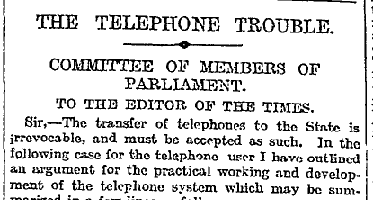
The Times, 21 February 1912, p12
I am glad you’ve asked. Not well, it would appear. Over in 1912 they’ve had less than two months of it and even the politicians are beginning to notice:
A majority of complaints fall under the following headings:-
1. Premature disconnexion.
2. Interruptions to conversations by operators.
3. Wrong numbers given.
4. Delay in answering calls…
Etcetera, etcetera…
Do they know why? Yes they do:
…the incentives inherent in a private concern to give the best no longer prevail. It will suffice to state that in Government concerns initiative is often dormant, staffs are largely permanent, and not necessarily promoted by merit or dismissed on inefficiency, and the system of organization generally stereotyped and non-progressive.
So, are they going to do anything about it? Not exactly:
The transfer of telephones to the State is irrevocable, and must be accepted as such.
Fortunately, “irrevocable” turned out to mean “until 1984” when British Telecom was privatised.
The Times, 22 February 1912. Click to enlarge.
Update Title changed so that it makes sense.
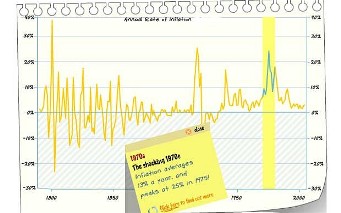
I was struck by this graphic, produced by the money printers at the Bank of England and reproduced in the Telegraph:
We are told (not least by the Bank of England) that deflation is the greatest threat to our well-being. But look at the Nineteenth Century. There’s no end of deflation there. And yet in this time they managed to build almost all of Britain’s railways (including three routes from London to Manchester), the Great Eastern, Crystal Palace, most of London, bring clean water and sewerage to the cities, introduce street lighting, make huge advances in science and medicine. and establish just about all the industries (coal, shipbuilding, steel etc) whose loss is so lamented, especially by people on the left.
OK, so I suspect a lot of those industries would have closed anyway but I fail to see how anyone could look at this graph and honestly claim that deflation was something to fear.
PS I now notice that the BoE does indeed talk about “Years of Deflation” between 1921 and 1931 and my understanding is that it was a pretty grim time. I would be interested to know if there’s a response to the implied claim that deflation is or was a bad thing.
One of my hobbies is to browse the pages of the (London) Times from a hundred years ago. As I intend (though I promise nothing) to write the odd post around articles from the time I thought it might be a good idea to describe (as best I can) the world in 1912. Or, at least, the world as seen through the pages of the Times which is a potentially dangerous thing to do. Imagine, for instance, describing the world of 2012 with the BBC News as your only source.
I cannot read articles from 1912 without being aware that there’s a big war coming up. A huge war. A Great War. A war that will change just about everything. Mostly for the worse. But can I see it coming? Not really. There clearly are tensions between Britain and Germany. Last year two British officers (Brandon and Trench) were jailed for spying. Seeing as one of them went on to become a leading light in MI6 it looks like the Germans got their man. More to the point it demonstrates that there is a lot of distrust.
→ Continue reading: The world in 1912 (according to the Times)
I enjoyed this thoughtful article in the Telegraph by Ronald Stewart-Brown on the ramifications of Britain’s leaving the EU. He seems to think it wouldn’t be too bad because an acceptable trade agreement would be fairly easy to come by. As he says:
We could negotiate at least as good access to other EU services markets as we have at present. We would no longer need to contribute towards the excessive levels of trade-distorting agricultural subsidy other EU member states dish out under the Common Agricultural Policy.
Personally, I wouldn’t be too sure about that – I think we could be in for a fair amount of vindictiveness. But that’s by the by. My real question is whether we need or, indeed, should want trade agreements at all. After all, if we can’t sell to them, how will they be able to sell to us?
|
Commentary
Economics
Politics
Specialist
Tech
|