We are developing the social individualist meta-context for the future. From the very serious to the extremely frivolous... lets see what is on the mind of the Samizdata people.
Samizdata, derived from Samizdat /n. - a system of clandestine publication of banned literature in the USSR [Russ.,= self-publishing house]
|
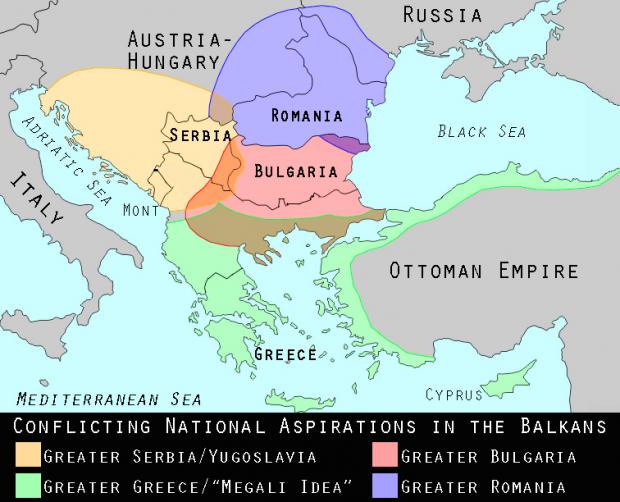
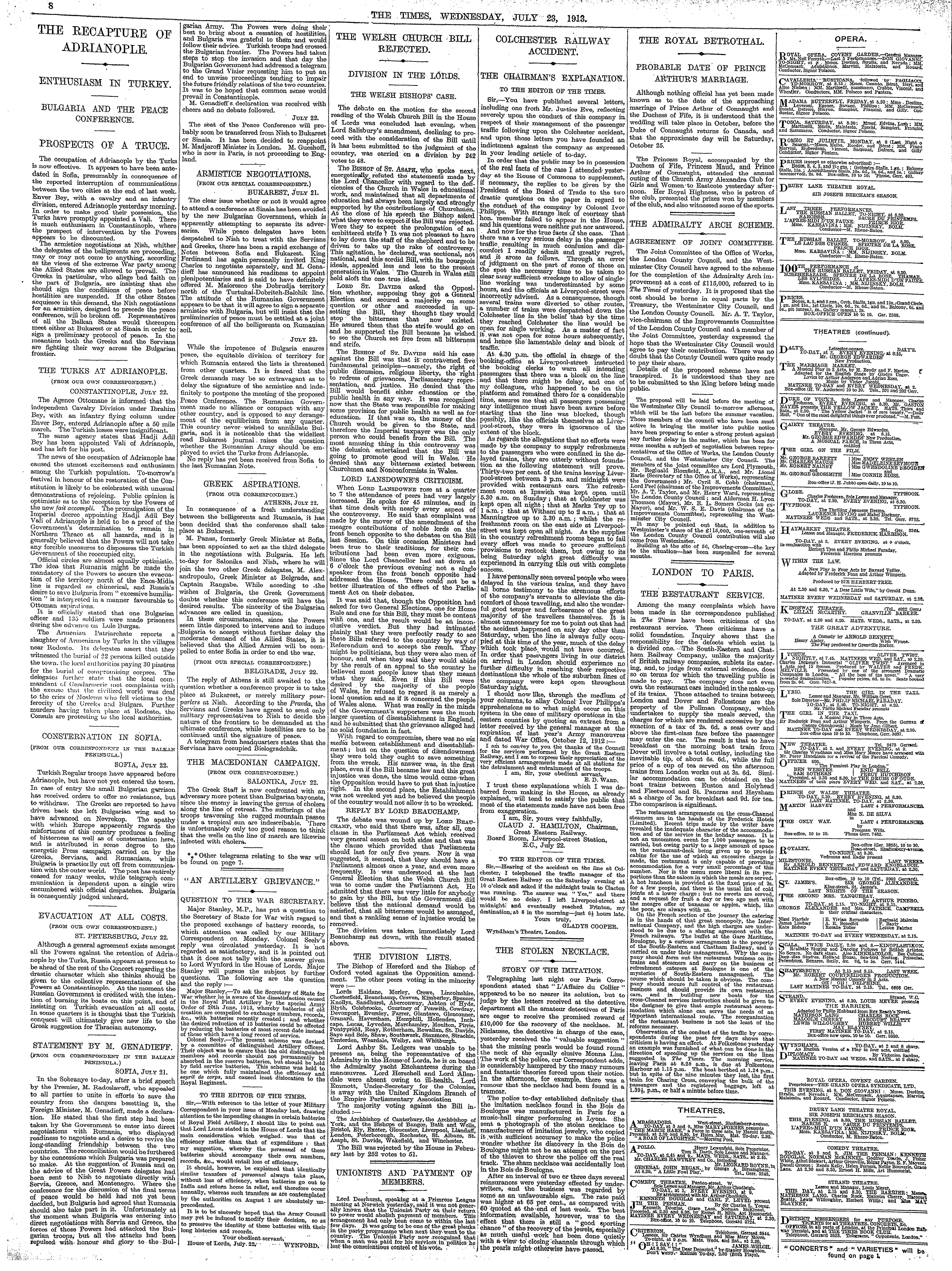
I do not claim to be an expert on the Balkan Wars which were fought in 1912 and 1913. If I understand correctly, in the First Balkan War Turkey was almost completely thrown out of Europe while in the second Bulgaria embarked upon a war of conquest and ended up with rather less than she’d started with.
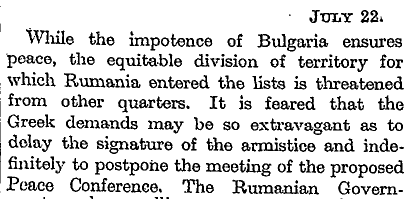 The Times 23 July 1913 p8 The significance of all this, as Eric Sass points out, lay in how it altered Russia’s relationship with Serbia. Russia, Serbia and Bulgaria were Slavic states. Russia, being the biggest, wanted to be the leader. Serbia and Bulgaria, being small wanted Russian protection. So, when a dispute rose over the borders between them the two small states submitted their dispute to the big one. When Bulgaria failed to get what she wanted she went to war.
Defeat led to Bulgaria allying herself with Austria-Hungary while Russia responded by allying herself ever more closely with Serbia. Hence, perhaps, the robustness of Russia’s response to Austria’s declaration of war against Serbia in 1914.
Update For a while now I’ve been in the habit of linking to the whole page rather than just the article. This has been to give readers the chance to see what else was making the news at the time and, perhaps, to find something just as bloggable. Well, it appears Simon Gibbs has done just that.
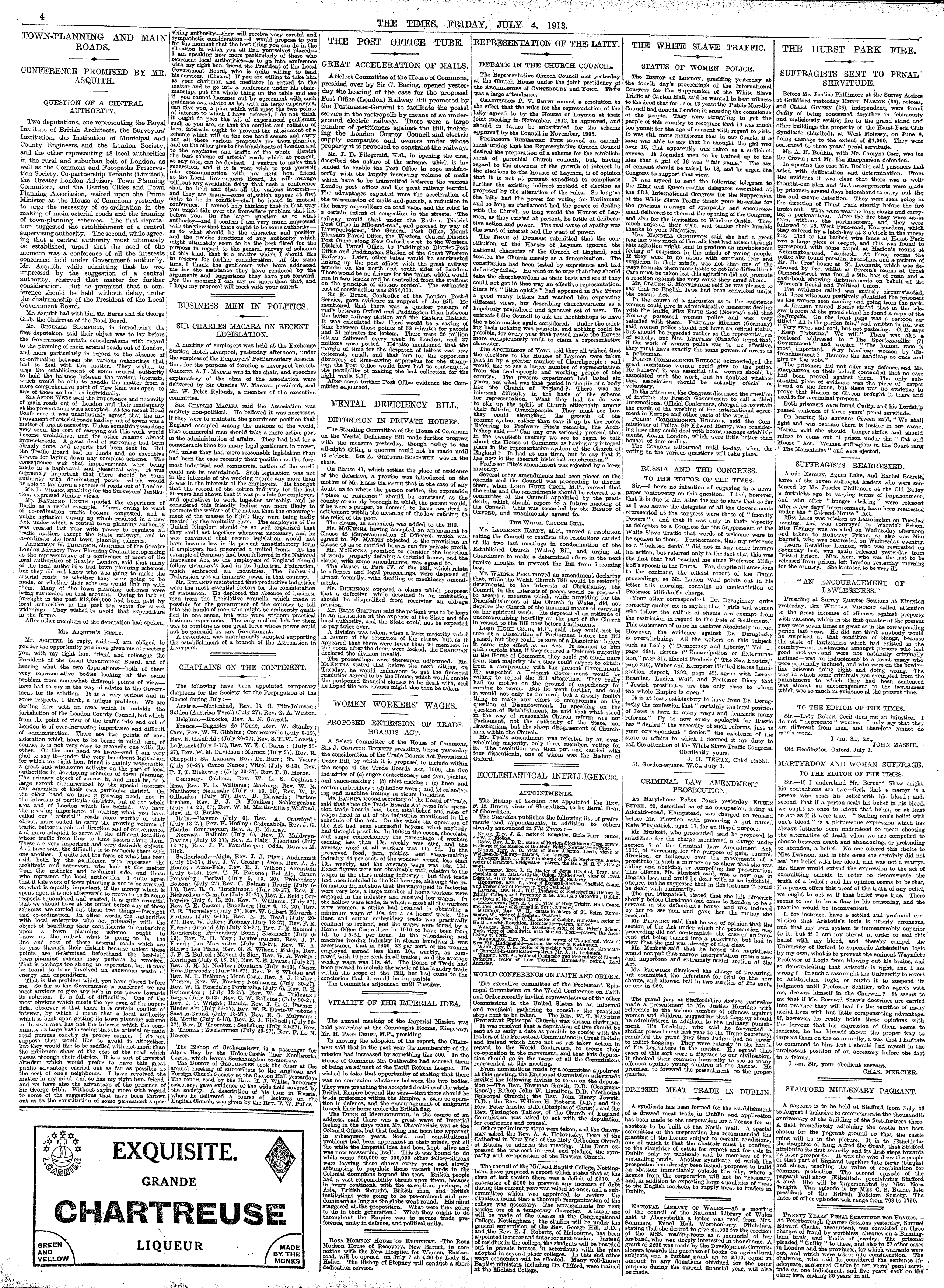
George Bernard Shaw was a playwright. He was also a supporter of Stalin. Therefore, it’s always amusing to see people poking fun at him. Here is one Charles Mercier responding to Shaw shortly after Emily Davison was trampled to death at the Derby:
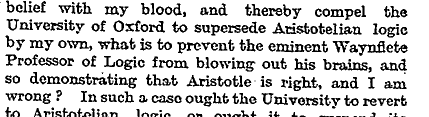 The Times, 4 July 1913 p4 (right click to see original) If I understand Mr Bernard Shaw aright, his contentions are two – first, that a martyr is a person who seals his belief with his blood; and, second, that if a person seals his belief in his blood, we ought at once to adopt that belief, or at least act as if it were true. “Sealing one’s belief with one’s blood” is a picturesque expression which has always hitherto been understood to mean choosing the alternative of death when we are compelled to choose between death and abandoning, or pretending to abandon, a belief. No one offered this choice to Miss Davison, and in this sense she certainly did not seal her belief with her blood, and was not a martyr. Mr Shaw would extend the expression to the act of committing suicide in order to demonstrate the truth of a belief; and his opinion seems to be that, if a person offers this proof of the truth of any belief, we ought to act as if the belief were true. There seems to me to be a flaw in his reasoning, and the practice would be inconvenient.
I, for instance, have a settled and profound conviction that Aristotle’s logic is utterly erroneous, and that my own system is immeasurably superior to it, but if I cut my throat in order to seal this belief with my blood, and thereby compel the University of Oxford to supersede Aristotelian logic with my own, what is to prevent the eminent Waynflete Professor of Logic from blowing out his brains, and demonstrating that Aristotle is right, and I am wrong? In such a case ought the University to revert to Aristotelian logic, or ought it to suspend its judgement until Professor Schiller, who agrees with me, drowns himself in the Cherwell? It seems to me that if Mr Bernard Shaw’s doctrines are carried into practice they will lead to the sacrifice of many useful lives with but little compensating advantage. If, however, he really holds these opinions with the fervour that his expression of them seems to indicate, he has himself shown the proper way to impress them on the community, a way that I hesitate to commend to him, lest I should find myself in the unpleasant position of an accessory before the fact to a felony.
In those days suicide was a crime.
Much as this is amusing there is a flaw: George Bernard Shaw didn’t actually say it.
A hundred years ago, London was undergoing a transport revolution. Electric trams, electric underground trains, motor cars and motor buses had all entered the market while horse-drawn buses, trams and cabs were leaving it. I’m guessing here, but it seems to me that for centuries the big class distinction was whether you owned a horse or not. Now that horses were becoming uninimportant, class barriers were starting to come down.
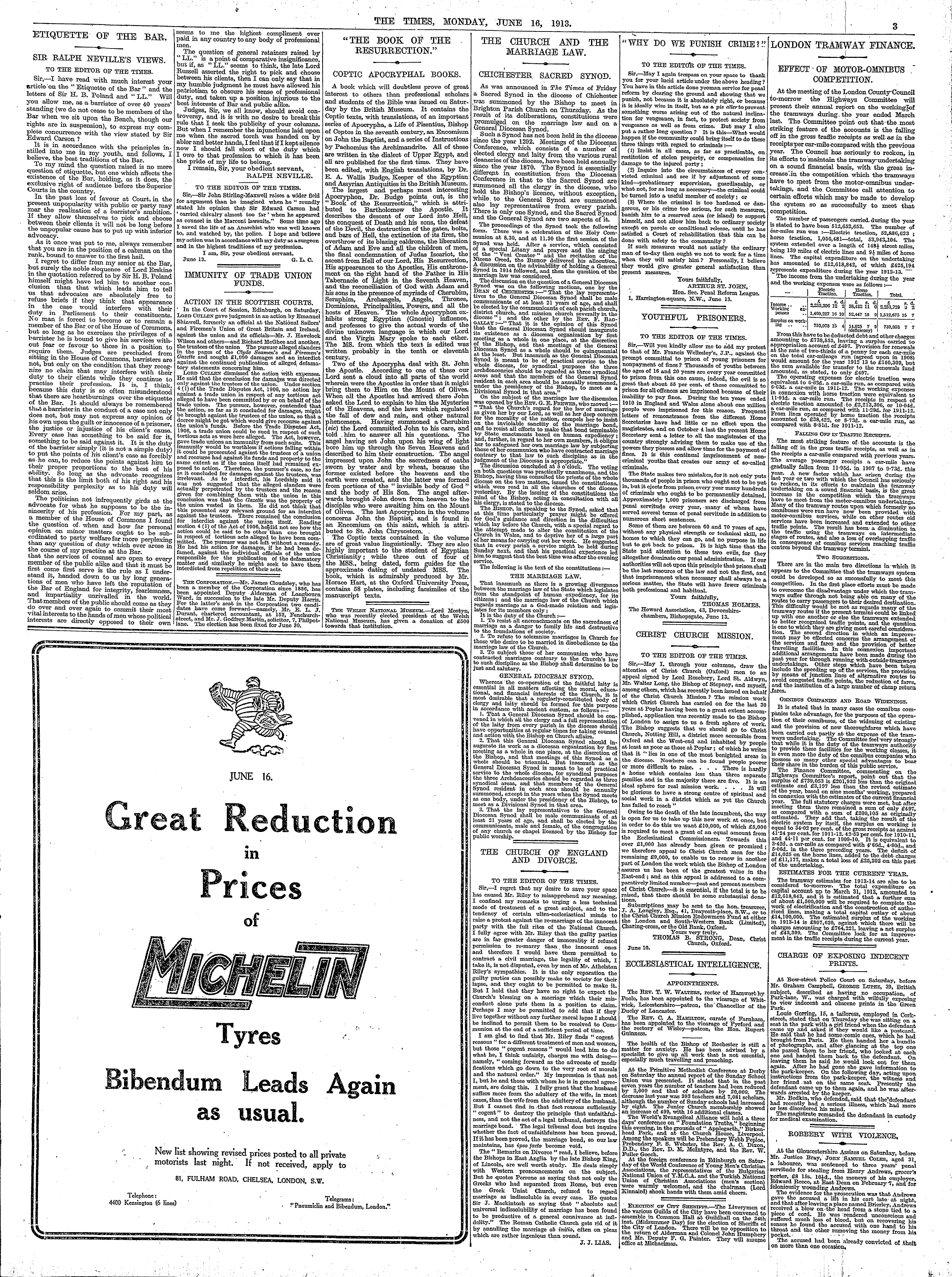
But that’s by the by. In a revolution there are winners and losers. And here, in the London County Council’s accounts, we see a loser, horse-drawn trams:
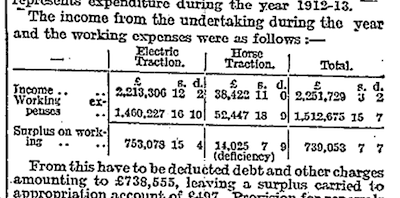 The Times 16 June 1913 page 3 But read a bit further and you see it’s not just horse-drawn trams that are losing out:
The most striking feature of the accounts is the falling off in gross traffic receipt, as well as in the receipts a car-mile compared with previous years. The average passenger receipts a car-mile have gradually fallen from 11.95d. in 1907 to 9.73d. this year. A new factor which has arisen during the last year or two which the Council has seriously to reckon, in its efforts to maintain the tramway undertaking on a sound financial basis, is the great increase in the competition which the tramways have to meet from the motor-omnibus undertakings.
In other words buses are taking their market. I must admit I’m in two minds on this. On the one hand, it’s hard to feel sympathy for the government losing money. On the other, trams are nicer than buses: smoother, quieter, cleaner. And commercial tram operators (they do exist) will not find bus competition any easier to deal with. You have to feel some sympathy with operators that have, at great expense, set up electric tram systems only to find them superseded by the internally combusted upstart within a few years.
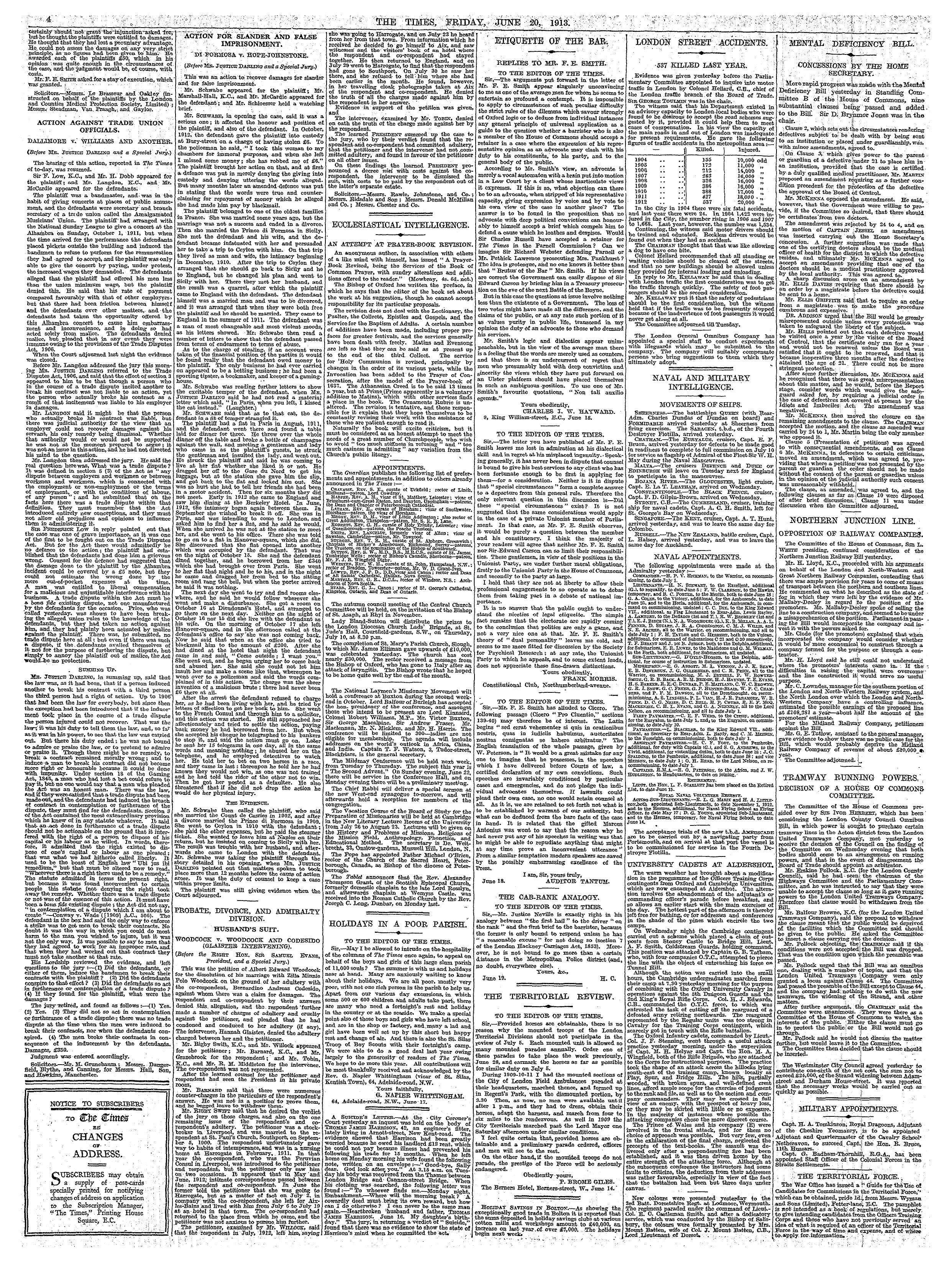
But buses are where the action is. Still. In 1911, they bought up the lion’s share of London’s tube network. [Yes, private enterprise integrated transport.] They may be dirty, noisy and uncomfortable but they are cheap and flexible and go where people want them to go. Oh, and dangerous. Did I mention dangerous:
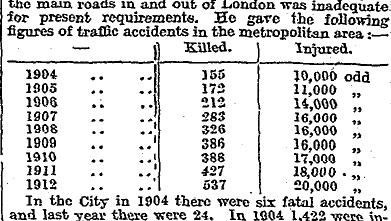 The Times 20 June 1913 page 4
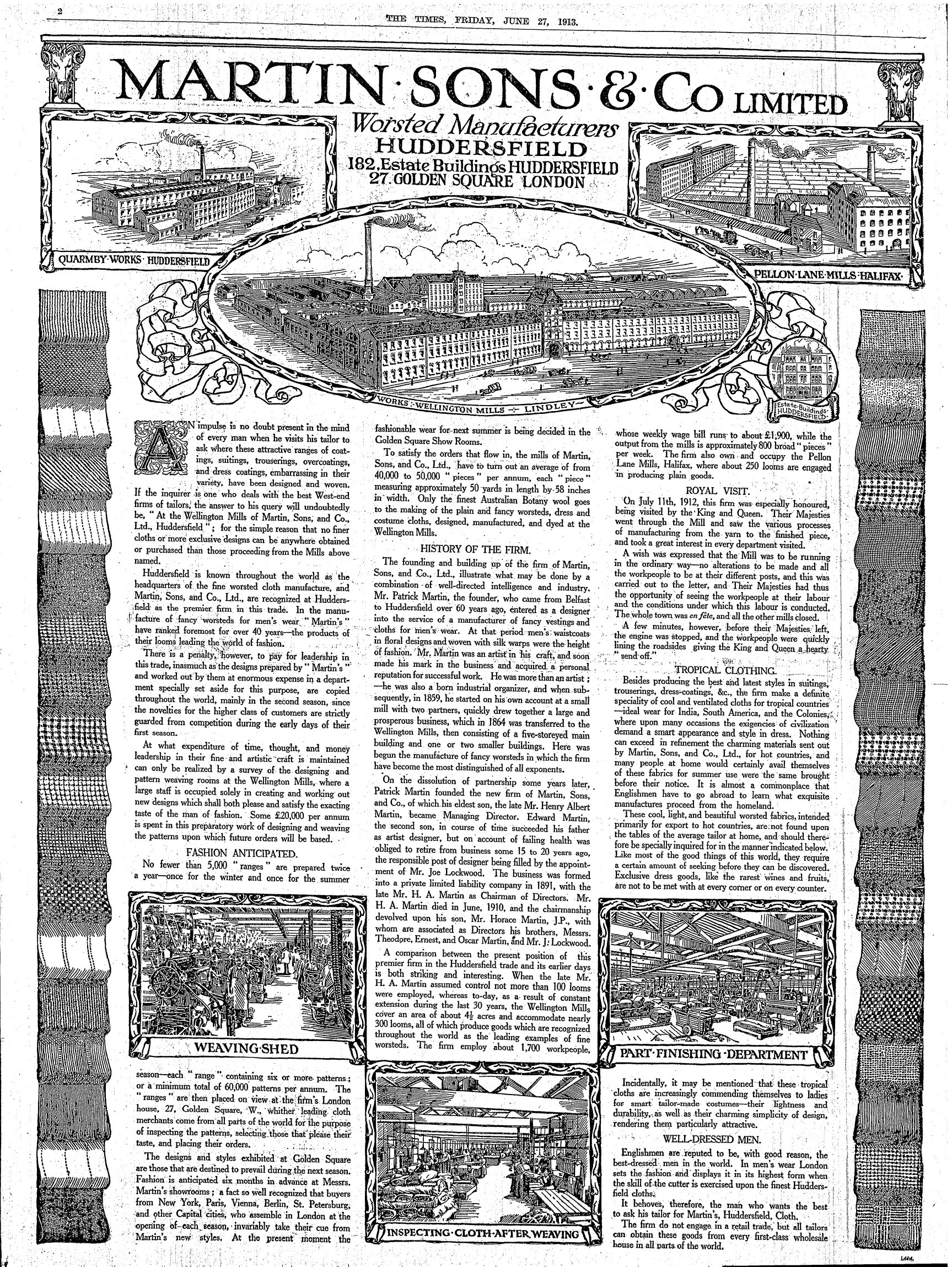
Back in 1913, the Times has just published a supplement on the textile industry. Just about every company that has advertised has included a picture of its factory.
For example:
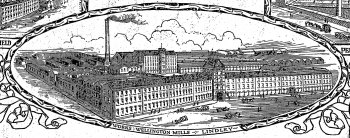
I think they look fantastic: big, modern, solid, clean even. But why are they used in adverts? Perhaps the question should be why companies don’t use them any more? What it does suggest is that at the time they were regarded as far from the dark, satanic mills of modern-day folklore.
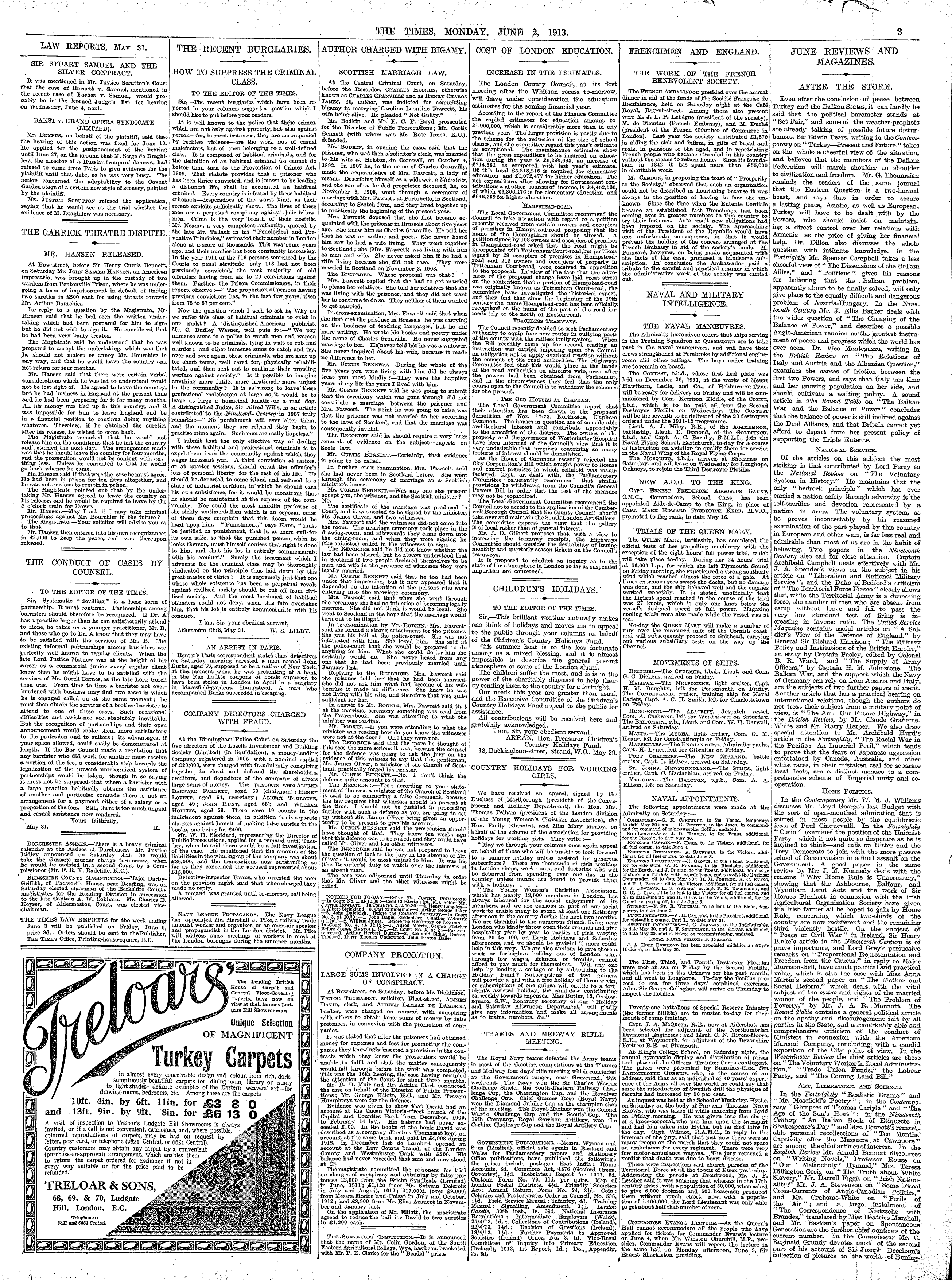
Take this letter to the Times from 2 June 1913:
I submit that the only effective way of dealing with these habitual and professional criminals is to expel them from the community against which they wager incessant war. A third conviction at assizes, or at quarter sessions, should entail the offender’s loss of personal liberty for the rest of his life. He should be deported to some island and reduced to a state of industrial serfdom…
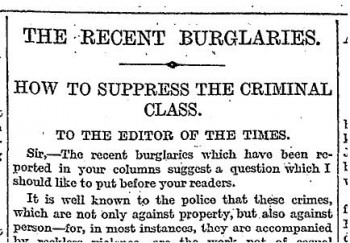
To view the whole page it seems you have to click on the image, right click and select “Open image in new tab” and then zoom in. This is for Google Chrome. Other browsers may be different.
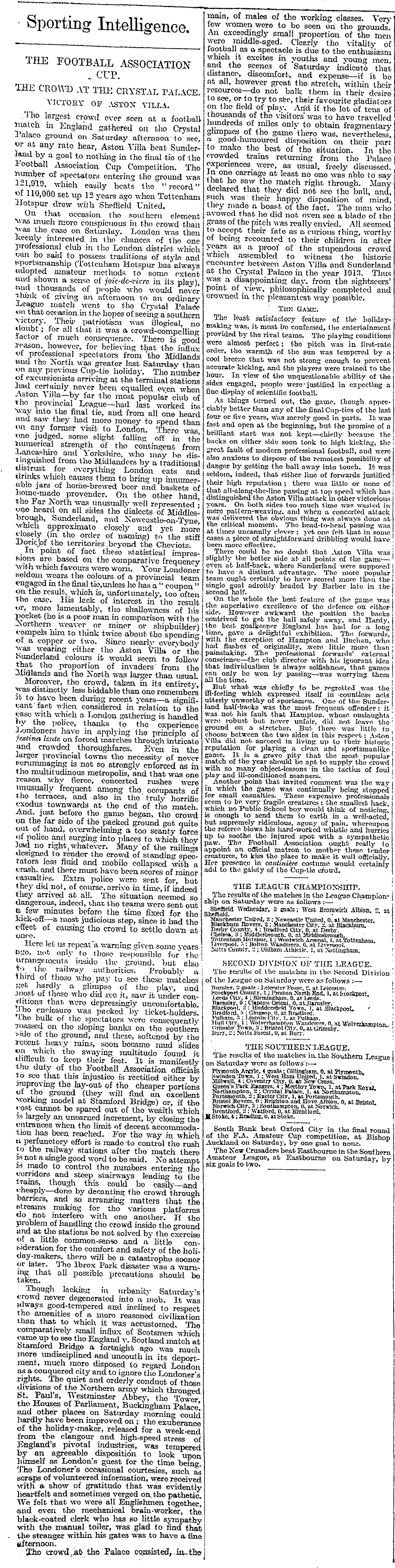
This made me laugh:
These expensive professionals seem to be very fragile creatures; the smallest hack, which no Public School boy would think of noticing, is enough to send them to earth in a well-acted, but supremely ridiculous, agony of pain, whereupon the referee blows his hard-worked whistle and hurries to soothe the injured spot with a sympathetic paw.
As you can probably tell from the language it’s from a while ago. 1913 to be exact and it’s from The Times’s report of that year’s FA Cup final. Yes, people then were making exactly the same complaints about footballers that they do now. At least they weren’t trying to eat one another.
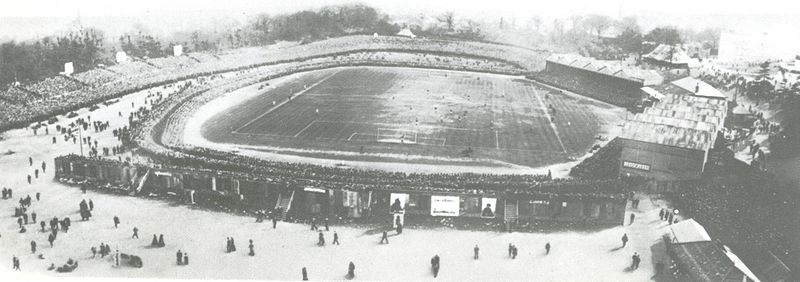
What is really astonishing is the size of the crowd. 120,000 (the second highest ever) at Crystal Palace, of all places. I googled and found this photo from 1905:
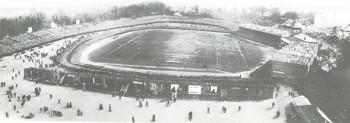
What a mess! But as the article I linked to points out most of the crowd had no idea what was going on. Not only that but it was clearly a dangerous place to be:
Many of the railings designed to render the crowd of standing spectators less fluid and mobile collapsed with a crash, and there must have been scores of minor casualties.
Read the whole thing as they used to say.
Voting to leave Brussels will cause your wife to have bigger breasts and increase your chances of owning a BMW M3.
– Boris Johnson, leader of the Conservative Party during the EU referendum of 2017 (as imagined by David Charter in Au Revoir, Europe: What if Britain left the EU?)
It is to do with urbanisation. Quite simply, the more people who live in cities the greater the amount of gun control.
It’s not just Britain and America. Switzerland, largely rural, has very little gun control, while America’s cities, as I understand it, tend to have plenty. I suspect one of the reasons for this is that in the cities you can have a reasonably effective police force. OK there’s the quip about “When seconds count the cops are only minutes away.” but better minutes than hours.
Also, I suspect politicians themselves are affected by this. In a city a politician finds himself surrounded by potential assassins, all of whom are nearby. “Best to disarm them”, he thinks. In less populated areas this is far less the case. It is perhaps no accident that high-rise New York City had gun control well before anywhere in the UK.
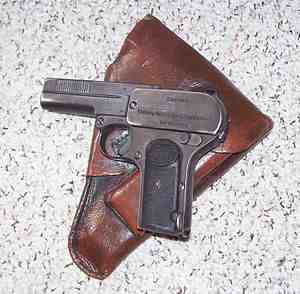 A pistol. A 1907 Dreyse to be exact.
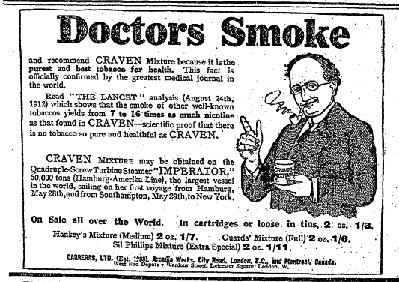 The Times, Tuesday, Feb 25, 1913; pg. 10. Click to enlarge
Many months ago I recorded a BBC documentary called “Health before the NHS”. Not having much of a stomach for statist propaganda I had been putting off watching it. The other night I finally got round to doing so.
Now, you will be shocked (shocked I tell you!) to hear, that the conclusion they reached was that the creation of the NHS was a very wonderful thing indeed. The problem was that if you actually looked at the evidence they presented – without making allowances for cherry picking – you’d have to reach precisely the opposite conclusion. This is what the BBC thought counted as evidence:
- There have always been state hospitals.
- They have always been awful. Dirty, miserable, useless.
- Before 1900 most operations were carried out at home
- Almost all developments in medicine in the first half of the 20th Century were pioneered by voluntary hospitals (ie private hospitals).
- It was voluntary hospitals that pioneered the idea that you might have an operation in a hospital and not at home.
- Voluntary hospitals were able to survive on charity until taxation in the 1920s got so high that this became increasingly difficult.
Something they did not cover was the introduction of a state general practitioner service in 1912. This was the real beginning of the NHS. At the time, I assume, no one in government thought voluntary hospitals particularly important, so they were ignored and, of course, they went on to transform healthcare. It really is amazing what a little freedom can do. It was only in 1948 that the government realised its “mistake” and nationalised the voluntary hospitals as well.
The BBC even opined that the NHS “integrated” healthcare (whatever that might mean) and managed to give the impression that it brought forth infinite resources for its activities. You have to admire their chutzpah.
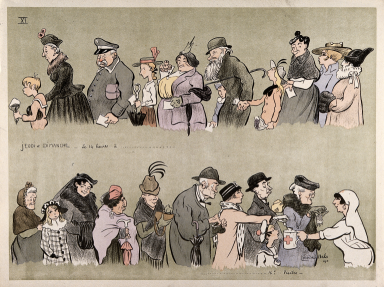 Hospital subscribers in 1916. For further info see here.
In an ideal world we wouldn’t have states. But we don’t live in an ideal world and so we do have states and the borders that exist between them.
In the run up to the First World War state power was on the rise. For reasons I don’t entirely understand but I suspect are related, nationalist movements were springing up all over the world. Irish nationalism was one of them.
In 1912 the British government, which was dependent on Irish nationalist support began its third attempt to grant Home Rule to Ireland. This would have given Ireland a similar status to the one Scotland enjoys today – autonomy but not independence. Unionists objected.
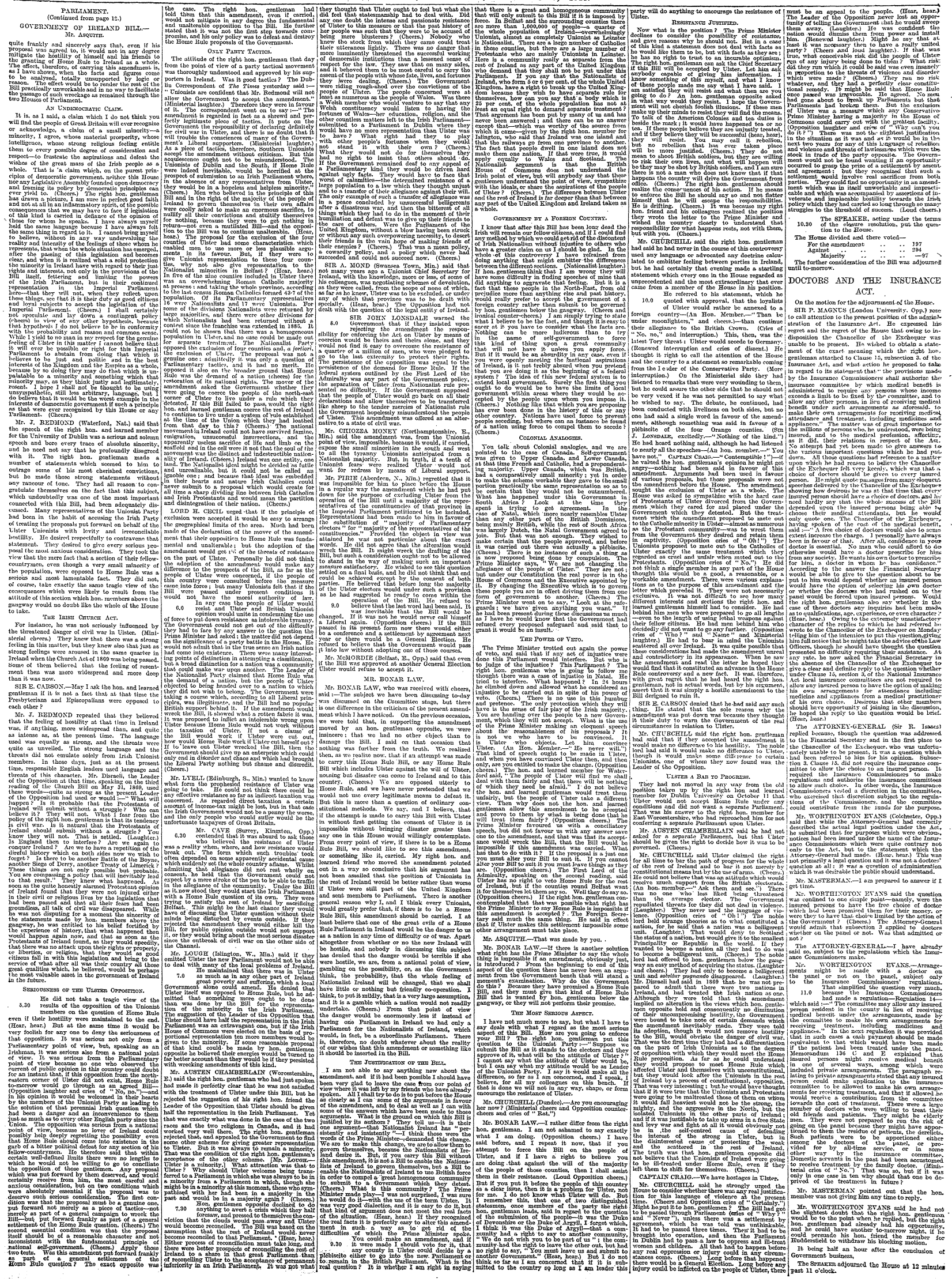
On 1 January 1913 Edward Carson, the leader of Irish unionism, moved an amendment to exclude Ulster. This can’t have been easy for a man who as MP for Dublin University represented a non-Ulster constituency. It is significant because it marks the moment when Unionists accepted that Home Rule in some form was going to happen. What they were trying to do was to salvage something – as they would have seen it – from the wreckage.
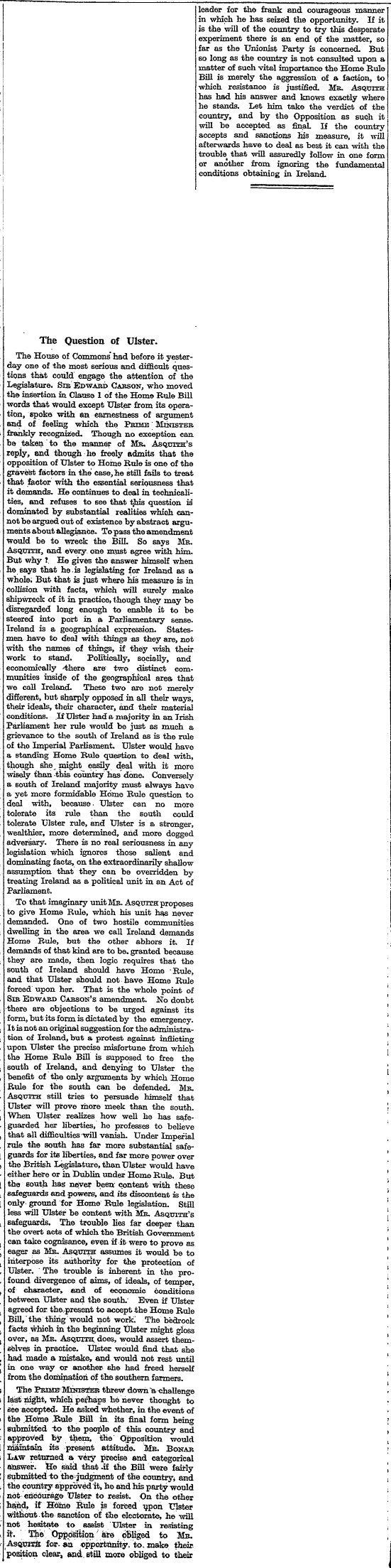
The Times of 2 January 1913 explained the situation:
Ireland is a geographical expression. Statesmen have to deal with things as they are, not with the names of things, if they wish their work to stand. Politically, socially, and economically there are two distinct communities inside the geographical area we call Ireland. These two are not merely different, but sharply opposed in their ways, their ideals, their character, and their material conditions.
This is something that was recently echoed by Ruth Dudley-Edwards:
As a Dubliner from Catholic, nationalist stock (albeit by then an atheist), the biggest problem I faced when I began to cover Northern Ireland as a journalist two decades ago was that I couldn’t understand the thought-processes of most Protestant unionists. It took me a while to grasp that one of the biggest differences between the two tribes is that Catholics are naturally hierarchical, and Protestants aren’t.
John Redmond (leader of the nationalists) thought exclusion was absurd.
The proposal for the exclusion of the four counties of Ulster had some characteristics which enabled men to use more or less plausible arguments in its favour. But, if they were to give Unionist representation to these four counties, why not also give representation to the Nationalist minorities in Belfast?
Frankly I rather wish he’d been taken up on his suggestion. But anyway, the disturbing part is that he didn’t accept Ulster’s exclusion. Why not? Was it really so difficult to accept that there are two nations in Ireland and still are? Was it really so difficult to accept that if the Irish had a right to independence from Britain then the Ulster British had a right to independence from Ireland? Had Redmond accepted it he would have saved us all a lot of trouble. There would have been no Rising in 1916, no martyrs, no IRA campaign and no subsequent myth that the IRA were responsible for Ireland’s independence.
So, why the resistance to Ulster’s exclusion? Money may have been a factor. Then, as now, Ulster was much richer than the rest of the island. Revenge may have been another. This would have been revenge for lands nationalists felt they had lost three hundred years previously, although one dreads to think quite what form this revenge might have taken.
One of the baffling aspects of what was going on was the utter refusal of the British government to take note of the strength of opinion in Ulster. Half a million people signed the Ulster Covenant committing themselves to resisting Home Rule. The following 18 months would see large-scale gun-running, the foundation of an Ulster militia and an army “mutiny”.
Bringing this all up to date a recent poll suggested that only 7% of Northern Ireland’s population want unification with the Republic immediately and only 32% in 20 years’ time. It does rather beg the question why 45% or so vote for explicitly nationalist parties.
By the way I couldn’t help noticing that this historic parliamentary debate took place on New Year’s Day. In 2013, the politicians didn’t turn up until the 7th.
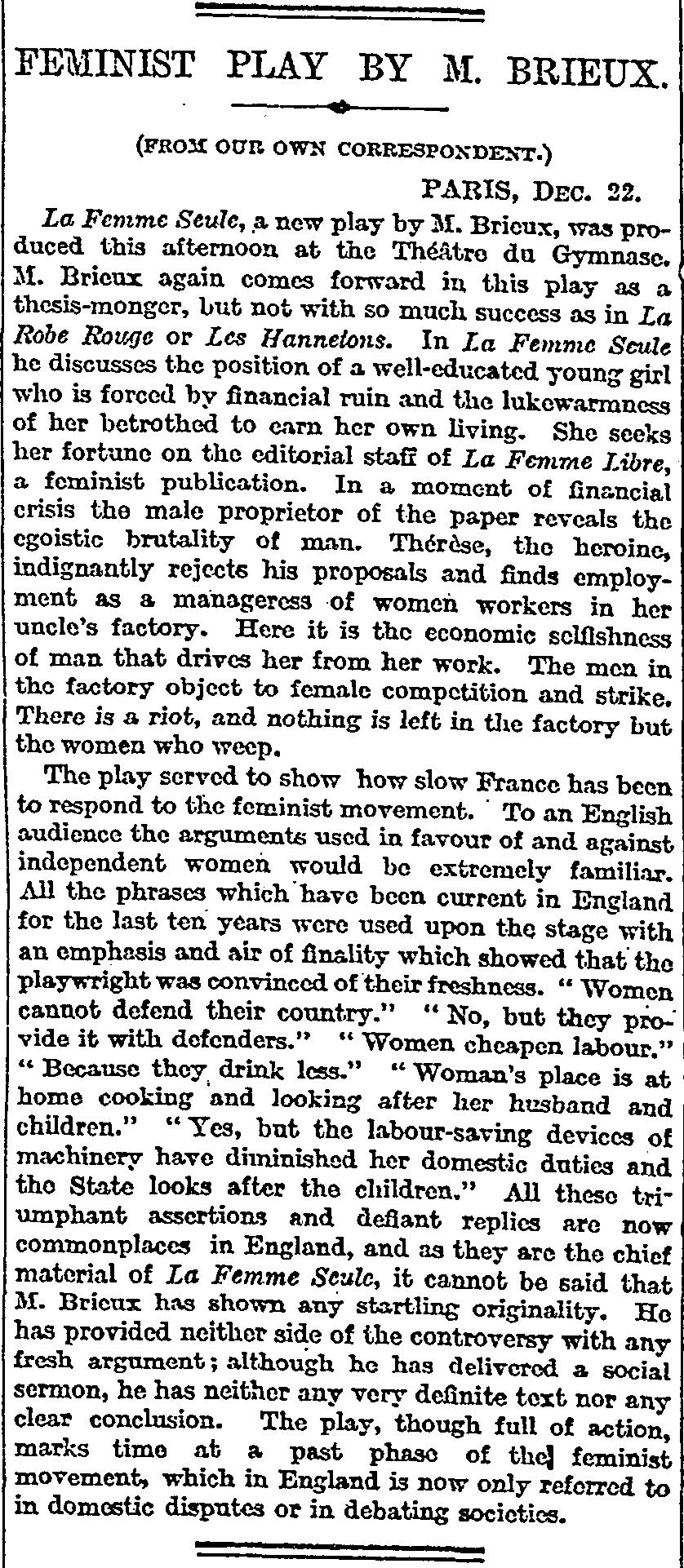
Not only that but feminist plays. In France, it is only fair to point out:
 The Times, 23 December 1912 p8 In La Femme Seule he discusses the position of a well-educated young girl who is forced by financial ruin and the lukewarmness of her betrothed to earn her own living.
Threrese, the heroine… finds employment as a manageress of women workers in her uncle’s factory. Here it is the economic selfishness of man that drives her from her work. The men in the factory object to female competition and strike.
Not that that doesn’t present itself with an opportunity for some cross-Channel point scoring:
The play served to show how slow France has been to respond to the feminist movement.
In comparison to England, that is. Which I find surprising. I know there has been a revolution when it comes to women in the workforce over the last 40 years, but a century ago? But if it was the case that women were entering the workforce and they were paying the newly-introduced income tax could that explain the demand for female suffrage?
By the way, the latest suffragist tactic is to pour acid into pillar boxes.
Correction 15/1/13 Income tax (in the UK) was not introduced just before 1912. It was introduced (on a permanent basis) by Peel in 1842.
|
Who Are We? The Samizdata people are a bunch of sinister and heavily armed globalist illuminati who seek to infect the entire world with the values of personal liberty and several property. Amongst our many crimes is a sense of humour and the intermittent use of British spelling.
We are also a varied group made up of social individualists, classical liberals, whigs, libertarians, extropians, futurists, ‘Porcupines’, Karl Popper fetishists, recovering neo-conservatives, crazed Ayn Rand worshipers, over-caffeinated Virginia Postrel devotees, witty Frédéric Bastiat wannabes, cypherpunks, minarchists, kritarchists and wild-eyed anarcho-capitalists from Britain, North America, Australia and Europe.
|





Recent Comments