We are developing the social individualist meta-context for the future. From the very serious to the extremely frivolous... lets see what is on the mind of the Samizdata people.
Samizdata, derived from Samizdat /n. - a system of clandestine publication of banned literature in the USSR [Russ.,= self-publishing house]
|
Let us salute the heroic secret agent at the Guardian who subverted this quietly sinister article by giving it a brazenly sinister title and undid most of its power to persuade at a stroke: Don’t give climate change heretics an easy ride.
Fun as it is to play Galileo, the author, an Oxford academic called Jay Griffiths, is not calling for the Holy Office to resume work against climate “deniers”. Oh no, she’s far too nice and British for that sort of thing. She reveres democracy:
One more thing is required of academia: to play its role right at the heart of democracy. Being adequately informed is a democratic duty, just as the vote is a democratic right. A misinformed electorate, voting without knowledge, is not a true democracy. Society needs the expertise of academics in the most important issues: climate science above all.
And
I would propose a system of certification for media articles in which there is a clear issue of social responsibility – a kitemark of quality assurance. It would be awarded by teams of academics, and be given to the article, not the journalist, recognising the facts, not the sometimes spurious credibility of being a “personality”. It would be awarded when the article is accurate, using reliable sources and peer reviewed studies. There already exists the Climate Science Rapid Response Team, which answers journalists’ questions to help them achieve accuracy. A misinformed electorate, voting without knowledge, is not a true democracy.Accuracy must not only be achieved, but be seen to have been achieved.
The certification should be voluntary.
I am relieved that she saw fit to add that it should be voluntary, but even with that, there is a whiff of early Dolores Umbridge here. “A misinformed electorate, voting without knowledge, is not a true democracy.” The modern tendency to make a god of democracy has its own dangers, but it is still the least worst form of government – and a democracy is not denatured by a misinformed electorate, or any other sort of wrong electorate. That’s the point of democracy, actually.
In so far as Jay Griffiths’ proposal is not merely the class interest of an academic talking, I suspect that it is another eddy in the same current of opinion that has led Michael Mann to sue Mark Steyn for libel.
Nepal to ban independent trekking. Public safety, job creation and ‘stimulus’ all in one; how long before other nations follow Nepal’s lead?
What have you failed to find on the internet that you expected to be there?
The investment strike is one the government would do well to bust, writes Michael Burke in the Guardian. When I read the headline I gave him the benefit of the doubt. The Guardian subs do not cope well with nuance. But the headline fairly represents the views of the man:
Since both the cause of the slump and the cause of the deficit are the same, the investment strike by firms, economically the remedy is very simple. Government policy should aim break that strike and release sufficient resources to fund an investment-led recovery.
I bet them fancy-pants government ministers are kicking themselves now they see how easy the solution is. You just redefine thousands of separate people and organisations not wishing to risk their money in the present economic climate as a ‘strike’. Then you break the strike.
Don’t knock Mr Burke’s logic – when the British government redefines pretty much any behaviour it does not like as ‘terrorism’ and then uses anti-terrorism powers to suppress it, the tactic seems to work just fine.
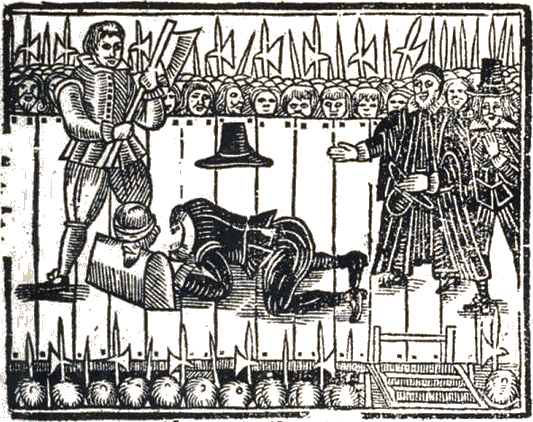
It is said, probably apocryphally, that in rejecting an appeal for the great French chemist Antoine Lavoisier to be spared the guillotine, the revolutionary judge said, “The Republic has no need of scientists”.
The great Pakistani physicist Abdus Salam, the first Muslim to win a Nobel prize for science, has been written out of Pakistani history for being the wrong sort of Muslim, writes Rob Crilly in the Telegraph. Among the saddest aspects of this story is that when reading this I could not wholeheartedly join in with Mr Crilly’s wish that Professor Salam’s name should again be honoured in his homeland. While public and elite opinion in Pakistan remains such that it does not wish to claim a great nuclear physicist – and one of the architects of Pakistan’s nuclear weapons programme – as its own, better for the world that Pakistan gets its wish.
World’s biggest eco-toilet scheme fails
Not that I wish to discount the idea of improvements to the current design of toilets entirely. One must not be too quick to pooh-pooh new ideas.
The conviction of Paul Chambers for making an obvious joke on Twitter about blowing an airport sky high has been quashed in the High Court.
So someone in the justice system has a brain cell to call his own. Pity the case had to get as far as the Lord Chief Justice, the aptly named Lord Judge in the job he was born for, before that person was found.
Tell you what is “clearly menacing”, though, if the future of liberty in this country means anything to you at all. The airport security manager who finked on Chambers to the police, the police who arrested him, the Crown Prosecution Service lawyers who prosecuted him, the magistrate who first convicted him, and Judge Jacqueline Davis who refused his initial appeal all still have their heads attached to their necks.
I jest.
Probably.
As I do tire of pointing out, belief in the free market no more obliges you to approve of every single transaction than belief in free speech obliges you to approve of every word spoken.
The eBay account of our very small business was hacked into recently and a bunch of non-existent stuff sold in our name. The direct results of this have been sorted out and the victims of the scam repaid. However at some point eBay and/or Paypal (Paypal is a subsidiary of eBay) wrongly compensated us for some of these “purchases”. Our Paypal account currently has coming up to a thousand pounds more in it than it should have. Do Paypal want to know? No they do not. There is something wrong with a company so complacent that it cannot even rouse itself to take back its own. To be fair, the young Irish people I talk to when I ring up Paypal try to help. If my customer service experience stopped there it would still be ghastly because all possible customer service experiences in all possible worlds are ghastly but it would be ghastly in a comparatively good way. Unfortunately they do not have the authority to relieve me of the burden (it is a burden) of nearly a thousand quid, so they pass the buck to eBay central, over in one of the lesser circles of Hell staffed by resentful demons who failed to qualify as incubi and succubi. Their task is to choose whichever of six formulaic replies bears least resemblance to the actual situation and email it to me overnight.
eBay and Paypal could do with some competition.
Who’s the coolest? Terry Deary, the author of “Horrible Histories” or Lars the Emo Kid?
Deary: “Attack the elite. Overturn the hierarchy.”
Lars: “I’ve got so much passion in my body that I just wanna … kill you!”
Deary: “I started challenging authority at school, really, and just kind of never stopped.”
Lars: “I’m just so complicated that you’d never understand me.”
Deary: “It’s why I’m dangerous; inculcating rebel ideas into the minds of innocent young people using humour.”
Lars: “I got the cops called in on me last week because I walked outside with a gun and professed my love to a flower.”
Thanks for doing Horrible Histories, Mr Deary. As I said in 2005, when my then eight year old son asked me “Who is your favourite Habsburg?”, I knew that was £200 we could afford after all. He literally read those magazines to pieces; we still have them in their free cardboard holders, and the best-loved issues are reduced to stacks of flaky individual sheets of paper, like illustrated filo pastry.
Furthermore, Mr Deary, I have a lot of sympathy with your views on education and its ruination by twonks in government, or would if I thought you meant them, though could I just add that it is not without the bounds of human variety for trigonometry, chemistry or French to turn out to be “the skills you are going to need.” Now please stop being such a poseur. You are not Han Solo. Lars is cooler than you.
North Wales Police have issued a (probably illegal) “dispersal order” banning unaccompanied teenagers from Bangor in the evenings. They say it is not a blanket ban. The words of the order say it is.
Ellie May O’Hagan opposes it because it makes teenagers feel bad, and because it would have made her feel bad when she was a teenager:
For the 13-year-old me, a curfew would have meant more isolation, more casting adrift, a stronger sense that the town in which I lived didn’t really care about my place in it. I might have felt frustrated that a lack of youth services forced me on to the street, and then that my presence there automatically made me deviant. Then I might have decided not to care about a city that didn’t care about me.
Keith Towler, the Children’s Commissioner for Wales opposes it because it makes people have bad feelings towards teenagers:
“It demonises under 16s, isolates them from their communities, alienates them from police and spreads the misconception all young people are troublemakers.”
There is talk of the Equalities and Human Rights Commission opposing it because it is discrimination. At least they won’t have far to toddle. The EHRC has an office in Bangor.
I am glad all these worthies and unworthies oppose the curfew. It needs opposing. But it saddens me that nobody opposes it on the grounds of how dare they. How dare they stop people who have committed no crime from walking or standing in the public street? In the case of a shopping centre or a nightclub I vehemently support the right of the proprietors to exclude whomsoever they wish. I also support, if more cautiously, the right of small areas to set local rules and covenants as to whether alcohol is permitted, rules about noise and similar constraints. But North Wales Police have exactly as much a right to expel teenagers from a public space as North Wales teenagers have a right to expel the police.
Bob Neill MP, Parliamentary Under Secretary of State for the Department for Communities and Local Government, has written to all local authority leaders.
Yes, I know, be still my beating heart, a post about local government. I will try to keep it brief and malicious, like Bob Neill’s letter.
Remember how John Prescott’s Standards Board for England curbed freedom of speech for local councillors under the guise of “standards”?
Remember how its supposedly reformed local sucessors demanded that councillors “show respect and consideration for others”? This meant, for example, that John Dixon, a Cardiff councillor visiting London who tweeted while passing the Scientologist church in Tottenham Court Road that he just hurried past “in case the stupid rubs off” was reported to the local Standards Board. He was cleared, but as so often, and as the Scientologist who reported him knew very well, the process is the punishment.
Well, the local Standards Boards have in their turn been abolished and new rules come in tomorrow. I have not studied them in detail and am slightly less likely to do so than to gnaw off my own legs. They will probably go bad in their turn. The new rules, not my legs. But just for today, I find myself happy about this part of Bob Neill’s letter:
However, given the importance that the new arrangements are, and are clearly perceived to be, a wholly fresh start we are minded to make further provision so that any former member of a standards committee appointed under the transitional arrangements as an independent person can hold that office only until 30 June 2013.
So we bid farewell today to some quangocrats. And just for once the revolving door that smoothly glides in front of such people as it leads them from one sinecure to the next has stuck.
|
Who Are We? The Samizdata people are a bunch of sinister and heavily armed globalist illuminati who seek to infect the entire world with the values of personal liberty and several property. Amongst our many crimes is a sense of humour and the intermittent use of British spelling.
We are also a varied group made up of social individualists, classical liberals, whigs, libertarians, extropians, futurists, ‘Porcupines’, Karl Popper fetishists, recovering neo-conservatives, crazed Ayn Rand worshipers, over-caffeinated Virginia Postrel devotees, witty Frédéric Bastiat wannabes, cypherpunks, minarchists, kritarchists and wild-eyed anarcho-capitalists from Britain, North America, Australia and Europe.
|