Or perhaps language ‘lesions’ might be a better description over on Spanglolink‘s page Inside Europe: Iberian Notes. Their resident ‘cranky yanqui’ seems to be living up to his billing! Not for the delicate of disposition. 
|
|||||
|
February 20th, 2002 | Comments are closed
 As many of you may already know, blogger.com and blogspot hosting was down for most of today. We will be looking to move off the blogspot server in the near future. Also thanks to Sandra who sent us the 100k screen shot. We hope you like your extorted prize. We blew through 100,000 visitors fast.  February 20th, 2002 | Comments are closed
It is a small matter really, just a trivial case involving some grocers who sold some fruit using Imperial rather than metric measurements. Yet the implications are staggering for the entire structure of British life. 
Don’t co-operate in your own repression February 19th, 2002 | Comments are closed
Within the next few hours we will get our 100,000th visitor (as I write this we have already had 142,643 page views)… we would be grateful if the person who makes it 100,000 takes a screenshot and sends it to us. We are small fry compared to Instapundit but that is not shabby for having only been around for four months! In the last 72 hours we have had e-mail from USA, UK, Ireland, Italy, Switzerland, Senegal, Pakistan and Australia. February 19th, 2002 | Comments are closed
…and a bit of hijacked satire, but more on that bit later. Scott Rubush replies to a pair of articles by David Carr and myself. In response to my view that technologically unsophisticated societies do not produce great thinkers Scott replied:
Ask and you shall receive, for the names of the modern Socrates and the modern Aquinas are Frederick Hayek and Karl Popper. I turn on the radio and I also hear Aaron Copland and Lisa Gerard. I watch the cable television and learn of astonishing breakthroughs in genetic sciences and hear it explained for people like myself who did not study that field. I read accessible, inexpensive paperback books like David Deutsch’s ‘Fabric of Reality’, purchased not from some sanctum of gnostic wisdom but available in a bookshop inside a train station. If all you see is Oprah and Jerry Springer then you need a new remote control, Scott (and quickly!). I also see a programme about anthropology and the Leaky family in Kenya, and with the push of a button I see a superb Japanese version of Macbeth and then a remarkable show about the fusion of Irish and Senegalese music. It is all there at the touch of a button and at prices the great majority of the population can afford. Bad culture does not drive out good, it just looks for a different market niche. The low brow, scandalous, scurrilous and bawdy Hogarth prints of one era are the ‘biting social commentary’ of the next era. Back in the good old days, ‘good culture’ was not more pervasive than now as it was never available to more than the ruling classes… and ruling classes by their nature exist not to ‘steer its citizens towards’ good culture but rather towards a culture of deference to the rulers. Mozart is thought of now as ‘good culture’ but not because of anything intrinsic to the music, for it was once regarded as subversive. Rather it is because of who listens to it. One hundred years from now patrician critics might lament the fact people turn their backs on classics like Pink Floyd. Far from being ‘value neutral’, a dynamist society must underpin itself with objective morality as the guide to the evolving new. Only this way can we know when ‘tried-and-true’ becomes untrue, and when to leave well enough alone, for just as the ‘tried-and-true’ evolves, so to does understanding. The greatest of many errors made by Marx was highlighted by Hayek when he pointed out that to remake society entirely by revolution implies that the revolutionary can know by the application of scientific reason what will always be the best, and therefore make it so at bayonet point. Yet society is not the product of reason, but of complex evolutionary processes. Once this is understood Marx’s ‘scientific socialism’ is revealed to be nothing of the sort but rather an exercise in self-delusion, a ‘fatal conceit’. This is also why when people refer to the remarkable events which came to a head in 1776, I have always depreciated the term ‘American Revolution’ which is so popular in the USA. I prefer the term ‘American War of Independence’ used more typically in the rest of the Anglosphere: What Jefferson et al did was free the thirteen colonies from the stasis imposed by the British Crown, not to radically remake society at bayonet point as would soon happen in France in 1789 and later in Russia in 1917, but rather to allow it to evolve in a manner consistent with the very best of the underlying civil society’s values. The Constitution of the United States did not overthrow society, it enshrined its values and attempted to protect it from the encroachment of the state and the worst aspects of democratic mob rule, even if not entirely successfully. But that is also why I am not a conservative… the authors of America’s Independence and others forsaw the problem intrinsic to any democratic system, that as Sir Alex Fraser Tytler (1742-1813) put it:
The situation has developed in which nation states forcibly appropriate over 50 per cent of a nations wealth and yet this is seen as legitimate due to a ‘democratic mandate’. Yet the reality is that not only is it immoral, it is unsupportable in the long run. As a libertarian I see that society must continue to evolve away from the all-consuming centralised state and towards a more spontaneous, truly capitalist and less rigid system. Just as the wealth gobbling nations of the world grow fatter by the year, the seeds of a freer future are also becoming more visible almost by the day. I suspect the difference between conservatives such as Scott and libertarians such as myself is that whilst we both abominate the statist impositions of the left, he sees a perpetual rear guard action of fighting the laws of the left with laws of the right as a viable option, whilst I see a very different future. I see the disintergration of the politicized legal edifice over which left and right fight as being a long term economic inevitability, not necessarily from catastrophic collapse (though most likely Japan and some of Europe will do just that) but from the gradual technologically driven creeping irrelevance that will see that what follows the current order is something both familiar and excitingly different. Unlike Scott, I see this as a good thing as I expect the good and enhancing aspects of culture to survive because such things are objectively good and efficacious. Which brings me to Scott’s ire regarding David’s remarks. I suspect he took ‘And what did the Romans ever do for us?’ a tad too literally. David was using Scott’s earlier remarks to reference a well known bit of British humour in the form of an extended skit from Monty Python’s Life of Brian and thus was only indirectly addressing Scott. And now for something completely different… February 18th, 2002 | Comments are closed
Fellow Samizdata contributor and cunning shyster to the cognoscenti David Carr has written recently and at length why he dislikes the Olympics and I agree with some of his remarks. However I do not find the Olympics entirely without its attractions…  February 18th, 2002 | Comments are closed
Any British Isles bloggers within range of London who are interested in getting together with the cream of the bloggerati on Saturday, 23rd February, should e-mail us at admin at samizdata.net” as soon as possible for information. We can probably handle a few more. Blog this, you bounder! Bloggin’ ‘ell!
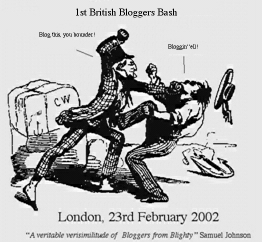 A veritable verisimilitude of Bloggers from Blighty Samuel Johnson February 17th, 2002 | Comments are closed
The Blue Button is a highly polemical independent libertarian blog. It is largely limited to American issues but within that purview tends to throw a fairly wide net. The blog has a blunt ‘in your face’ style and it would be fair to say ambiguity and nuance are eschewed for the Monster Truck car crushing approach.
Quite so. The Blue Button says it the way the author sees it. If you like opinions straight from the shoulder, then this is the blog for you. February 17th, 2002 | Comments are closed
I must say that the most egregious omission from the Oscar line up for best flick is director Chris Nolan‘s highly unconventional Memento. Unlike the linked review I think it quite possibly does make it to “favorite-of-all-time status” rather than just pretty damn good. Guy Pearce turns in his best performance yet, sympathetic without being sentimental and Carrie-Ann Moss proves there is more to her than just ‘Trinity’ from The Matrix with her alluring, pitiable and in the end utterly detestable character. Joe Pantoliano is of course as dependable as ever. The structure of this work is pretty much in a class of its own: we see a scene and we think we understand what is going on, but a few minutes later we see the exact same scene but the context has changed, and we realise what we thought had happened before was not the case at all. This happens several times throughout the film, which in effect starts at the end and works not so much backwards as backwards, forwards, backwards again, hop to the middle, jump back again… This little non-linear gem is certainly in my top 5 movies of all time. Hey Oscar, we wuz robbed!  February 16th, 2002 | Comments are closed
Scott Rubush write a reasonable piece on his self-named blog called Libertarianism and Marxism. I quite like the way Scott writes but I have to say he drives into several well worn potholes of misunderstanding when he mistakenly sees a confluence of views between Karl Marx and Dinesh D’Souza. The notion that libertarians always disdain the ‘tried-and-true’ is his first misunderstanding. What libertarianism is based on is the rejection of the conservative and socialist predisposition to deference for deferences sake. Ours is the way that places civil society, and not state, at the centre of social interaction. We reject the nationalisation of private life. Yet civil society is not the product of our intellects but rather complex social evolutionary processes. Libertarians seek the solutions that emphasize free consent, binding contract and free association, all rooted in the ‘tried-and-true’ common law culture of the Anglosphere. It is only the state which can sweep away the ‘tried-and-true’ with the stroke of a pen, not libertarianism. What we reject is ‘traditions’ which have outlived their time, ‘tried-and-no-longer-true’, things like slavery, prohibiting women from owning property and legislated actions against consensual sexual practices like prostitution, homosexuality and other more unusual peccadillos. The second misunderstanding is what D’Souza and Marx both said in the quoted passages. Whilst they both initially seem to confirm Rubush’s thesis, the last sentences in both of them illuminate why dialectical materialism is not the issue here at all because D’Souza and Marx have in fact drawn the opposite conclusions. When Marx says in his well know remark “The weapons with which the bourgeoisie felled feudalism to the ground are now turned against the bourgeoisie itself”, he is arguing that the factory system of bourgeois collectivisation of the proletariat due to the advent of technologically derived mass production, makes the merging of society and state inevitable, thereby eliminating the raison d’etre of the bourgeoisie and resulting logically in a dictatorship of the proletariat which imposes social truth on all, leading to socialist ‘New Man’. However when D’Souza says “So technology helped to free human beings from bondage, and that is a moral gain because it extends a cherished value: freedom”, he saying the exact opposite. His thesis is not that technology will collectivise us but rather that it will make the proletariat into the bourgeoisie… in other words, we are all de-collectivised middle class now. Technology frees us from an existence of collective tribal subsistence, allowing us to develop socially towards the more several existence of an extended de-collectivised civil order. It is this extended order that allows morality, and not just collectivised force, to govern our actions. Man is still man but the idea that changing his circumstance makes no difference to his moral development is hard to support. Where is the Hottentot Aristotle? Where is the Nung Socrates? Where is the Inuit Aquinas? It is from a level of economic development driven by technology that permits us to spend less time shooting arrows at antelope and more time becoming more than just upright animals-that-survive. That’s why his piece is fatally flawed. Rubush fails to see that whilst mankind’s nature may be essentially unchanging, his circumstances are not… and that is a non-trivial matter when it comes to allowing people to spend more time in non-utilitarian activities and less time just surviving. Marx felt technology would turn society into a vast state-society based on ‘scientific socialist’ principles in which truth itself in collectively derived. D’Souza feels technology frees us to think and entertain such concepts as liberty itself. February 16th, 2002 | Comments are closed
I think Tom Burroughes is far to genteel with his treatment of EU Commissioner Chris Patten‘s remarks in the Financial Times.
Here is the core of the crypto-socialist beliefs of purported conservatives like Chris Patten. Only the collective approach works.
Indeed. That is why the ‘failed state’ which harboured and succored Al Qaeda was overthrown by force of arms and replaced with one more to America’s liking.
I suspect in fact the US actions were based on the quaint notion that a dead enemy tends not to plan further attacks against you and that time was of the essence, given that attack by Al Qaeda was not just a possibility but had actually occurred. Expeditious action was unlikely to have been served by waited for the participation of Belgian, Portuguese and Greek para-commandos. How long did it take for the Europeans to acquiesce in the tepid military action against the Bosnian Serbs who had been randomly shelling civilians in Sarajevo? Is that how long Patten expected the Americans to wait after September 11th?
The US said ‘you are either with us or with the terrorists’, which sounds like leadership to me. They then proceeded to blow seven shades of crap out of Afghanistan… at which point nations such as Syria, Sudan and Yemen started ‘co-operation on an unprecedented scale’ with the US. Sounds like leadership and co-operation to me. The problem lies in the Islamic world and this it is the co-operation of the relavent bits of the Islamic world that matters. If the people who flew the aircraft into the WTC were mostly French and German, no doubt there would be more of an imperitive to secure French and German co-operation. Of course partnership is pretty much the antithesis of leadership so quite what Patten means by leadership should be exercised in partnership is unclear to me.
Exactly. Which is why the US worked with the UK and not Brussels. The US and the UK share values. The US and the EU do not.
The ‘dark side’ of globalisation is creating global capitalist wealth generating networks which stasis based institutions like the EU and repressive regimes everywhere have great difficulty controlling. The ‘common problems’ Patten refers to are common to trade unions, subsidised farmers and protected national industries. The ‘problem’ they have is that they are trying to sunbathe and finding themselves in the shadow of the Statue of Liberty. Patten said a few days after September 11th that the attack was ‘due to globalization’. So presumably if we restrict trade to within national borders and subject all economic activity to state regulation, Al-Qaeda would not have attacked the USA. Here is an alternate thesis: if for the last 50 years the EU and other trading nations had
The UN, IMF, World Bank and WTO are idiotic institutions. Not because they are not ‘democratic’, which is just another way of saying ‘politicized’ , but because they are statist, which is to say, they are based on the premise that trade occurs between states rather than people and free associations (companies). Legitimacy does not come from democracy, it comes from non-coercion and free choice. And so does prosperity. Left to their own devises and without layer upon layer of regulations and tariffs, would companies trade more or less? Obviously more, and as more trade means more wealth is created, the problem is not how can states facilitate companies trading but how can companies prevent states and the whole alphabet soup of state-based organisations they create, from getting in the way.
By providing “55 per cent of total international assistance and as much as two-thirds of all grant aid”…TO STATES the EU underwrites 55% of the problem, not the solution. It takes money confiscated from EU taxpayers and gives it to kleptocratic regimes across the world, who allocate the money on socialist-statist principles. Far from adding to global security, the EU undermines it. Far better would be to take that ‘aid’ money, which only aids the very regimes which lock-in the self reinforcing doom loop of politicized economics, and leaving it with the individual EU taxpayers to whom it belongs. If the EU insists on stealing it however, they would do a hell of a lot more for global security by spending the money on aircraft carriers rather than supporting flawed third world governance.
Almost invariably when someone says “I need hardly say that as well as affection and admiration for America around the world” it means nothing could be further from the truth and they are about to say something that proves quite the contrary. Patten represents a fundamentally illegitimate organisation which even by his own standards of advocating legitimacy-by-democracy is illegitimate. Who elected EU Commissioner Chris Patten.
And what exactly is the good that ‘we’ must build on in North Korea, Iraq and Iran?
Militarily crushing the entire political and military apparatus of Iran and Iraq would be pretty much an unmatchable way of ‘supporting reform’. That is no more ‘putting up shutters’ than the manner in which the US and UK interacted with Nazi Germany. We did not remove the ‘problem’ of Auschwitz and Belsen by prevailing upon the Nazis to allow inspectors to visit. If Iran and Iraq do indeed pose a clear and present danger, then it must be made clear to them in no uncertain terms that such actions will lead the USA to pose a clear and present danger to them. Publicly calling them part of an ‘axis of evil’ seems to achieve that pretty well.
Patten ended up by quoting Henry Kissinger:
Finally I agree with Patten… or more accurately, with Henry Kissinger. Although the US should not seek to impose them, the sooner the US realises its policy of benign neglect is a mistake the better: it does indeed needs to encourage the willing acceptance of its values… by Europe.  February 15th, 2002 | Comments are closed
As Sandline International proved in Sierra Leon once when they dramatically improved the security situation before their good work was largely undone by the amoral drones in the British Foreign and Commonwealth Office, private military organisations can be a valuable and stabilizing factor in many parts of the world. It is interesting that there are progressive elements in the British government who see this. Not surprisingly many socialist Labour MPs are horrified at the thought of non-state owned military formations even existing, as if somehow only being a state makes the use of force moral. Yet if the 20th century showed anything, it is that nations are far more likely to use force to murder their own citizens than to fight foreign wars. Third world armies in particular are notorious for endemic human rights abuses and rather than protecting the societies that fund them, in fact pose the primary threat to them. Highly professional modern mercenary outfits could give many small nations the best of both worlds: first world capabilities without third world problems. Also the hiring nation is not forced into being a neo-colonial supplicant that results from accepting British, American or (particularly) French military ‘assistance’. Similarly for countries like Britain or the US to contract out certain military operations is not just a return to practices that were common in the 19th century but give more ‘casualty sensitive’ nations like the US a good way to bring stability without making worthy objectives hostage to opportunist politicians looking to boost their exposure with every returning flag draped coffin. Companies like Sandline and Executive Outcomes are almost certainly the face of low intensity warfare in the future regardless of short term opposition because they make such eminent sense.  February 14th, 2002 | Comments are closed
|
   |
||||

All content on this website (including text, photographs, audio files, and any other original works), unless otherwise noted, is licensed under a Creative Commons License. |
|||||